


Automotive Rear Seat Infotainment Market Overview
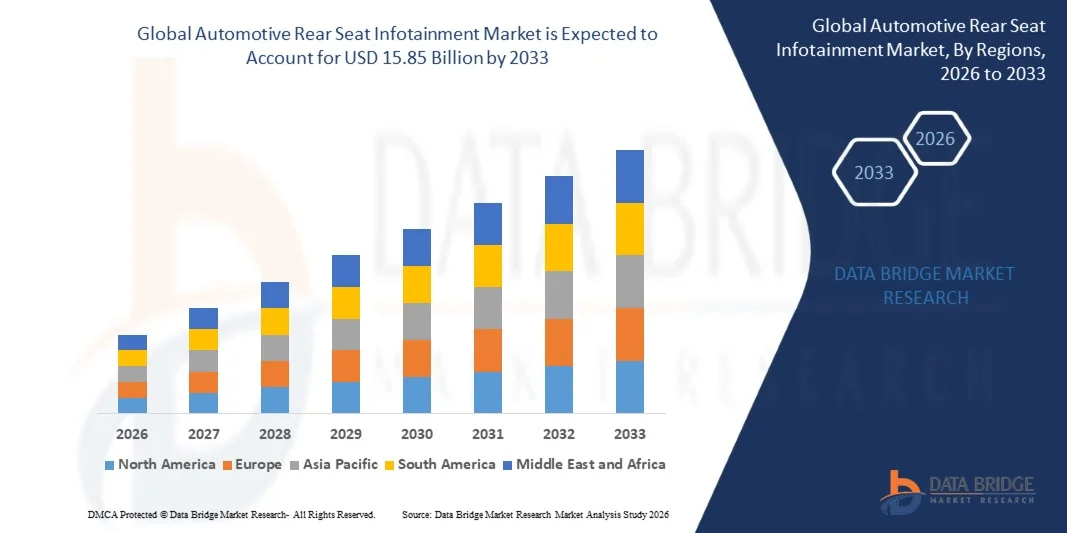
As per Data Bridge Market Research analysis the global automotive rear seat infotainment market was valued at USD 6.76 billion in 2025 and is projected to reach USD 15.85 billion by 2033, growing at a CAGR of 11.24% from 2026 to 2033. The market is witnessing strong growth driven by rising consumer demand for enhanced in-vehicle entertainment, increasing integration of connected car technologies, and growing adoption of premium infotainment systems across passenger vehicles.
The growing preference for connected mobility experiences, coupled with rising sales of luxury vehicles and SUVs, is encouraging automakers to equip vehicles with advanced rear seat infotainment systems featuring high-definition displays, wireless connectivity, streaming services, gaming, and smartphone integration. In addition, advancements in 5G connectivity, cloud-based content delivery, and over-the-air software updates are improving user experience, while increasing demand for electric and autonomous vehicles is further accelerating the adoption of sophisticated rear seat entertainment solutions across global automotive markets.
Market Size & Forecast
- Global Market Value (2025): USD 6.76 Billion
- Expected Market Value (2033): USD 15.85 Billion
- Forecast CAGR (2026–2033): 11.24%
- Leading Region in 2025: North America
- Fastest Growing Region: Asia-Pacific
Key Market Trends & Insights
- North America dominated the automotive rear seat infotainment market with the largest revenue share of 40.5% in 2025, supported by strong demand for premium passenger vehicles, high consumer spending on advanced automotive technologies, and widespread adoption of connected vehicle solutions.
- Asia-Pacific automotive rear seat infotainment market is expected to witness the fastest growth rate from 2026 to 2033 holding approximately 25.5% of the global share, supported by rapid urbanization, rising disposable incomes, increasing passenger vehicle production, and growing consumer demand for connected mobility solutions.
- The light vehicle segment dominated the market in 2025, driven by high global production of passenger cars, SUVs, crossover vehicles, and luxury automobiles equipped with factory-installed infotainment systems. Rising consumer demand for connected mobility, premium in-cabin experiences, and advanced multimedia entertainment continues to encourage OEMs to integrate rear seat infotainment solutions as standard or optional features. The growing popularity of electric vehicles and premium family vehicles is further supporting segment expansion across developed and emerging automotive markets.
- The heavy vehicle segment is projected to witness the fastest growth during the forecast period of 2026 to 2033, driven by increasing deployment of infotainment systems in luxury coaches, long-distance buses, executive shuttles, and premium commercial transport fleets. Fleet operators are increasingly investing in passenger comfort, digital entertainment, and connected services to improve customer experience and differentiate transportation offerings.
- The 8'' to 10'' segment accounted for the largest market share in 2025 owing to growing demand for larger high-definition displays that deliver enhanced video streaming, gaming, internet browsing, and multimedia experiences. Automakers are increasingly integrating larger touchscreens into premium and mid-range vehicle models to provide cinema-like entertainment and support multiple connected applications. Improved display technologies, including IPS and OLED panels, are also contributing to segment growth.
- The 5'' to 7'' segment is expected to register steady growth during the forecast period due to its affordability, compact design, and widespread adoption in entry-level passenger vehicles and aftermarket entertainment systems. Increasing demand for economical infotainment upgrades in developing automotive markets is expected to support continued adoption.
Report Scope and Automotive Rear Seat Infotainment Market Segmentation
|
Attributes |
Automotive Rear Seat Infotainment Key Market Insights |
|
Segments Covered |
|
|
Countries Covered |
North America
Europe
Asia-Pacific
Middle East and Africa
South America
|
|
Key Market Players |
|
|
Market Opportunities |
|
|
Value Added Data Infosets |
In addition to the market insights such as market value, growth rate, market segments, geographical coverage, market players, and market scenario, the market report curated by the Data Bridge Market Research team includes in-depth expert analysis, import/export analysis, pricing analysis, production consumption analysis, and pestle analysis. |
Automotive Rear Seat Infotainment Market Trends
Trend: Rising Adoption Of AI-Powered Connected In-Cabin Entertainment Systems
Growing consumer demand for immersive digital experiences and connected mobility is accelerating the adoption of advanced rear seat infotainment systems across the global automotive industry. Automakers are increasingly integrating high-definition displays, AI-enabled personalization, streaming services, gaming capabilities, and seamless smartphone connectivity into rear passenger cabins to enhance comfort and differentiate premium vehicle offerings. The rapid evolution of software-defined vehicles and over-the-air (OTA) software updates is further strengthening investment in intelligent in-cabin entertainment platforms.
The expansion of premium electric vehicles and luxury SUVs is creating sustained demand for intelligent rear seat infotainment technologies capable of delivering personalized multimedia experiences. For instance, in January 2024, HARMAN introduced its next-generation Ready Display, Ready Vision, and Ready Connect platforms at CES 2025, showcasing AI-driven and contextual in-cabin technologies designed to transform passenger entertainment and connectivity experiences. These innovations demonstrate the industry's growing focus on intelligent digital cockpit ecosystems that support enhanced rear passenger engagement.
The increasing shift toward AI-enabled digital cockpit platforms and connected passenger experiences is expected to reinforce long-term demand for automotive rear seat infotainment systems, positioning manufacturers to benefit from rising consumer expectations for premium in-vehicle entertainment.
Automotive Rear Seat Infotainment Market Dynamics
Key Market Driver: Increasing Adoption Of Digital Cockpit Technologies In Premium And Electric Vehicles
The global automotive industry is witnessing increasing investment in digital cockpit technologies as consumers demand seamless connectivity, personalized infotainment, and intelligent user interfaces. Premium automakers are integrating advanced computing architectures capable of supporting multiple displays, cloud connectivity, entertainment applications, and continuous software upgrades, significantly expanding opportunities for rear seat infotainment systems.
Automotive manufacturers continue investing heavily in centralized computing platforms for next-generation vehicles. For instance, in March 2025, BMW announced that its upcoming Neue Klasse platform will utilize four high-performance "Superbrains" to power infotainment, automated driving, comfort features, and vehicle functions through a new zonal electronic architecture. This next-generation computing platform enables increasingly sophisticated infotainment capabilities throughout the vehicle cabin, including rear passenger entertainment.
As digital cockpit technologies continue to evolve and software-defined vehicles become mainstream, manufacturers of automotive rear seat infotainment systems are expected to benefit from sustained demand driven by intelligent vehicle architectures, premium mobility experiences, and expanding connected vehicle ecosystems.
Key Restraint/Challenge: Increasing Complexity Of Software Integration And Vehicle Computing Architectures
Automotive rear seat infotainment manufacturers continue to face challenges associated with integrating advanced entertainment platforms into increasingly complex vehicle electronic architectures. The need to support artificial intelligence, cloud connectivity, cybersecurity, multiple operating systems, and continuous over-the-air updates significantly increases development costs while extending product validation cycles for both OEMs and Tier-1 suppliers.
The growing convergence of infotainment, connectivity, and vehicle intelligence is raising system integration requirements across the automotive industry. For instance, in September 2025, Qualcomm Technologies and HARMAN announced a strategic collaboration to develop next-generation AI-powered cockpit solutions capable of delivering contextual, adaptive, and continuously evolving in-cabin experiences. The collaboration highlights the increasing complexity involved in integrating advanced computing, AI, and infotainment into modern vehicle platforms.
Despite strong market demand, reducing software integration complexity, improving interoperability, and optimizing development costs will remain critical for manufacturers to maintain long-term competitiveness in the automotive rear seat infotainment market.
Key Market Opportunity: Expansion Of Software-Defined Vehicles And Personalized Digital Experiences
Automakers are increasingly transitioning toward software-defined vehicles capable of delivering new features through continuous software upgrades, creating significant long-term opportunities for advanced rear seat infotainment systems. Growing consumer demand for personalized multimedia, intelligent voice assistants, cloud-based applications, and seamless digital ecosystems is encouraging manufacturers to develop highly scalable infotainment platforms for future mobility.
Leading automotive manufacturers continue investing in next-generation human-machine interface technologies. For instance, In January 2025, at CES 2025, BMW unveiled its new Panoramic iDrive powered by BMW Operating System X, introducing an advanced software-based display and operating concept that will be deployed across all future BMW models from the end of 2025. The platform provides extensive personalization, intelligent software capabilities, and enhanced digital functionality that support the continued evolution of in-cabin infotainment experiences.
As software-defined vehicles become the foundation of next-generation mobility and consumers increasingly expect connected digital experiences throughout the vehicle cabin, intelligent infotainment platforms and personalized rear seat entertainment technologies are expected to create substantial long-term growth opportunities for the global automotive rear seat infotainment market.
Automotive Rear Seat Infotainment Market Scope
The market is segmented on the basis of vehicle type, screen size, operating system, technology type, end-user, component, propulsion type, connectivity generation, and type.
- By Vehicle Type
On the basis of vehicle type, the automotive rear seat infotainment market is segmented into light vehicle and heavy vehicle. The light vehicle segment dominated the market in 2025, driven by high global production of passenger cars, SUVs, crossover vehicles, and luxury automobiles equipped with factory-installed infotainment systems. Rising consumer demand for connected mobility, premium in-cabin experiences, and advanced multimedia entertainment continues to encourage OEMs to integrate rear seat infotainment solutions as standard or optional features. The growing popularity of electric vehicles and premium family vehicles is further supporting segment expansion across developed and emerging automotive markets.
The heavy vehicle segment is projected to witness the fastest growth during the forecast period of 2026 to 2033, driven by increasing deployment of infotainment systems in luxury coaches, long-distance buses, executive shuttles, and premium commercial transport fleets. Fleet operators are increasingly investing in passenger comfort, digital entertainment, and connected services to improve customer experience and differentiate transportation offerings.
- By Screen Size
On the basis of screen size, the automotive rear seat infotainment market is segmented into 5'' to 7'' and 8'' to 10''. The 8'' to 10'' segment accounted for the largest market share in 2025 owing to growing demand for larger high-definition displays that deliver enhanced video streaming, gaming, internet browsing, and multimedia experiences. Automakers are increasingly integrating larger touchscreens into premium and mid-range vehicle models to provide cinema-like entertainment and support multiple connected applications. Improved display technologies, including IPS and OLED panels, are also contributing to segment growth.
The 5'' to 7'' segment is expected to register steady growth during the forecast period due to its affordability, compact design, and widespread adoption in entry-level passenger vehicles and aftermarket entertainment systems. Increasing demand for economical infotainment upgrades in developing automotive markets is expected to support continued adoption.
- By Operating System
On the basis of operating system, the automotive rear seat infotainment market is segmented into QNX, Linux, Microsoft, and others. The Linux segment held the largest market share of 46.26% in 2025, driven by increasing adoption of open-source software platforms, Android Automotive ecosystems, and customizable infotainment solutions. Automakers are increasingly utilizing Linux-based platforms to accelerate software development, reduce costs, and enable faster deployment of connected vehicle services.
The QNX segment is anticipated to witness the fastest growth from 2026 to 2033 due to its proven reliability, real-time operating capabilities, advanced cybersecurity features, and extensive adoption by global automotive manufacturers. The platform enables stable operation of complex infotainment applications while meeting stringent automotive safety requirements. Continuous support for software-defined vehicle architectures further strengthens its market position.
- By Technology Type
On the basis of technology type, the automotive rear seat infotainment market is segmented into multimedia player and navigation systems. The multimedia player segment dominated the market in 2025, driven by rising consumer preference for high-quality video streaming, music playback, gaming applications, wireless screen mirroring, and on-demand digital content. Increasing availability of high-speed internet connectivity inside vehicles is enabling passengers to access a wide range of entertainment services during travel. Growing integration with smartphones and cloud-based applications continues to support segment growth.
The navigation systems segment is expected to witness substantial growth during the forecast period owing to increasing adoption of cloud-based navigation, AI-powered route optimization, real-time traffic information, and GPS-enabled travel assistance. The growing popularity of connected vehicles is further accelerating integration of advanced navigation technologies.
- By End-User
On the basis of end-user, the automotive rear seat infotainment market is segmented into OEM and aftermarket. The OEM segment accounted for the largest market share in 2025, supported by increasing factory installation of advanced infotainment systems in newly manufactured passenger vehicles. Leading automotive manufacturers are integrating rear seat entertainment solutions to enhance customer satisfaction, improve vehicle differentiation, and strengthen premium brand positioning. Continuous technological advancements and increasing demand for connected vehicle ecosystems are further supporting OEM adoption.
The aftermarket segment is projected to witness robust growth during the forecast period due to rising consumer interest in upgrading existing vehicles with modern infotainment systems. Growing availability of wireless, plug-and-play, and customizable entertainment solutions is encouraging vehicle owners to invest in aftermarket installations.
- By Component
On the basis of component, the automotive rear seat infotainment market is segmented into display/touch-screen module and more. The display/touch-screen module segment held the largest market share of 48.34% in 2025, driven by increasing installation of high-resolution displays offering superior image quality, responsive touch functionality, and interactive user interfaces. Manufacturers continue introducing larger and thinner displays with improved durability and enhanced viewing angles to improve passenger experience. The increasing use of dual-screen and multi-screen configurations is further supporting segment growth.
The other components segment is expected to experience healthy growth from 2026 to 2033 as automakers continue integrating processors, audio systems, wireless connectivity modules, memory devices, electronic control units, and advanced communication technologies into next-generation infotainment platforms.
- By Propulsion Type
On the basis of propulsion type, the automotive rear seat infotainment market is segmented into internal-combustion engine vehicles and more. The internal-combustion engine vehicles segment held the largest market share of 64.98% in 2025, due to its significantly larger global vehicle fleet and continued production of passenger vehicles equipped with rear entertainment systems. Widespread adoption across conventional sedans, SUVs, and premium vehicles continues to generate strong demand for integrated infotainment solutions. Established automotive production infrastructure also contributes to segment dominance.
The electric vehicle segment is expected to register the fastest growth during the forecast period, driven by rapid global EV adoption, increasing investment in intelligent cockpit technologies, and growing consumer demand for connected digital experiences. Software-defined vehicle platforms are further accelerating integration of advanced rear seat infotainment systems.
- By Connectivity Generation
On the basis of connectivity generation, the automotive rear seat infotainment market is segmented into 4G LTE and more. The 4G LTE segment held the largest market share in 2025 owing to its widespread deployment across connected vehicles, enabling reliable media streaming, cloud-based services, software updates, and real-time infotainment functionality. The mature global telecommunications infrastructure and broad network coverage continue to support its dominance across automotive markets.
The next-generation connectivity segment, including 5G-enabled platforms, is anticipated to witness the fastest growth during the forecast period due to increasing deployment of ultra-fast mobile networks capable of supporting cloud gaming, ultra-high-definition streaming, artificial intelligence applications, and vehicle-to-everything (V2X) communication. Growing investments in connected mobility infrastructure are expected to accelerate adoption.
- By Type
On the basis of type, the automotive rear seat infotainment market is segmented into headrest monitor system, overhead system, and plug and play system. The headrest monitor system segment accounted for the largest market share in 2025, driven by its widespread integration into premium passenger vehicles, superior viewing comfort, individual passenger control, and seamless OEM installation. The growing popularity of luxury SUVs and family vehicles continues to strengthen demand for headrest-mounted entertainment solutions.
The plug and play system segment is projected to witness the fastest growth during the forecast period due to increasing consumer preference for portable, affordable, and easily installable entertainment systems. Rising demand for aftermarket infotainment upgrades and compatibility with multiple vehicle models is expected to support strong long-term growth across both developed and emerging automotive markets.
Automotive Rear Seat Infotainment Market Regional Analysis
North America Automotive Rear Seat Infotainment Market Insight
North America dominated the automotive rear seat infotainment market with the largest revenue share of 40.5% in 2025, supported by strong demand for premium passenger vehicles, high consumer spending on advanced automotive technologies, and widespread adoption of connected vehicle solutions. The region benefits from the presence of leading automotive manufacturers and technology providers investing in intelligent cockpit systems and digital in-vehicle experiences. Increasing demand for luxury SUVs, electric vehicles, and family-oriented vehicles equipped with advanced entertainment systems continues to strengthen the regional market.
U.S. Automotive Rear Seat Infotainment Market Insight
The U.S. automotive rear seat infotainment market captured the largest revenue share in 2025 within North America, fueled by rising sales of premium vehicles, growing adoption of connected mobility technologies, and increasing consumer preference for enhanced passenger comfort. Automakers are increasingly integrating high-resolution displays, wireless streaming, AI-enabled infotainment, and smartphone connectivity into new vehicle models. The country's strong automotive innovation ecosystem and growing adoption of software-defined vehicles continue to accelerate market expansion.
Europe Automotive Rear Seat Infotainment Market Insight
The Europe automotive rear seat infotainment market is expected to witness the fastest growth rate from 2026 to 2033 with 30.5% of the global market share, primarily driven by increasing production of premium passenger vehicles, growing demand for connected car technologies, and rapid adoption of electric mobility. Stringent vehicle safety standards, rising investments in intelligent cockpit technologies, and expanding consumer preference for luxury in-car experiences are encouraging automakers to integrate advanced rear seat entertainment systems across multiple vehicle segments.
U.K. Automotive Rear Seat Infotainment Market Insight
The U.K. automotive rear seat infotainment market is expected to witness the fastest growth rate from 2026 to 2033, driven by increasing adoption of premium vehicles, rapid electrification of the automotive sector, and growing demand for connected digital services. Consumers are increasingly seeking advanced multimedia systems that provide seamless smartphone integration, video streaming, and personalized passenger experiences. Continued investments in connected vehicle infrastructure and automotive software development are expected to support long-term market growth.
Germany Automotive Rear Seat Infotainment Market Insight
The Germany automotive rear seat infotainment market is expected to witness the fastest growth rate from 2026 to 2033, fueled by the country's strong automotive manufacturing base, technological leadership, and growing production of luxury vehicles. Leading German OEMs continue investing in digital cockpit technologies, AI-enabled infotainment platforms, and software-defined vehicle architectures to enhance passenger comfort and vehicle differentiation. The increasing popularity of premium electric vehicles is further supporting market expansion.
Asia-Pacific Automotive Rear Seat Infotainment Market Insight
The Asia-Pacific automotive rear seat infotainment market is expected to witness the fastest growth rate from 2026 to 2033 holding approximately 25.5% of the global share, supported by rapid urbanization, rising disposable incomes, increasing passenger vehicle production, and growing consumer demand for connected mobility solutions. Expanding automotive manufacturing across China, Japan, South Korea, and India, along with increasing penetration of electric and premium vehicles, is accelerating adoption of advanced rear seat infotainment systems. Continuous technological advancements and improving affordability are further contributing to regional growth.
Japan Automotive Rear Seat Infotainment Market Insight
The Japan automotive rear seat infotainment market is expected to witness the fastest growth rate from 2026 to 2033 due to the country's advanced automotive technology ecosystem, strong consumer preference for innovative in-car electronics, and increasing demand for premium mobility experiences. Japanese automakers continue introducing intelligent cockpit technologies, high-definition displays, and connected infotainment solutions to enhance passenger convenience. Growing investments in autonomous and software-defined vehicles are expected to further drive market growth.
China Automotive Rear Seat Infotainment Market Insight
The China automotive rear seat infotainment market accounted for the largest market revenue share in Asia-Pacific in 2025, attributed to the country's position as the world's largest automotive manufacturing hub and one of the fastest-growing markets for connected and electric vehicles. Rising consumer demand for premium vehicle features, expanding production of new energy vehicles, and increasing adoption of intelligent cockpit technologies are encouraging widespread integration of advanced rear seat infotainment systems. Strong domestic automotive manufacturers and continuous innovation in connected vehicle technologies continue to reinforce China's market leadership.
Automotive Rear Seat Infotainment Market Share
The Automotive Rear Seat Infotainment industry is primarily led by well-established companies, including:
- HARMAN International (U.S.)
- Continental AG (Germany)
- Panasonic Corporation (Japan)
- DENSO CORPORATION (Japan)
- Robert Bosch GmbH (Germany)
- Visteon Corporation (U.S.)
- Aptiv PLC (Ireland)
- Alpine Electronics, Inc. (Japan)
- Pioneer Corporation (Japan)
- JVCKENWOOD Corporation (Japan)
- Garmin Ltd. (Switzerland)
- Marelli Holdings Co., Ltd. (Japan)
- FORVIA (France)
- LG Electronics Inc. (South Korea)
- Sony Honda Mobility Inc. (Japan)
Latest Developments in Automotive Rear Seat Infotainment Market
- In June 2025, Lenovo announced a strategic partnership with Toyota Boshoku to co-develop next-generation intelligent cabin solutions combining AI-powered cockpit technologies, cross-device connectivity, and advanced rear-seat entertainment systems. The collaboration aims to create personalized and immersive passenger experiences for future software-defined vehicles, strengthening innovation in connected automotive interiors and accelerating the adoption of intelligent rear seat infotainment technologies.
- In March 2025, Lexus India opened bookings for the updated LX 500d luxury SUV featuring dual 11.6-inch rear-seat entertainment displays, HDMI connectivity, wireless remote controls, and a premium 25-speaker Mark Levinson audio system. The launch reinforces the growing integration of premium rear passenger entertainment technologies in luxury vehicles and supports increasing demand for high-end in-cabin digital experiences.

- Interactive Data Analysis Dashboard
- Company Analysis Dashboard for high growth potential opportunities
- Research Analyst Access for customization & queries
- Competitor Analysis with Interactive dashboard
- Latest News, Updates & Trend analysis
- Harness the Power of Benchmark Analysis for Comprehensive Competitor Tracking
Data collection and base year analysis are done using data collection modules with large sample sizes. The stage includes obtaining market information or related data through various sources and strategies. It includes examining and planning all the data acquired from the past in advance. It likewise envelops the examination of information inconsistencies seen across different information sources. The market data is analysed and estimated using market statistical and coherent models. Also, market share analysis and key trend analysis are the major success factors in the market report. To know more, please request an analyst call or drop down your inquiry.
The key research methodology used by DBMR research team is data triangulation which involves data mining, analysis of the impact of data variables on the market and primary (industry expert) validation. Data models include Vendor Positioning Grid, Market Time Line Analysis, Market Overview and Guide, Company Positioning Grid, Patent Analysis, Pricing Analysis, Company Market Share Analysis, Standards of Measurement, Global versus Regional and Vendor Share Analysis. To know more about the research methodology, drop in an inquiry to speak to our industry experts.
Data Bridge Market Research is a leader in advanced formative research. We take pride in servicing our existing and new customers with data and analysis that match and suits their goal. The report can be customized to include price trend analysis of target brands understanding the market for additional countries (ask for the list of countries), clinical trial results data, literature review, refurbished market and product base analysis. Market analysis of target competitors can be analyzed from technology-based analysis to market portfolio strategies. We can add as many competitors that you require data about in the format and data style you are looking for. Our team of analysts can also provide you data in crude raw excel files pivot tables (Fact book) or can assist you in creating presentations from the data sets available in the report.













