


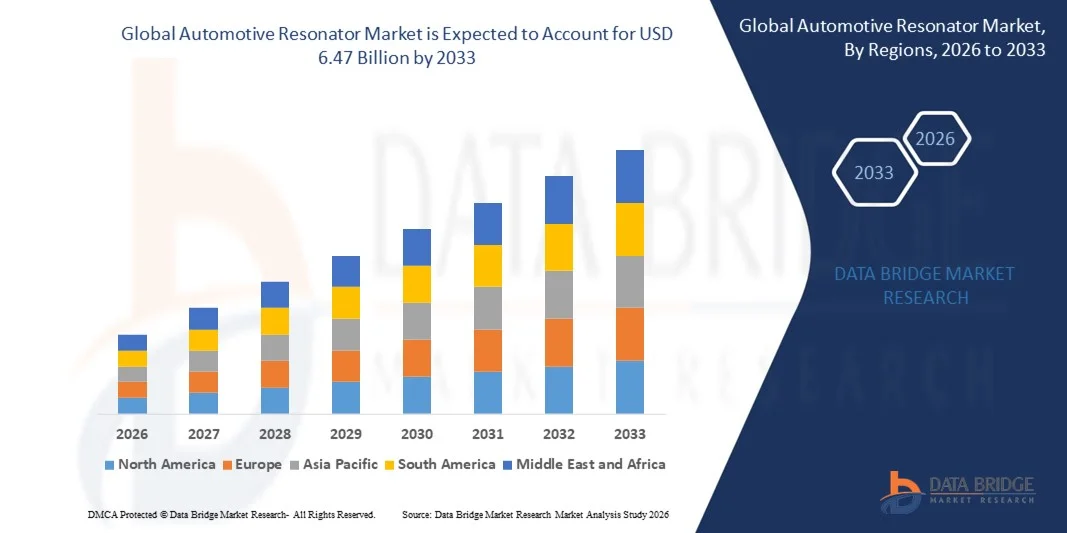
What is the Global Automotive Resonator Market Size and Growth Rate?
- The global automotive resonator market size was valued at USD 4.91 billion in 2025 and is expected to reach USD 6.47 billion by 2033, at a CAGR of3.50% during the forecast period
- The rising inclination of consumers towards sport vehicles in a cost effective way and the surging production of automotive vehicle are the major factors driving the growth of automotive resonator market
- The implementation of government regulations associated with the vehicle’s exhaust noise and sound and the rise in the AR popularity owning to the benefits they offer such as decreased sound level and improvement of automotive vehicle performance through reducing the back pressure of exhaust gasses accelerate the automotive resonator market growth
What are the Major Takeaways of Automotive Resonator Market?
- The ability of automotive resonator to decrease the back pressure which is responsible for lowering down the horsepower or overall performance of vehicles also influences the automotive resonator market and the increasing adoption of 3D printing of automotive resonator intake ducts along with other plastic parts also influence the automotive resonator market. 3D printing is utilized to design wiring connectors and harnesses
- In addition, technological advancement, emergence of new material technologies such as use of light weight material for their properties including high structural strength and high heat distortion temperature, increasing demand of advanced vehicles and rise in disposable income positively affect the automotive resonator market
- Asia-Pacific dominated the automotive resonator market with a 33.8% revenue share in 2025, driven by rapid growth in automotive manufacturing, electronics integration, and semiconductor expansion across China, Japan, India, South Korea, and Southeast Asia
- North America is projected to register the fastest CAGR of 11.69% from 2026 to 2033, led by rapid adoption of EVs, hybrid vehicles, and connected car technologies across the U.S. and Canada
- The Steel segment dominated the market with a 44.6% share in 2025, driven by its high thermal resistance, structural durability, cost-effectiveness, and suitability for exhaust and intake systems exposed to extreme temperatures and vibrations
Report Scope and Automotive Resonator Market Segmentation
|
Attributes |
Automotive Resonator Key Market Insights |
|
Segments Covered |
|
|
Countries Covered |
North America
Europe
Asia-Pacific
Middle East and Africa
South America
|
|
Key Market Players |
|
|
Market Opportunities |
|
|
Value Added Data Infosets |
In addition to the insights on market scenarios such as market value, growth rate, segmentation, geographical coverage, and major players, the market reports curated by the Data Bridge Market Research also include in-depth expert analysis, pricing analysis, brand share analysis, consumer survey, demography analysis, supply chain analysis, value chain analysis, raw material/consumables overview, vendor selection criteria, PESTLE Analysis, Porter Analysis, and regulatory framework. |
What is the Key Trend in the Automotive Resonator Market?
Increasing Shift Toward High-Efficiency, Lightweight, and Emission-Optimized Automotive Resonators
- The automotive resonator market is witnessing strong adoption of lightweight composite materials, compact geometries, and aerodynamically optimized resonator designs to meet stringent emission and NVH (Noise, Vibration & Harshness) regulations
- Manufacturers are introducing high-temperature-resistant, corrosion-proof, and multi-chamber resonator systems to improve exhaust flow performance and engine efficiency in modern internal combustion and hybrid vehicles
- Growing demand for fuel-efficient, low-noise, and environment-friendly exhaust systems is driving integration of advanced resonators across passenger cars, commercial vehicles, and premium automotive platforms
- For instance, companies such as Tenneco, MAHLE, MANN+HUMMEL, and Marelli have expanded their automotive resonance solutions featuring lightweight polymers, metallic hybrids, and precision-molded architectures
- Increasing focus on noise reduction, engine breathing efficiency, and thermal durability is accelerating the shift toward next-generation resonator technologies
- As automotive powertrains evolve, high-performance resonators will remain essential for enhancing emission control, engine acoustics, and overall vehicle refinement
What are the Key Drivers of Automotive Resonator Market?
- Rising demand for low-emission, fuel-efficient, and noise-optimized exhaust systems to comply with tightening global automotive regulations
- For instance, in 2025, leading companies such as MANN+HUMMEL, Tenneco, and MAHLE upgraded their resonator portfolios with lightweight composites, integrated muffler-resonator modules, and thermal-resistant materials for improved engine performance
- Growing adoption of hybrid vehicles, turbocharged engines, and downsized powertrains is boosting demand for resonators to control airflow harmonics and enhance efficiency
- Advancements in acoustic engineering, material science, and additive manufacturing have strengthened resonator durability, weight reduction, and design flexibility
- Increasing usage of engine encapsulation, advanced intake systems, and smart exhaust architectures is driving demand for high-performance resonators
- Supported by ongoing investments in automotive R&D, powertrain enhancement, and lightweight component innovation, the Automotive Resonator market is expected to record strong long-term growth
Which Factor is Challenging the Growth of the Automotive Resonator Market?
- High costs associated with advanced composite materials, precision molding, and multi-chamber resonator designs limit adoption for budget vehicle categories
- For instance, during 2024–2025, rising prices of metallic alloys, engineering plastics, and heat-resistant polymers increased manufacturing costs for exhaust component suppliers
- Technical complexity in achieving optimal acoustic tuning, backpressure control, and thermal endurance increases the need for specialized engineering capabilities
- Limited awareness in emerging markets regarding NVH benefits, airflow optimization, and emission-reduction performance slows adoption in low-cost vehicle segments
- Competition from integrated muffler systems, active acoustic control, and electrified vehicle architectures reduces product differentiation and pressures pricing
- To address these challenges, companies are focusing on cost-efficient materials, modular resonator designs, smart acoustic simulations, and high-volume production efficiencies to increase global adoption
How is the Automotive Resonator Market Segmented?
The market is segmented on the basis of material, engine type, vehicle type, and sales channel.
- By Material
On the basis of material, the automotive resonator market is segmented into Ceramic, Steel, and Glass-Fibre Amalgamation. The Steel segment dominated the market with a 44.6% share in 2025, driven by its high thermal resistance, structural durability, cost-effectiveness, and suitability for exhaust and intake systems exposed to extreme temperatures and vibrations. Steel resonators are widely used in passenger cars, LCVs, and heavy-duty vehicles due to their excellent acoustic performance, corrosion protection, and compatibility with precision automotive manufacturing processes. Their long lifespan and ability to withstand harsh operating environments make them the preferred choice for OEMs globally.
The Glass-Fibre Amalgamation segment is expected to grow at the fastest CAGR from 2026 to 2033, fueled by rising demand for lightweight, heat-resistant, and acoustically optimized components. Increasing adoption of composite materials in EVs, hybrid vehicles, and premium automotive platforms is driving this shift toward advanced lightweight resonator materials.
- By Engine Type
Based on engine type, the automotive resonator market is segmented into Diesel Engine and Gasoline Engine. The Gasoline Engine segment dominated the market with a 58.3% share in 2025, driven by higher global production volumes of gasoline-powered passenger cars, urban mobility vehicles, and compact SUVs. Gasoline engines generate distinct acoustic and airflow patterns that require specialized intake and exhaust resonators for noise reduction, improved engine breathing, and refined vehicle performance. Increasing adoption of turbocharged gasoline engines further supports resonator demand due to elevated airflow harmonics.
The Diesel Engine segment is projected to grow at the fastest CAGR from 2026 to 2033, supported by rising demand for diesel-powered commercial vehicles, long-haul transportation fleets, and off-highway machinery. Modern diesel engines require advanced resonator systems to meet stricter global emission norms, reduce NVH levels, and enhance torque efficiency, driving strong adoption across heavy-duty OEMs.
- By Vehicle Type
On the basis of vehicle type, the market is segmented into Passenger Car, Light Commercial Vehicle (LCV), Heavy Commercial Vehicle (HCV), and Two Wheeler. The Passenger Car segment dominated the market with a 49.7% share in 2025, owing to high production volumes, rapid model launches, and strong integration of advanced NVH and emission-control systems across sedans, hatchbacks, and SUVs. Passenger car manufacturers increasingly adopt lightweight, compact, and aerodynamically optimized resonators to enhance cabin comfort, fuel efficiency, and engine refinement. Growing demand for hybrid and turbocharged vehicles also supports resonator deployment.
The Heavy Commercial Vehicle (HCV) segment is expected to grow at the fastest CAGR from 2026 to 2033, driven by rising global freight movement, expansion of logistics networks, and stringent emissions regulations requiring advanced exhaust resonator technologies. Higher engine displacement, greater vibration levels, and demand for durable high-temperature resonators reinforce segment growth.
- By Sales Channel
On the basis of sales channel, the automotive resonator market is segmented into Original Equipment Manufacturer (OEM) and Aftermarket. The OEM segment dominated the market with a 62.1% share in 2025, primarily due to automakers’ emphasis on integrating precision-engineered resonators to meet global emission standards, maintain vehicle acoustic quality, and optimize engine performance. OEM resonators offer superior durability, fitment accuracy, and material consistency, making them the preferred choice for new vehicle manufacturing. Tightening NVH norms and increasing adoption of lightweight composites further strengthen OEM demand.
The Aftermarket segment is projected to grow at the fastest CAGR from 2026 to 2033, driven by rising replacement needs for aging vehicle fleets, performance upgrades, and demand for cost-effective resonator solutions. Growing vehicle parc in Asia-Pacific, Europe, and Latin America, along with increasing consumer preference for affordable high-performance exhaust components, fuels strong aftermarket expansion.
Which Region Holds the Largest Share of the Automotive Resonator Market?
- Asia-Pacific dominated the automotive resonator market with a 33.8% revenue share in 2025, driven by rapid growth in automotive manufacturing, electronics integration, and semiconductor expansion across China, Japan, India, South Korea, and Southeast Asia. Increasing production of EVs, hybrid vehicles, and advanced combustion engines, combined with rising adoption of embedded electronics and intelligent vehicle systems, is fueling demand for high-performance Automotive Resonators across passenger cars, LCVs, and HCVs. The region’s strong industrial base, cost-competitive manufacturing, and government-backed EV and smart mobility initiatives reinforce its market leadership
- Leading companies in Asia-Pacific are launching advanced resonator solutions with lightweight materials, optimized acoustic performance, and multi-protocol compatibility, further strengthening regional dominance. Continuous investment in R&D, smart mobility projects, and local automotive innovation hubs drives long-term expansion
- High engineering talent availability, expansive automotive supply chains, and strong policy support for EVs and emission reduction systems further consolidate regional market leadership
China Automotive Resonator Market Insight
China is the largest contributor in Asia-Pacific due to extensive automotive manufacturing, EV production, and robust semiconductor investments. Rising demand for lightweight, heat-resistant, and acoustically optimized resonators for high-speed engines and hybrid systems drives market growth. Local OEMs and component suppliers increasingly integrate advanced resonators into new vehicle platforms, while competitive manufacturing costs enhance domestic and export adoption.
Japan Automotive Resonator Market Insight
Japan shows steady growth supported by precision automotive manufacturing, advanced electronics integration, and stringent NVH regulations. Premium passenger car manufacturers and EV developers rely on high-quality resonators for performance optimization and acoustic comfort. Continuous focus on low-emission technologies, robotics-enabled production lines, and high-performance engine solutions reinforces long-term market expansion.
India Automotive Resonator Market Insight
India is emerging as a major growth hub, driven by expanding automotive R&D centers, increasing EV adoption, and government-backed manufacturing initiatives. Growing demand for embedded controllers, hybrid vehicles, and advanced automotive electronics fuels Automotive Resonator deployment in testing, prototyping, and mass production. Rising infrastructure investment and smart mobility programs further accelerate market penetration.
South Korea Automotive Resonator Market Insight
South Korea contributes significantly due to high-volume EV production, semiconductor integration in automotive systems, and adoption of smart mobility solutions. Increasing need for high-performance, heat-resistant, and lightweight resonators in passenger cars, commercial vehicles, and EVs drives regional growth. Strong innovation ecosystems, advanced manufacturing capacity, and supportive government policies ensure sustained adoption.
North America Automotive Resonator Market
North America is projected to register the fastest CAGR of 11.69% from 2026 to 2033, led by rapid adoption of EVs, hybrid vehicles, and connected car technologies across the U.S. and Canada. Rising investment in smart mobility, autonomous vehicle prototypes, and high-performance ICE engines fuels demand for advanced resonators with enhanced acoustic performance and thermal resilience. Strong presence of automotive R&D centers, OEM innovation labs, and robust aftersales support accelerates regional growth.
U.S. Automotive Resonator Market Insight
The U.S. contributes the most in North America, supported by significant EV and hybrid vehicle production, high-performance vehicle engineering, and extensive utilization of advanced resonator technologies for noise and vibration control. OEMs are increasingly integrating lightweight and compact resonators in engine systems to comply with emission norms and enhance cabin comfort.
Canada Automotive Resonator Market Insight
Canada shows growing adoption of Automotive Resonators due to rising hybrid and EV manufacturing, advanced vehicle testing labs, and government incentives supporting low-emission vehicle production. Expanding automotive supply chains and skilled engineering workforce enhance regional market penetration.
Which are the Top Companies in Automotive Resonator Market?
The automotive resonator industry is primarily led by well-established companies, including:
- Murata Manufacturing Co., Ltd. (Japan)
- DuPont (U.S.)
- Tenneco Inc. (U.S.)
- MAHLE GmbH (Germany)
- MANN+HUMMEL (Germany)
- Gasgoo.com Corporation (China)
- FennoSteel (Finland)
- Donaldson Company, Inc. (U.S.)
- Munjal Auto Industries Limited (India)
- Mark Exhaust Systems Limited (India)
- AP Emissions Technologies (U.K.)
- Marelli Holdings Co., Ltd. (Japan)
- DURA Automotive Systems (U.S.)
- DSM (Netherlands)
- HUTCHINSON (France)
- Mitsui Chemicals, Inc. (Japan)
- Woco Industrietechnik GmbH (Germany)
What are the Recent Developments in Global Automotive Resonator Market?
- In July 2023, Kia India, the Indian subsidiary of South Korean automaker Kia, launched the 2023 Seltos facelift, featuring major exterior and interior updates. To promote this redesigned model, the company released a new television commercial (TVC) highlighting enhancements such as the dual sport exhaust system. This launch reinforces Kia India’s strong presence in the compact SUV segment and aims to attract a broader customer base
- In July 2023, Milltek Sport introduced a high-performance exhaust system for BMW’s M2 Coupé, enhancing the performance capabilities of the new baby M vehicle. This aftermarket upgrade caters to performance enthusiasts seeking improved engine output and driving experience, further solidifying Milltek Sport’s position in the automotive performance market

- Interactive Data Analysis Dashboard
- Company Analysis Dashboard for high growth potential opportunities
- Research Analyst Access for customization & queries
- Competitor Analysis with Interactive dashboard
- Latest News, Updates & Trend analysis
- Harness the Power of Benchmark Analysis for Comprehensive Competitor Tracking
Data collection and base year analysis are done using data collection modules with large sample sizes. The stage includes obtaining market information or related data through various sources and strategies. It includes examining and planning all the data acquired from the past in advance. It likewise envelops the examination of information inconsistencies seen across different information sources. The market data is analysed and estimated using market statistical and coherent models. Also, market share analysis and key trend analysis are the major success factors in the market report. To know more, please request an analyst call or drop down your inquiry.
The key research methodology used by DBMR research team is data triangulation which involves data mining, analysis of the impact of data variables on the market and primary (industry expert) validation. Data models include Vendor Positioning Grid, Market Time Line Analysis, Market Overview and Guide, Company Positioning Grid, Patent Analysis, Pricing Analysis, Company Market Share Analysis, Standards of Measurement, Global versus Regional and Vendor Share Analysis. To know more about the research methodology, drop in an inquiry to speak to our industry experts.
Data Bridge Market Research is a leader in advanced formative research. We take pride in servicing our existing and new customers with data and analysis that match and suits their goal. The report can be customized to include price trend analysis of target brands understanding the market for additional countries (ask for the list of countries), clinical trial results data, literature review, refurbished market and product base analysis. Market analysis of target competitors can be analyzed from technology-based analysis to market portfolio strategies. We can add as many competitors that you require data about in the format and data style you are looking for. Our team of analysts can also provide you data in crude raw excel files pivot tables (Fact book) or can assist you in creating presentations from the data sets available in the report.













