


Automotive Sodium-Ion Battery Market Overview
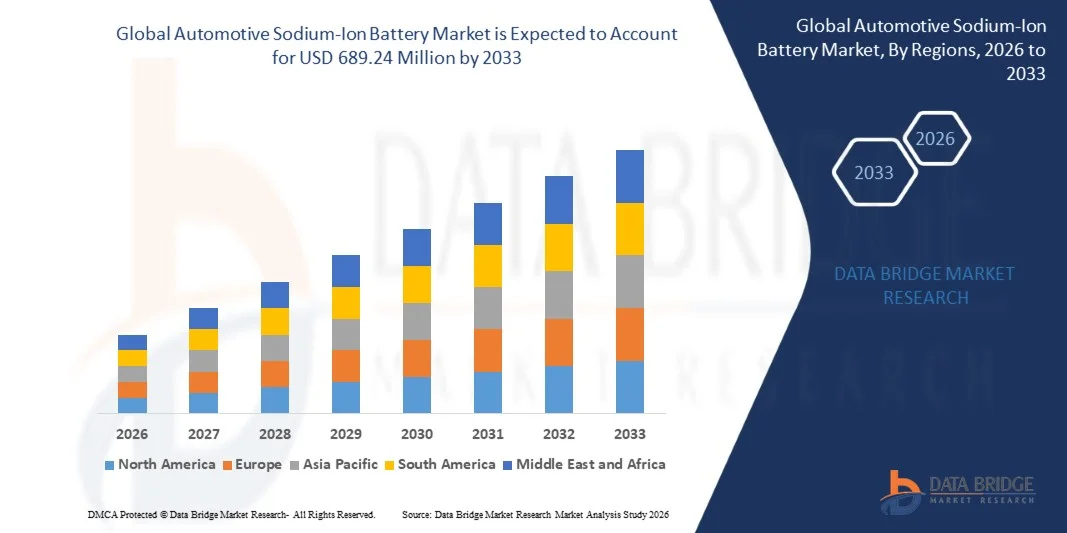
As per Data Bridge Market Research Analysis, the Automotive Sodium-Ion Battery Market was valued at USD 189.7 million in 2025 and is projected to reach USD 689.24 million by 2033, growing at a CAGR of 17.50% from 2026 to 2033. Sodium-ion batteries are an emerging electrochemical energy storage technology that utilizes sodium ions as charge carriers instead of lithium ions. Owing to the abundance and low cost of sodium resources, these batteries are increasingly being evaluated as a complementary alternative to lithium-ion batteries for cost-sensitive electric vehicle applications, particularly urban mobility, two-wheelers, three-wheelers, and entry-level passenger vehicles.
The market is experiencing significant expansion driven by the rising demand for electric vehicles, advancements in battery technology, and the need for diversified battery supply chains. Sodium-ion batteries utilize abundant and widely available raw materials, enabling improved resource security and localized production. Continuous research efforts are improving cathode structures such as Prussian blue analogues, layered oxides, and polyanionic compounds, enhancing durability and operational stability. Recent breakthroughs have significantly improved sodium-ion battery energy density, narrowing the gap with lithium iron phosphate (LFP) batteries.
Market Size & Forecast
- Global Market Value (2025): USD 189.7 Million
- Expected Market Value (2033): USD 689.24 Million
- Forecast CAGR (2026–2033): 17.50%
- Leading Region in 2025: Asia-Pacific
- Fastest Growing Region: Europe
Key Market Trends & Insights
- Asia-Pacific is the largest market for automotive sodium-ion batteries, driven by the presence of leading battery manufacturers and rapid EV adoption in countries such as China, Japan, and South Korea.
- Europe is the fastest-growing region in the automotive sodium-ion battery market, driven by strong policy support for battery localization, accelerated EV adoption, and a strategic focus on reducing lithium dependency.
- The Non-Aqueous Sodium-Ion Technology segment is expected to lead the market, delivering higher energy density and operating voltage while being compatible with modified lithium-ion manufacturing lines.
- The 10 to 40 kWh capacity segment is expected to record significant growth from 2026 to 2033, aligning with the requirements of compact passenger vehicles and urban mobility platforms.
- Electric two-wheelers, three-wheelers, and compact passenger EVs are expected to represent the earliest commercial adoption segments owing to their relatively lower energy density requirements and emphasis on affordability.
- Continuous improvements in cathode materials, thermal stability, low-temperature performance, and cycle life are narrowing the performance gap with lithium iron phosphate batteries.
- Government initiatives promoting domestic battery manufacturing and alternative chemistries are accelerating market adoption.
Report Scope and Automotive Sodium-Ion Battery Market Segmentation
|
Attributes |
Automotive Sodium-Ion Battery Key Market Insights |
|
Segments Covered |
|
|
Countries Covered |
North America · U.S. · Canada · Mexico Europe · Germany · France · U.K. · Netherlands · Switzerland · Belgium · Russia · Italy · Spain · Turkey · Rest of Europe Asia-Pacific · China · Japan · India · South Korea · Singapore · Malaysia · Australia · Thailand · Indonesia · Philippines · Rest of Asia-Pacific Middle East and Africa · Saudi Arabia · U.A.E. · South Africa · Egypt · Israel · Rest of Middle East and Africa South America · Brazil · Argentina · Rest of South America |
|
Key Market Players |
· Contemporary Amperex Technology Co., Limited (CATL) (China) · BYD Company Ltd. (China) · Faradion (Reliance Industries) (UK/India) · HiNa Battery Technology Co., Ltd. (China) · Tiamat Energy (France) · AMTE Power plc (UK) · Natron Energy, Inc. (U.S.) · Altris AB (Sweden) · Gotion High-Tech Co., Ltd. (China) · EVE Energy Co., Ltd. (China) · Farasis Energy, Inc. (China) · Zhejiang Natrium Energy Co., Ltd. (China) · Jiangsu Transimage Sodium-Ion Battery Technology Co., Ltd. (China) · Peak Energy (U.S.) · Aeson Power (Malaysia) · Changan Automobile (China) · Reliance Industries Limited (India, through Faradion) |
|
Market Opportunities |
· Rising demand for cost-effective and sustainable battery solutions for electric vehicles · Expansion of sodium-ion battery applications in electric two-wheelers and three-wheelers · Increasing government support for domestic battery manufacturing and alternative chemistries · Growing demand for battery solutions in urban EV fleets, electric two-wheelers and commercial vehicles |
|
Value Added Data Infosets |
In addition to the market insights such as market value, growth rate, market segments, geographical coverage, market players, and market scenario, the market report curated by the Data Bridge Market Research team includes in-depth expert analysis, import/export analysis, pricing analysis, production consumption analysis, and pestle analysis. |
Automotive Sodium-Ion Battery Market Trends
Trend: Technological Advancements in Sodium-Ion Battery Chemistry
Continuous research efforts are improving cathode structures, such as layered oxides, Prussian blue analogues, and polyanionic compounds, thereby enhancing durability and operational stability. Non-aqueous sodium-ion technology is leading the automotive sodium-ion battery market for electric vehicles because it delivers higher energy density and operating voltage through a wider electrochemical stability window, enabling practical driving range for passenger and light commercial electric vehicles. It is also compatible with modified lithium-ion manufacturing lines, allowing companies such as CATL and HiNa Battery Technology to scale production with lower capital adjustments. Recent advances have significantly improved sodium-ion battery energy density, narrowing the gap with lithium iron phosphate (LFP) batteries.
Automotive Sodium-Ion Battery Market Dynamics
Key Market Driver: Increasing Demand for Electric Vehicles
One of the primary growth factors driving the automotive sodium-ion battery market is the increasing demand for sustainable and eco-friendly transportation solutions. Governments worldwide are implementing stringent emission regulations and offering incentives for the adoption of electric vehicles. Sodium-ion batteries offer a viable alternative to lithium-ion batteries, which are more expensive and have supply chain concerns due to limited lithium resources. The rapid electrification of urban mobility and fleet-based transportation is shaping the automotive sodium-ion battery market. As the demand for electric vehicles continues to rise, sodium-ion batteries are expected to complement lithium-ion batteries in cost-sensitive vehicle segments rather than completely replace them.
Key Restraint/Challenge: Lower Energy Density Compared to Lithium-Ion Batteries
A significant challenge facing the automotive sodium-ion battery market is the lower energy density compared to lithium-ion batteries. Sodium is heavier than lithium, and its ions are larger, resulting in lower energy capacity for the same cell size. Sodium-ion cells currently achieve approximately 140–180 Wh/kg, compared to 180–300 Wh/kg for lithium-ion batteries, limiting the driving range of vehicles. However, sodium-ion batteries reduce dependence on lithium, cobalt and nickel while improving raw material availability, making them a cost-effective alternative for specific applications.
Key Market Opportunity: Expansion of Sodium-Ion Battery Applications
The expansion of sodium-ion battery applications in electric two-wheelers, three-wheelers, and light commercial vehicles presents a significant growth opportunity for the market. Sodium-ion batteries offer inherent safety advantages due to improved thermal behavior and a lower risk of thermal runaway compared to some lithium-based systems. As cities implement stricter emissions regulations and fleet operators focus on total cost of ownership, sodium-ion batteries are emerging as a competitive energy storage solution in cost-sensitive automotive segments.
Automotive Sodium-Ion Battery Market Scope
The automotive sodium-ion battery market is segmented on the basis of battery chemistry, technology, capacity, and end use.
By Battery Chemistry:
On the basis of battery chemistry, the Automotive Sodium-Ion Battery Market is segmented into Prussian blue sodium-ion, layered oxide sodium-ion and polyanionic sodium-ion. Prussian Blue Sodium-Ion batteries utilize Prussian blue analogues as cathode materials, offering high stability and long cycle life. Layered Oxide Sodium-Ion batteries employ transition metal oxides as cathode materials, providing high energy density and good rate capability. Polyanionic Sodium-Ion batteries use compounds such as NASICON-type materials, offering excellent structural stability and long cycle life. These chemistries are being increasingly adopted by automotive OEMs for entry-level electric vehicles and urban mobility platforms where cost-effectiveness and safety are prioritized over extreme range requirements. Continuous advancements in cathode chemistry and electrolyte formulations are further enhancing the performance and commercial viability of sodium-ion batteries for automotive applications.
By Technology:
On the basis of technology, the Automotive Sodium-Ion Battery Market is segmented into aqueous sodium-ion technology and non-aqueous sodium-ion technology. Non-Aqueous Sodium-Ion Technology is expected to lead the market, delivering higher energy density and operating voltage through a wider electrochemical stability window, enabling practical driving range for passenger and light commercial electric vehicles. It is also compatible with modified lithium-ion manufacturing lines, allowing companies to scale production with lower capital adjustments. Non-aqueous sodium-ion technology offers better performance across a broader range of temperatures than aqueous systems, making it better aligned with vehicle performance and manufacturing requirements. The use of non-aqueous electrolytes also enables higher operating voltages and improved cycle stability, which are critical for long-term automotive applications. Leading manufacturers such as CATL and HiNa Battery Technology are focusing on non-aqueous sodium-ion technology for their commercial EV battery products, driving widespread adoption across the industry.
By Capacity:
On the basis of capacity, the Automotive Sodium-Ion Battery Market is segmented into below 10 kWh, 10 to 40 kWh and above 40 kWh. The 10 to 40 kWh segment is expected to record significant growth from 2026 to 2033, aligning with the requirements of compact passenger vehicles and urban mobility platforms. This capacity band is particularly suitable for electric two-wheelers, three-wheelers, and light commercial vehicles operating within short-to-medium-range duty cycles. The 10 to 40 kWh capacity range offers an optimal balance between cost, weight, and driving range, making it the preferred choice for cost-sensitive EV segments. As sodium-ion battery technology continues to improve, this capacity segment is expected to expand further, capturing a larger share of the overall automotive sodium-ion battery market. The growing demand for affordable electric vehicles in emerging economies is expected to further drive growth in this capacity segment.
By End Use:
On the basis of end use, the Automotive Sodium-Ion Battery Market is segmented into electric 2-wheeler, electric 3-wheeler, passenger electric vehicles and light commercial vehicles. Electric two-wheelers, three-wheelers, and compact passenger EVs are expected to represent the earliest commercial adoption segments owing to their relatively lower energy density requirements and emphasis on affordability. Rising demand for electric two-wheelers, three-wheelers, compact passenger vehicles, and last-mile delivery vans is creating a strong market pull for sodium-ion batteries that prioritize affordability, safety, and thermal stability over extended driving range. Electric two-wheelers and three-wheelers are particularly well-suited for sodium-ion battery adoption due to their lower energy requirements and frequent charging cycles. Light commercial vehicles, including delivery vans and small trucks, represent a growing segment for sodium-ion batteries, offering fleet operators a cost-effective alternative to lithium-ion systems for urban logistics and last-mile delivery operations.
Automotive Sodium-Ion Battery Market Regional Analysis
Asia-Pacific Automotive Sodium-Ion Battery Market Insight
Asia-Pacific is the largest market for automotive sodium-ion batteries, driven by the presence of leading battery manufacturers and rapid EV adoption in countries such as China, Japan, and South Korea. China is at the forefront of sodium-ion battery development, with major producers such as CATL and BYD investing heavily in the technology. BYD began construction of its first sodium-ion battery plant in Xuzhou, Jiangsu province in January 2024, investing RMB 10 billion (approximately USD 1.4 billion) with a planned annual capacity of 30 GWh. CATL, which announced its first-generation sodium-ion battery in 2021, launched a sodium-ion product line called Naxtra in April 2025 and claims to have already started manufacturing it at scale. The Chinese government's 14th Five-Year Plan and Made in China 2025 initiative both prioritize new energy technologies, including sodium-ion batteries.
Europe Automotive Sodium-Ion Battery Market Insight
Europe is the fastest-growing region in the automotive sodium-ion battery market, driven by strong policy support for battery localization, accelerated electric vehicle adoption, and a strategic focus on reducing lithium dependency. The European Union is advancing battery sovereignty through initiatives such as the European Battery Alliance, which encourages domestic development of alternative chemistries, including sodium-ion. Automotive OEMs in the region are prioritizing cost-competitive battery solutions for entry-level EVs and urban mobility platforms, where sodium-ion offers material availability advantages over lithium-based systems. Regional developers such as Tiamat Energy and Altris AB are strengthening the local technology ecosystem. Strong climate targets, rapid electrification of two-wheelers and compact vehicles, and investments in gigafactory infrastructure are collectively driving market growth in Europe.
North America Automotive Sodium-Ion Battery Market Insight
North America holds a significant position in the Automotive Sodium-Ion Battery Market, supported by increasing investments in battery manufacturing and growing demand for electric vehicles. Trade policies encouraging domestic battery production may support investment in alternative battery chemistries, including sodium-ion. Key players such as Natron Energy and Peak Energy are active in the North American market, focusing on sodium-ion battery technology for automotive and energy storage applications. Growing emphasis on sustainable energy solutions and reducing dependence on imported lithium and cobalt is expected to drive market growth in the region.
Automotive Sodium-Ion Battery Market Share
The Automotive Sodium-Ion Battery industry is primarily led by well-established companies, including:
- Contemporary Amperex Technology Co., Limited (CATL) (China)
- BYD Company Ltd. (China)
- Faradion (Reliance Industries) (UK/India)
- HiNa Battery Technology Co., Ltd. (China)
- Tiamat Energy (France)
- AMTE Power plc (UK)
- Natron Energy, Inc. (U.S.)
- Altris AB (Sweden)
- Gotion High-Tech Co., Ltd. (China)
- EVE Energy Co., Ltd. (China)
- Farasis Energy, Inc. (China)
- Zhejiang Natrium Energy Co., Ltd. (China)
- Jiangsu Transimage Sodium-Ion Battery Technology Co., Ltd. (China)
- Peak Energy (U.S.)
- Aeson Power (Malaysia)
- Changan Automobile (China)
- Reliance Industries Limited (India, through Faradion)
Latest Developments in Automotive Sodium-Ion Battery Market
- In February 2026, CATL and Changan unveiled the world's first mass-produced passenger electric vehicle powered by sodium-ion batteries. The Changan Nevo A06 features a 45 kWh CATL Naxtra sodium-ion battery, promising an initial driving range of over 400 kilometers on a single charge. The vehicle is set to reach the market by mid-2026, with CATL supplying its advanced Naxtra sodium-ion batteries across Changan's full brand portfolio. This development marks a transition from laboratory-level sodium battery research to commercial EV deployment.
- In April 2025, CATL launched three new electric vehicle battery products at its inaugural Super Tech Day: the Freevoy Dual Power Battery, Naxtra (the first mass-produced sodium-ion battery), and the second-generation Shenxing superfast charging battery. CATL's Naxtra passenger EV battery can achieve an energy density of up to 175 watt-hours per kilogram. The Naxtra battery also passed China's new national standard certification (GB 38031-2025), becoming the first sodium-ion battery to meet that safety standard, and is scheduled for mass vehicle integration in 2026.
- In October 2025, HiNa Battery Technology successfully hosted a product mass-production launch event themed "Evolution & Leap: From the Product Era to the Commercial Era". The company has been mass-producing two types of sodium-ion batteries and announced development of fast-charging sodium-ion batteries targeting heavy-duty applications. HiNa has established the world's first GWh-scale mass production line for sodium-ion batteries and has successfully delivered its self-developed 1.1 MWh sodium-ion battery cluster to a major German energy company.
- In November 2025, Reliance Industries (through its subsidiary Faradion) announced plans to scale up sodium-ion battery manufacturing in India, targeting electric two-wheeler and three-wheeler applications. This initiative aligns with India's push for domestic battery production and aims to reduce reliance on imported lithium-ion batteries for the country's rapidly growing electric mobility sector. Reliance's planned 30 GWh battery gigafactory in Jamnagar, Gujarat, is expected to leverage Faradion's sodium-ion technology for commercial production.
- In January 2024, BYD began construction of its first sodium-ion battery plant in Xuzhou, Jiangsu province, investing RMB 10 billion (approximately USD 1.4 billion). The facility has a planned annual capacity of 30 GWh and will produce sodium-ion battery cells and battery packs, targeting applications in electric vehicles, grid-scale storage, and industry. This significant investment underscores BYD's commitment to sodium-ion technology as a strategic alternative to lithium-ion batteries.

- Interactive Data Analysis Dashboard
- Company Analysis Dashboard for high growth potential opportunities
- Research Analyst Access for customization & queries
- Competitor Analysis with Interactive dashboard
- Latest News, Updates & Trend analysis
- Harness the Power of Benchmark Analysis for Comprehensive Competitor Tracking
Data collection and base year analysis are done using data collection modules with large sample sizes. The stage includes obtaining market information or related data through various sources and strategies. It includes examining and planning all the data acquired from the past in advance. It likewise envelops the examination of information inconsistencies seen across different information sources. The market data is analysed and estimated using market statistical and coherent models. Also, market share analysis and key trend analysis are the major success factors in the market report. To know more, please request an analyst call or drop down your inquiry.
The key research methodology used by DBMR research team is data triangulation which involves data mining, analysis of the impact of data variables on the market and primary (industry expert) validation. Data models include Vendor Positioning Grid, Market Time Line Analysis, Market Overview and Guide, Company Positioning Grid, Patent Analysis, Pricing Analysis, Company Market Share Analysis, Standards of Measurement, Global versus Regional and Vendor Share Analysis. To know more about the research methodology, drop in an inquiry to speak to our industry experts.
Data Bridge Market Research is a leader in advanced formative research. We take pride in servicing our existing and new customers with data and analysis that match and suits their goal. The report can be customized to include price trend analysis of target brands understanding the market for additional countries (ask for the list of countries), clinical trial results data, literature review, refurbished market and product base analysis. Market analysis of target competitors can be analyzed from technology-based analysis to market portfolio strategies. We can add as many competitors that you require data about in the format and data style you are looking for. Our team of analysts can also provide you data in crude raw excel files pivot tables (Fact book) or can assist you in creating presentations from the data sets available in the report.













