


Global Automotive Stabilizer Bar Link Market Size
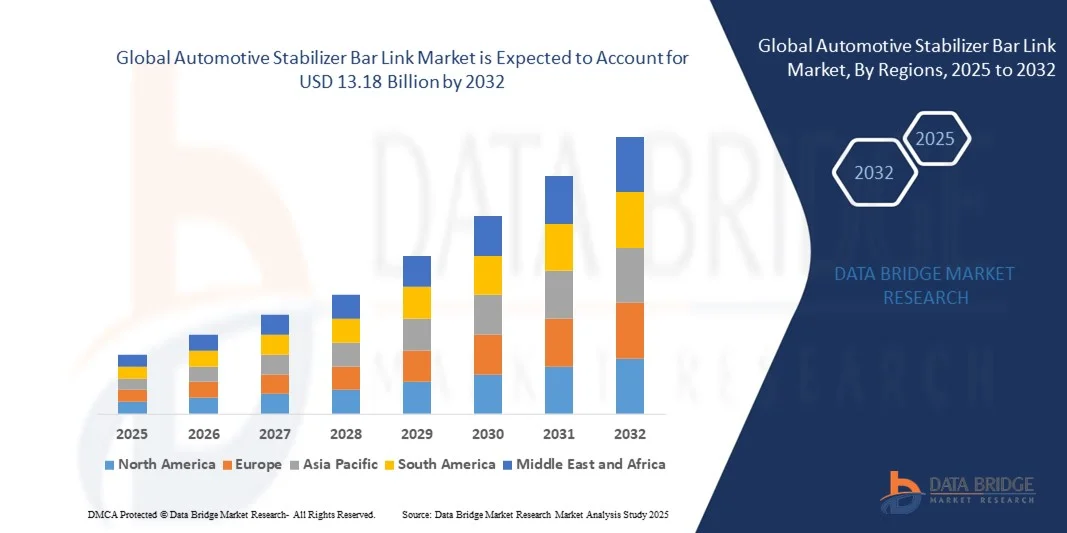
- The global Automotive Stabilizer Bar Link Market size was valued at USD 9.20 billion in 2024 and is expected to reach USD 13.18 billion by 2032, growing at a CAGR of 4.60% during the forecast period
- Market growth is primarily driven by increasing demand for vehicle safety and stability, coupled with advancements in automotive suspension technologies to enhance ride comfort and handling
- Additionally, the rising production of passenger and commercial vehicles worldwide, along with stricter government regulations on vehicle safety standards, is fueling the adoption of advanced stabilizer bar link systems, significantly contributing to market expansion
Global Automotive Stabilizer Bar Link Market Analysis
- Automotive stabilizer bar links, critical components of vehicle suspension systems, play a vital role in improving vehicle stability, handling, and safety by reducing body roll during cornering in both passenger and commercial vehicles
- The rising demand for enhanced driving comfort and vehicle safety, along with advancements in materials and manufacturing technologies, is driving the increasing adoption of advanced stabilizer bar link systems
- Asia-Pacific dominated the Global Automotive Stabilizer Bar Link Market with the largest revenue share of 36.1% in 2024, attributed to the region’s well-established automotive industry, stringent vehicle safety regulations, and high adoption of advanced suspension technologies, with the U.S. leading in innovation and aftermarket upgrades
- North America is projected to be the fastest-growing region in the Global Automotive Stabilizer Bar Link Market during the forecast period, driven by rapid urbanization, growing automotive production, and rising disposable incomes in countries such as China and India
- The steel segment dominated the market with the largest revenue share of approximately 48% in 2024, attributed to its high strength, durability, and cost-effectiveness, making it the preferred choice for a wide range of vehicles.
Report Scope and Global Automotive Stabilizer Bar Link Market Segmentation
|
Attributes |
Automotive Stabilizer Bar Link Key Market Insights |
|
Segments Covered |
|
|
Countries Covered |
North America
Europe
Asia-Pacific
Middle East and Africa
South America
|
|
Key Market Players |
|
|
Market Opportunities |
|
|
Value Added Data Infosets |
In addition to the market insights such as market value, growth rate, market segments, geographical coverage, market players, and market scenario, the market report curated by the Data Bridge Market Research team includes in-depth expert analysis, import/export analysis, pricing analysis, production consumption analysis, and pestle analysis. |
Global Automotive Stabilizer Bar Link Market Trends
Enhanced Performance Through Advanced Materials and Smart Integration
- A significant and accelerating trend in the global Automotive Stabilizer Bar Link Market is the adoption of advanced materials such as high-strength steel and lightweight alloys, combined with smart sensor integration to improve vehicle stability and ride comfort. This fusion of innovations is significantly enhancing the durability and functionality of stabilizer bar link systems.
- For instance, some leading manufacturers are incorporating sensors that monitor suspension performance in real-time, enabling adaptive adjustments to optimize handling and reduce body roll during cornering. These smart stabilizer bar links can communicate with vehicle control systems to improve overall driving safety.
- Integration of smart technologies in stabilizer bar links allows for predictive maintenance features, where sensor data is used to detect wear or damage early, reducing downtime and repair costs. For example, certain systems can alert drivers or fleet managers when a component needs replacement before failure occurs, enhancing vehicle reliability. Furthermore, these intelligent components contribute to the development of semi-autonomous and autonomous driving capabilities by providing critical data on vehicle dynamics.
- The seamless integration of stabilizer bar links with electronic stability control (ESC) and advanced driver-assistance systems (ADAS) facilitates better vehicle control and safety outcomes. Through real-time data exchange, vehicles can dynamically adjust suspension settings to maintain optimal performance under varying driving conditions.
- This trend towards smarter, more resilient, and interconnected suspension components is fundamentally reshaping expectations for vehicle safety and performance. Consequently, companies such as ZF Friedrichshafen AG and Hyundai are investing heavily in R&D to develop smart stabilizer bar links featuring sensor integration and adaptive technologies.
- The demand for automotive stabilizer bar links that offer enhanced material strength and smart system integration is growing rapidly across passenger and commercial vehicle segments, as manufacturers and consumers increasingly prioritize safety, durability, and driving comfort.
Global Automotive Stabilizer Bar Link Market Dynamics
Driver
Growing Need Due to Increasing Vehicle Safety Regulations and Demand for Ride Comfort
- The rising implementation of stringent vehicle safety standards globally, combined with growing consumer demand for enhanced ride comfort and handling, is a significant driver for the increased adoption of advanced automotive stabilizer bar links
- For instance, in 2024, several automakers announced updates to suspension systems incorporating more durable and lightweight stabilizer bar links to meet new safety and emission regulations, supporting market growth during the forecast period
- As consumers and fleet operators seek vehicles that offer better stability and control, stabilizer bar links with improved materials and designs provide crucial benefits such as reduced body roll and enhanced cornering performance, offering a compelling upgrade over older suspension components
- Furthermore, the growing production of passenger and commercial vehicles, especially in emerging markets, is fueling demand for reliable suspension parts that contribute to overall vehicle safety and driving experience
- The increasing trend towards electric and autonomous vehicles also requires advanced stabilizer bar link systems that integrate with electronic stability control and adaptive suspension technologies, driving innovation and adoption in the market
Restraint/Challenge
Concerns Regarding Durability, Maintenance Costs, and Market Fragmentation
- Concerns over the durability and maintenance costs of automotive stabilizer bar links, especially in harsh driving conditions, pose challenges to broader market penetration. Frequent exposure to road debris, corrosion, and mechanical stress can lead to premature wear, causing consumer hesitation
- For instance, reports of early failure in lower-quality stabilizer bar links have made some vehicle owners reluctant to invest in aftermarket replacements without trusted brand assurance
- Addressing these concerns through the use of high-quality materials, enhanced corrosion protection, and longer-lasting designs is crucial for building consumer confidence. Companies such as ZF Friedrichshafen AG and Mubea emphasize their stringent quality control and advanced manufacturing techniques in their marketing to reassure buyers. Additionally, the relatively high replacement cost of premium stabilizer bar links compared to basic aftermarket parts can be a barrier for price-sensitive customers, particularly in developing regions or for older vehicles
- While prices have become more competitive due to increased manufacturing efficiencies, the perceived cost of quality suspension components can still limit adoption, especially among budget-conscious consumers
- Overcoming these challenges through continuous product innovation, consumer education on the importance of suspension maintenance, and offering competitively priced, durable options will be vital for sustained market growth
Global Automotive Stabilizer Bar Link Market Scope
Automotive stabilizer bar link market is segmented on the basis of material type, vehicle type and sales channel.
- By Material Type
On the basis of material type, the Global Automotive Stabilizer Bar Link Market is segmented into cast iron, steel, aluminium, and carbon fibre reinforced plastic (CFRP). The steel segment dominated the market with the largest revenue share of approximately 48% in 2024, attributed to its high strength, durability, and cost-effectiveness, making it the preferred choice for a wide range of vehicles. Cast iron remains relevant for heavy-duty applications due to its excellent load-bearing capacity.
Aluminium and CFRP segments are anticipated to witness the fastest growth rates, at around 22.5% and 25.3% CAGR respectively, between 2025 and 2032. This growth is driven by increasing demand for lightweight and fuel-efficient vehicles, particularly in passenger and electric vehicle segments. The superior corrosion resistance and strength-to-weight ratio of aluminium and CFRP materials are encouraging automakers to adopt these materials for advanced stabilizer bar links, promoting improved vehicle performance and emissions reduction.
- By Vehicle Type
on the basis of vehicle type, the Global Automotive Stabilizer Bar Link Market is segmented into passenger cars (PC), light commercial vehicles (LCV), and heavy commercial vehicles (HCV). The passenger car segment held the largest market revenue share of approximately 55% in 2024, driven by the high production volume of passenger vehicles worldwide and the rising focus on ride comfort and safety features among consumers.
The light commercial vehicle segment is expected to witness the fastest CAGR of around 21.2% during the forecast period from 2025 to 2032, fueled by the expansion of logistics, last-mile delivery services, and increasing demand for better vehicle handling in urban transport. Heavy commercial vehicles maintain steady demand, particularly in emerging economies, due to their requirement for robust suspension components capable of handling heavy loads and rough terrains.
- By Sales Channel
On the basis of sales channel, the Global Automotive Stabilizer Bar Link Market is segmented into original equipment manufacturers (OEM), aftermarket, and others. The OEM segment dominated the market with the largest revenue share of about 60% in 2024, reflecting the integration of stabilizer bar links as standard components in new vehicle production. Regulatory compliance and safety standards continue to drive demand through this channel.
The aftermarket segment is projected to register the fastest CAGR of approximately 19.8% from 2025 to 2032, supported by the growing vehicle parc and increasing need for replacement parts due to wear and tear. Aftermarket growth is also propelled by rising consumer preference for quality components and longer vehicle lifespans. The ‘others’ segment includes fleet sales and specialized distributors, contributing modestly to the overall market expansion.
Global Automotive Stabilizer Bar Link Market Regional Analysis
- Asia-Pacific dominated the Global Automotive Stabilizer Bar Link Market with the largest revenue share of 36.1% in 2024, driven by a well-established automotive industry and strong demand for vehicle safety and stability components.
- Consumers and manufacturers in the region prioritize high-quality stabilizer bar links to enhance driving comfort, reduce body roll, and improve vehicle handling across passenger and commercial vehicles.
- This dominance is further supported by high disposable incomes, advanced manufacturing capabilities, stringent safety regulations, and the presence of major automotive OEMs and suppliers fostering innovation and adoption of advanced stabilizer bar link technologies.
U.S. Automotive Stabilizer Bar Link Market Insight
The U.S. automotive stabilizer bar link market captured the largest revenue share of 35% in 2024 within North America, driven by the country’s advanced automotive manufacturing industry and stringent safety regulations. Increasing consumer demand for improved vehicle handling and stability, coupled with rising production of passenger and commercial vehicles, is fueling market growth. Moreover, the focus on lightweight materials and the adoption of advanced suspension systems in electric and hybrid vehicles are further propelling demand. Strong R&D activities and the presence of key OEMs and aftermarket suppliers contribute significantly to the expansion of the U.S. market.
Europe Automotive Stabilizer Bar Link Market Insight
The Europe automotive stabilizer bar link market is projected to expand at a substantial CAGR during the forecast period, supported by strict vehicle safety standards and increasing demand for enhanced driving comfort. The rise in vehicle production, especially in countries like Germany, France, and Italy, is driving the adoption of high-performance stabilizer bar links. Additionally, the growing focus on emission reduction and fuel efficiency encourages the use of lightweight materials such as aluminium and carbon fibre composites. Europe’s mature automotive sector and increasing investment in electric vehicle infrastructure further bolster market growth.
U.K. Automotive Stabilizer Bar Link Market Insight
The U.K. automotive stabilizer bar link market is expected to grow steadily during the forecast period, driven by growing awareness around vehicle safety and the increasing volume of new vehicle registrations. The government’s emphasis on vehicle safety regulations and investments in automotive technology innovation encourage the integration of advanced stabilizer bar links in new models. Additionally, rising consumer preference for improved ride quality and stability in passenger cars and commercial vehicles supports market expansion, complemented by strong aftermarket demand for replacement parts.
Germany Automotive Stabilizer Bar Link Market Insight
Germany, as Europe’s automotive hub, is expected to lead the region with significant growth in the automotive stabilizer bar link market. The country’s well-established automotive manufacturing industry, focus on technological advancements, and strict safety regulations drive demand for advanced stabilizer components. Increasing production of electric and hybrid vehicles encourages the use of lightweight and durable materials in stabilizer bar links. Furthermore, Germany’s emphasis on innovation and quality ensures a robust market for both OEM and aftermarket segments, particularly in passenger and commercial vehicles.
Asia-Pacific Automotive Stabilizer Bar Link Market Insight
The Asia-Pacific automotive stabilizer bar link market is poised to grow at the fastest CAGR of around 22% during the forecast period from 2025 to 2032. This rapid growth is driven by increasing vehicle production in emerging markets such as China, India, and Southeast Asia, coupled with rising urbanization and disposable incomes. The expanding demand for passenger and commercial vehicles, along with government incentives supporting automotive manufacturing and safety regulations, is fueling market expansion. Additionally, the region’s emergence as a manufacturing hub for automotive components is enhancing the availability and affordability of stabilizer bar links.
Japan Automotive Stabilizer Bar Link Market Insight
Japan’s automotive stabilizer bar link market is experiencing steady growth due to the country’s advanced automotive industry and strong focus on vehicle safety and quality. The demand for improved ride comfort and handling, especially in passenger cars, supports the adoption of high-performance stabilizer bar links. Japan’s commitment to innovation and the production of electric and hybrid vehicles also drives the use of lightweight materials and advanced designs. Additionally, the aging population’s preference for safer and more comfortable vehicles further contributes to market growth.
China Automotive Stabilizer Bar Link Market Insight
China accounted for the largest market revenue share in the Asia-Pacific region in 2024, propelled by its status as the world’s largest automotive market. Rapid urbanization, increasing middle-class population, and growing demand for passenger and commercial vehicles fuel the need for advanced suspension components such as stabilizer bar links. China’s push toward electric vehicle adoption and smart automotive technologies accelerates the demand for lightweight and durable stabilizer components. Furthermore, strong domestic manufacturing capabilities and government initiatives supporting automotive safety standards underpin market growth in China.
Global Automotive Stabilizer Bar Link Market Share
The Automotive Stabilizer Bar Link industry is primarily led by well-established companies, including:
• ZF Friedrichshafen AG (Germany)
• Teknorot (Turkey)
• Synergy Manufacturing (U.S.)
• Ruian Wuhuan Auto Spare Parts (China)
• Delphi Technologies (U.K.)
• NHK International Corporation (Japan)
• Yangzhou Dongsheng Automotive (China)
• Taizhou Yongzheng Automobile Parts (China)
• ADDCO Manufacturing Company (U.S.)
• Swaytec (Germany)
• SOGEFI Group (Italy)
• Mubea (Germany)
• Hyundai (South Korea)
• Wanxiang Group (China)
• YOROZU (Japan)
• Kongsberg Automotive (Norway)
• Tinsley Bridge (U.K.)
What are the Recent Developments in Global Automotive Stabilizer Bar Link Market?
- In April 2023, ZF Friedrichshafen AG, a global leader in automotive components, announced the launch of an advanced stabilizer bar link system in South Africa designed to enhance vehicle stability and safety across diverse driving conditions. This initiative reflects ZF’s commitment to delivering innovative suspension solutions tailored to regional road challenges, strengthening its position in the rapidly expanding global automotive stabilizer bar link market. By leveraging cutting-edge materials and engineering expertise, ZF aims to improve ride comfort and handling for both passenger and commercial vehicles in emerging markets.
- In March 2023, Synergy Manufacturing, a specialist in automotive suspension components based in the U.S., introduced a next-generation stabilizer bar link optimized for electric and hybrid vehicles. The new product is engineered to reduce weight while maintaining durability, addressing the growing demand for lightweight automotive parts that improve fuel efficiency and vehicle dynamics. This innovation underscores Synergy Manufacturing’s dedication to supporting the evolving automotive landscape and advancing the global stabilizer bar link market.
- In March 2023, Delphi Technologies successfully partnered with a leading commercial vehicle manufacturer in India to deploy enhanced stabilizer bar link systems aimed at improving heavy commercial vehicle safety and load management. The collaboration highlights Delphi’s expertise in advanced suspension components and its role in supporting safer, more efficient transportation in rapidly urbanizing regions. This project exemplifies the increasing importance of robust stabilizer systems in heavy-duty applications within the global market.
- In February 2023, Wanxiang Group, a major Chinese automotive parts supplier, announced a strategic collaboration with several automotive OEMs to expand production capacity for stabilizer bar links using high-strength steel and aluminum alloys. This move is intended to meet growing demand driven by rising vehicle production and stricter safety regulations in the Asia-Pacific region. Wanxiang’s initiative reflects its commitment to innovation and supply chain optimization in the competitive global automotive stabilizer bar link market.
- In January 2023, Kongsberg Automotive, a key player in automotive suspension solutions, unveiled its new carbon-fiber reinforced plastic (CFRP) stabilizer bar links at the European Automotive Components Expo. This lightweight, high-performance product is designed to enhance fuel efficiency and vehicle handling without compromising strength, targeting premium passenger car segments. Kongsberg’s advancement highlights the growing trend toward sustainable and technologically advanced materials within the global automotive stabilizer bar link market.

- Interactive Data Analysis Dashboard
- Company Analysis Dashboard for high growth potential opportunities
- Research Analyst Access for customization & queries
- Competitor Analysis with Interactive dashboard
- Latest News, Updates & Trend analysis
- Harness the Power of Benchmark Analysis for Comprehensive Competitor Tracking
Data collection and base year analysis are done using data collection modules with large sample sizes. The stage includes obtaining market information or related data through various sources and strategies. It includes examining and planning all the data acquired from the past in advance. It likewise envelops the examination of information inconsistencies seen across different information sources. The market data is analysed and estimated using market statistical and coherent models. Also, market share analysis and key trend analysis are the major success factors in the market report. To know more, please request an analyst call or drop down your inquiry.
The key research methodology used by DBMR research team is data triangulation which involves data mining, analysis of the impact of data variables on the market and primary (industry expert) validation. Data models include Vendor Positioning Grid, Market Time Line Analysis, Market Overview and Guide, Company Positioning Grid, Patent Analysis, Pricing Analysis, Company Market Share Analysis, Standards of Measurement, Global versus Regional and Vendor Share Analysis. To know more about the research methodology, drop in an inquiry to speak to our industry experts.
Data Bridge Market Research is a leader in advanced formative research. We take pride in servicing our existing and new customers with data and analysis that match and suits their goal. The report can be customized to include price trend analysis of target brands understanding the market for additional countries (ask for the list of countries), clinical trial results data, literature review, refurbished market and product base analysis. Market analysis of target competitors can be analyzed from technology-based analysis to market portfolio strategies. We can add as many competitors that you require data about in the format and data style you are looking for. Our team of analysts can also provide you data in crude raw excel files pivot tables (Fact book) or can assist you in creating presentations from the data sets available in the report.













