


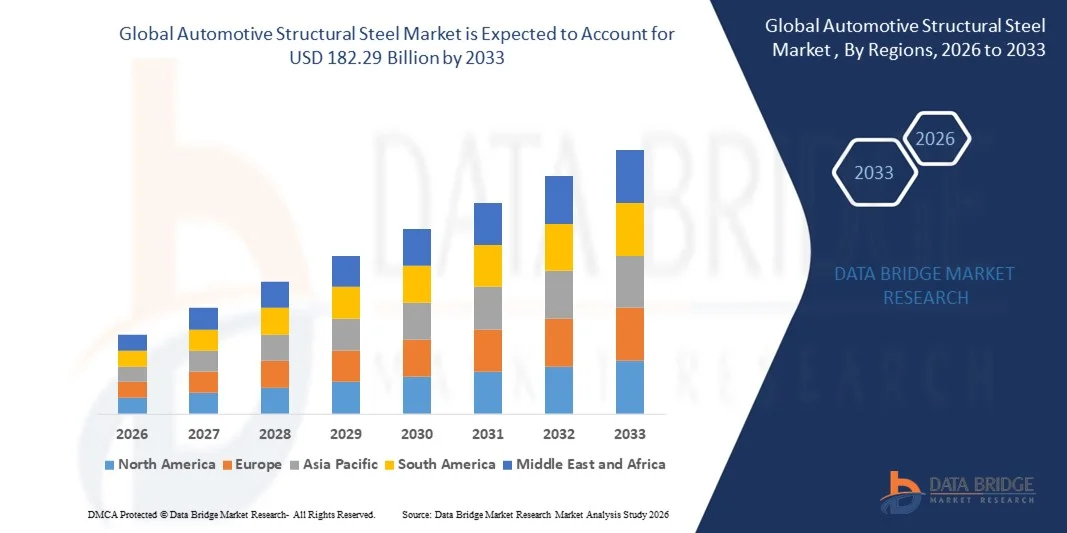
Global Automotive Structural Steel Market Size
- The global Automotive Structural Steel Market was valued at USD 130.16 billion in 2025 and is projected to reach USD 182.29 billion by 2033, registering a CAGR of 4.30% over the forecast period.
- Market expansion is primarily driven by the increasing shift toward lightweight, high-strength materials in vehicle manufacturing, alongside rapid advancements in steel processing technologies that enhance durability, safety, and fuel efficiency.
- Additionally, the rising demand for cost-effective, reliable, and performance-optimized structural components across passenger and commercial vehicles is positioning advanced structural steel as a preferred material. These aligned trends are accelerating adoption and significantly strengthening overall industry growth.
Global Automotive Structural Steel Market Analysis
- Automotive structural steel, used for frames, chassis, and key load-bearing components, is becoming increasingly crucial in modern vehicle design across both passenger and commercial segments due to its superior strength-to-weight ratio, enhanced safety performance, and compatibility with advanced manufacturing and forming technologies.
- The rising demand for automotive structural steel is primarily driven by the industry-wide focus on lightweighting, stricter global safety and emission regulations, and a growing preference among automakers for high-strength and ultra-high-strength steels that offer improved crash resistance while supporting vehicle efficiency.
- North America dominated the Global Automotive Structural Steel Market with the largest revenue share of 34.3% in 2025, supported by strong automotive production capabilities, rapid adoption of advanced steel grades, and the presence of major OEMs and steel manufacturers. The U.S. market experienced notable growth due to increased investment in next-generation vehicle platforms and expanding use of AHSS in SUVs and light trucks.
- Asia-Pacific is expected to be the fastest-growing region in the Global Automotive Structural Steel Market during the forecast period, driven by rapid urbanization, rising vehicle production, expanding manufacturing infrastructure, and growing demand for affordable yet robust structural materials.
- The hot rolling segment dominated the market with a revenue share of 57.4% in 2025, driven by its widespread use in producing high-strength steel sheets and structural components for vehicle frames, chassis, and crash-critical parts.
Report Scope and Global Automotive Structural Steel Market Segmentation
|
Attributes |
Automotive Structural Steel Key Market Insights |
|
Segments Covered |
|
|
Countries Covered |
North America
Europe
Asia-Pacific
Middle East and Africa
South America
|
|
Key Market Players |
• ArcelorMittal (Luxembourg) |
|
Market Opportunities |
|
|
Value Added Data Infosets |
In addition to the market insights such as market value, growth rate, market segments, geographical coverage, market players, and market scenario, the market report curated by the Data Bridge Market Research team includes in-depth expert analysis, import/export analysis, pricing analysis, production consumption analysis, and pestle analysis. |
Global Automotive Structural Steel Market Trends
Advancements in High-Strength Steel Driven by AI-Enabled Manufacturing
- A significant and accelerating trend in the Global Automotive Structural Steel Market is the deeper integration of artificial intelligence (AI) and digital manufacturing technologies into steel design, processing, and quality control. This technological fusion is greatly enhancing production efficiency, material consistency, and structural performance across modern vehicle platforms.
- For instance, leading steel producers are adopting AI-driven rolling and forming systems that automatically adjust temperature, pressure, and forming sequences to achieve optimal strength and durability. Similarly, next-generation hot-stamping lines equipped with predictive algorithms ensure precise shaping of ultra-high-strength steel components for crash-critical vehicle structures.
- AI integration also enables advanced capabilities such as predictive maintenance, real-time defect detection, and automated microstructure analysis, improving reliability and reducing production downtime. For example, automated inspection systems powered by machine learning can identify micro-cracks or distortions during forming and guide corrective actions instantly.
- The seamless incorporation of AI, robotics, and digital twins into steel manufacturing supports centralized production control, allowing engineers to monitor forming, welding, and assembly processes alongside energy use and material flow in a unified digital environment.
- This shift toward more intelligent, highly automated, and interconnected production ecosystems is reshaping expectations for material performance and efficiency in vehicle manufacturing. Consequently, major companies are investing in AI-optimized steel development, producing grades tailored for electric vehicles, crash structures, and lightweight body architectures.
- The demand for automotive structural steel enhanced through AI-supported manufacturing and quality optimization is rising rapidly across global automotive OEMs, as manufacturers prioritize durability, safety, and material efficiency for next-generation vehicle platforms.
Global Automotive Structural Steel Market Dynamics
Driver
Growing Demand Driven by Vehicle Safety Regulations and Lightweighting Trends
- The increasing emphasis on vehicle safety standards, fuel efficiency, and emission regulations, coupled with the rising adoption of electric and hybrid vehicles, is a significant driver for the growing demand for automotive structural steel.
- For instance, in 2025, POSCO announced the launch of new ultra-high-strength steel grades specifically designed for electric vehicle battery enclosures and crash-critical components. Such innovations by leading steel producers are expected to accelerate the growth of the automotive structural steel market during the forecast period.
- As automakers strive to meet stricter crash safety and environmental regulations, advanced structural steels provide superior strength, energy absorption, and weight reduction, offering a compelling alternative to traditional materials.
- Furthermore, the shift toward lightweight vehicle architectures and modular platforms is increasing the integration of high-strength and ultra-high-strength steels in both passenger and commercial vehicles, enhancing overall performance while reducing emissions.
- The combination of regulatory compliance, improved vehicle efficiency, and enhanced safety is driving strong adoption of advanced structural steels across global automotive manufacturing, particularly in markets emphasizing EV production and premium vehicle segments.
Restraint/Challenge
High Production Costs and Technical Complexity
- The relatively high production costs associated with advanced high-strength and ultra-high-strength steels, along with the technical complexity of forming, welding, and assembling these materials, pose significant challenges to broader adoption in the automotive industry.
- For instance, the manufacturing of hot-stamped ultra-high-strength steel components requires specialized equipment and skilled labor, which can increase production costs and lead times, particularly for smaller automakers or emerging market manufacturers.
- Addressing these challenges through innovations in cost-efficient steel processing, improved forming technologies, and advanced simulation tools is crucial for wider adoption. Companies such as ArcelorMittal and Nippon Steel emphasize investments in AI-driven production and automated quality control systems to mitigate technical barriers.
- Additionally, while ultra-high-strength steels offer superior performance, integrating them into existing vehicle platforms can require design modifications and advanced joining techniques, which may deter some manufacturers due to higher upfront investment.
- Overcoming these challenges through process optimization, workforce training, and research into cost-effective high-strength steel solutions will be vital for sustaining market growth in the long term.
Global Automotive Structural Steel Market Scope
Automotive structural steel market is segmented on the basis of manufacturing process, product type, component and vehicle type.
- By Manufacturing Process
On the basis of manufacturing process, the Global Automotive Structural Steel Market is segmented into cold rolling and hot rolling. The hot rolling segment dominated the market with a revenue share of 57.4% in 2025, driven by its widespread use in producing high-strength steel sheets and structural components for vehicle frames, chassis, and crash-critical parts. Hot rolling offers superior formability, dimensional accuracy, and cost efficiency, making it the preferred choice for mass automotive production.
The cold rolling segment is expected to witness the fastest CAGR of 21.2% from 2026 to 2033, fueled by increasing demand for precision steel sheets with smooth surfaces for body panels, interiors, and lightweight components. Cold-rolled steel is gaining traction as automakers focus on high-performance, lightweight designs and advanced manufacturing processes, particularly in electric and premium vehicles, where tight tolerances and superior surface finishes are critical.
- By Product Type
On the basis of product type, the Global Automotive Structural Steel Market is segmented into galvanized steel, stainless steel, high-strength steel, mild carbon steel, and ultra-high-strength steel (UHSS). The high-strength steel segment dominated the market with a revenue share of 45.3% in 2025, owing to its excellent strength-to-weight ratio, energy absorption capabilities, and compliance with modern safety standards. High-strength steel is extensively used in body-in-white structures, chassis, and load-bearing components, enabling manufacturers to meet stringent crash safety and fuel efficiency regulations.
The UHSS segment is expected to witness the fastest CAGR of 22.5% from 2026 to 2033, driven by the growing adoption of electric vehicles, advanced passenger vehicles, and heavy commercial vehicles. UHSS offers enhanced crash performance, lightweighting benefits, and compatibility with hot-stamping and other advanced forming techniques, making it a key material in next-generation vehicle platforms.
- By Component
On the basis of component, the Global Automotive Structural Steel Market is segmented into body structure components, drivetrain components, and under chassis components. The body structure components segment dominated the market with a revenue share of 49.7% in 2025, due to the extensive use of structural steel in vehicle frames, pillars, roofs, and side members that ensure rigidity, crash safety, and overall structural integrity. Steel components in the body structure also enable automakers to achieve lightweighting while maintaining strength.
The drivetrain components segment is expected to witness the fastest CAGR of 20.8% from 2026 to 2033, driven by the rising adoption of electric and hybrid powertrains that require high-strength and heat-resistant steel in engine mounts, transmission housings, and battery enclosures. The need for durability, performance, and reduced weight in drivetrain applications continues to propel structural steel adoption in this segment.
- By Vehicle Type
On the basis of vehicle type, the Global Automotive Structural Steel Market is segmented into passenger cars, light commercial vehicles (LCVs), heavy commercial vehicles (HCVs), and two-wheelers. The passenger car segment dominated the market with a revenue share of 52.6% in 2025, supported by the large-scale production of compact, midsize, and premium vehicles that use structural steel for body frames, safety-critical components, and chassis parts. Passenger cars drive demand due to safety regulations, lightweighting initiatives, and fuel efficiency requirements.
The LCV segment is expected to witness the fastest CAGR of 21.0% from 2026 to 2033, fueled by the growing logistics, e-commerce, and last-mile delivery sectors globally. LCVs increasingly use high-strength steel to improve payload capacity, fuel efficiency, and component durability, particularly in emerging markets where commercial vehicle adoption is rapidly expanding.
Global Automotive Structural Steel Market Regional Analysis
- North America dominated the Global Automotive Structural Steel Market with the largest revenue share of 34.3% in 2025, driven by a strong automotive manufacturing base, advanced vehicle safety regulations, and high adoption of electric and hybrid vehicles.
- The region’s demand is supported by well-established automotive OEMs, robust R&D infrastructure, and the integration of high-strength and ultra-high-strength steels in passenger cars, commercial vehicles, and specialty vehicles to meet safety and fuel efficiency standards.
- High consumer preference for lightweight, safe, and durable vehicles, combined with government incentives for emission reduction and electric mobility, further propels the use of advanced structural steels. The presence of technologically advanced production facilities and a skilled workforce also facilitates the adoption of modern steel manufacturing processes such as hot rolling and cold rolling, making North America a leading market for automotive structural steel in both passenger and commercial vehicle segments.
U.S. Automotive Structural Steel Market Insight
The U.S. automotive structural steel market captured the largest revenue share of 38% in 2025 within North America, driven by the strong presence of leading automotive OEMs and suppliers, advanced manufacturing capabilities, and stringent vehicle safety regulations. High demand for passenger cars, light commercial vehicles (LCVs), and electric vehicles (EVs) is propelling the use of high-strength and ultra-high-strength steel for chassis, body structures, and drivetrain components. Additionally, growing emphasis on fuel efficiency, lightweighting, and crash safety standards is boosting structural steel adoption. The increasing integration of advanced steel grades and modern hot-rolling and cold-rolling processes in production facilities further enhances market growth, positioning the U.S. as the largest contributor to North America’s automotive structural steel market.
Europe Automotive Structural Steel Market Insight
The Europe automotive structural steel market is projected to expand at a substantial CAGR during the forecast period, primarily driven by stringent vehicle safety and emission regulations, alongside a growing focus on lightweight materials for fuel efficiency. Increasing urbanization, rising vehicle production in Germany, France, and Italy, and the adoption of high-strength steel in electric and hybrid vehicles are key growth factors. European manufacturers are increasingly integrating advanced steels in body-in-white structures, chassis, and drivetrain components to meet regulatory compliance while enhancing performance. The market growth is also supported by the region’s emphasis on sustainable production practices and high-quality automotive manufacturing standards.
U.K. Automotive Structural Steel Market Insight
The U.K. automotive structural steel market is expected to grow at a noteworthy CAGR during the forecast period, driven by rising demand for passenger cars, LCVs, and electric vehicles that require lightweight and high-strength materials. The increasing focus on road safety, vehicle emissions reduction, and vehicle durability encourages automakers to adopt advanced structural steels such as high-strength and ultra-high-strength steel. Additionally, the U.K.’s strong automotive supply chain, combined with growing exports of vehicles and components, supports structural steel consumption in the country’s automotive sector.
Germany Automotive Structural Steel Market Insight
The Germany automotive structural steel market is anticipated to expand at a considerable CAGR during the forecast period, fueled by the country’s robust automotive industry, which is a hub for premium and electric vehicle production. High adoption of high-strength and ultra-high-strength steel in chassis, body-in-white, and drivetrain components is driven by stringent crash safety norms and efficiency standards. Germany’s focus on innovation, precision manufacturing, and sustainability encourages the integration of advanced steel grades and hot-rolling/cold-rolling technologies, making it one of the key automotive structural steel markets in Europe.
Asia-Pacific Automotive Structural Steel Market Insight
The Asia-Pacific automotive structural steel market is poised to grow at the fastest CAGR of 23% during 2026–2033, driven by rapid industrialization, urbanization, and expanding automotive production in China, India, Japan, and South Korea. Rising demand for passenger cars, LCVs, and HCVs, along with government incentives for electric and hybrid vehicles, is increasing the adoption of high-strength and ultra-high-strength steels. APAC is also emerging as a major manufacturing hub for automotive steel components, enabling cost-effective production and wider accessibility of advanced steels. The growth of automotive assembly facilities and increasing investment in modern manufacturing processes further accelerate market expansion in the region.
Japan Automotive Structural Steel Market Insight
The Japan automotive structural steel market is gaining momentum due to the country’s advanced automotive industry, strong focus on EVs, and adoption of lightweight, high-strength steel in vehicle frames, body structures, and drivetrain components. Rising demand for fuel-efficient, safe, and technologically advanced vehicles is driving the market, particularly for high-strength and ultra-high-strength steel. Japan’s integration of precision hot-rolling and cold-rolling processes, along with strong R&D in advanced materials, supports the adoption of structural steel in passenger cars, LCVs, and HCVs, while meeting rigorous safety and performance standards.
China Automotive Structural Steel Market Insight
The China automotive structural steel market accounted for the largest market revenue share in Asia-Pacific in 2025, supported by rapid automotive production, urbanization, and the expanding middle-class demand for passenger cars, LCVs, and HCVs. High adoption of high-strength and ultra-high-strength steel in chassis, body-in-white, and safety-critical components is driven by government regulations, EV growth, and smart manufacturing initiatives. China’s domestic automotive steel industry, combined with affordable production and supply of advanced steel grades, enables widespread adoption across passenger, commercial, and industrial vehicles, making it a key contributor to the region’s automotive structural steel market.
Global Automotive Structural Steel Market Share
The Automotive Structural Steel industry is primarily led by well-established companies, including:
• ArcelorMittal (Luxembourg)
• Nippon Steel Corporation (Japan)
• POSCO (South Korea)
• Baosteel Group / China Baowu Steel Group (China)
• Tata Steel (India)
• JFE Steel Corporation (Japan)
• Hyundai Steel (South Korea)
• SSAB (Sweden)
• Voestalpine AG (Austria)
• Steel Dynamics Inc. (U.S.)
• Nucor Corporation (U.S.)
• JSW Steel Ltd. (India)
• Shougang Group (China)
• EVRAZ (U.K.)
• Severstal (Russia)
• Gestamp (Spain)
• Liberty Steel Group (U.K.)
• Tenaris (Italy)
• Marcegaglia (Italy)
• Outokumpu (Finland)
What are the Recent Developments in Global Automotive Structural Steel Market?
- In April 2024, ArcelorMittal, a global leader in steel manufacturing, announced the expansion of its automotive structural steel production facility in South Africa. The initiative aims to supply high-strength and ultra-high-strength steels to local automotive OEMs and component manufacturers, supporting the growth of passenger and commercial vehicle production. By leveraging its advanced metallurgical expertise and innovative steel solutions, ArcelorMittal is addressing regional demand for durable, lightweight, and safety-compliant automotive components, reinforcing its position in the rapidly growing global automotive structural steel market.
- In March 2024, POSCO, a leading South Korean steel manufacturer, launched a new line of advanced high-strength steels specifically designed for electric and hybrid vehicle body structures and chassis components. The initiative focuses on enhancing crash safety, reducing vehicle weight, and improving fuel efficiency, highlighting POSCO’s commitment to providing cutting-edge steel solutions that meet evolving automotive standards globally.
- In March 2024, Nippon Steel Corporation successfully completed the integration of advanced hot-rolling and cold-rolling technologies at its Japanese automotive steel facility to supply premium-grade structural steel for EV and commercial vehicle applications. This development underscores the company’s focus on innovation, sustainability, and meeting stringent automotive safety regulations, strengthening its market presence in Asia and globally.
- In February 2024, Baosteel Group announced a strategic collaboration with leading automotive OEMs in China to develop lightweight, ultra-high-strength steel components for next-generation passenger cars and commercial vehicles. This partnership aims to enhance structural integrity, fuel efficiency, and safety while facilitating cost-effective mass production. The initiative demonstrates Baosteel’s dedication to innovation and operational efficiency in the automotive sector.
- In January 2024, Tata Steel Europe unveiled its latest range of hot-rolled and galvanized high-strength steels at the International Automotive Steel Conference 2024. The new products, engineered for chassis, body-in-white, and drivetrain applications, provide superior crash resistance, durability, and lightweighting benefits. Tata Steel’s development highlights the company’s commitment to advancing automotive structural steel technologies while addressing the evolving demands of manufacturers worldwide.

- Interactive Data Analysis Dashboard
- Company Analysis Dashboard for high growth potential opportunities
- Research Analyst Access for customization & queries
- Competitor Analysis with Interactive dashboard
- Latest News, Updates & Trend analysis
- Harness the Power of Benchmark Analysis for Comprehensive Competitor Tracking
Data collection and base year analysis are done using data collection modules with large sample sizes. The stage includes obtaining market information or related data through various sources and strategies. It includes examining and planning all the data acquired from the past in advance. It likewise envelops the examination of information inconsistencies seen across different information sources. The market data is analysed and estimated using market statistical and coherent models. Also, market share analysis and key trend analysis are the major success factors in the market report. To know more, please request an analyst call or drop down your inquiry.
The key research methodology used by DBMR research team is data triangulation which involves data mining, analysis of the impact of data variables on the market and primary (industry expert) validation. Data models include Vendor Positioning Grid, Market Time Line Analysis, Market Overview and Guide, Company Positioning Grid, Patent Analysis, Pricing Analysis, Company Market Share Analysis, Standards of Measurement, Global versus Regional and Vendor Share Analysis. To know more about the research methodology, drop in an inquiry to speak to our industry experts.
Data Bridge Market Research is a leader in advanced formative research. We take pride in servicing our existing and new customers with data and analysis that match and suits their goal. The report can be customized to include price trend analysis of target brands understanding the market for additional countries (ask for the list of countries), clinical trial results data, literature review, refurbished market and product base analysis. Market analysis of target competitors can be analyzed from technology-based analysis to market portfolio strategies. We can add as many competitors that you require data about in the format and data style you are looking for. Our team of analysts can also provide you data in crude raw excel files pivot tables (Fact book) or can assist you in creating presentations from the data sets available in the report.













