


Automotive Suspension Market Overview
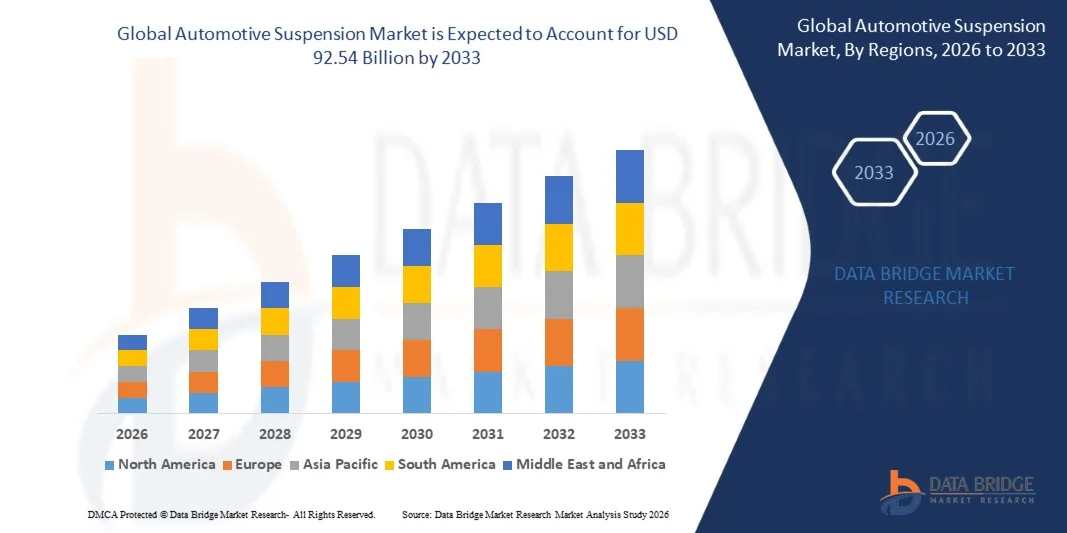
The Automotive Suspension Market was valued at USD 66.08 Billion in 2025 and is projected to reach USD 92.54 Billion by 2033, growing at a CAGR of 4.3% from 2026 to 2033. The market is experiencing consistent growth driven by increasing global vehicle production, rising demand for enhanced ride comfort and vehicle stability, and growing adoption of advanced suspension technologies across passenger and commercial vehicles. Expanding integration of electronic suspension systems, lightweight suspension components, and adaptive ride control technologies is further supporting market expansion across developed and emerging automotive markets.
The increasing global focus on vehicle safety, driving comfort, and fuel efficiency, combined with rapid advancements in electric and autonomous mobility technologies, is compelling automakers to adopt intelligent suspension systems across modern vehicle platforms. Advanced suspension solutions are increasingly replacing conventional mechanical systems to improve vehicle handling, reduce vibration, and enhance passenger experience under varying road conditions. Rising production of electric vehicles, premium SUVs, and high-performance mobility platforms is further accelerating demand for electronically controlled and active suspension technologies worldwide.
Key Market Trends & Insights
- Asia-Pacific dominated the Automotive Suspension Market with the largest revenue share of 49.46% in 2025, supported by high automobile production volumes, expanding vehicle ownership, and strong manufacturing capabilities across passenger and commercial vehicle segments
- The passive suspension segment led the market with a 64.82% share in 2025, driven by its affordability, simple mechanical design, and widespread deployment across mass-market vehicles
- North America is expected to be the fastest-growing region at a CAGR of 13.5% from 2026 to 2033, fueled by increasing demand for advanced suspension technologies in electric vehicles, pickup trucks, and premium SUVs
- Air spring are the fastest-growing component type, projected to register a CAGR of 9.72% from 2026 to 2033, supported by rising adoption of air-based suspension technologies in premium vehicles and commercial transportation fleets
- The passenger car segment dominated the vehicle type category with a 59.42% revenue share in 2025, led by high global passenger vehicle production volumes and increasing consumer demand for enhanced ride comfort and driving stability
- Independent segment accounted for 56.2% of the market in 2025, preferred by its superior ride comfort, vehicle stability, and enhanced wheel movement control compared to conventional suspension layouts
- The active suspension segment is the fastest-growing system category, with a CAGR of 9.24% from 2026 to 2033, driven by increasing integration of advanced driver assistance systems and electronically controlled vehicle dynamics technologies
Market Size & Forecast
- Global Market Value (2025): USD 66.08 Billion
- Expected Market Value (2033): USD 92.54 Billion
- Forecast CAGR (2026–2033): 4.3%
- Leading Region in 2025: Asia-Pacific
- Fastest Growing Region: North America
Report Scope and Automotive Suspension Market Segmentation
|
Attributes |
Automotive Suspension Key Market Insights |
|
Segments Covered |
|
|
Countries Covered |
North America · U.S. · Canada · Mexico Europe · Germany · France · U.K. · Netherlands · Switzerland · Belgium · Russia · Italy · Spain · Turkey · Rest of Europe Asia-Pacific · China · Japan · India · South Korea · Singapore · Malaysia · Australia · Thailand · Indonesia · Philippines · Rest of Asia-Pacific Middle East and Africa · Saudi Arabia · U.A.E. · South Africa · Egypt · Israel · Rest of Middle East and Africa South America · Brazil · Argentina · Rest of South America |
|
Key Market Players |
· KYB Americas Corporation (U.S.) · Hendrickson USA, L.L.C (U.S.) · ANAND Group (India) · FOX Factory, Inc. (U.S.) · BWI Group (China) · Tenneco Inc (U.S.) · Continental AG (Germany) · Parker Hannifin Corp (U.S.) · Sogefi SpA (Italy) · HYUNDAI MOBIS (South Korea) · ZF Friedrichshafen AG (Germany) · Hitachi Astemo (Japan) · Magneti Marelli S.p.A. (Italy) |
|
Market Opportunities |
· Growing Adoption of Suspension Systems in Electric Vehicles · Expansion of Smart and Software-Defined Vehicle Architectures · Increasing Demand for Lightweight Suspension Components in Fuel-Efficient Vehicles |
|
Value Added Data Infosets |
In addition to the market insights such as market value, growth rate, market segments, geographical coverage, market players, and market scenario, the market report curated by the Data Bridge Market Research team includes in-depth expert analysis, import/export analysis, pricing analysis, production consumption analysis, and pestle analysis. |
Automotive Suspension Market Trends
Trend: Rising Integration of Active and Adaptive Suspension Systems
Automotive manufacturers are increasingly integrating active and adaptive suspension systems to improve ride comfort, vehicle stability, and driving performance across passenger and commercial vehicles. Electronically controlled suspension technologies are gaining strong adoption in premium vehicles, electric vehicles, and performance-oriented mobility platforms due to their ability to automatically adjust damping and ride characteristics based on road conditions. Advancements in intelligent chassis systems, sensor technologies, and software-defined vehicle architectures are further accelerating adoption across global automotive markets.
Companies such as ZF Friedrichshafen AG and Continental AG are actively developing advanced active suspension and electronic damping technologies to enhance vehicle dynamics, passenger comfort, and autonomous driving capabilities across next-generation vehicles.
Automotive Suspension Market Dynamics
Key Market Driver: Increasing Global Demand for Enhanced Ride Comfort and Vehicle Stability
The growing consumer preference for improved ride quality, handling precision, and vehicle safety is significantly driving demand for advanced automotive suspension systems. Automakers are increasingly adopting lightweight and electronically controlled suspension technologies to improve driving comfort, reduce vibration, and enhance overall vehicle stability under varying road conditions. Rising production of SUVs, luxury vehicles, and electric vehicles is further accelerating integration of intelligent suspension architectures across global automotive markets.
Major companies such as Tenneco Inc, HYUNDAI MOBIS, and KYB Americas Corporation are expanding development of adaptive damping systems, lightweight suspension modules, and electronically controlled ride technologies to support growing demand for advanced mobility solutions.
Key Restraint/Challenge: High Cost of Advanced Suspension Systems
A major challenge in the Automotive Suspension market is the high cost associated with advanced suspension technologies including active suspension, air suspension, and electronically controlled damping systems. These systems require sophisticated sensors, actuators, electronic control units, and software integration, which significantly increase manufacturing and maintenance costs compared to conventional suspension solutions. High integration complexity and rising raw material costs are further impacting affordability, particularly across entry-level and mid-range vehicle segments.
The January 2025 acquisition of Öhlins Racing by Brembo highlights increasing industry investment in premium ride control and adaptive suspension technologies, while also reflecting the high development expenditure associated with next-generation chassis systems.
Key Market Opportunity: Growing Adoption of Suspension Systems in Electric Vehicles
The rapid expansion of electric vehicle production is creating significant growth opportunities for the Automotive Suspension market. Electric vehicles require advanced suspension systems capable of supporting heavy battery loads, improving ride stability, and enhancing energy efficiency through lightweight vehicle architectures. Increasing focus on premium ride quality and intelligent vehicle control in electric mobility platforms is accelerating adoption of adaptive and active suspension technologies globally. Advancements in lightweight materials, smart damping systems, and integrated chassis electronics are further improving suspension performance for electric vehicles.
Companies such as Hitachi Astemo, BWI Group, and FOX Factory, Inc. are actively investing in next-generation suspension technologies designed specifically for electric and intelligent mobility platforms, supporting long-term market expansion across the global EV industry.
Automotive Suspension Market Scope
The automotive suspension market is segmented on the basis of architecture, geometry, system, component, and vehicle type.
- By Architecture
On the basis of architecture, the Automotive Suspension Market is segmented into Macpherson Strut, Double Wishbone, Multilink Suspension, Twist Beam/Torsion Beam Suspension, Leaf Spring Suspension, and Air Suspension. The Macpherson Strut segment dominated the market with the largest share of 42.32% in 2025, driven by its compact design, lightweight structure, and cost-efficient integration across high-volume passenger vehicles. Automakers increasingly prefer Macpherson strut systems due to their simplified assembly process and lower manufacturing costs while maintaining adequate ride comfort and handling stability. The architecture supports improved fuel efficiency through weight reduction, which aligns with rising vehicle efficiency standards globally. Strong adoption across entry-level and mid-range passenger cars in Asia-Pacific and Europe further strengthens segment expansion. Continuous advancements in suspension tuning and material optimization continue to reinforce its dominant market position.
The Air Suspension segment is projected to register the fastest growth at a CAGR of 8.5% from 2026 to 2033, driven by increasing consumer demand for premium ride comfort, adaptive vehicle dynamics, and luxury vehicle features. Rising integration of electronically controlled suspension systems in electric and high-performance vehicles is accelerating segment adoption across developed automotive markets. Air suspension systems provide enhanced load balancing, adjustable ride height, and improved vibration isolation, which significantly improves driving performance and passenger comfort. Advancements in lightweight compressors, air springs, and intelligent suspension control modules are improving reliability and operational efficiency. Growing deployment across luxury SUVs, commercial fleets, and electric mobility platforms is further supporting rapid market growth.
- By Geometry
On the basis of geometry, the Automotive Suspension Market is segmented into Dependent, Semi-Independent, and Independent. The Independent segment dominated the market with a share of 56.2% in 2025, supported by its superior ride comfort, vehicle stability, and enhanced wheel movement control compared to conventional suspension layouts. Independent suspension systems allow each wheel to react separately to road conditions, which improves traction, handling precision, and passenger comfort across varying terrains. Increasing adoption in passenger cars, SUVs, and premium electric vehicles is significantly contributing to segment dominance. Automakers continue integrating advanced independent suspension configurations to improve driving dynamics and safety performance. Rising consumer preference for smoother driving experiences and enhanced vehicle maneuverability further strengthens segment leadership.
The Semi-Independent segment is projected to register the fastest growth at a CAGR of 8.1% from 2026 to 2033, driven by rising demand for cost-effective suspension systems that balance ride comfort and manufacturing efficiency. Semi-independent geometries are increasingly adopted in compact and mid-sized passenger vehicles due to their lightweight structure and reduced production complexity. The system offers improved space utilization and fuel economy benefits, making it suitable for modern urban mobility platforms. Advancements in torsion beam technology and chassis integration are further enhancing vehicle handling and durability. Expanding production of affordable passenger vehicles in emerging economies continues to accelerate market penetration.
- By System
On the basis of system, the Automotive Suspension Market is segmented into Passive Suspension, Semi-Active Suspension, and Active Suspension. The Passive Suspension segment dominated the market with the largest share of 64.82% in 2025, driven by its affordability, simple mechanical design, and widespread deployment across mass-market vehicles. Passive systems continue to remain highly preferred due to their low maintenance requirements and reliable performance under diverse driving conditions. The segment benefits from extensive adoption in passenger cars, light commercial vehicles, and two-wheelers where cost optimization remains a major purchasing factor. Manufacturers continue enhancing passive suspension efficiency through improved damping materials and optimized spring configurations. Strong global automotive production volumes continue supporting sustained segment dominance.
The Active Suspension segment is projected to register the fastest growth at a CAGR of 9.24% from 2026 to 2033, driven by increasing integration of advanced driver assistance systems and electronically controlled vehicle dynamics technologies. Active suspension systems continuously adjust damping and ride characteristics in real time, improving stability, safety, and passenger comfort. Rising production of luxury vehicles, autonomous mobility platforms, and premium electric vehicles is significantly accelerating adoption. Technological advancements in sensors, actuators, and vehicle control software are improving system responsiveness and energy efficiency. Growing consumer demand for intelligent and adaptive driving experiences continues to support rapid segment expansion.
- By Component
On the basis of OE market component, the Automotive Suspension Market is segmented into Coil Spring, Leaf Spring, Air Spring, Shock Absorber, Control Arm, Rubber Bushing, Link Stabilizer/Sway Bar, Ball Joint, and Strut. The Shock Absorber segment dominated the market with a share of 40.71% in 2025, supported by its essential role in maintaining ride stability, vibration control, and passenger comfort across all vehicle categories. Shock absorbers are extensively integrated into modern suspension systems to minimize road impact and improve tire-road contact during vehicle operation. Increasing vehicle production and replacement demand from OEM assembly lines continue driving segment expansion globally. Manufacturers are introducing advanced gas-filled and electronically adjustable shock absorbers to improve damping performance and vehicle handling. Rising demand for improved ride quality and safety performance further strengthens market leadership.
The Air Spring segment is projected to register the fastest growth at a CAGR of 9.72% from 2026 to 2033, driven by rising adoption of air-based suspension technologies in premium vehicles and commercial transportation fleets. Air springs provide superior load management, ride comfort, and suspension flexibility compared to traditional mechanical spring systems. Growing demand for luxury SUVs, electric vehicles, and heavy-duty commercial vehicles is significantly accelerating segment deployment. Technological advancements in durable elastomer materials and smart air pressure management systems are improving operational efficiency and lifespan. Increasing focus on driver comfort and cargo protection in commercial mobility applications further supports strong market growth.
- By Vehicle Type
On the basis of vehicle type, the Automotive Suspension Market is segmented into Passenger Car, Light Commercial Vehicle (LCV), Truck, Bus, and Two Wheeler. The Passenger Car segment dominated the market with the largest share of 59.42% in 2025, driven by high global passenger vehicle production volumes and increasing consumer demand for enhanced ride comfort and driving stability. Automakers continue integrating advanced suspension technologies across compact, sedan, SUV, and electric passenger car models to improve handling and passenger experience. Rising urbanization, disposable income growth, and expanding vehicle ownership rates are significantly supporting segment expansion worldwide. Increasing demand for fuel-efficient and lightweight suspension architectures is further enhancing adoption across passenger mobility platforms. Strong growth of electric passenger vehicles continues reinforcing segment leadership.
The Light Commercial Vehicle (LCV) segment is projected to register the fastest growth at a CAGR of 7.21% from 2026 to 2033, driven by rapid expansion of e-commerce logistics, urban delivery networks, and last-mile transportation services. LCV manufacturers are increasingly focusing on advanced suspension systems that improve load-bearing efficiency, ride comfort, and operational durability. Growing fleet modernization initiatives and rising adoption of electric delivery vans are significantly accelerating segment growth. Technological advancements in lightweight suspension components and adaptive load management systems are improving vehicle efficiency and maintenance performance. Increasing commercial transportation demand across emerging economies continues to support strong market expansion.
Automotive Suspension Market Regional Analysis
Asia-Pacific dominated the automotive suspension market and accounted for the largest revenue share of 49.46% in 2025, supported by high automobile production volumes, expanding vehicle ownership, and strong manufacturing capabilities across passenger and commercial vehicle segments. The region benefits from the presence of major automotive OEMs, cost-efficient component manufacturing infrastructure, and increasing investments in electric mobility platforms. Rising consumer demand for improved ride comfort, vehicle safety, and fuel-efficient suspension technologies is accelerating market expansion across developing economies. Growing urbanization, expanding logistics industries, and rapid adoption of advanced vehicle technologies are further strengthening regional market growth.
China Automotive Suspension Market Insight
China held the largest share in the Asia-Pacific Automotive Suspension market in 2025, supported by its massive automotive production capacity and extensive presence of domestic and international vehicle manufacturers. The country has a well-developed automotive component ecosystem that enables large-scale manufacturing of suspension systems for passenger cars, commercial vehicles, and electric vehicles. Rising adoption of premium vehicles and intelligent suspension technologies is significantly contributing to market expansion. Strong government support for electric mobility and increasing demand for lightweight automotive components are further accelerating innovation in suspension systems. In addition, expanding exports of automotive parts and vehicles are reinforcing China’s leadership position in the global automotive suspension industry.
India Automotive Suspension Market Insight
India is witnessing the fastest growth in the Asia-Pacific region, driven by rising passenger vehicle demand, expanding commercial transportation activities, and increasing production of affordable vehicles. Growing investments in road infrastructure and rapid urban mobility development are significantly supporting demand for durable and efficient suspension systems. The country is also benefiting from rising adoption of SUVs and electric vehicles that require advanced ride stability and comfort technologies. Increasing localization of automotive component manufacturing and expansion of domestic OEM production facilities are further strengthening market growth. In addition, rising aftermarket demand for replacement suspension components is supporting long-term industry expansion.
Europe Automotive Suspension Market Insight
The Europe Automotive Suspension market is expanding steadily, supported by strong demand for premium vehicles, advanced vehicle dynamics technologies, and high-performance automotive engineering solutions. Automakers across the region are increasingly integrating adaptive and electronically controlled suspension systems to improve safety, ride comfort, and handling performance. Rising production of electric and luxury vehicles is significantly contributing to demand for lightweight and intelligent suspension architectures. Strong regulatory focus on vehicle efficiency, emission reduction, and passenger safety is further accelerating technological advancements. In addition, increasing investments in autonomous mobility and next-generation automotive platforms are supporting regional market development.
Germany Automotive Suspension Market Insight
Germany accounted for the largest share in the Europe Automotive Suspension market in 2025, driven by the strong presence of luxury automobile manufacturers and advanced automotive engineering capabilities. The country extensively utilizes advanced suspension systems across premium sedans, sports vehicles, and electric mobility platforms to improve ride precision and vehicle stability. Rising investments in intelligent chassis systems, active suspension technologies, and lightweight vehicle architectures are significantly supporting market growth. Strong research and development activities across automotive component manufacturers are further accelerating innovation in suspension technologies. In addition, increasing exports of high-performance vehicles are reinforcing Germany’s leading market position.
U.K. Automotive Suspension Market Insight
The U.K. market is supported by growing production of premium passenger vehicles, increasing adoption of electric mobility, and rising demand for advanced vehicle comfort technologies. Automotive manufacturers across the country are increasingly integrating adaptive suspension systems to improve handling efficiency and passenger experience. Growing consumer preference for SUVs and luxury vehicles is significantly supporting market expansion. The country is also witnessing rising investments in automotive research focused on lightweight materials and electronically controlled chassis systems. In addition, expansion of automotive aftermarket services and replacement component demand is contributing to steady market growth.
North America Automotive Suspension Market Insight
North America is projected to grow at the fastest CAGR of 13.5% from 2026 to 2033, driven by increasing demand for advanced suspension technologies in electric vehicles, pickup trucks, and premium SUVs. Rising consumer focus on ride comfort, vehicle safety, and off-road performance is significantly accelerating adoption of intelligent suspension systems across the region. Strong presence of automotive technology companies and increasing investments in autonomous driving platforms are further supporting market expansion. Growing utilization of active and semi-active suspension systems in luxury and commercial vehicle segments is strengthening regional demand. In addition, rapid expansion of electric commercial fleets and high-performance vehicles is contributing to long-term industry growth.
U.S. Automotive Suspension Market Insight
The U.S. accounted for the largest share in the North America Automotive Suspension market in 2025, supported by strong production and sales of SUVs, pickup trucks, luxury vehicles, and electric mobility platforms. The country benefits from extensive adoption of advanced suspension technologies designed to improve driving stability, towing capability, and passenger comfort. Rising investments in autonomous vehicle development and intelligent chassis integration are significantly supporting market growth. Increasing consumer preference for premium ride quality and performance-oriented vehicles is further accelerating adoption of adaptive suspension systems. In addition, strong aftermarket demand for performance suspension upgrades and replacement components is reinforcing the U.S. leadership position in the regional market.
Automotive Suspension Market Share
The automotive suspension industry is primarily led by well-established companies, including:
- KYB Americas Corporation (U.S.)
- Hendrickson USA, L.L.C (U.S.)
- ANAND Group (India)
- FOX Factory, Inc. (U.S.)
- BWI Group (China)
- Tenneco Inc (U.S.)
- Continental AG (Germany)
- Parker Hannifin Corp (U.S.)
- Sogefi SpA (Italy)
- HYUNDAI MOBIS (South Korea)
- ZF Friedrichshafen AG (Germany)
- Hitachi Astemo (Japan)
- Magneti Marelli S.p.A. (Italy)
Latest Developments in Automotive Suspension Market
- In January 2025, Tenneco finalized the sale of Öhlins Racing to Brembo for USD 405 million, strengthening integration between high-performance braking and adaptive suspension technologies for premium and performance vehicles. The acquisition is expected to accelerate development of intelligent chassis systems that improve ride stability, vehicle handling, and driving precision. The transaction also supports rising demand for electronically controlled suspension platforms across luxury and electric vehicle segments, further advancing innovation within the automotive suspension market
- In January 2025, Sona Comstar invested USD 4 million in ClearMotion to support commercialization of proactive suspension technologies capable of predicting and adjusting to road conditions in real time. The investment is expected to enhance development of advanced ride comfort and vehicle dynamics solutions for next-generation passenger and electric vehicles. Growing industry focus on intelligent mobility systems and premium driving experiences is likely to accelerate adoption of active suspension technologies across global automotive markets
- In October 2024, ams OSRAM showcased high-resolution position sensors designed for steer-by-wire and active suspension integration, supporting advancement of software-defined vehicle architectures and intelligent chassis control systems. The innovation is expected to improve suspension responsiveness, steering precision, and overall vehicle safety through enhanced real-time motion sensing capabilities. Increasing adoption of autonomous driving technologies and electronically controlled vehicle systems is further driving demand for advanced sensor-enabled suspension platforms across the automotive industry
- In December 2022, Magnaflow Group acquired Camburg Engineering to expand its presence in the off-road and aftermarket suspension segment through race-tested suspension components and performance upgrade solutions. The acquisition strengthened product diversification within the aftermarket automotive suspension industry while supporting rising demand for off-road vehicles and customized performance applications. Increasing consumer preference for enhanced vehicle durability, handling performance, and recreational off-road mobility continues to support growth opportunities across the aftermarket suspension market
- In December 2022, FleetPride acquired Keystone Spring Service to strengthen its commercial vehicle suspension and heavy-duty aftermarket service capabilities across North America. The acquisition enhanced FleetPride’s portfolio of suspension, wheel-end, driveline, and hydraulic component services for trucking and fleet operators. Rising demand for maintenance, repair, and replacement solutions in heavy commercial transportation is expected to support long-term expansion of the commercial automotive suspension aftermarket industry

- Interactive Data Analysis Dashboard
- Company Analysis Dashboard for high growth potential opportunities
- Research Analyst Access for customization & queries
- Competitor Analysis with Interactive dashboard
- Latest News, Updates & Trend analysis
- Harness the Power of Benchmark Analysis for Comprehensive Competitor Tracking
Data collection and base year analysis are done using data collection modules with large sample sizes. The stage includes obtaining market information or related data through various sources and strategies. It includes examining and planning all the data acquired from the past in advance. It likewise envelops the examination of information inconsistencies seen across different information sources. The market data is analysed and estimated using market statistical and coherent models. Also, market share analysis and key trend analysis are the major success factors in the market report. To know more, please request an analyst call or drop down your inquiry.
The key research methodology used by DBMR research team is data triangulation which involves data mining, analysis of the impact of data variables on the market and primary (industry expert) validation. Data models include Vendor Positioning Grid, Market Time Line Analysis, Market Overview and Guide, Company Positioning Grid, Patent Analysis, Pricing Analysis, Company Market Share Analysis, Standards of Measurement, Global versus Regional and Vendor Share Analysis. To know more about the research methodology, drop in an inquiry to speak to our industry experts.
Data Bridge Market Research is a leader in advanced formative research. We take pride in servicing our existing and new customers with data and analysis that match and suits their goal. The report can be customized to include price trend analysis of target brands understanding the market for additional countries (ask for the list of countries), clinical trial results data, literature review, refurbished market and product base analysis. Market analysis of target competitors can be analyzed from technology-based analysis to market portfolio strategies. We can add as many competitors that you require data about in the format and data style you are looking for. Our team of analysts can also provide you data in crude raw excel files pivot tables (Fact book) or can assist you in creating presentations from the data sets available in the report.













