


What is the Automotive Teen Driver Technology Market Size and Overview?
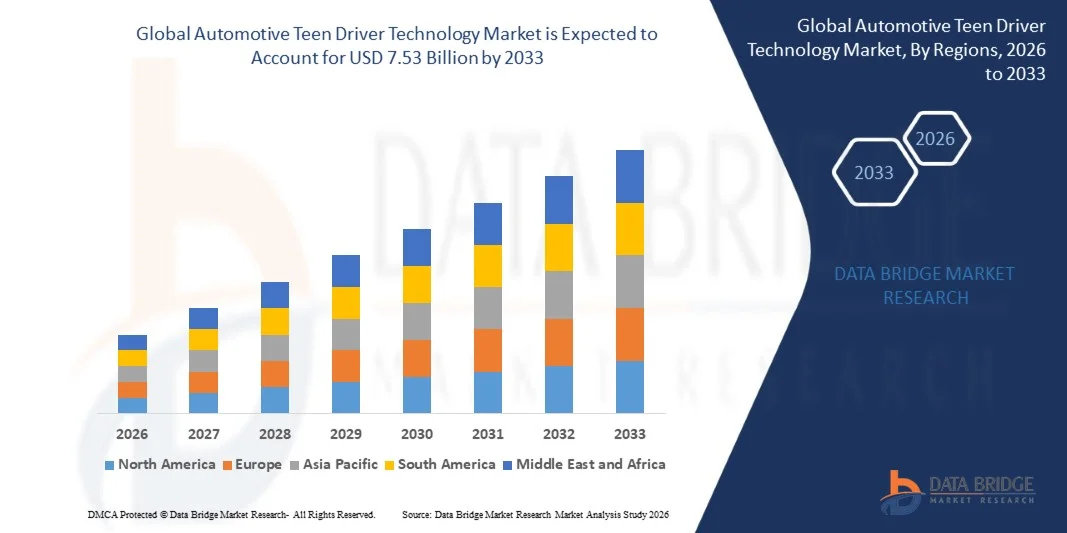
As per Data Bridge Market Research analysis, the automotive teen driver technology market was valued at USD 3.20 billion in 2025 and is projected to reach USD 7.53 billion by 2033, growing at a CAGR of 11.30% from 2026 to 2033. The market is experiencing consistent growth driven by rising demand for enhanced vehicle safety features, increasing adoption of connected vehicle technologies, growing emphasis on teen driver education tools, and the integration of advanced driver monitoring and feedback systems.
The increasing focus on reducing road accidents involving young drivers, combined with rising adoption of parental monitoring systems and advanced automotive safety technologies, is encouraging automakers and technology providers to develop solutions such as distracted driving prevention, speed limit monitoring, teen driver feedback systems, and emergency response assistance. Driver assistance systems, telematics, and in-vehicle communication technologies are increasingly being integrated into vehicles to provide real-time driving insights, improve safety awareness, and support responsible driving behavior among teenage drivers.
Market Size & Forecast
- Global Market Value (2025): USD 3.20 Billion
- Expected Market Value (2033): USD 7.53 Billion
- Forecast CAGR (2026–2033): 11.30%
- Leading Region in 2025: North America
- Fastest Growing Region: Asia-Pacific
Key Market Trends & Insights
- North America dominated the automotive teen driver technology market with 45.0% of the market share in 2025, supported by the strong presence of leading automotive manufacturers, widespread adoption of connected vehicle technologies, and increasing implementation of advanced teen driver safety solutions
- The driver assistance systems segment led the market with a 38.5% share in 2025, driven by increasing integration of collision avoidance systems, lane departure warning, automatic emergency braking, and adaptive cruise control technologies in vehicles used by young drivers
- Asia-Pacific is expected to be the fastest-growing region at a CAGR of 9.2% from 2026 to 2033, fueled by rising vehicle ownership, increasing road safety awareness, expanding automotive technology adoption, and growing demand for connected vehicle solutions across emerging economies
- Telematics are the fastest-growing technology type, projected to register a CAGR of 13.2%, reflecting the surge in demand for real-time vehicle tracking, driver behavior analytics, geofencing, and parental monitoring solutions
- The passenger vehicles segment dominated the vehicle type category with a 56.4% revenue share in 2025, led by the large number of teenage drivers using passenger cars as their primary mode of transportation
- Distracted driving prevention accounted for 34.7% of the market, preferred by increasing concerns regarding smartphone usage, texting while driving, and other forms of distraction among teen drivers
- The teen driver feedback systems segment is the fastest-growing feature set category, with a CAGR of 13.5%, driven by increasing demand for personalized driving assessments and behavior-based coaching solutions
Report Scope and Automotive Teen Driver Technology Market Segmentation
|
Attributes |
Automotive Teen Driver Technology Key Market Insights |
|
Segments Covered |
|
|
Countries Covered |
North America
Europe
Asia-Pacific
Middle East and Africa
South America
|
|
Key Market Players |
|
|
Market Opportunities |
|
|
Value Added Data Infosets |
In addition to the market insights such as market value, growth rate, market segments, geographical coverage, market players, and market scenario, the market report curated by the Data Bridge Market Research team includes in-depth expert analysis, import/export analysis, pricing analysis, production consumption analysis, and pestle analysis. |
What is the Key Trend in the Automotive Teen Driver Technology Market?
Trend: Rising Integration of Connected Driver Monitoring and Parental Control Technologies
Automotive manufacturers are increasingly integrating connected teen driver technologies that combine driver monitoring, speed alerts, geofencing, seat belt reminders, and smartphone-based parental notifications to improve young driver safety. The adoption of telematics, in-vehicle connectivity, and ADAS is enabling continuous monitoring of driving behavior while providing actionable feedback to both drivers and parents. Vehicle manufacturers are also embedding configurable teen driver modes that support safer driving habits through speed management, distraction reduction, and personalized safety settings, strengthening the role of connected safety ecosystems in modern passenger vehicles. For instance, in October 2024, during National Teen Driver Safety Week, General Motors highlighted the expansion of its Teen Driver technology across Chevrolet, Cadillac, Buick, and GMC models, offering configurable speed alerts, audio volume limits, seat belt reminders, Buckle to Drive, and the industry's only in-vehicle Teen Driver Report Card to help parents coach safer driving habits.
Growing integration of connected monitoring, parental controls, and ADAS features is transforming teen driver technology into a core vehicle safety differentiator.
Automotive Teen Driver Technology Market Dynamics
Key Market Driver: Increasing Demand for Advanced Driver Assistance and Teen-Specific Safety Technologies
The increasing focus on reducing crashes involving novice drivers is accelerating adoption of advanced driver assistance systems and teen-specific vehicle technologies that address speeding, distraction, lane departures, and seat belt compliance. Automakers are integrating collision avoidance systems with parental monitoring capabilities to provide real-time driver feedback, improve hazard awareness, and support safer driving behavior. Growing regulatory emphasis on road safety and consumer demand for connected vehicle features are further encouraging manufacturers to expand teen driver safety technologies across new vehicle platforms. For instance, in September 2021, the Insurance Institute for Highway Safety (IIHS) reported that crash avoidance features combined with teen-driver-specific technologies have the potential to prevent or mitigate 78% of teen driver fatalities, 47% of injuries, and 41% of crashes, demonstrating the substantial safety benefits of integrating advanced driver assistance systems with teen-focused safety features.
Proven safety benefits are driving broader deployment of integrated ADAS and teen-specific technologies across passenger vehicles.
Key Restraint/Challenge: Privacy Concerns and Limited Adoption of Continuous Driver Monitoring
A major challenge for the automotive teen driver technology market is balancing continuous driver monitoring with user privacy, parental acceptance, and driver trust. While connected safety technologies provide valuable insights into driving behavior, concerns regarding data collection, privacy, and acceptance may limit widespread adoption. Achieving an effective balance between safety monitoring and user confidence remains critical for broader deployment of connected teen driver solutions across different vehicle segments. For instance, in May 2025, researchers published the study “Evaluating Driver Perceptions of Integrated Safety Monitoring Systems for Alcohol Impairment and Distraction”, which found that privacy, transparency, trust, and perceived usefulness significantly influence driver acceptance of in-vehicle monitoring technologies, highlighting key barriers to broader adoption despite their recognized safety benefits.
Addressing privacy and trust concerns will be essential for accelerating long-term adoption of connected teen driver technologies.
Key Market Opportunity: Expansion of Connected Telematics and AI-Based Driver Coaching Platforms
The expansion of connected telematics, AI-enabled driver coaching, and real-time behavioral analytics presents a significant opportunity for the automotive teen driver technology market. Cloud-connected platforms can deliver personalized driving feedback, detect risky behaviors, and support continuous driver improvement while enabling parents and fleet operators to remotely monitor vehicle usage. Increasing integration of AI, smartphone connectivity, and predictive safety analytics is creating new opportunities for automakers and technology providers to deliver intelligent, data-driven teen driver safety solutions. For instance, in March 2025, researchers published the systematic article “Driving Education Advancements of Novice Drivers: A Systematic Literature Review”, which found that technology-enhanced driver education approaches, including simulator-based training, digital feedback systems, and advanced learning platforms, improved hazard anticipation, attention management, and adherence to safe driving practices among novice drivers.
AI-powered coaching and connected telematics platforms are expected to become key growth opportunities as demand for intelligent teen driver safety solutions continues to increase.
How is the Automotive Teen Driver Technology Market Segmented?
The automotive teen driver technology market is segmented on the basis of technology, vehicle type, feature set, and end user.
- By Technology
On the basis of technology, the automotive teen driver technology market is segmented into driver assistance systems, telematics, in-vehicle communication systems, and navigation systems. The driver assistance systems segment dominated the market with an estimated 38.5% share in 2025, driven by increasing integration of collision avoidance systems, lane departure warning, automatic emergency braking, and adaptive cruise control technologies in vehicles used by young drivers. These technologies help reduce accident risks associated with driver inexperience and distraction. Automakers are increasingly incorporating ADAS features into mainstream vehicle models to improve safety performance and comply with evolving safety standards. Growing consumer awareness regarding teen driver protection is further supporting adoption. Integration with connected vehicle platforms enables real-time monitoring and driver feedback. Continuous advancements in vehicle automation and safety technologies continue to strengthen the segment's leadership position globally.
The telematics segment is expected to witness the fastest growth at an estimated CAGR of 13.2% from 2026 to 2033, driven by rising demand for real-time vehicle tracking, driver behavior analytics, geofencing, and parental monitoring solutions. Telematics platforms provide detailed insights into speeding, harsh braking, rapid acceleration, and distracted driving events. Rising adoption of connected vehicles is creating favorable conditions for deployment across developed and emerging markets. Cloud-based analytics and smartphone integration are enhancing accessibility and functionality. Insurance providers are increasingly utilizing telematics data for usage-based insurance programs and risk assessment. Growing demand for data-driven safety management and personalized driver coaching is expected to accelerate future growth.
- By Vehicle Type
On the basis of vehicle type, the automotive teen driver technology market is segmented into passenger vehicles, SUVs, trucks, and motorcycles. The passenger vehicles segment dominated the market with an estimated 56.4% share in 2025, driven by the large number of teenage drivers using passenger cars as their primary mode of transportation. Automotive manufacturers are increasingly integrating teen driver technologies such as speed alerts, seat belt reminders, driving report cards, and parental control systems into passenger vehicles. Rising consumer demand for enhanced vehicle safety is supporting broader adoption of these technologies. Passenger vehicles also represent the largest installed base for connected vehicle and telematics solutions. Growing penetration of ADAS technologies further strengthens demand within this category. Continuous innovation in connected mobility and safety systems is expected to maintain segment leadership throughout the forecast period.
The SUVs segment is expected to witness the fastest growth at an estimated CAGR of 12.8% from 2026 to 2033, driven by increasing consumer preference for sport utility vehicles among families with teenage drivers. SUVs are increasingly equipped with advanced safety technologies, driver monitoring systems, and connected vehicle platforms. Their larger size and perceived safety advantages are attracting family-oriented buyers seeking enhanced protection for young drivers. Automakers are actively introducing teen-driver-focused safety packages within SUV portfolios. Growing sales of connected and premium SUVs are further contributing to technology adoption. Rising awareness regarding accident prevention and vehicle safety is expected to support strong segment growth globally.
- By Feature Set
On the basis of feature set, the automotive teen driver technology market is segmented into distracted driving prevention, speed limit monitoring, teen driver feedback systems, and emergency response assistance. The distracted driving prevention segment dominated the market with an estimated 34.7% share in 2025, driven by increasing concerns regarding smartphone usage, texting while driving, and other forms of distraction among teen drivers. These solutions help identify and mitigate risky driving behaviors through alerts, monitoring systems, and intervention technologies. Governments and road safety organizations continue to emphasize distraction reduction as a critical safety priority. Automakers are increasingly integrating distraction management capabilities into connected vehicle ecosystems. Advances in artificial intelligence and driver monitoring technologies are improving effectiveness and reliability. Growing focus on accident prevention continues to strengthen demand for these solutions globally.
The teen driver feedback systems segment is expected to witness the fastest growth at an estimated CAGR of 13.5% from 2026 to 2033, driven by increasing demand for personalized driving assessments and behavior-based coaching solutions. These systems generate driving scorecards and performance reports that help teenagers improve driving habits over time. Parents benefit from enhanced visibility into driving performance and safety compliance. Integration with mobile applications is improving accessibility and user engagement. Growing emphasis on continuous driver education is supporting adoption across developed and emerging markets. Expanding use of analytics and connected technologies is expected to accelerate future growth opportunities.
- By End User
On the basis of end user, the automotive teen driver technology market is segmented into parents, teen drivers, and driving schools. The parents segment dominated the market with an estimated 51.2% share in 2024, driven by increasing demand for technologies that provide visibility into teen driving behavior and improve vehicle safety. Parents increasingly rely on monitoring tools such as location tracking, speed notifications, driving reports, and emergency alerts to encourage responsible driving habits. Rising concerns regarding road accidents involving inexperienced drivers are supporting adoption. Connected vehicle technologies allow parents to receive real-time safety information and coaching insights. Increasing awareness regarding preventive safety measures is further driving market growth. The segment continues to benefit from expanding availability of factory-installed teen driver solutions from major automotive manufacturers.
The driving schools segment is expected to witness the fastest growth at an estimated CAGR of 12.6% from 2025 to 2035, driven by increasing adoption of technology-enabled driver education programs and digital safety training platforms. Driving schools are incorporating telematics, driver monitoring systems, and performance analytics to improve training effectiveness. Advanced technologies allow instructors to evaluate driving behavior more accurately and provide targeted feedback. Growing demand for structured driver education programs is supporting technology integration. Regulatory emphasis on road safety education is further contributing to growth. Increasing use of connected learning platforms is expected to create substantial opportunities for this segment over the coming years.
Which Region Holds the Largest Share of the Automotive Teen Driver Technology Market?
North America dominated the automotive teen driver technology market with 45.0% of the market share in 2025, supported by the strong presence of leading automotive manufacturers, widespread adoption of connected vehicle technologies, and increasing implementation of advanced teen driver safety solutions. The region also benefits from widespread deployment of telematics, driver assistance systems, and parental monitoring technologies designed to improve driving behavior among young drivers. Growing emphasis on reducing road accidents involving novice drivers, together with increasing implementation of vehicle safety regulations and driver education initiatives, is accelerating market development. Rising adoption of data-driven safety solutions, real-time driver monitoring systems, and connected mobility platforms continues to strengthen North America's leadership position in the global market.
U.S. Automotive Teen Driver Technology Market Insight
The U.S. automotive teen driver technology market is witnessing strong growth due to rising investments in vehicle safety technologies, connected mobility platforms, and advanced driver assistance systems designed to reduce accidents involving young drivers. The country's mature automotive ecosystem, combined with increasing adoption of telematics, parental monitoring systems, and driver behavior analytics, is driving demand across passenger vehicle segments. In addition, growing emphasis on road safety education and accident prevention is accelerating technology adoption among automakers and consumers. According to the U.S. Centers for Disease Control and Prevention (CDC), approximately 2,883 teenagers aged 13–19 years were killed and about 227,000 were injured in motor vehicle crashes in the United States in 2023, highlighting the continued need for advanced teen driver safety technologies and monitoring solutions.
Europe Automotive Teen Driver Technology Market Insight
The Europe automotive teen driver technology market remains a major contributor to global revenue, driven by strong vehicle safety regulations, technological innovation, and increasing adoption of connected vehicle solutions. The widespread integration of advanced driver assistance systems, telematics platforms, and vehicle monitoring technologies is supporting market expansion across the region. Increasing investments in road safety initiatives, coupled with growing consumer awareness regarding accident prevention, continue to enhance adoption of teen driver technologies. According to the European Commission, around 19,800 people were killed in road crashes across the European Union in 2024, representing a 3% decrease compared with 2023, reflecting continued regulatory focus on vehicle safety technologies and accident reduction measures across member states.
U.K. Automotive Teen Driver Technology Market Insight
The U.K. automotive teen driver technology market is experiencing steady growth, supported by increasing adoption of telematics-based insurance solutions, connected vehicle technologies, and advanced driver safety systems. Rising investments in digital mobility infrastructure and growing demand for behavior-based driving assessment tools are contributing to market growth. Furthermore, integration of smartphone-connected monitoring systems and AI-enabled safety analytics is improving driver coaching and risk management capabilities. According to the U.K. Department for Transport, reported road casualties totaled 128,920 in 2023, highlighting the continued importance of technologies that support safer driving behavior and accident prevention.
Germany Automotive Teen Driver Technology Market Insight
The Germany automotive teen driver technology market is expanding steadily due to the country's strong automotive manufacturing base, advanced research capabilities, and increasing adoption of next-generation vehicle safety technologies. Automotive companies are increasingly integrating ADAS, connected vehicle platforms, and driver monitoring systems into passenger vehicles. Continuous advancements in vehicle automation, telematics, and predictive safety analytics are further supporting market growth. According to the Federal Statistical Office of Germany (Destatis), around 2,780 people lost their lives in road traffic accidents in Germany during 2024, reinforcing demand for technologies that improve driver awareness and reduce crash risks.
Asia-Pacific Automotive Teen Driver Technology Market Insight
The Asia-Pacific automotive teen driver technology market is expected to witness rapid growth, driven by increasing vehicle ownership, expanding automotive production, and rising investments in connected vehicle infrastructure across countries such as China, India, and Japan. Growing awareness regarding road safety, increasing adoption of telematics solutions, and rising demand for advanced vehicle monitoring technologies are supporting regional market expansion. In addition, the growing presence of automotive innovation centers and connected mobility initiatives is accelerating technology adoption. According to the World Health Organization, the Asia-Pacific region continues to account for a significant share of global road traffic fatalities, driving government and industry focus on advanced vehicle safety and driver monitoring solutions.
Japan Automotive Teen Driver Technology Market Insight
The Japan automotive teen driver technology market is witnessing consistent growth due to rising investments in advanced vehicle safety technologies, connected mobility platforms, and road safety initiatives. Automotive manufacturers and technology providers are increasingly adopting driver monitoring systems, telematics solutions, and ADAS technologies to improve driver awareness and reduce accident risks. Moreover, increasing integration of artificial intelligence and connected vehicle technologies is further contributing to market growth. According to the Ministry of Land, Infrastructure, Transport and Tourism (MLIT), Japan aims to reduce road traffic fatalities to fewer than 2,000 by 2030 under its 11th Fundamental Traffic Safety Program, reflecting the country's sustained focus on road safety, intelligent transportation systems, and advanced vehicle safety technologies.
China Automotive Teen Driver Technology Market Insight
The China automotive teen driver technology market is growing rapidly, driven by increasing vehicle ownership, expanding transportation infrastructure, and rising government focus on intelligent transportation systems and road safety. Growing adoption of connected vehicle platforms, telematics technologies, and AI-enabled driver monitoring systems is significantly boosting market demand. In addition, rising investments in automotive digitalization and advanced mobility solutions are positioning China as one of the fastest-growing markets for automotive safety technologies. According to China's Ministry of Public Security, the country had more than 353 million motor vehicles on the road, creating substantial opportunities for connected safety technologies, driver monitoring solutions, and vehicle telematics platforms.
Which are the Top Companies in Automotive Teen Driver Technology Market?
The automotive teen driver technology industry is primarily led by well-established companies, including:
- General Motors (U.S.)
- Ford Motor Company (U.S.)
- TOYOTA MOTOR CORPORATION (Japan)
- Hyundai Motor (South Korea)
- Kia Corporation (South Korea)
- Volvo Car Corporation (Sweden)
- Robert Bosch GmbH (Germany)
- Continental AG (Germany)
- DENSO CORPORATION (Japan)
- Aptiv PLC (Ireland)
- Magna International Inc. (Canada)
- Valeo (France)
- Mobileye Global Inc. (Israel)
- Seeing Machines Limited (Australia)
- Smart Eye AB (Sweden)
- Geotab Inc. (Canada)
- Samsara Inc. (U.S.)
- Nauto (U.S.)
- Trimble Inc. (U.S.)
- Garmin Ltd. (Switzerland)
What are Latest Developments in Automotive Teen Driver Technology Market?
- In October 2024, General Motors announced the continued rollout of its Teen Driver technology across Chevrolet, Buick, GMC, and Cadillac models. The system includes Buckle to Drive, configurable speed alerts, audio volume limits, automatic activation of safety features, and the industry's first in-vehicle Teen Driver Report Card, enabling parents to monitor and coach young drivers. This expansion strengthens GM's connected safety portfolio for novice drivers
- In February 2024, Volvo Cars introduced Accident Ahead Alert, a connected safety feature that provides real-time warnings of accidents ahead using traffic management center data. The technology helps drivers react earlier to hazards and represents a major advancement in connected vehicle safety, supporting safer driving for inexperienced and young drivers
- In January 2023, HARMAN, a subsidiary of Samsung Electronics, announced the expansion of its Ready Care platform with new driver monitoring capabilities, including contactless vital sign sensing, radar-based child presence detection, cognitive distraction monitoring, and AI-driven personalized interventions. The enhanced platform helps detect distracted and drowsy driving while providing tailored in-cabin responses to improve driver safety, supporting the evolution of intelligent safety technologies for young and novice drivers
- In February 2022, Magna International announced its industry-first Integrated Driver and Occupant Monitoring System, combining high-resolution camera, infrared emitters, and electronics within the interior rear-view mirror. The system detects distracted driving, drowsiness, fatigue, and occupant presence while supporting future Euro NCAP and General Safety Regulation requirements
- In November 2021, General Motors expanded availability of its Buckle to Drive safety feature across additional Chevrolet, GMC, Buick, and Cadillac vehicles. Working alongside Teen Driver mode, the feature prevents shifting out of Park until the driver's seat belt is fastened, helping establish safer driving habits among novice drivers and reinforcing occupant safety

- Interactive Data Analysis Dashboard
- Company Analysis Dashboard for high growth potential opportunities
- Research Analyst Access for customization & queries
- Competitor Analysis with Interactive dashboard
- Latest News, Updates & Trend analysis
- Harness the Power of Benchmark Analysis for Comprehensive Competitor Tracking
Data collection and base year analysis are done using data collection modules with large sample sizes. The stage includes obtaining market information or related data through various sources and strategies. It includes examining and planning all the data acquired from the past in advance. It likewise envelops the examination of information inconsistencies seen across different information sources. The market data is analysed and estimated using market statistical and coherent models. Also, market share analysis and key trend analysis are the major success factors in the market report. To know more, please request an analyst call or drop down your inquiry.
The key research methodology used by DBMR research team is data triangulation which involves data mining, analysis of the impact of data variables on the market and primary (industry expert) validation. Data models include Vendor Positioning Grid, Market Time Line Analysis, Market Overview and Guide, Company Positioning Grid, Patent Analysis, Pricing Analysis, Company Market Share Analysis, Standards of Measurement, Global versus Regional and Vendor Share Analysis. To know more about the research methodology, drop in an inquiry to speak to our industry experts.
Data Bridge Market Research is a leader in advanced formative research. We take pride in servicing our existing and new customers with data and analysis that match and suits their goal. The report can be customized to include price trend analysis of target brands understanding the market for additional countries (ask for the list of countries), clinical trial results data, literature review, refurbished market and product base analysis. Market analysis of target competitors can be analyzed from technology-based analysis to market portfolio strategies. We can add as many competitors that you require data about in the format and data style you are looking for. Our team of analysts can also provide you data in crude raw excel files pivot tables (Fact book) or can assist you in creating presentations from the data sets available in the report.













