


Automotive Terminal Market Size
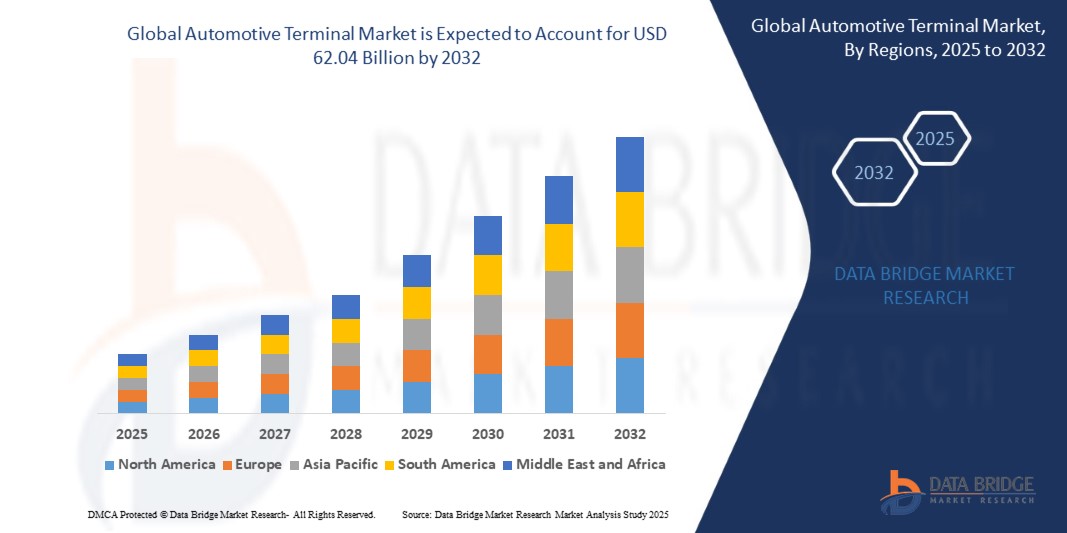
- The Global Automotive Terminal Market size was valued at USD 27.87 billion in 2024 and is expected to reach USD 62.04 billion by 2032, at a CAGR of 10.52% during the forecast period
- This growth is predominantly driven by the increasing complexity of electronic architectures in modern vehicles, including the integration of advanced driver assistance systems (ADAS), infotainment systems, and electric drivetrain components, all of which require robust and reliable terminal connectivity solutions.
- Furthermore, the shift toward electric vehicles (EVs) and hybrid vehicles is significantly contributing to market expansion, as EVs demand high-performance terminals to manage higher voltages, efficient current distribution, and ensure safety compliance.
Automotive Terminal Market Analysis
- Automotive terminals, critical connectors within a vehicle’s electrical and electronic architecture, are increasingly vital components in modern automobiles due to their role in ensuring secure and efficient electrical signal and power transmission across systems. These terminals are widely used in powertrains, safety systems, infotainment units, lighting, HVAC, and battery management systems.
- The escalating demand for automotive terminals is primarily fueled by the surge in electric and hybrid vehicle production, rising electronic content per vehicle, and advancements in connected and autonomous vehicle technologies. As vehicles become more software-defined and data-intensive, the need for reliable, high-performance terminals that ensure seamless connectivity and power distribution becomes paramount.
- Additionally, global safety and emission regulations are driving OEMs to integrate more sensors and electronic control units (ECUs), which in turn boosts demand for terminals in automotive wiring harnesses and module interconnections.
- North America dominates the Automotive Terminal Market with the largest revenue share of 37.17% in 2024, driven by strong consumer adoption of smart home and connected devices alongside growing awareness about home security solutions.
- The Asia-Pacific region is poised to grow at the fastest CAGR of 14.5% between 2025 and 2032, driven by rapid urbanization, rising middle-class incomes, and technological advances in countries like China, India, and Japan.
- The below 40 ampere segment dominates the market, as it covers most standard automotive applications with lower power requirements. However, the above 100 ampere segment is forecasted to grow rapidly owing to the increasing electrification of vehicles, particularly electric and hybrid vehicles, which demand terminals capable of handling high current loads safely and efficiently.
Report Scope and Automotive Terminal Market Segmentation
|
Attributes |
Automotive Terminal Key Market Insights |
|
Segments Covered |
|
|
Countries Covered |
North America
Europe
Asia-Pacific
Middle East and Africa
South America
|
|
Key Market Players |
|
|
Market Opportunities |
|
|
Value Added Data Infosets |
In addition to the insights on market scenarios such as market value, growth rate, segmentation, geographical coverage, and major players, the market reports curated by the Data Bridge Market Research also include in-depth expert analysis, pricing analysis, brand share analysis, consumer survey, demography analysis, supply chain analysis, value chain analysis, raw material/consumables overview, vendor selection criteria, PESTLE Analysis, Porter Analysis, and regulatory framework. |
Automotive Terminal Market Trends
“Rising Demand for Smart Home Integration and Enhanced Vehicle Connectivity”
- The growing consumer preference for connected vehicles and smart home ecosystems is a key driver for the Automotive Terminal Market. Automotive Terminals that offer seamless integration with smartphones, voice assistants, and other IoT devices provide enhanced convenience, security, and remote access capabilities, making them highly attractive to tech-savvy users.
- For instance, companies like TE Connectivity and Molex are developing terminals that support advanced connectivity features, enabling vehicle systems to communicate more efficiently with smart infrastructure and user devices, driving market adoption.
Automotive Terminal Market Dynamics
Driver
“Increasing Safety Regulations and Electrification in Automotive Sector”
- Stricter global safety and emission regulations are pushing automakers to adopt advanced electrical systems, increasing demand for reliable and efficient automotive terminals. Additionally, the surge in electric and hybrid vehicles requires specialized terminals to manage higher voltage and current ratings, fueling market growth.
- Leading players such as Lear Corporation and PKC Group Ltd. are innovating to provide terminals suitable for electric vehicles, tapping into the rapidly expanding EV market and creating new revenue streams.
Restraint/Challenge
“Concerns Regarding Cybersecurity and High Initial Costs”
- Concerns surrounding the cybersecurity vulnerabilities of connected automotive terminals pose a significant challenge to broader market penetration. As these terminals rely on network connectivity and software, they are susceptible to hacking attempts and data breaches, raising consumer anxieties about vehicle safety and data privacy.
- Additionally, the relatively high initial cost of advanced automotive terminal systems, especially those designed for electric vehicles or integrated with smart features, can deter price-sensitive buyers, particularly in developing regions. This price barrier limits adoption despite the growing demand for smart and connected automotive components.
Automotive Terminal Market Scope
The market is segmented on the basis of on-highway vehicle, off-highway vehicle, current rating, and application.
- By On-Highway Vehicle
On the basis of on-highway vehicle, the Automotive Terminal Market is segmented into passenger car, light commercial vehicle, heavy commercial vehicle, electric vehicle, hybrid electric vehicle, and plug-in hybrid electric vehicle. The passenger car segment holds a significant share due to the high volume production of passenger vehicles globally and increasing adoption of advanced electronic systems for improved safety and convenience. The electric vehicle segment is expected to witness the fastest growth rate during the forecast period, driven by the rising demand for EVs and associated advanced electronic components, which require specialized automotive terminals to support higher electrical loads and connectivity.
- By Off-Highway Vehicle
On the basis of off-highway vehicle, the market is segmented into agriculture vehicle and construction vehicle. The agriculture vehicle segment is gaining traction due to increased mechanization and the adoption of automated control systems in farming, requiring reliable automotive terminals for enhanced operational efficiency. The construction vehicle segment also shows steady growth, supported by rising infrastructure projects worldwide and the integration of smart control systems in heavy machinery.
- By Current Rating
On the basis of current rating, the Automotive Terminal Market is segmented into below 40 ampere, 41-100 ampere, and above 100 ampere. The below 40 ampere segment dominates the market, as it covers most standard automotive applications with lower power requirements. However, the above 100 ampere segment is forecasted to grow rapidly owing to the increasing electrification of vehicles, particularly electric and hybrid vehicles, which demand terminals capable of handling high current loads safely and efficiently.
- By Application
On the basis of application, the market is segmented into cooling, engine, emission control, safety and security system, body control & interiors, infotainment, lighting system, and battery system. The safety and security system segment holds a major market share due to the increasing regulatory emphasis on vehicle safety and the incorporation of advanced driver-assistance systems (ADAS). The battery system segment is anticipated to grow at the fastest CAGR, driven by the surge in electric vehicle production and the corresponding need for high-performance electrical terminals to support battery management systems.
Automotive Terminal Market Regional Analysis
- North America dominates the Automotive Terminal Market with the largest revenue share of 37.17% in 2024, driven by strong consumer adoption of smart home and connected devices alongside growing awareness about home security solutions.
- Consumers in the region highly value the convenience, advanced security features, and seamless integration offered by automotive terminals with other smart systems such as lighting, thermostats, and security cameras.
- This adoption is further boosted by high disposable incomes, a tech-savvy population, and the widespread trend of remote monitoring and smart access control, positioning automotive terminals as a preferred solution in both residential and commercial sectors.
U.S. Automotive Terminal Market Insight
The U.S. Automotive Terminal Market holds the largest revenue share within North America at 78.43% in 2024, fueled by rapid adoption of connected devices and increasing penetration of smart home technologies. Consumers are prioritizing secure, keyless entry solutions that integrate with voice assistants like Alexa, Google Assistant, and Apple HomeKit. The trend towards DIY smart home setups and demand for smartphone-controlled access systems continues to propel growth in this market.
Europe Automotive Terminal Market Insight
Europe is expected to witness steady growth at a CAGR of around 11.34% during the forecast period, supported by strict safety regulations and growing demand for enhanced security in residential and commercial properties. Increasing urbanization and the rise in connected devices adoption are significant growth drivers. European consumers appreciate the convenience and energy efficiency that automotive terminals bring, with strong adoption in new constructions and renovation projects.
U.K. Automotive Terminal Market Insight
The U.K. market is set to grow steadily, driven by rising awareness of home automation and security. Heightened concerns around burglary and personal safety encourage homeowners and businesses to adopt keyless entry solutions. The U.K.’s mature e-commerce infrastructure and consumer readiness for connected home technologies support market expansion.
Germany Automotive Terminal Market Insight
Germany’s market is expanding at a considerable rate due to growing emphasis on digital security, eco-friendly technologies, and sustainability. German consumers favor technologically advanced and privacy-focused automotive terminals integrated within smart home systems. Well-developed infrastructure and innovation-led environment also bolster the adoption in both commercial and residential buildings.
Asia-Pacific Automotive Terminal Market Insight
The Asia-Pacific region is poised to grow at the fastest CAGR of 14.5% between 2025 and 2032, driven by rapid urbanization, rising middle-class incomes, and technological advances in countries like China, India, and Japan. Government initiatives promoting digital infrastructure and smart home adoption are significant catalysts. Furthermore, APAC’s position as a manufacturing hub ensures affordability and wider availability of automotive terminals, expanding the market reach.
Japan Automotive Terminal Market Insight
Japan’s automotive terminal market growth is propelled by the country’s tech-centric culture, increasing smart home penetration, and demand for convenience. The aging population also stimulates demand for easy-to-use, secure access solutions. Integration with other IoT devices such as security cameras and lighting systems strengthens market potential.
China Automotive Terminal Market Insight
China leads the Asia-Pacific market with the largest revenue share in 2024, driven by rapid urbanization, a growing middle class, and high technology adoption rates. The push towards smart cities and government support for digital infrastructure fuel market growth. Additionally, competitive domestic manufacturers and affordable pricing models accelerate penetration in residential, commercial, and rental segments.
Automotive Terminal Market Share
The Automotive Terminal industry is primarily led by well-established companies, including:
- Viney Corporation Ltd. (United Kingdom)
- Keats Manufacturing Company (United States)
- Molex (United States)
- PKC Group Ltd (Finland)
- FURUKAWA ELECTRIC CO. LTD. (Japan)
- Lear Corporation(United States)
- Delphi Technologies(United Kingdom)
- Sumitomo Electric Industries(Japan)
- TE Connectivity (Switzerland)
- Koopman Logistics Group(Netherlands)
- Terminal Technologies (United States)
- BLG LOGISTICS GROUP AG(Germany)
- IRISO ELECTRONICS COMPANY LTD(Japan)
- Terminal Supply Co.(United States)
- Ascon Engineering Industries(India)
- Vehicle Wiring Products Ltd.(United Kingdom)
- KOREA ELECTRIC TERMINAL CO. LTD.(South Korea)
Latest Developments in Global Automotive Terminal Market
- In April 2025, TE Connectivity, a global leader in connectivity and sensor solutions, launched an advanced Automotive Terminal designed specifically for electric vehicles (EVs). This new product line focuses on improving electrical performance and durability under high-voltage conditions, reinforcing TE Connectivity’s commitment to supporting the rapidly growing EV market and advancing automotive electrification worldwide.
- In March 2025, Molex announced a strategic partnership with a major automotive OEM to develop next-generation terminals featuring integrated smart sensors for real-time monitoring of vehicle electrical systems. This collaboration aims to enhance vehicle safety and predictive maintenance capabilities, highlighting Molex’s focus on innovation in connected automotive components.
- In February 2025, Lear Corporation introduced its latest Automotive Terminal solutions optimized for autonomous and connected vehicles. These terminals offer improved signal integrity and robustness, enabling seamless integration with advanced driver-assistance systems (ADAS). Lear’s development underscores the increasing demand for reliable, high-performance terminals in next-gen automotive applications.
- In January 2025, Sumitomo Electric Industries expanded its production capacity for Automotive Terminals at its manufacturing facilities in Asia to meet growing regional demand. The expansion is driven by rising vehicle production and the increasing adoption of smart terminals in emerging markets, reflecting Sumitomo’s strategy to strengthen its footprint in the Asia-Pacific automotive sector.
- In January 2025, PKC Group Ltd. unveiled its new range of lightweight, corrosion-resistant automotive terminals aimed at improving fuel efficiency and vehicle longevity. The new products are tailored for commercial and off-highway vehicles, supporting PKC Group’s efforts to address evolving regulatory requirements and customer preferences for durable automotive electrical components.

- Interactive Data Analysis Dashboard
- Company Analysis Dashboard for high growth potential opportunities
- Research Analyst Access for customization & queries
- Competitor Analysis with Interactive dashboard
- Latest News, Updates & Trend analysis
- Harness the Power of Benchmark Analysis for Comprehensive Competitor Tracking
Data collection and base year analysis are done using data collection modules with large sample sizes. The stage includes obtaining market information or related data through various sources and strategies. It includes examining and planning all the data acquired from the past in advance. It likewise envelops the examination of information inconsistencies seen across different information sources. The market data is analysed and estimated using market statistical and coherent models. Also, market share analysis and key trend analysis are the major success factors in the market report. To know more, please request an analyst call or drop down your inquiry.
The key research methodology used by DBMR research team is data triangulation which involves data mining, analysis of the impact of data variables on the market and primary (industry expert) validation. Data models include Vendor Positioning Grid, Market Time Line Analysis, Market Overview and Guide, Company Positioning Grid, Patent Analysis, Pricing Analysis, Company Market Share Analysis, Standards of Measurement, Global versus Regional and Vendor Share Analysis. To know more about the research methodology, drop in an inquiry to speak to our industry experts.
Data Bridge Market Research is a leader in advanced formative research. We take pride in servicing our existing and new customers with data and analysis that match and suits their goal. The report can be customized to include price trend analysis of target brands understanding the market for additional countries (ask for the list of countries), clinical trial results data, literature review, refurbished market and product base analysis. Market analysis of target competitors can be analyzed from technology-based analysis to market portfolio strategies. We can add as many competitors that you require data about in the format and data style you are looking for. Our team of analysts can also provide you data in crude raw excel files pivot tables (Fact book) or can assist you in creating presentations from the data sets available in the report.













