


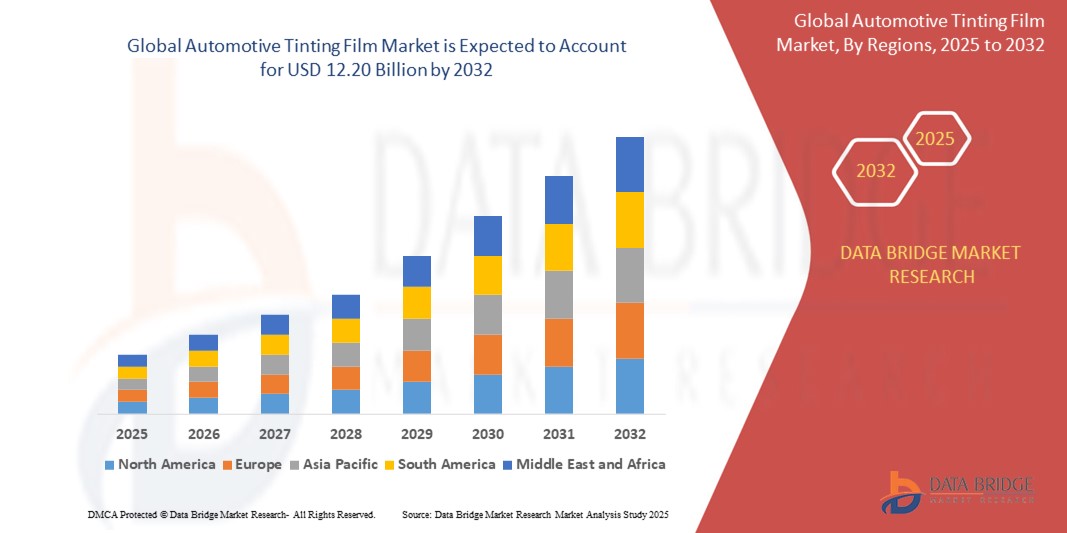
Automotive Tinting Film Market Size
- The global automotive tinting film market size was valued at USD 6.54 billion in 2024 and is expected to reach USD 12.20 billion by 2032, at a CAGR of 8.1% during the forecast period
- The market growth is largely fuelled by the increasing demand for UV protection, heat rejection, and enhanced vehicle aesthetics, along with rising awareness of interior protection and privacy benefits among vehicle owners
- Increasing consumer awareness regarding vehicle interior protection and enhanced driving comfort is further propelling the demand for automotive tinting films across both OEM and aftermarket channels
Automotive Tinting Film Market Analysis
- The automotive tinting film market is witnessing steady growth as more consumers prioritize vehicle customization and protection features to enhance aesthetics and reduce glare
- Growing demand from both luxury and economy vehicle segments is encouraging manufacturers to innovate with high-performance, durable, and UV-resistant tinting solutions
- North America dominates the automotive tinting film market with the largest revenue share of 33.9% in 2024, driven by a mature automotive industry and increasing demand for vehicle heat and UV protection solutions
- Asia-Pacific is expected to be the fastest growing region in the automotive tinting film market during the forecast period driven by rapid urbanization, increasing vehicle ownership, and rising awareness of heat and UV protection benefits, particularly in countries such as China, India, and Southeast Asian nations
- The windshield segment holds the largest market revenue share of 70% in 2024, supported by rising adoption of advanced ceramic and nano-ceramic films that offer superior heat rejection and UV protection without compromising visibility. Increasing regulations on windshield tinting and the growing aftermarket for heat-reducing films are also fuelling this growth
Report Scope and Automotive Tinting Film Market Segmentation
|
Attributes |
Automotive Tinting Film Key Market Insights |
|
Segments Covered |
|
|
Countries Covered |
North America
Europe
Asia-Pacific
Middle East and Africa
South America
|
|
Key Market Players |
|
|
Market Opportunities |
|
|
Value Added Data Infosets |
In addition to the insights on market scenarios such as market value, growth rate, segmentation, geographical coverage, and major players, the market reports curated by the Data Bridge Market Research also include import export analysis, production capacity overview, production consumption analysis, price trend analysis, climate change scenario, supply chain analysis, value chain analysis, raw material/consumables overview, vendor selection criteria, PESTLE Analysis, Porter Analysis, and regulatory framework. |
Automotive Tinting Film Market Trends
“Rising Preference for Ceramic-Based Tinting Films”
- Ceramic-based tinting films are becoming the preferred choice due to their ability to block heat and harmful UV rays without reducing visibility
- These films maintain signal clarity for GPS and smartphones, unlike metallic films, making them ideal for tech-integrated vehicles
- In hot climates such as the U.A.E., ceramic films are favored for keeping car interiors cooler, reducing reliance on air conditioning
- Luxury car owners seek ceramic tints for both style and performance
- For instance, Tesla offers factory ceramic tint upgrades to enhance vehicle comfort and efficiency
- Dealerships are increasingly including ceramic tint packages in vehicle sales
- For instance, several Lexus dealerships in the U.S. promote ceramic tints as a value-added option for premium buyers
Automotive Tinting Film Market Dynamics
Driver
“Rising Demand for Enhanced Vehicle Comfort and Safety”
- Rising consumer awareness about the harmful effects of UV radiation and solar heat is increasing the demand for automotive tinting films with superior heat rejection and UV protection
- Tinting films help maintain cooler cabin temperatures by blocking solar energy, reducing the reliance on air conditioning and improving fuel efficiency
- These films enhance privacy, reduce glare, and contribute to a safer and more comfortable driving experience, especially in regions with hot climates such as the U.A.E. and India
- Automakers are responding to this demand by offering factory-installed tinting options or partnering with film providers
- For instance, Mercedes-Benz offers solar-control glass as a comfort feature in its premium models
- The rise of electric vehicles, which require optimized thermal management to extend battery life, is further fueling the adoption of high-performance tinting films for better energy efficiency and passenger comfort
Restraint/Challenge
“Regulatory Restrictions on Visible Light Transmission (VLT)”
- Regulatory restrictions on visible light transmission levels limit how dark automotive tint films can be, affecting market growth and consumer choices
- Different countries have varying laws, complicating standardization efforts for manufacturers and distributors operating internationally
- Excessive tinting is often viewed as a safety risk due to reduced night-time visibility and challenges in roadside inspections
- For instance, many U.S. states and European countries require front window tints to allow more than 70% light transmission, restricting darker film options
- These strict regulations discourage aftermarket tint installations and may result in fines, deterring some potential buyers and limiting market expansion
Automotive Tinting Film Market Scope
The market is segmented on the basis of application and vehicle type.
- By Application
On the basis of application, the automotive tinting film market is segmented into windows and windshields. The windshield segment holds the largest market revenue share of 70% in 2024, supported by rising adoption of advanced ceramic and nano-ceramic films that offer superior heat rejection and UV protection without compromising visibility. Increasing regulations on windshield tinting and the growing aftermarket for heat-reducing films are also fuelling this growth.
The window segment is expected to witness the fastest growth rate from 2025 to 2032, driven by its extensive use in passenger vehicles and commercial fleets to reduce glare and improve privacy. Consumers increasingly prefer window tinting for its ability to enhance driving comfort and protect vehicle interiors from UV damage. In addition, window films are favoured for their aesthetic appeal and energy-saving benefits by reducing air conditioning usage.
- By Vehicle Type
On the basis of vehicle type, the automotive tinting film market is segmented into passenger cars, light commercial vehicles (LCVs), and heavy commercial vehicles (HCVs). The passenger car segment dominated the market revenue share of 66.2% in 2024, owing to the high volume of passenger vehicles worldwide and consumer focus on comfort and aesthetics. Passenger cars benefit from aftermarket tinting as well as factory-installed films by manufacturers aiming to enhance vehicle value.
The light commercial vehicle segment is expected to witness the fastest growth rate from 2025 to 2032 during the forecast period, driven by increasing fleet owners’ adoption of tinting films to protect cargo, improve driver comfort, and reduce vehicle interior heat.
Automotive Tinting Film Market Regional Analysis
- North America dominates the automotive tinting film market with the largest revenue share of 33.9% in 2024, driven by a mature automotive industry and increasing demand for vehicle heat and UV protection solutions
- Consumers prioritize tint films for enhancing passenger comfort, reducing glare, and protecting interiors from sun damage, especially in regions with diverse climatic conditions
- Growth is supported by advancements in film technology, including ceramic and infrared-reflective coatings, alongside rising adoption in both OEM and aftermarket segments
U.S. Automotive Tinting Film Market Insight
The U.S. dominate in the North America automotive tinting film market with the highest revenue share in 2024, fuelled by strong aftermarket demand and growing consumer awareness of heat rejection and UV protection benefits. The trend towards vehicle customization and increasing regulations promoting safer tinting standards further boost market expansion. Automakers’ growing incorporation of factory-tinted windows complements aftermarket sales, creating a diverse product ecosystem.
Europe Automotive Tinting Film Market Insight
The Europe automotive tinting film market is expected to witness the fastest growth rate, supported by regulatory emphasis on vehicle safety and comfort. Consumers seek films that improve driving visibility while offering thermal insulation. The growth is prominent in both new vehicle installations and retrofit projects, with countries such as Germany and France showing significant uptake due to rising environmental concerns and urban traffic conditions.
U.K. Automotive Tinting Film Market Insight
The U.K. market for automotive tinting films is expected to witness the fastest growth rate, driven by demand for improved passenger comfort and glare reduction in urban and suburban settings. Increased interest in vehicle aesthetics and rising awareness of UV protection benefits encourage adoption. In addition, evolving vehicle safety regulations influence consumer choices, balancing tint darkness with compliance.
Germany Automotive Tinting Film Market Insight
The Germany is expected to witness the fastest growth rate in automotive tinting films, attributed to its advanced automotive manufacturing sector and high consumer focus on vehicle comfort and energy efficiency. German consumers prefer technologically advanced films that reduce cabin heat and contribute to lower fuel consumption. The integration of these films in premium vehicles and aftermarket options supports sustained market growth.
Asia-Pacific Automotive Tinting Film Market Insight
The Asia-Pacific region is expected to witness the fastest growth rate, driven by expanding automotive production and rising disposable incomes in countries such as China, India, and Japan. Increasing awareness of heat rejection, UV protection, and vehicle aesthetics is boosting demand. Government initiatives promoting energy efficiency and vehicle safety further encourage the use of advanced tint films.
Japan Automotive Tinting Film Market Insight
The Japan’s automotive tinting film market is expected to witness the fastest growth rate due to strong consumer preference for high-quality, technologically advanced tint films that enhance driving comfort and safety. The presence of major automotive manufacturers and integration of tint films in OEM vehicles accelerate market penetration. Rising interest in aftermarket customization also contributes to growth.
China Automotive Tinting Film Market Insight
The China holds the largest share of the Asia-Pacific automotive tinting film market, propelled by rapid urbanization, rising vehicle ownership, and increasing demand for heat and UV protection solutions. The country’s growing middle class and focus on smart mobility support the adoption of advanced tint films. Strong domestic manufacturing capabilities and competitive pricing enhance market accessibility.
Automotive Tinting Film Market Share
The automotive tinting film industry is primarily led by well-established companies, including:
- 3M (U.S.)
- Eastman Chemical Company (U.S.)
- TintFit Window Films Ltd. (U.K.)
- Avery Dennison Israel Ltd. (Israel)
- Johnson Window Films, Inc. (U.S.)
- GLOBAL WINDOW FILMS (U.S.)
- Madico, Inc. (U.S.)
- Saint-Gobain Performance Plastics Corporation (France)
- TWF (U.K.)
- Armolan (Finland)
- NEXFIL (South Korea)
- Solar Screen International SA (Switzerland)
- Huper Optik USA (U.S.)
Latest Developments in Global Automotive Tinting Film Market
- In February 2025, Avery Dennison introduced its Encore Series automotive film portfolio, featuring three key variants: Encore Supreme, Encore Supreme IR, and Encore. These films offer superior heat rejection, glare reduction, and block over 99% of harmful UV rays, while also providing enhanced privacy and a durable, color-stable finish. The new product line addresses growing consumer demands for both comfort and aesthetics in vehicle tinting. By broadening its portfolio, Avery Dennison strengthens its competitive edge in the global automotive tinting market. This launch is expected to boost adoption rates in regions with high solar exposure, improving driver and passenger experience
- In February 2025, Luminous unveiled its Carbon Window Film in the MENA region via Al-Rabiya Auto Accessories. This innovative tint offers high durability, effective heat rejection, and robust UV protection, combined with an attractive aesthetic finish that appeals to style-conscious consumers. The product targets the growing demand for advanced window films in hot climates, where temperature control and sun protection are critical. By expanding its product range with Carbon Window Film, Luminous aims to capture a larger share of the Middle East and Africa automotive tinting market, reinforcing its regional presence and reputation for quality
- In August 2023, Solar Art completed the acquisition of Layr, a rapidly expanding window film company serving commercial customers in New York City. This move significantly strengthens Solar Art’s presence on the East Coast and enhances its operational infrastructure in a key commercial market. The acquisition enables Solar Art to offer a wider range of products and services, boosting its ability to meet diverse client needs. This strategic expansion supports Solar Art’s long-term growth ambitions by leveraging Layr’s established customer base and market expertise, positioning the company as a leading player in commercial automotive tinting solutions

- Interactive Data Analysis Dashboard
- Company Analysis Dashboard for high growth potential opportunities
- Research Analyst Access for customization & queries
- Competitor Analysis with Interactive dashboard
- Latest News, Updates & Trend analysis
- Harness the Power of Benchmark Analysis for Comprehensive Competitor Tracking
Global Automotive Tinting Film Market, Supply Chain Analysis and Ecosystem Framework
To support market growth and help clients navigate the impact of geopolitical shifts, DBMR has integrated in-depth supply chain analysis into its Global Automotive Tinting Film Market research reports. This addition empowers clients to respond effectively to global changes affecting their industries. The supply chain analysis section includes detailed insights such as Global Automotive Tinting Film Market consumption and production by country, price trend analysis, the impact of tariffs and geopolitical developments, and import and export trends by country and HSN code. It also highlights major suppliers with data on production capacity and company profiles, as well as key importers and exporters. In addition to research, DBMR offers specialized supply chain consulting services backed by over a decade of experience, providing solutions like supplier discovery, supplier risk assessment, price trend analysis, impact evaluation of inflation and trade route changes, and comprehensive market trend analysis.
Data collection and base year analysis are done using data collection modules with large sample sizes. The stage includes obtaining market information or related data through various sources and strategies. It includes examining and planning all the data acquired from the past in advance. It likewise envelops the examination of information inconsistencies seen across different information sources. The market data is analysed and estimated using market statistical and coherent models. Also, market share analysis and key trend analysis are the major success factors in the market report. To know more, please request an analyst call or drop down your inquiry.
The key research methodology used by DBMR research team is data triangulation which involves data mining, analysis of the impact of data variables on the market and primary (industry expert) validation. Data models include Vendor Positioning Grid, Market Time Line Analysis, Market Overview and Guide, Company Positioning Grid, Patent Analysis, Pricing Analysis, Company Market Share Analysis, Standards of Measurement, Global versus Regional and Vendor Share Analysis. To know more about the research methodology, drop in an inquiry to speak to our industry experts.
Data Bridge Market Research is a leader in advanced formative research. We take pride in servicing our existing and new customers with data and analysis that match and suits their goal. The report can be customized to include price trend analysis of target brands understanding the market for additional countries (ask for the list of countries), clinical trial results data, literature review, refurbished market and product base analysis. Market analysis of target competitors can be analyzed from technology-based analysis to market portfolio strategies. We can add as many competitors that you require data about in the format and data style you are looking for. Our team of analysts can also provide you data in crude raw excel files pivot tables (Fact book) or can assist you in creating presentations from the data sets available in the report.













