


What is the Automotive Torque Sensor Market Size and Overview?
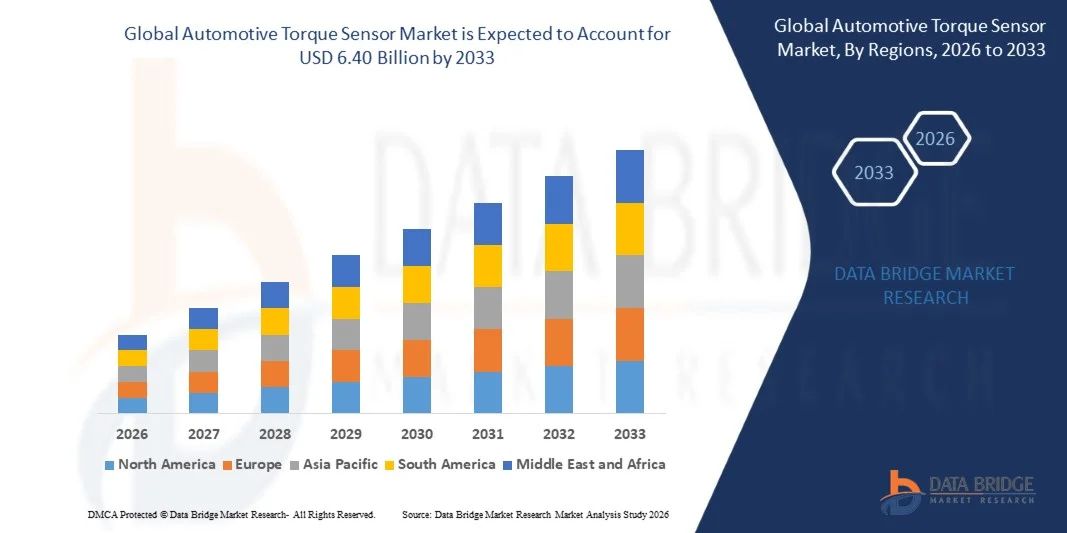
As per Data Bridge Market Research analysis the Automotive Torque Sensor Market was valued at USD 3.10 billion in 2025 and is projected to reach USD 6.40 billion by 2033, growing at a CAGR of 9.50% from 2026 to 2033. The market is experiencing strong growth driven by increasing production of electric and hybrid vehicles, rising adoption of electric power steering systems, and growing demand for advanced driver assistance systems and vehicle safety technologies.
Market Size & Forecast
- Global Market Value (2025): USD 3.10 Billion
- Expected Market Value (2033): USD 6.40 Billion
- Forecast CAGR (2026–2033): 9.50%
The increasing focus on vehicle electrification, fuel efficiency, and precise steering control is encouraging automotive manufacturers to integrate torque sensors into steering columns, drivetrains, transmissions, and electric motor systems. Automotive torque sensors enable real-time measurement of rotational force, supporting responsive electric power steering, improved vehicle handling, and enhanced energy management in electric vehicles. The growing deployment of steer-by-wire systems, autonomous driving technologies, and connected vehicle platforms is further accelerating demand for high-accuracy torque sensing solutions across passenger cars and commercial vehicles.
What are the Major Takeaways of Automotive Torque Sensor Market?
- North America dominated the automotive torque sensor market with the largest revenue share in 2025, supported by strong adoption of electric power steering, increasing investment in electric and autonomous vehicle development, high demand for advanced driver assistance technologies, and the presence of established automotive manufacturers and component suppliers.
- Asia-Pacific is expected to be the fastest-growing region, recording a CAGR of 10.60% from 2026 to 2033. Growth is driven by rapid electric vehicle production, expanding automotive manufacturing capacity, rising adoption of electric power steering systems, and increasing integration of connected vehicle and advanced safety technologies across China, Japan, India, and South Korea.
- The passenger vehicles segment held the largest market revenue share of approximately 72.6% in 2025 driven by high production volumes, growing penetration of electric power steering, and rising integration of advanced driver assistance systems. Passenger vehicle manufacturers are increasingly deploying torque sensors to support lane-keeping assistance, parking assistance, adaptive steering, and electric vehicle energy management functions.
- The commercial vehicles segment is projected to register the fastest growth at a CAGR of 10.1% from 2026 to 2033, driven by increasing electrification of buses, delivery vans, and trucks, along with rising demand for fleet safety and vehicle performance monitoring. Growing adoption of electric commercial vehicles for logistics and urban transportation is accelerating the requirement for durable torque sensing systems.
- The shaft style segment held the largest market revenue share of approximately 58.9% in 2025 driven by its widespread integration into steering columns, electric motors, drivetrain assemblies, and rotating test equipment. Shaft style sensors support direct torque measurement and are increasingly used in electric power steering applications requiring compact installation and continuous rotational measurement.
- The flange style segment is projected to register the fastest growth at a CAGR of 9.8% from 2026 to 2033, driven by increasing use in automotive test benches, electric motor validation, transmission testing, and high-torque commercial vehicle applications. Flange style sensors provide robust mounting, high measurement stability, and suitability for applications requiring precise torque measurement under demanding loads.
- The automotive segment held the largest market revenue share of approximately 46.3% in 2025 driven by rising deployment in electric power steering, electric drivetrains, transmission systems, and advanced driver assistance technologies. Growing production of electric and hybrid vehicles is increasing demand for torque sensors that support accurate steering control, motor performance optimization, and energy-efficient vehicle operation.
- The test and measurement segment is projected to register the fastest growth at a CAGR of 10.7% from 2026 to 2033, driven by increasing automotive research and development activities, electric vehicle component testing, and demand for high-precision calibration systems. Automotive manufacturers and component suppliers are increasingly using torque sensors in dynamometers, test benches, and validation laboratories to assess motor, transmission, steering, and drivetrain performance.
Report Scope and Automotive Torque Sensor Market Segmentation
|
Attributes |
Automotive Torque Sensor Key Market Insights |
|
Segments Covered |
|
|
Countries Covered |
North America
Europe
Asia-Pacific
Middle East and Africa
South America
|
|
Key Market Players |
|
|
Market Opportunities |
|
|
Value Added Data Infosets |
In addition to the market insights such as market value, growth rate, market segments, geographical coverage, market players, and market scenario, the market report curated by the Data Bridge Market Research team includes in-depth expert analysis, import/export analysis, pricing analysis, production consumption analysis, and pestle analysis. |
What is the Key Trend in the Automotive Torque Sensor Market?
Trend: Growing Integration Of Torque Sensors In Electric Power Steering And Vehicle Electrification
The increasing transition toward electric vehicles, hybrid vehicles, and electronically controlled steering systems is accelerating the integration of automotive torque sensors. Conventional hydraulic power steering systems consume engine power continuously and require hydraulic fluids, pumps, hoses, and regular maintenance, encouraging vehicle manufacturers to adopt electric power steering systems with lower energy consumption and improved steering responsiveness.
In modern electric vehicles, torque sensors are integrated into steering columns to measure driver steering input and transmit real-time torque data to the electronic control unit. This enables the electric power steering motor to provide the required steering assistance based on vehicle speed, steering angle, and driving conditions. For instance, electric power steering systems can reduce fuel consumption by approximately 2% to 4% compared with hydraulic steering systems in internal combustion engine vehicles, while also supporting improved energy efficiency in electric and hybrid vehicle architectures.
The rapid expansion of advanced driver assistance systems and automated driving technologies is also increasing demand for high-precision torque sensing solutions. Torque sensors support lane-keeping assistance, parking assistance, driver monitoring, and steer-by-wire functions by helping systems distinguish between driver steering input and automated steering intervention. In addition, automotive manufacturers are increasingly adopting contactless magnetic torque sensors, which can provide high measurement accuracy while reducing mechanical wear and improving long-term reliability in demanding vehicle operating conditions.
Automotive Torque Sensor Market Dynamics
Key Market Driver: Rising Adoption Of Electric Power Steering And Advanced Vehicle Safety Systems
Automotive manufacturers worldwide are facing increasing regulatory and consumer pressure to improve vehicle fuel efficiency, reduce emissions, and enhance driving safety. The growing replacement of hydraulic steering systems with electric power steering is creating strong demand for torque sensors capable of measuring steering force accurately and supporting real-time electronic control. Electric power steering systems eliminate hydraulic pumps and fluid lines, reducing vehicle weight and lowering energy losses associated with conventional steering systems.
Automotive original equipment manufacturers are increasingly integrating torque sensors into electric power steering columns and steering gear assemblies to support adaptive steering assistance and advanced safety functions. For instance, the International Energy Agency reported that global electric car sales exceeded 17 million units in 2024, increasing the addressable market for electronically controlled steering, drivetrain, and motor control components. Torque sensors are also used in electric and hybrid vehicle powertrains to monitor motor output and optimize energy management under changing driving conditions.
Similarly, the growing deployment of advanced driver assistance systems is supporting demand for reliable steering torque measurement. Features such as lane-centering assistance, automated parking, and traffic-jam assist require continuous detection of steering input and driver engagement. The European Commission’s General Safety Regulation requires new vehicle types in the European Union to include several advanced safety features, supporting the broader adoption of electronically controlled vehicle systems and associated sensing technologies.
Key Restraint/Challenge: High System Cost And Complex Calibration Requirements
Automotive torque sensors require high accuracy, durability, and reliable performance across vibration, temperature variation, electromagnetic interference, and long operating lifecycles. The integration of magnetic elements, Hall-effect devices, strain gauges, electronic control units, and specialized calibration processes can increase component and system costs. These requirements can create affordability challenges for entry-level vehicle manufacturers and cost-sensitive vehicle segments, particularly where conventional mechanical steering systems remain widely used.
In addition, torque sensor performance can be affected by mechanical tolerances, shaft misalignment, temperature drift, and electromagnetic interference from electric motors and high-voltage vehicle systems. Manufacturers must conduct extensive calibration and validation to ensure accurate torque measurement under real-world driving conditions. For instance, automotive electronic components are commonly validated against ISO 16750 environmental test requirements, including temperature, vibration, electrical load, and mechanical stress conditions, increasing development complexity and testing costs.
The growing use of software-defined vehicle architectures can also increase integration requirements, as torque sensor data must communicate reliably with steering control units, advanced driver assistance systems, and vehicle networks. Any measurement error or communication delay can affect steering feel, safety functions, and automated driving performance. These factors increase the need for redundant sensor designs, cybersecurity protection, and functional safety compliance, adding to the overall cost and complexity of automotive torque sensor deployment.
Key Market Opportunity: Expansion Of Steer-By-Wire And Autonomous Vehicle Technologies
The growing development of steer-by-wire systems, autonomous vehicles, and connected mobility platforms is creating significant opportunities for automotive torque sensor manufacturers. Steer-by-wire technology replaces or supplements mechanical steering linkages with electronic controls, requiring precise torque measurement to interpret driver intent and support safe steering responses. These systems can enable flexible vehicle packaging, customizable steering feel, and improved integration with automated driving functions.
Automotive companies are increasingly introducing steer-by-wire technologies in premium electric vehicles and advanced mobility platforms. For instance, Nissan introduced its Direct Adaptive Steering technology, which uses electronic control to transmit steering input without a conventional mechanical connection under normal operation. Torque sensors play an important role in detecting steering effort and supporting feedback systems that maintain driver confidence and vehicle control.
In addition, the expansion of autonomous driving development is increasing the need for redundant steering and sensing architectures. The Society of Automotive Engineers defines Level 3 automated driving as conditional automation, where the automated driving system manages all aspects of driving within its operational design domain but may require the driver to take control when requested. This is increasing demand for torque sensors that can support driver handover detection, steering override recognition, and safe interaction between automated systems and human drivers.
Advancements in non-contact sensing, integrated sensor modules, and high-resolution magnetic technologies are expected to expand opportunities for automotive torque sensors across electric power steering, electric drivetrains, autonomous shuttles, and next-generation passenger vehicles.
How is the Automotive Torque Sensor Market Segmented?
The market is segmented on the basis of type, technology, vehicle type, mechanical configuration, and application.
• By Type
On the basis of type, the automotive torque sensor market is segmented into rotary torque sensors and reaction torque sensors. The rotary torque sensors segment held the largest market revenue share of approximately 61.8% in 2025 driven by its widespread use in electric power steering systems, electric drivetrains, transmission testing, and rotating motor applications. Rotary torque sensors are preferred due to their ability to measure dynamic torque during continuous shaft rotation, supporting real-time vehicle control and performance monitoring.
The reaction torque sensors segment is projected to register the fastest growth at a CAGR of 10.3% from 2026 to 2033, driven by increasing use in electric motor testing, component validation, battery manufacturing equipment, and stationary torque measurement applications. Rising adoption in automotive test benches and end-of-line quality inspection systems is accelerating segment expansion.
• By Technology
On the basis of technology, the automotive torque sensor market is segmented into surface acoustic wave, magnetoelastic, optical, and strain gauge. The magnetoelastic segment held the largest market revenue share of approximately 34.7% in 2025 driven by its increasing deployment in electric power steering systems and automotive drivetrains. Magnetoelastic torque sensors provide non-contact measurement, high durability, and reduced mechanical wear, making them suitable for continuous vehicle operation under vibration and temperature variation.
The surface acoustic wave segment is projected to register the fastest growth at a CAGR of 11.2% from 2026 to 2033, driven by rising demand for wireless torque measurement, compact sensor design, and high-accuracy monitoring in next-generation electric vehicles. Surface acoustic wave sensors can support contactless torque measurement without onboard batteries, improving suitability for rotating automotive components.
• By Vehicle Type
On the basis of vehicle type, the automotive torque sensor market is segmented into passenger vehicles and commercial vehicles. The passenger vehicles segment held the largest market revenue share of approximately 72.6% in 2025 driven by high production volumes, growing penetration of electric power steering, and rising integration of advanced driver assistance systems. Passenger vehicle manufacturers are increasingly deploying torque sensors to support lane-keeping assistance, parking assistance, adaptive steering, and electric vehicle energy management functions.
The commercial vehicles segment is projected to register the fastest growth at a CAGR of 10.1% from 2026 to 2033, driven by increasing electrification of buses, delivery vans, and trucks, along with rising demand for fleet safety and vehicle performance monitoring. Growing adoption of electric commercial vehicles for logistics and urban transportation is accelerating the requirement for durable torque sensing systems.
• By Mechanical Configuration
On the basis of mechanical configuration, the automotive torque sensor market is segmented into shaft style and flange style. The shaft style segment held the largest market revenue share of approximately 58.9% in 2025 driven by its widespread integration into steering columns, electric motors, drivetrain assemblies, and rotating test equipment. Shaft style sensors support direct torque measurement and are increasingly used in electric power steering applications requiring compact installation and continuous rotational measurement.
The flange style segment is projected to register the fastest growth at a CAGR of 9.8% from 2026 to 2033, driven by increasing use in automotive test benches, electric motor validation, transmission testing, and high-torque commercial vehicle applications. Flange style sensors provide robust mounting, high measurement stability, and suitability for applications requiring precise torque measurement under demanding loads.
• By Application
On the basis of application, the automotive torque sensor market is segmented into automotive, test and measurement, industrial, and others. The automotive segment held the largest market revenue share of approximately 46.3% in 2025 driven by rising deployment in electric power steering, electric drivetrains, transmission systems, and advanced driver assistance technologies. Growing production of electric and hybrid vehicles is increasing demand for torque sensors that support accurate steering control, motor performance optimization, and energy-efficient vehicle operation.
The test and measurement segment is projected to register the fastest growth at a CAGR of 10.7% from 2026 to 2033, driven by increasing automotive research and development activities, electric vehicle component testing, and demand for high-precision calibration systems. Automotive manufacturers and component suppliers are increasingly using torque sensors in dynamometers, test benches, and validation laboratories to assess motor, transmission, steering, and drivetrain performance.
Which Region Holds the Largest Share of the Automotive Torque Sensor Market?
North America Automotive Torque Sensor Market Insight
North America dominated the automotive torque sensor market with the largest revenue share in 2025, supported by high adoption of electric power steering systems, strong electric vehicle production, and increasing integration of advanced driver assistance systems. Automotive manufacturers across the region are increasingly deploying torque sensors in steering columns, electric motors, drivetrain systems, and vehicle testing platforms to improve steering responsiveness, vehicle safety, and energy efficiency. The established presence of major automotive original equipment manufacturers, technology suppliers, and advanced vehicle research facilities is further supporting market expansion across passenger and commercial vehicle applications.
U.S. Automotive Torque Sensor Market Insight
The U.S. automotive torque sensor market captured the largest revenue share in 2025 within North America, fueled by rising electric vehicle adoption, increasing deployment of electric power steering systems, and growing investment in autonomous driving technologies. Vehicle manufacturers are increasingly integrating high-accuracy torque sensors to support lane-keeping assistance, automated parking, adaptive steering, and driver engagement monitoring. Moreover, the growing demand for electric pickups, sport utility vehicles, delivery vans, and connected vehicles is significantly contributing to the expansion of automotive torque sensor applications across the country.
Europe Automotive Torque Sensor Market Insight
The Europe automotive torque sensor market is expected to witness the fastest growth rate from 2026 to 2033, primarily driven by stringent vehicle emission regulations, increasing electric vehicle production, and rising adoption of advanced safety technologies. European automotive manufacturers are increasingly incorporating torque sensors into electric power steering, electric drivetrains, transmission systems, and vehicle test equipment to improve performance and energy efficiency. The region is experiencing significant growth across passenger cars, commercial vehicles, and electric mobility platforms, with torque sensing technologies being incorporated into both new vehicle development and automotive component modernization projects.
U.K. Automotive Torque Sensor Market Insight
The U.K. automotive torque sensor market is expected to witness the fastest growth rate from 2026 to 2033, driven by increasing investment in electric vehicle manufacturing, connected mobility solutions, and automotive research and development activities. The growing focus on vehicle electrification, advanced driver assistance systems, and autonomous vehicle testing is encouraging automotive companies to deploy torque sensors for precise steering control and drivetrain monitoring. The U.K.’s established automotive engineering ecosystem, combined with rising investment in battery technology and electric mobility infrastructure, is expected to continue stimulating market growth.
Germany Automotive Torque Sensor Market Insight
The Germany automotive torque sensor market is expected to witness the fastest growth rate from 2026 to 2033, fueled by the country’s strong automotive manufacturing base and increasing demand for electric, hybrid, and technologically advanced vehicles. German manufacturers are increasingly adopting torque sensors in electric power steering systems, electric motors, transmission assemblies, and automotive testing equipment to improve vehicle handling and production quality. The integration of torque sensing technologies with steer-by-wire systems, automated driving platforms, and electric vehicle powertrains is also becoming increasingly prevalent across the country.
Asia-Pacific Automotive Torque Sensor Market Insight
The Asia-Pacific automotive torque sensor market is expected to witness the fastest growth rate from 2026 to 2033, supported by rapid growth in vehicle production, increasing electric vehicle adoption, and expanding automotive component manufacturing across countries such as China, Japan, and India. The region’s growing focus on fuel efficiency, vehicle safety, and smart mobility is driving the integration of electric power steering systems, advanced driver assistance technologies, and torque sensing solutions. Furthermore, the presence of large-scale automotive manufacturing facilities and expanding electric vehicle supply chains is improving the affordability and accessibility of automotive torque sensors across regional markets.
Japan Automotive Torque Sensor Market Insight
The Japan automotive torque sensor market is expected to witness the fastest growth rate from 2026 to 2033 due to the country’s advanced automotive technology sector, strong hybrid vehicle production, and increasing adoption of precision electronic components. Japanese vehicle manufacturers are increasingly integrating torque sensors into electric power steering systems, hybrid powertrains, and automated driving technologies to improve vehicle control and energy efficiency. The growing use of torque sensors in automotive research, electric motor testing, and next-generation mobility platforms is fueling market growth, while Japan’s emphasis on innovation and high-quality vehicle manufacturing is expected to support continued adoption.
China Automotive Torque Sensor Market Insight
The China automotive torque sensor market accounted for the largest market revenue share in Asia-Pacific in 2025, attributed to rapid electric vehicle production, expanding automotive manufacturing capacity, and increasing deployment of electric power steering systems. China is one of the largest markets for electric and hybrid vehicles, and torque sensors are becoming increasingly important for steering control, electric motor monitoring, and advanced driver assistance functions. The country’s push toward new energy vehicles, smart transportation systems, and domestic automotive component production, alongside the presence of large vehicle manufacturers and sensor suppliers, are key factors propelling the automotive torque sensor market in China.
Which are the Top Companies in Automotive Torque Sensor Market?
The Automotive Torque Sensor industry is primarily led by well-established companies, including:
• ABB (Switzerland)
• Crane Electronics Ltd. (U.K.)
• FUTEK Advanced Sensor Technology, Inc. (U.S.)
• HBM - Torque Transducers (Germany)
• Honeywell International Inc. (U.S.)
• Kistler Instruments India Pvt. Ltd. (India)
• Norbar Torque Tools Ltd. (U.K.)
• Infineon Technologies AG (Germany)
• Teledyne Technologies Incorporated (U.S.)
• Datum Electronics Ltd. (U.K.)
• MagCanica, Inc. (U.S.)
• Interface, Inc. (U.S.)
• AIMCO (U.S.)
• TE Connectivity Ltd. (Switzerland)
• Mountz, Inc. (U.S.)

- Interactive Data Analysis Dashboard
- Company Analysis Dashboard for high growth potential opportunities
- Research Analyst Access for customization & queries
- Competitor Analysis with Interactive dashboard
- Latest News, Updates & Trend analysis
- Harness the Power of Benchmark Analysis for Comprehensive Competitor Tracking
Data collection and base year analysis are done using data collection modules with large sample sizes. The stage includes obtaining market information or related data through various sources and strategies. It includes examining and planning all the data acquired from the past in advance. It likewise envelops the examination of information inconsistencies seen across different information sources. The market data is analysed and estimated using market statistical and coherent models. Also, market share analysis and key trend analysis are the major success factors in the market report. To know more, please request an analyst call or drop down your inquiry.
The key research methodology used by DBMR research team is data triangulation which involves data mining, analysis of the impact of data variables on the market and primary (industry expert) validation. Data models include Vendor Positioning Grid, Market Time Line Analysis, Market Overview and Guide, Company Positioning Grid, Patent Analysis, Pricing Analysis, Company Market Share Analysis, Standards of Measurement, Global versus Regional and Vendor Share Analysis. To know more about the research methodology, drop in an inquiry to speak to our industry experts.
Data Bridge Market Research is a leader in advanced formative research. We take pride in servicing our existing and new customers with data and analysis that match and suits their goal. The report can be customized to include price trend analysis of target brands understanding the market for additional countries (ask for the list of countries), clinical trial results data, literature review, refurbished market and product base analysis. Market analysis of target competitors can be analyzed from technology-based analysis to market portfolio strategies. We can add as many competitors that you require data about in the format and data style you are looking for. Our team of analysts can also provide you data in crude raw excel files pivot tables (Fact book) or can assist you in creating presentations from the data sets available in the report.













