


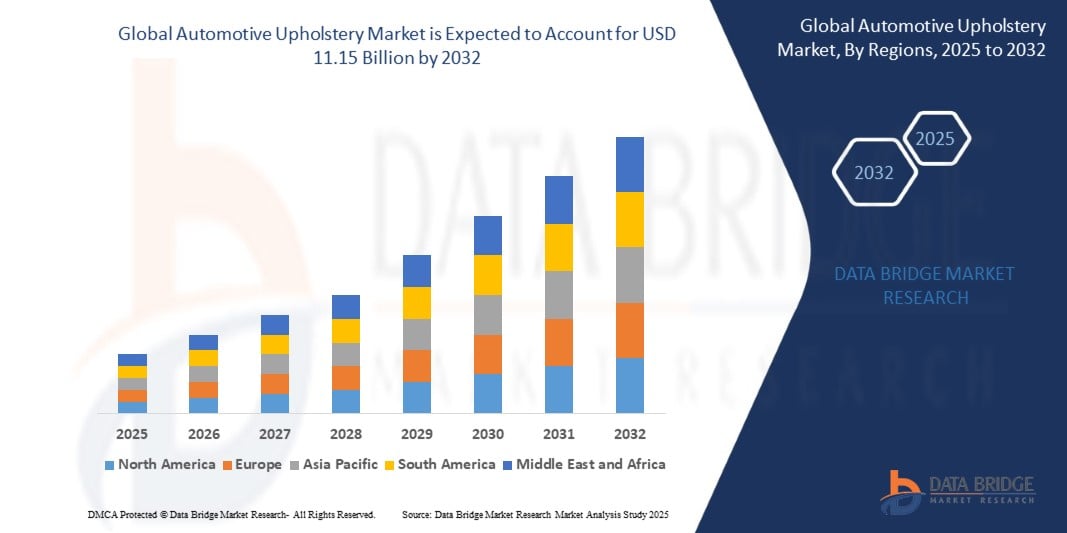
Automotive Upholstery Market Size
- The global automotive upholstery market was valued at USD 7.46 billion in 2024 and is projected to reach USD 11.15 billion by 2032, growing at a robust CAGR of 5.90% during the forecast period.
- Market growth is fueled by the rising demand for enhanced in-vehicle comfort, the growing preference for premium interiors, and the increasing production of electric and autonomous vehicles, which are driving innovation in sustainable, lightweight, and smart upholstery materials..
Automotive Upholstery Market Analysis
- Automotive upholstery refers to the materials and fabrics used to cover vehicle interiors, including seats, door panels, headliners, carpets, and dashboards, offering both functional support and aesthetic appeal.
- As consumers increasingly prioritize comfort, premium design, and customization, automotive upholstery is becoming a key differentiator in passenger vehicles, electric vehicles, and luxury models.
- Manufacturers are adopting advanced materials like synthetic leather, performance fabrics, and recycled composites to meet evolving regulations and sustainability goals without compromising durability or design.
- The shift toward electric and autonomous vehicles is driving demand for lightweight, noise-insulating, and smart textiles that enhance cabin acoustics, temperature control, and user interaction.
- Technological innovations in 3D knitting, antimicrobial coatings, and bio-based materials are reshaping the upholstery landscape—supporting circular economy goals while delivering enhanced in-vehicle experiences.
Report Scope and Automotive Upholstery Market Segmentation
|
Attributes |
Automotive Upholstery Market Key Market Insights |
|
Segments Covered |
|
|
Countries Covered |
North America
Europe
Asia-Pacific
Middle East and Africa
South America
|
|
Key Market Players |
|
|
Market Opportunities |
|
|
Value Added Data Infosets |
In addition to the insights on market scenarios such as market value, growth rate, segmentation, geographical coverage, and major players, the market reports curated by the Data Bridge Market Research also include import-export analysis, automotive upholstery production landscape, production and consumption patterns by material and vehicle type, price trend analysis of key upholstery materials (leather, vinyl, synthetic fibers, etc.), climate impact and sustainable material adoption outlook, supply chain and distribution channel analysis, value chain assessment from raw material sourcing to OEM delivery, raw material and consumables overview, vendor qualification and selection parameters, PESTLE Analysis, Porter’s Five Forces Analysis, and regulatory framework analysis focusing on automotive interior safety and sustainability standards. |
Automotive Upholstery Market Trends
Customization, Sustainability, and Technological Innovation Reshaping Automotive Interiors
- Surge in Demand for Sustainable Upholstery Materials: OEMs and suppliers are increasingly adopting eco-friendly materials such as recycled polyester, plant-based leather alternatives, and water-based adhesives to meet environmental regulations and consumer preferences for sustainable vehicles.
- Premiumization and Interior Personalization: As vehicle interiors become a focal point for user experience, there's growing demand for customizable upholstery options ranging from luxury leather to bespoke fabric textures especially in mid- to high-end vehicle segments.
- Integration of Smart and Temperature-Regulating Fabrics: Advancements in fabric technology are enabling the development of smart upholstery with features like seat heating, cooling, and embedded sensors, enhancing comfort and safety for occupants.
- Uptake of Synthetic Leather and Performance Fabrics: Due to their durability, ease of cleaning, and cost-efficiency, synthetic materials such as PU and PVC leather are seeing strong adoption, particularly in commercial and economy vehicle categories.
- Influence of EV and Autonomous Vehicle Design: The transition toward electric and self-driving vehicles is driving innovation in upholstery layouts, with flat-floor cabins and lounge-style seating demanding new forms of modular, breathable, and lightweight fabrics..
Automotive Upholstery Market Dynamics
Driver
Demand for Lightweight, Flexible, and Cost-Effective Electronics for Emerging Applications
- The growing need for conformable electronics in wearables, packaging, and automotive interiors is driving rapid adoption of printed components, which offer mechanical flexibility and reduced production costs.
- Applications such as e-paper displays, smart bandages, touch-sensitive surfaces, and interactive posters are increasing in volume, enabled by low-cost, scalable printed technology.
- Consumer electronics brands are integrating printed displays and sensors into curved screens, bendable devices, and compact form factors, encouraging continued R&D and material innovation.
- Governments and corporates are investing in bio-compatible printed sensors for healthcare and PV-integrated infrastructure, contributing to industry-wide expansion.
Restraint/Challenge
Rising Demand for Premium, Durable, and Sustainable Upholstery in Next-Generation Vehicles
- The shift in consumer preference toward enhanced in-cabin comfort, tactile experience, and aesthetics is driving automakers to invest in high-quality upholstery materials, including leather, suede, and advanced textiles.
- Electric vehicles (EVs) and luxury car segments are increasingly focusing on sophisticated and customizable interiors, prompting OEMs to differentiate through sustainable and ergonomic upholstery solutions.
- The adoption of vegan leather, recycled fabrics, and low-emission adhesives is accelerating, as automakers aim to meet global sustainability targets and appeal to environmentally conscious buyers.
- Smart fabrics that regulate temperature, resist stains, or integrate sensors are gaining traction in both high-end and mid-range vehicles, enhancing user experience and enabling integration with smart vehicle systems.
- Stringent automotive interior safety and environmental standards in regions like Europe and North America are pushing manufacturers to adopt flame-retardant, low-VOC, and hypoallergenic materials, expanding demand for advanced upholstery solutions.
Automotive Upholstery Market Scope
The market is segmented by material, fabric type, vehicle type, and sales channel, reflecting its integral role across diverse vehicle categories and production models.
- By Material
Includes Leather, Vinyl, Nylon, Polyester, PVC, and Others. Leather upholstery leads the market in 2025 due to its premium feel, durability, and association with luxury vehicles. However, synthetic materials like vinyl and polyester are gaining traction for their cost-efficiency, ease of maintenance, and growing demand in mid-range and electric vehicles. Sustainable and recycled materials are also emerging, especially among environmentally-conscious OEMs..
- By Fabric Type
Includes Woven and Non-Woven fabrics. Woven fabrics dominate the segment in 2025 due to their superior strength, aesthetic appeal, and use in both seating and interior trims. Non-woven fabrics, on the other hand, are witnessing faster growth owing to their lightweight nature, cost advantages, and increasing application in headliners, door panels, and trunk liners..
- By Vehicle Type
Includes Passenger Cars, Light Commercial Vehicles (LCVs), and Heavy Commercial Vehicles (HCVs). Passenger cars account for the largest share in 2025, driven by higher production volumes, consumer preferences for comfort, and rising demand for customizable interiors. Meanwhile, LCVs and HCVs are experiencing steady growth due to fleet expansions, especially in logistics and public transport, where durable and easy-to-clean upholstery is prioritized.
- By Sales Channel
Includes OEM and Aftermarket. OEMs dominate the market in 2025 as upholstery is primarily installed during vehicle manufacturing. However, the aftermarket segment is growing robustly, fueled by customization trends, refurbishment of older vehicles, and the popularity of luxury seat covers, especially in emerging economies and among ride-sharing fleets..
Automotive Upholstery Market Regional Analysis
- North America leads the global automotive upholstery market in 2025 due to strong demand for premium vehicles, advanced safety features, and comfort-focused interiors. The U.S. dominates regional growth, driven by rising consumer preference for leather-trimmed seating, growing electric vehicle (EV) adoption, and technological integration like climate-controlled seating and memory foams in upholstery.
- Europe follows closely, supported by high-end vehicle production, particularly in Germany, France, and the U.K. Automakers in this region emphasize sustainability and are increasingly incorporating eco-friendly materials such as recycled polyester, synthetic leather alternatives, and vegan interiors. The strong presence of luxury car brands further boosts demand for high-quality, customized upholstery solutions.
- Asia-Pacific is the fastest-growing region, led by China, India, Japan, and South Korea. The region’s expansion is fueled by surging automotive production, expanding middle-class income groups, and shifting preferences toward aesthetic vehicle interiors. China leads in volume, while Japan and South Korea focus on material innovation—such as antibacterial and lightweight fabrics—backed by strong OEM networks.
- Middle East & Africa (MEA) is witnessing moderate growth, driven by increasing demand for SUVs and luxury vehicles, especially in UAE and Saudi Arabia. The region's hot climate also spurs demand for heat-resistant and ventilated upholstery solutions. Emerging manufacturing setups and aftermarket growth contribute to gradual market development.
- South America, led by Brazil and Argentina, is seeing growth in mid-range and utility vehicle segments, where fabric-based and synthetic leather upholstery are gaining traction due to affordability. Automotive OEMs and tier suppliers are expanding production and localization efforts to serve growing domestic markets.
United States
The U.S. leads regional growth with a strong focus on comfort and safety. Demand is high for advanced seating systems, leather upholstery, and customization in both ICE and electric vehicle segments. OEM partnerships with upholstery suppliers are driving product innovation and volume deployment.
Germany
Germany’s automotive upholstery market thrives on premium vehicle production, with manufacturers prioritizing high-performance, sustainable materials. Innovations in heated/cooled seating and integration of upholstery with ambient lighting and acoustic comfort systems align with Industry 4.0 standards.
China
China dominates in vehicle production volume and is rapidly shifting toward premium interiors, even in mass-market vehicles. Domestic OEMs are incorporating synthetic leather and modern fabric designs at scale, supported by rising urban demand and local material production capabilities..
India
India is emerging as a key market for cost-effective upholstery in hatchbacks, compact SUVs, and two-wheelers. The shift from basic fabric seats to improved synthetic leather in entry-level vehicles is driven by consumer aspirations and rapid OEM model launches across segments.
South Korea
South Korea continues to focus on material innovation, driven by major OEMs like Hyundai and Kia. The country is adopting smart and eco-friendly upholstery with antimicrobial, anti-odor, and sustainable fabric technologies aligned with global EV trends and green manufacturing practices.
Automotive Upholstery Market Share
The automotive upholstery industry is primarily led by well-established companies, including:
- ear Corporation,
- TOYOTA BOSHOKU CORPORATION,
- Faurecia,
- Borgers SE & Co. KGaA,
- The Haartz Corporation,
- MARTUR,
- Sage Automotive Interiors,
- SEIREN Co., LTD,
- MarvelVinyls, Rabe Auto Upholstery,
- Katzkin Leather, Inc.,
- Auto textile S.A.
- Moorestown Auto & Boat Upholstery Inc.,
- SMS Auto Fabrics,
- PD,
- TMI Products Automotive.,
- Gruppo Mastrotto spa,
- Morbern, Simi Auto Upholstery,
- Gilbreath Upholstery Supply
Latest Developments in Global Automotive Upholstery Market
- In April 2025, a leading Russian custom auto shop made headlines by upholstering a Ford F‑250 using grizzly bear fur, showcasing ultra-luxury materials though such customization sparked ethical and legal debates within the EU and North America.
- March 2025, Car Design News teamed with Ultrafabrics to launch the CMF Trend Survey 2025, highlighting growing designer interest in sustainable microfiber upholstery for vehicle interiors.
- February 2025, automotive suppliers widely adopted Ultrasuede microfiber fabric, engineered to meet automotive flammability and durability standards; its polyester/polyurethane structure continues to replace traditional suede in high-end and mass-market interiors.

- Interactive Data Analysis Dashboard
- Company Analysis Dashboard for high growth potential opportunities
- Research Analyst Access for customization & queries
- Competitor Analysis with Interactive dashboard
- Latest News, Updates & Trend analysis
- Harness the Power of Benchmark Analysis for Comprehensive Competitor Tracking
Table of Content
1 INTRODUCTION
1.1 OBJECTIVES OF THE STUDY
1.2 MARKET DEFINITION
1.3 OVERVIEW OF GLOBAL AUTOMOTIVE UPHOLSTERY MARKET
1.4 CURRENCY AND PRICING
1.5 IMPACT OF COVID-19 PANDEMIC ON THE MARKET
1.5.1 PRICE IMPACT
1.5.2 IMPACT ON DEMAND
1.5.3 IMPACT ON SUPPLY CHAIN
1.5.4 CONCLUSION
1.6 LIMITATION
1.7 MARKETS COVERED
2 MARKET SEGMENTATION
2.1 KEY TAKEAWAYS
2.2 ARRIVING AT THE GLOBAL AUTOMOTIVE UPHOLSTERY MARKET
2.2.1 VENDOR POSITIONING GRID
2.2.2 TECHNOLOGY LIFE LINE CURVE
2.2.3 MARKET GUIDE
2.2.4 COMPANY POSITIONING GRID
2.2.5 COMAPANY MARKET SHARE ANALYSIS
2.2.6 MULTIVARIATE MODELLING
2.2.7 TOP TO BOTTOM ANALYSIS
2.2.8 STANDARDS OF MEASUREMENT
2.2.9 VENDOR SHARE ANALYSIS
2.2.10 DATA POINTS FROM KEY PRIMARY INTERVIEWS
2.2.11 DATA POINTS FROM KEY SECONDARY DATABASES
2.3 GLOBAL AUTOMOTIVE UPHOLSTERY MARKET: RESEARCH SNAPSHOT
2.4 ASSUMPTIONS
3 MARKET OVERVIEW
3.1 DRIVERS
3.2 RESTRAINTS
3.3 OPPORTUNITIES
3.4 CHALLENGES
4 EXECUTIVE SUMMARY
5 PREMIUM INSIGHTS
5.1 RECENT TRENDS FOR AUTOMOTIVE UPHOLSTERY MARKET (QUALITATTIVE )
5.1.1 PASSENGER CAR
5.1.2 LIGHT COMMERCIAL VEHICLE
5.1.3 HEAVY COMMERCIAL VEHICLE
6 IMPACT OF COVID-19 PANDEMIC ON THE MARKET
6.1 ANALYSIS ON IMPACT OF COVID-19 ON THE MARKET
6.2 AFTER MATH OF COVID-19 AND GOVERNMENT INITIATIVE TO BOOST THE MARKET
6.3 STRATEGIC DECISIONS FOR MANUFACTURERS AFTER COVID-19 TO GAIN COMPETITIVE MARKET SHARE
6.4 PRICE IMPACT
6.5 IMPACT ON DEMAND
6.6 IMPACT ON SUPPLY CHAIN
6.7 CONCLUSION
7 GLOBAL AUTOMOTIVE UPHOLSTERY MARKET, BY MATERIAL TYPE
7.1 OVERVIEW
7.2 GENUINE LEATHER
7.2.1 BY VEHICLE TYPE
7.2.1.1. PASSENGER CAR
7.2.1.2. LIGHT COMMERCIAL VEHICLE
7.2.1.3. HEAVY COMMERCIAL VEHICLE
7.2.1.4. ELECTRIC VEHICLE
7.3 SYNTHETIC LEATHER
7.3.1 BY TYPE
7.3.1.1. PU-BASED
7.3.1.2. PVC BASED
7.3.1.3. BIO-BASED
7.4 AUTOMOTIVE TEXTILES
7.4.1 BY VEHICLE TYPE
7.4.1.1. PASSENGER CAR
7.4.1.2. LIGHT COMMERCIAL VEHICLE
7.4.1.3. HEAVY COMMERCIAL VEHICLE
7.4.1.4. ELECTRIC VEHICLE
7.5 PLASTICS
7.5.1 BY VEHICLE TYPE
7.5.1.1. PASSENGER CAR
7.5.1.2. LIGHT COMMERCIAL VEHICLE
7.5.1.3. HEAVY COMMERCIAL VEHICLE
7.5.1.4. ELECTRIC VEHICLE
7.6 SMART FABRICS
7.6.1 BY TYPE
7.6.1.1. NONWOVENS FABRICS
7.6.1.2. COMPOSITE FABRICS
7.6.1.3. COATING FABRICS
7.6.1.4. FOAM FABRICS
7.6.1.5. UPHOLSTERY , TRIMMING FABRICS
7.6.1.6. FILTER FABRIC
7.6.1.7. BELT FABRIC
7.6.2 BY VEHICLE TYPE
7.6.2.1. PASSENGER CAR
7.6.2.2. LIGHT COMMERCIAL VEHICLE
7.6.2.3. HEAVY COMMERCIAL VEHICLE
7.6.2.4. ELECTRIC VEHICLE
7.7 THERMOPLASTIC POLYMERS
7.7.1 BY VEHICLE TYPE
7.7.1.1. PASSENGER CAR
7.7.1.2. LIGHT COMMERCIAL VEHICLE
7.7.1.3. HEAVY COMMERCIAL VEHICLE
7.7.1.4. ELECTRIC VEHICLE
8 GLOBAL AUTOMOTIVE UPHOLSTERY MARKET, BY APPLICATION
8.1 OVERVIEW
8.2 AUTO FLOOR MATS
8.3 AUTOMOTIVE CARPETING
8.4 AUTOMOTIVE SEATING
8.5 SEAT BELTS
8.6 AIR BAGS
8.7 STEERING WHEEL COVERS
8.8 AUTOMOTIVE HEADLINERS
8.9 AUTO TRIM/SUPPORTED PVC
8.1 AUTO TRIM/ LEATHER
8.11 CAR COVERS
8.12 CARPETS
8.12.1 DASHBOARDS
8.13 ROOF LINERS
8.14 SEAT COVERS
8.15 SUN VISORS
8.16 TRUNK LINERS
8.17 OTHERS
9 GLOBAL AUTOMOTIVE UPHOLSTERY MARKET, BY INTEGRATED TECHNOLOGY
9.1 OVERVIEW
9.2 CONVENTIONAL
9.3 SMART SEATS
9.4 VENTILATED
10 GLOBAL AUTOMOTIVE UPHOLSTERY MARKET, BY PROPULSION TYPE
10.1 OVERVIEW
10.2 DIESEL
10.3 PETROL
10.4 ELECTRIC VEHICLE
10.5 OTHERS
11 GLOBAL AUTOMOTIVE UPHOLSTERY MARKET, BY HIDE SIZE
11.1 OVERVIEW
11.2 18 TO 20 SQ FT
11.3 20 TO 50 SQ FT
11.4 50 TO 55 SQ FT
11.5 MORE THAN 55 SQ FT
12 GLOBAL AUTOMOTIVE UPHOLSTERY MARKET, BY FABRIC TYPE
12.1 OVERVIEW
12.2 NON-WOVEN
12.3 WOVEN
13 GLOBAL AUTOMOTIVE UPHOLSTERY MARKET, BY FINISH TYPE
13.1 OVERVIEW
13.2 SEMI-ANILINE
13.3 SUEDE
13.4 PIGMENTED
13.5 ANILINE PLUS
13.6 OTHERS
14 GLOBAL AUTOMOTIVE UPHOLSTERY MARKET, BY SALES CHANNEL
14.1 OVERVIEW
14.2 OEM
14.3 AFTER-MARKET
15 GLOBAL AUTOMOTIVE UPHOLSTERY MARKET, BY COLORS
15.1 OVERVIEW
15.2 DARK COLOR
15.3 SEMI-DARK COLOR
15.4 NUDE COLOURS
15.5 LIGHT COLOR
16 GLOBAL AUTOMOTIVE UPHOLSTERY MARKET, BY VEHICLE TYPE
16.1 OVERVIEW
16.2 PASSENGER CARS
16.2.1 BY VEHICLE TYPE
16.2.1.1. HATCHBACK
16.2.1.2. SEDAN
16.2.1.3. MPV
16.2.1.4. SUV
16.2.1.5. CROSSOVER
16.2.1.6. COUPE
16.2.1.7. CONVERTIBLE
16.2.1.8. OTHERS
16.3 LCV
16.3.1.1. VANS
16.3.1.1.1. PASSENGER VANS
16.3.1.1.2. CARGO VANS
16.3.1.2. PICK UP TRUCKS
16.3.1.3. MINI BUS
16.3.1.4. COACHES
16.3.1.5. OTHERS
16.4 HCV
16.4.1.1. TRUCKS
16.4.1.1.1. DUMP TRUCK
16.4.1.1.2. TOW TRUCKS
16.4.1.1.3. CEMENT TRUCKS
16.4.1.2. BUSES
16.5 ELECTRIC VEHICLE
16.5.1 PHEV
16.5.2 HEV
16.5.3 BEV
17 GLOBAL AUTOMOTIVE UPHOLSTERY MARKET, BY GEOGRAPHY
18 GLOBAL AUTOMOTIVE UPHOLSTERY MARKET, BY REGION
18.1 GLOBAL AUTOMOTIVE UPHOLSTERY MARKET, (ALL SEGMENTATION PROVIDED ABOVE IS REPRESENTED IN THIS CHAPTER BY COUNTRY)
18.1.1 NORTH AMERICA
18.1.1.1. U.S.
18.1.1.2. CANADA
18.1.1.3. MEXICO
18.1.2 EUROPE
18.1.2.1. GERMANY
18.1.2.2. U.K.
18.1.2.3. FRANCE
18.1.2.4. ITALY
18.1.2.5. SPAIN
18.1.2.6. THE NETHERLANDS
18.1.2.7. SWITZERLAND
18.1.2.8. TURKEY
18.1.2.9. BELGIUM
18.1.2.10. RUSSIA
18.1.2.11. REST OF EUROPE
18.1.3 ASIA-PACIFIC
18.1.3.1. CHINA
18.1.3.2. JAPAN
18.1.3.3. SOUTH KOREA
18.1.3.4. INDIA
18.1.3.5. SINGAPORE
18.1.3.6. AUSTRALIA
18.1.3.7. MALAYSIA
18.1.3.8. PHILIPPINES
18.1.3.9. THAILAND
18.1.3.10. INDONESIA
18.1.3.11. REST OF ASIA-PACIFIC
18.1.4 SOUTH AMERICA
18.1.4.1. BRAZIL
18.1.4.2. ARGENTINA
18.1.4.3. REST OF SOUTH AMERICA
18.1.5 MIDDLE EAST AND AFRICA
18.1.5.1. SOUTH AFRICA
18.1.5.2. EGYPT
18.1.5.3. SAUDI ARABIA
18.1.5.4. U.A.E
18.1.5.5. ISRAEL
18.1.5.6. REST OF MIDDLE EAST AND AFRICA
18.2 KEY PRIMARY INSIGHTS: BY MAJOR COUNTRIES
19 GLOBAL AUTOMOTIVE UPHOLSTERY MARKET, COMPANY LANDSCAPE
19.1 COMPANY SHARE ANALYSIS: GLOBAL
19.2 COMPANY SHARE ANALYSIS: NORTH AMERICA
19.3 COMPANY SHARE ANALYSIS: EUROPE
19.4 COMPANY SHARE ANALYSIS: ASIA-PACIFIC
19.5 MERGERS & ACQUISITIONS
19.6 NEW PRODUCT DEVELOPMENT & APPROVALS
19.7 EXPANSIONS
19.8 REGULATORY CHANGES
19.9 PARTNERSHIP AND OTHER STRATEGIC DEVELOPMENTS
20 GLOBAL AUTOMOTIVE UPHOLSTERY MARKET, SWOT AND DBMR ANALYSIS
21 GLOBAL AUTOMOTIVE UPHOLSTERY MARKET, COMPANY PROFILE
21.1 KYOWA LEATHER CLOTH CO. LTD.
21.1.1 COMPANY SNAPSHOT
21.1.2 REVENUE ANALYSIS
21.1.3 GEOGRAPHIC PRESENCE
21.1.4 PRODUCT PORTFOLIO
21.1.5 RECENT DEVELOPMENTS
21.2 BOXMARK
21.2.1 COMPANY SNAPSHOT
21.2.2 REVENUE ANALYSIS
21.2.3 GEOGRAPHIC PRESENCE
21.2.4 PRODUCT PORTFOLIO
21.2.5 RECENT DEVELOPMENTS
21.3 STAHL AUTOMOTIVE SOLUTIONS
21.3.1 COMPANY SNAPSHOT
21.3.2 REVENUE ANALYSIS
21.3.3 GEOGRAPHIC PRESENCE
21.3.4 PRODUCT PORTFOLIO
21.3.5 RECENT DEVELOPMENTS
21.4 SADDLES INDIA PVT. LTD.
21.4.1 COMPANY SNAPSHOT
21.4.2 REVENUE ANALYSIS
21.4.3 GEOGRAPHIC PRESENCE
21.4.4 PRODUCT PORTFOLIO
21.4.5 RECENT DEVELOPMENTS
21.5 NATROYAL GROUP
21.5.1 COMPANY SNAPSHOT
21.5.2 REVENUE ANALYSIS
21.5.3 GEOGRAPHIC PRESENCE
21.5.4 PRODUCT PORTFOLIO
21.5.5 RECENT DEVELOPMENTS
21.6 LEAR CORPORATION
21.6.1 COMPANY SNAPSHOT
21.6.2 REVENUE ANALYSIS
21.6.3 GEOGRAPHIC PRESENCE
21.6.4 PRODUCT PORTFOLIO
21.6.5 RECENT DEVELOPMENTS
21.7 GRUPO ANTOLIN IRAUSA, S.A.
21.7.1 COMPANY SNAPSHOT
21.7.2 REVENUE ANALYSIS
21.7.3 GEOGRAPHIC PRESENCE
21.7.4 PRODUCT PORTFOLIO
21.7.5 RECENT DEVELOPMENTS
21.8 SEIREN CO., LTD.
21.8.1 COMPANY SNAPSHOT
21.8.2 REVENUE ANALYSIS
21.8.3 GEOGRAPHIC PRESENCE
21.8.4 PRODUCT PORTFOLIO
21.8.5 RECENT DEVELOPMENTS
21.9 SAGE AUTOMOTIVE INTERIORS
21.9.1 COMPANY SNAPSHOT
21.9.2 REVENUE ANALYSIS
21.9.3 GEOGRAPHIC PRESENCE
21.9.4 PRODUCT PORTFOLIO
21.9.5 RECENT DEVELOPMENTS
21.1 ACME MILLS COMPANY
21.10.1 COMPANY SNAPSHOT
21.10.2 REVENUE ANALYSIS
21.10.3 GEOGRAPHIC PRESENCE
21.10.4 PRODUCT PORTFOLIO
21.10.5 RECENT DEVELOPMENTS
21.11 MARTUR AUTOMOTIVE SEATING SYSTEMS
21.11.1 COMPANY SNAPSHOT
21.11.2 REVENUE ANALYSIS
21.11.3 GEOGRAPHIC PRESENCE
21.11.4 PRODUCT PORTFOLIO
21.11.5 RECENT DEVELOPMENTS
21.12 HAARTZ CORPORATION
21.12.1 COMPANY SNAPSHOT
21.12.2 REVENUE ANALYSIS
21.12.3 GEOGRAPHIC PRESENCE
21.12.4 PRODUCT PORTFOLIO
21.12.5 RECENT DEVELOPMENTS
21.13 BORGERS SE & CO. KGAA
21.13.1 COMPANY SNAPSHOT
21.13.2 REVENUE ANALYSIS
21.13.3 GEOGRAPHIC PRESENCE
21.13.4 PRODUCT PORTFOLIO
21.13.5 RECENT DEVELOPMENTS
21.14 TOYOTA BOSHOKU CORPORATION
21.14.1 COMPANY SNAPSHOT
21.14.2 REVENUE ANALYSIS
21.14.3 GEOGRAPHIC PRESENCE
21.14.4 PRODUCT PORTFOLIO
21.14.5 RECENT DEVELOPMENTS
21.15 FAURECIA S.A.
21.15.1 COMPANY SNAPSHOT
21.15.2 REVENUE ANALYSIS
21.15.3 GEOGRAPHIC PRESENCE
21.15.4 PRODUCT PORTFOLIO
21.15.5 RECENT DEVELOPMENTS
21.16 GRAMMER AG
21.16.1 COMPANY SNAPSHOT
21.16.2 REVENUE ANALYSIS
21.16.3 GEOGRAPHIC PRESENCE
21.16.4 PRODUCT PORTFOLIO
21.16.5 RECENT DEVELOPMENTS
21.17 ADIENT PLC
21.17.1 COMPANY SNAPSHOT
21.17.2 REVENUE ANALYSIS
21.17.3 GEOGRAPHIC PRESENCE
21.17.4 PRODUCT PORTFOLIO
21.17.5 RECENT DEVELOPMENTS
21.18 DELPHI AUTOMOTIVE PLC
21.18.1 COMPANY SNAPSHOT
21.18.2 REVENUE ANALYSIS
21.18.3 GEOGRAPHIC PRESENCE
21.18.4 PRODUCT PORTFOLIO
21.18.5 RECENT DEVELOPMENTS
21.19 VISTEON S.A.
21.19.1 COMPANY SNAPSHOT
21.19.2 REVENUE ANALYSIS
21.19.3 GEOGRAPHIC PRESENCE
21.19.4 PRODUCT PORTFOLIO
21.19.5 RECENT DEVELOPMENTS
21.2 JOHNSON CONTROLS
21.20.1 COMPANY SNAPSHOT
21.20.2 REVENUE ANALYSIS
21.20.3 GEOGRAPHIC PRESENCE
21.20.4 PRODUCT PORTFOLIO
21.20.5 RECENT DEVELOPMENTS
21.21 LEAR CORPORATION
21.21.1 COMPANY SNAPSHOT
21.21.2 REVENUE ANALYSIS
21.21.3 GEOGRAPHIC PRESENCE
21.21.4 PRODUCT PORTFOLIO
21.21.5 RECENT DEVELOPMENTS
21.22 MAGNA INTERNATIONAL INC.
21.22.1 COMPANY SNAPSHOT
21.22.2 REVENUE ANALYSIS
21.22.3 GEOGRAPHIC PRESENCE
21.22.4 PRODUCT PORTFOLIO
21.22.5 RECENT DEVELOPMENTS
21.23 SEIREN CO. LTD.
21.23.1 COMPANY SNAPSHOT
21.23.2 REVENUE ANALYSIS
21.23.3 GEOGRAPHIC PRESENCE
21.23.4 PRODUCT PORTFOLIO
21.23.5 RECENT DEVELOPMENTS
21.24 CMI ENTERPRISES
21.24.1 COMPANY SNAPSHOT
21.24.2 REVENUE ANALYSIS
21.24.3 GEOGRAPHIC PRESENCE
21.24.4 PRODUCT PORTFOLIO
21.24.5 RECENT DEVELOPMENTS
21.25 KATZKIN LEATHERS
21.25.1 COMPANY SNAPSHOT
21.25.2 REVENUE ANALYSIS
21.25.3 GEOGRAPHIC PRESENCE
21.25.4 PRODUCT PORTFOLIO
21.25.5 RECENT DEVELOPMENTS
NOTE: THE COMPANIES PROFILED IS NOT EXHAUSTIVE LIST AND IS AS PER OUR PREVIOUS CLIENT REQUIREMENT. WE PROFILE MORE THAN 100 COMPANIES IN OUR STUDY AND HENCE THE LIST OF COMPANIES CAN BE MODIFIED OR REPLACED ON REQUEST
22 CONCLUSION
23 RELATED REPORTS
24 ABOUT DATA BRIDGE MARKET RESEARCH

Data collection and base year analysis are done using data collection modules with large sample sizes. The stage includes obtaining market information or related data through various sources and strategies. It includes examining and planning all the data acquired from the past in advance. It likewise envelops the examination of information inconsistencies seen across different information sources. The market data is analysed and estimated using market statistical and coherent models. Also, market share analysis and key trend analysis are the major success factors in the market report. To know more, please request an analyst call or drop down your inquiry.
The key research methodology used by DBMR research team is data triangulation which involves data mining, analysis of the impact of data variables on the market and primary (industry expert) validation. Data models include Vendor Positioning Grid, Market Time Line Analysis, Market Overview and Guide, Company Positioning Grid, Patent Analysis, Pricing Analysis, Company Market Share Analysis, Standards of Measurement, Global versus Regional and Vendor Share Analysis. To know more about the research methodology, drop in an inquiry to speak to our industry experts.
Data Bridge Market Research is a leader in advanced formative research. We take pride in servicing our existing and new customers with data and analysis that match and suits their goal. The report can be customized to include price trend analysis of target brands understanding the market for additional countries (ask for the list of countries), clinical trial results data, literature review, refurbished market and product base analysis. Market analysis of target competitors can be analyzed from technology-based analysis to market portfolio strategies. We can add as many competitors that you require data about in the format and data style you are looking for. Our team of analysts can also provide you data in crude raw excel files pivot tables (Fact book) or can assist you in creating presentations from the data sets available in the report.













