What is Autonomous Farming Equipment Market Size and Overview ?
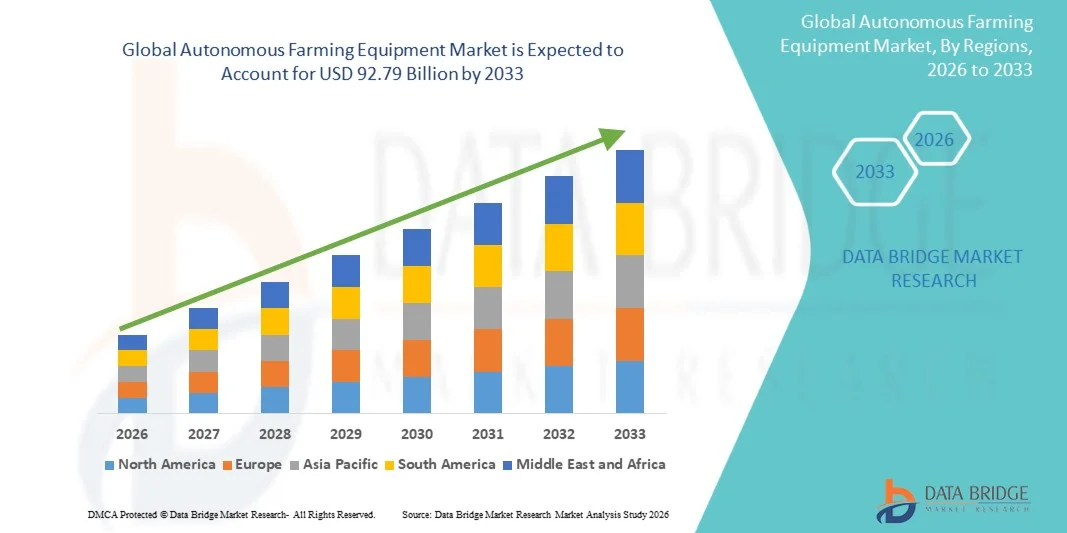
- As per Data Bridge Market Research Analysis the Autonomous Farming Equipment Market was valued at USD 29.3 Billion in 2025 and is projected to reach USD 92.79 Billion by 2033, growing at a CAGR of 15.50% from 2026 to 2033. The market is experiencing consistent growth driven by increasing adoption of precision agriculture technologies, rising labor shortages in the agricultural sector, and growing demand for improved farm productivity and efficiency. Expanding integration of artificial intelligence, robotics, GPS guidance systems, and autonomous navigation technologies is further supporting market expansion across both developed and emerging agricultural economies.
- The increasing global focus on sustainable farming and resource optimization, combined with rising food demand and the need to enhance agricultural output, is encouraging farmers to adopt autonomous equipment across diverse farming operations. Autonomous tractors, harvesters, spraying systems, and UAVs are increasingly replacing conventional machinery to improve accuracy, reduce labor dependency, and optimize the use of water, fertilizers, and pesticides. Continuous advancements in machine learning, sensor technologies, and smart farming platforms are further accelerating the transition toward highly automated and data-driven agriculture.
Market Size & Forecast
- Global Market Value (2025): USD 29.3 Billion
- Expected Market Value (2033): USD 92.79 Billion
- Forecast CAGR (2026–2033): 15.50%
- Leading Region in 2025: North America
- Fastest Growing Region: Asia-Pacific
Key Market Trends & Insights
- North America dominated the Autonomous Farming Equipment Market with the largest revenue share of 34.5% in 2025, supported by high adoption of precision agriculture technologies, strong mechanization levels, and increasing investments in smart farming solutions
- The partially-autonomous segment led the market with a 67.5% share in 2025, driven by the higher affordability and easier integration of semi-autonomous technologies into existing farming operations
- Asia-Pacific is expected to be the fastest-growing region at a CAGR of 10.7% from 2026 to 2033, fueled by rapid agricultural modernization, increasing labor shortages, and rising adoption of precision farming practices
- Fully autonomous is the fastest-growing automation type, projected to register a CAGR of 16.4% from 2026 to 2033, supported by rising demand for labor-free agricultural operations and increasing adoption of AI-powered machinery
- The field farming segment dominated the application category with a 58.2% revenue share in 2025, led by extensive deployment of autonomous equipment for planting, harvesting, spraying, and soil management activities
- Tractors accounted for 34.8% of the market in 2025, preferred by the widespread adoption of autonomous tractors for plowing, seeding, and field preparation activities
- The Unmanned Aerial Vehicles (UAVs) segment is the fastest-growing product category, with a CAGR of 15.2% from 2026 to 2033, driven by increasing use of drones for crop monitoring, spraying, and precision agriculture applications. UAVs provide real-time field data and help optimize water, fertilizer, and pesticide usage
Report Scope and Autonomous Farming Equipment Market Segmentation
|
Attributes |
Autonomous Farming Equipment Key Market Insights |
|
Segments Covered |
|
|
Countries Covered |
North America
Europe
Asia-Pacific
Middle East and Africa
South America
|
|
Key Market Players |
|
|
Market Opportunities |
|
|
Value Added Data Infosets |
In addition to the insights on market scenarios such as market value, growth rate, segmentation, geographical coverage, and major players, the market reports curated by the Data Bridge Market Research also include import export analysis, production capacity overview, production consumption analysis, price trend analysis, climate change scenario, supply chain analysis, value chain analysis, raw material/consumables overview, vendor selection criteria, PESTLE Analysis, Porter Analysis, and regulatory framework. |
What is the Key Trend in Autonomous Farming Equipment Market ?
Trend: Rising Adoption of AI-Enabled Precision Farming Technologies
Farmers are increasingly adopting AI-enabled autonomous equipment to improve productivity, optimize resource utilization, and address labor shortages across agricultural operations. Advanced technologies such as machine learning, computer vision, GPS guidance, and real-time analytics are being integrated into tractors, harvesters, drones, and spraying systems to enhance field efficiency and crop management. Precision farming practices are gaining strong traction across North America, Europe, and Asia-Pacific as growers focus on maximizing yields while reducing input costs. The increasing use of data-driven farming platforms and autonomous machinery is further accelerating the transition toward smart agriculture.
Companies such as Deere & Company are actively advancing autonomous farming technologies. In January 2025, the company introduced its next-generation autonomous 9RX tractor at CES, equipped with AI-powered obstacle detection, LiDAR sensors, and stereo cameras, strengthening the adoption of intelligent farming solutions across large-scale agricultural operations.
Autonomous Farming Equipment Market Dynamics
Key Market Driver: Increasing Labor Shortages and Demand for Higher Agricultural Productivity
The growing shortage of agricultural labor and increasing need to enhance crop productivity are significantly driving demand for autonomous farming equipment. Farmers are increasingly adopting automated tractors, robotic harvesters, and UAVs to reduce dependence on manual labor and improve operational efficiency. According to the Food and Agriculture Organization, global food production needs are expected to increase substantially to meet rising population demands, encouraging wider adoption of advanced agricultural technologies. Precision farming equipment is enabling growers to optimize the use of fertilizers, pesticides, and water resources while improving yield quality and consistency.
Major companies such as AGCO Corporation, CNH Industrial N.V., and KUBOTA Corporation are increasing investments in autonomous and smart farming technologies to address labor challenges and improve agricultural productivity across global markets.
Key Restraint/Challenge: High Initial Investment and Equipment Acquisition Costs
A major challenge in the Autonomous Farming Equipment market is the high capital investment associated with purchasing and deploying advanced agricultural machinery. Autonomous tractors, robotic harvesters, drones, AI software platforms, and precision guidance systems require substantial upfront expenditure, which limits adoption among small and medium-sized farms. Additional costs related to maintenance, connectivity infrastructure, software upgrades, and operator training further increase the total cost of ownership. Limited access to financing and slower technology penetration in developing regions continue to restrain widespread implementation.
The launch of advanced autonomous solutions by companies such as Deere & Company and KUBOTA Corporation in 2025 highlights the increasing technological sophistication and associated investment requirements involved in deploying next-generation autonomous farming systems across commercial agricultural operations.
Key Market Opportunity: Expansion of Autonomous UAV Applications in Crop Monitoring and Spraying
The increasing deployment of autonomous UAVs for crop monitoring, precision spraying, and field analytics is creating significant growth opportunities for the Autonomous Farming Equipment market. Agricultural drones enable farmers to collect real-time field data, detect diseases, monitor crop health, and optimize chemical application with greater accuracy. Advancements in AI imaging, multispectral sensors, and autonomous flight technologies are improving efficiency and expanding drone applications across modern farming operations. Rising government support for precision agriculture and growing demand for sustainable farming practices are further supporting market development.
Companies such as DJI and XAG are actively expanding autonomous drone solutions for agriculture. Their AI-enabled spraying and crop monitoring platforms are accelerating the adoption of UAV-based precision farming technologies and creating new opportunities across the Autonomous Farming Equipment Market.
Autonomous Farming Equipment Market Scope
The autonomous farming equipment market is segmented on the basis of product, automation, and application.
- By Product
On the basis of product, the Autonomous Farming Equipment Market is segmented into tractors, harvesting equipment, irrigation equipment, livestock equipment, haying & forage equipment, spraying equipment, unmanned aerial vehicles (UAVs), and others. The Tractors segment dominated the market with the largest share of 34.8% in 2025, driven by the widespread adoption of autonomous tractors for plowing, seeding, and field preparation activities. These machines provide enhanced operational efficiency and enable precision farming across large agricultural lands. Increasing labor shortages and rising demand for higher productivity are encouraging farmers to deploy self-guided tractor systems. Advancements in GPS, sensors, and AI-based navigation technologies are further improving performance and reliability. Growing investments by agricultural equipment manufacturers continue to strengthen the segment’s leading position.
The Unmanned Aerial Vehicles (UAVs) segment is projected to register the fastest growth at a CAGR of 15.2% from 2026 to 2033, driven by increasing use of drones for crop monitoring, spraying, and precision agriculture applications. UAVs provide real-time field data and help optimize water, fertilizer, and pesticide usage. Rapid developments in imaging technologies and AI-enabled analytics are expanding their capabilities across modern farming operations. Supportive government initiatives promoting smart agriculture are encouraging adoption in emerging economies. Rising focus on reducing input costs and improving crop yields is further accelerating segment growth across commercial farms.
- By Automation
On the basis of automation, the Autonomous Farming Equipment Market is segmented into partially-autonomous and fully autonomous. The Partially-Autonomous segment dominated the market with a share of 67.5% in 2025, supported by the higher affordability and easier integration of semi-autonomous technologies into existing farming operations. These systems allow operators to maintain supervision while benefiting from automated steering, guidance, and precision control features. Farmers are increasingly adopting partially autonomous solutions to improve productivity without requiring complete operational transformation. Compatibility with conventional machinery and lower investment requirements are contributing to wider acceptance. Continuous technological improvements are reinforcing the segment’s dominant position.
The Fully Autonomous segment is projected to register the fastest growth at a CAGR of 16.4% from 2026 to 2033, driven by rising demand for labor-free agricultural operations and increasing adoption of AI-powered machinery. Fully autonomous systems enable continuous field operations with minimal human intervention, improving efficiency and reducing labor dependency. Advancements in machine learning, robotics, and computer vision are enhancing navigation and decision-making capabilities. Increasing investments by leading agricultural technology companies are accelerating commercialization of fully autonomous platforms. Growing emphasis on precision farming and operational cost reduction is supporting strong segment expansion.
- By Application
On the basis of application, the Autonomous Farming Equipment Market is segmented into field farming, horticulture, dairy farming and livestock management, and others. The Field Farming segment dominated the market with the largest share of 58.2% in 2025, driven by extensive deployment of autonomous equipment for planting, harvesting, spraying, and soil management activities. Large-scale crop cultivation requires efficient and precise operations, encouraging adoption of advanced farming technologies. Increasing demand for improved crop productivity and optimized resource utilization is supporting segment growth. Autonomous systems help reduce labor costs while enhancing operational consistency across extensive farmlands. Rising implementation of precision agriculture practices further strengthens the segment’s leadership.
The Horticulture segment is projected to register the fastest growth at a CAGR of 14.6% from 2026 to 2033, driven by increasing demand for high-value fruits, vegetables, and greenhouse crops. Autonomous technologies are enabling better crop monitoring, targeted spraying, and efficient harvesting in horticultural operations. Advancements in robotics and imaging systems are improving precision and reducing crop losses. Growing emphasis on sustainable farming and controlled-environment agriculture is supporting adoption across developed and emerging markets. Rising investments in smart farming technologies are expected to accelerate the expansion of the segment.
Autonomous Farming Equipment Market Regional Analysis
North America dominated the autonomous farming equipment market and accounted for the largest revenue share of 34.5% in 2025, driven by high adoption of precision agriculture technologies, strong mechanization levels, and increasing investments in smart farming solutions. The region benefits from large commercial farms, advanced GPS infrastructure, and widespread use of AI enabled agricultural machinery. Farmers are increasingly deploying autonomous tractors, harvesters, and UAVs to improve productivity and address labor shortages. Strong support from government programs promoting sustainable agriculture and the presence of major equipment manufacturers continue to strengthen regional market growth. In addition, continuous technological advancements and rising demand for data driven farming practices reinforce North America’s leading position in the global market.
U.S. Autonomous Farming Equipment Market Insight
The U.S. Autonomous Farming Equipment market is experiencing strong growth driven by increasing adoption of precision farming technologies, rising labor shortages, and strong investments in agricultural automation. Farmers are increasingly utilizing autonomous tractors, spraying systems, and UAVs to enhance efficiency and reduce operational costs. The country’s highly developed agricultural sector and strong presence of leading equipment manufacturers are supporting rapid deployment of advanced farming technologies. Growing demand for sustainable crop production and resource optimization is encouraging adoption across large scale farms. In addition, continuous advancements in AI, robotics, and machine learning are accelerating market expansion across the U.S.
Canada Autonomous Farming Equipment Market Insight
The Canada Autonomous Farming Equipment market is witnessing steady growth supported by rising mechanization in agriculture and increasing focus on improving farm productivity. Farmers are adopting autonomous equipment to optimize labor utilization and enhance operational efficiency across vast agricultural lands. The country’s strong emphasis on precision agriculture and sustainable farming practices is encouraging investments in advanced agricultural machinery. Growing adoption of GPS enabled systems and drone technologies is further supporting market growth. In addition, government initiatives aimed at promoting smart farming are contributing to the expansion of the market in Canada.
Europe Autonomous Farming Equipment Market Insight
The Europe Autonomous Farming Equipment market is expanding steadily due to increasing emphasis on sustainable agriculture, rising labor costs, and growing adoption of precision farming technologies. The region benefits from strong agricultural modernization programs and increasing investments in digital farming solutions. Farmers are increasingly deploying autonomous tractors, robotic harvesting systems, and drone based monitoring technologies to improve efficiency and reduce environmental impact. Growing demand for resource optimization and reduced chemical usage is supporting market development. Rising integration of AI and IoT technologies in agricultural operations continues to strengthen the growth of the autonomous farming equipment market across Europe.
U.K. Autonomous Farming Equipment Market Insight
The U.K. Autonomous Farming Equipment market is growing steadily, driven by increasing labor shortages, rising demand for precision agriculture, and strong focus on sustainable farming practices. Farmers are increasingly adopting autonomous machinery to improve productivity and reduce dependence on seasonal labor. The country’s advanced agricultural research ecosystem and growing investments in agri-tech innovations are supporting technology adoption. Rising use of AI driven monitoring and automated field management systems is further accelerating market development. In addition, government support for digital agriculture initiatives is strengthening growth across the U.K.
Germany Autonomous Farming Equipment Market Insight
The Germany Autonomous Farming Equipment market is expanding due to strong agricultural mechanization, increasing adoption of smart farming technologies, and growing focus on operational efficiency. Farmers are increasingly utilizing autonomous tractors, harvesting equipment, and precision spraying systems to optimize productivity and reduce costs. The country’s advanced manufacturing capabilities and strong presence of agricultural equipment companies are supporting market expansion. Rising emphasis on sustainable farming and efficient resource utilization is encouraging investments in innovative agricultural technologies. In addition, continuous advancements in robotics and automation are accelerating market growth in Germany.
Asia-Pacific Autonomous Farming Equipment Market Insight
The Asia-Pacific Autonomous Farming Equipment market is expected to register the fastest growth with a CAGR of 10.7% from 2026 to 2033, driven by rapid agricultural modernization, increasing labor shortages, and rising adoption of precision farming practices. Growing investments in smart agriculture and supportive government initiatives are encouraging deployment of autonomous machinery across the region. Countries such as China, India, Japan, and Australia are witnessing increasing demand for AI enabled tractors, UAVs, and robotic harvesting systems. Expanding awareness regarding sustainable farming and efficient resource management is supporting market growth. In addition, rising food demand and technological advancements are further accelerating regional market expansion.
Japan Autonomous Farming Equipment Market Insight
The Japan Autonomous Farming Equipment market is witnessing steady growth supported by an aging farming population, increasing labor shortages, and strong focus on agricultural automation. Farmers are adopting autonomous tractors and robotic systems to improve efficiency and maintain agricultural productivity. The country’s advanced robotics capabilities and strong emphasis on technological innovation are supporting market development. Increasing investments in precision farming and AI based monitoring systems are enhancing adoption rates. In addition, government initiatives promoting smart agriculture are contributing to sustained market growth in Japan.
China Autonomous Farming Equipment Market Insight
The China Autonomous Farming Equipment market is growing rapidly due to increasing agricultural mechanization, rising investments in smart farming technologies, and growing demand for higher crop productivity. Farmers are actively adopting autonomous tractors, UAVs, and precision spraying systems to improve efficiency and optimize resource utilization. The country’s large agricultural sector and strong support for agricultural modernization are accelerating deployment of advanced equipment. Increasing integration of AI, IoT, and satellite navigation technologies is further strengthening market development. In addition, rising focus on food security and sustainable farming practices is driving strong market growth in China.
Autonomous Farming Equipment Market Share
The autonomous farming equipment industry is primarily led by well-established companies, including
- Deere & Company (U.S.)
- CNH Industrial N.V. (Netherlands)
- KUBOTA Corporation (Japan)
- AGCO Corporation (U.S.)
- JCB (U.K.)
- Trringo (India)
- Escorts Limited (India)
- Tractors and Farm Equipment Limited (India)
- The Papé Group, Inc. (U.S.)
- Premier Equipment Limited (Canada)
- Flaman (Canada)
- Pacific Ag Rentals (Canada)
- Pacific Tractor & Implement (U.S.)
- Farmease (India)
- KWIPPED, Inc. (U.S.)
- Cedar Street (U.S.)
- EM3 Agri Services (India)
- Princeville (U.S.)
- Friesen Sales & Rentals (Canada)
- Messick's (U.S.)
- Autonomous Tractor Corporation (U.S.)
Latest Developments in Autonomous Farming Equipment Market
- In February 2026, TerraClear launched the TerraScout autonomous robot platform equipped with AI-powered imaging and real-time field intelligence capabilities to generate precision mission plans for existing farm equipment, strengthening the adoption of autonomous technologies across large-scale row crop operations. The development is expected to enhance productivity, improve resource utilization, and accelerate the transition toward data-driven and highly automated farming practices, thereby supporting overall market expansion
- In November 2025, Claas showcased its advanced TORION Autonomy Connect system at Agritechnica, featuring an autonomous wheel loader powered by LiDAR sensors and AI-based pile analysis for GPS-independent silage handling, along with the Weed Detector system and Dynamic Field Scout platform. These innovations are strengthening the adoption of precision agriculture technologies and improving operational efficiency, thereby supporting the expansion of the autonomous farming equipment market through enhanced productivity and resource optimization
- In May 2025, Case IH unveiled a concept autonomous tractor incorporating advanced AI algorithms, radar-based obstacle detection, and remote operation capabilities designed for tillage and planting activities. The introduction of intelligent and highly automated machinery is expected to accelerate precision farming adoption and address labor shortages, contributing to increasing demand for autonomous farming equipment across commercial agricultural operations
- In January 2025, John Deere introduced its next-generation autonomous machinery portfolio at CES, led by the autonomous 9RX tractor equipped with 360-degree perception through stereo cameras, LiDAR sensors, and AI-powered obstacle detection systems. This advancement reinforces the company’s leadership in large-scale farm automation and is driving broader market growth by enabling higher efficiency, improved safety, and reduced dependence on manual labor
- In January 2025, Kubota unveiled multiple autonomous solutions at CES, including the Agri Concept 2.0 electric tractor with GPS guidance and remote mission planning, an AI-enabled smart sprayer, a multifunctional robotic cart, and robotic orchard pruners. These innovations are promoting sustainable and technology-driven agriculture while expanding the scope of autonomous applications, thereby supporting long-term growth opportunities for the autonomous farming equipment market

- Interactive Data Analysis Dashboard
- Company Analysis Dashboard for high growth potential opportunities
- Research Analyst Access for customization & queries
- Competitor Analysis with Interactive dashboard
- Latest News, Updates & Trend analysis
- Harness the Power of Benchmark Analysis for Comprehensive Competitor Tracking
Data collection and base year analysis are done using data collection modules with large sample sizes. The stage includes obtaining market information or related data through various sources and strategies. It includes examining and planning all the data acquired from the past in advance. It likewise envelops the examination of information inconsistencies seen across different information sources. The market data is analysed and estimated using market statistical and coherent models. Also, market share analysis and key trend analysis are the major success factors in the market report. To know more, please request an analyst call or drop down your inquiry.
The key research methodology used by DBMR research team is data triangulation which involves data mining, analysis of the impact of data variables on the market and primary (industry expert) validation. Data models include Vendor Positioning Grid, Market Time Line Analysis, Market Overview and Guide, Company Positioning Grid, Patent Analysis, Pricing Analysis, Company Market Share Analysis, Standards of Measurement, Global versus Regional and Vendor Share Analysis. To know more about the research methodology, drop in an inquiry to speak to our industry experts.
Data Bridge Market Research is a leader in advanced formative research. We take pride in servicing our existing and new customers with data and analysis that match and suits their goal. The report can be customized to include price trend analysis of target brands understanding the market for additional countries (ask for the list of countries), clinical trial results data, literature review, refurbished market and product base analysis. Market analysis of target competitors can be analyzed from technology-based analysis to market portfolio strategies. We can add as many competitors that you require data about in the format and data style you are looking for. Our team of analysts can also provide you data in crude raw excel files pivot tables (Fact book) or can assist you in creating presentations from the data sets available in the report.