What is the Autonomous Greenhouse Pollination Systems Market Size and Growth Rate?
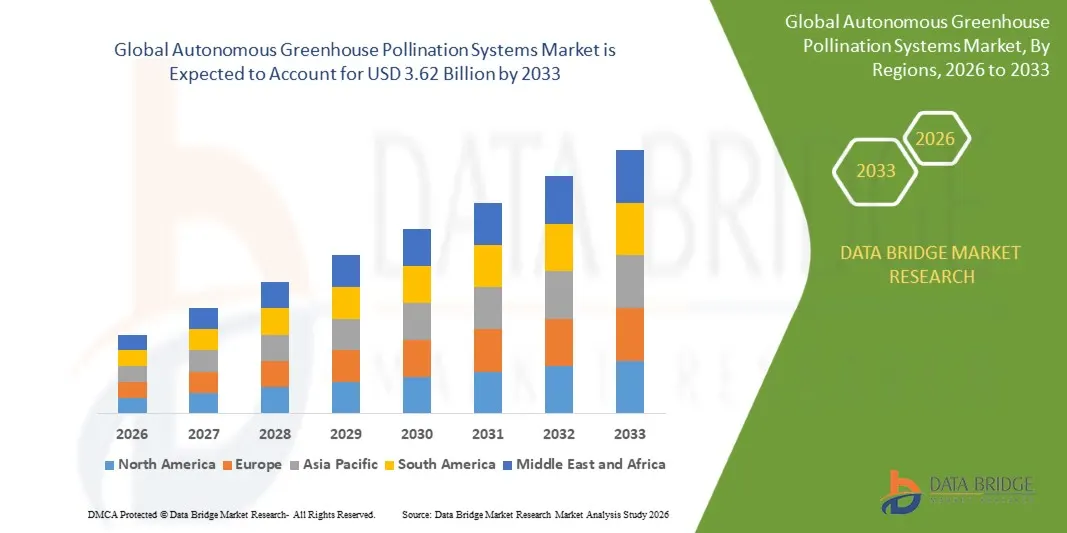
- As per Data Bridge Market Research analysis, the autonomous greenhouse pollination systems market was valued at USD 1.42 billion in 2025 and is projected to reach USD 3.62 billion by 2033, growing at a CAGR of 12.40% from 2026 to 2033.
- The market is experiencing rapid growth driven by rising greenhouse labor costs, increasing adoption of AI-enabled robotics, and expanding need for reliable pollination in energy-saving and year-round protected cultivation.
- The increasing shift toward high-tech greenhouse production, data-driven crop management, and reduced dependence on bumblebees and manual labor, combined with growing integration of machine vision, sensors, and plant-level analytics, is supporting market adoption. Autonomous pollination is being applied across tomato, pepper, and berry greenhouses, offering growers greater control over fruit set using agricultural robots, greenhouse horticulture, and precision farming technologies.
Market Size & Forecast
- Global Market Value (2025): USD 1.42 Billion
- Expected Market Value (2033): USD 3.62 Billion
- Forecast CAGR (2026–2033): 12.40%
- Leading Region in 2025: Europe
- Fastest Growing Region: Asia-Pacific
What are the Major Takeaways of the Autonomous Greenhouse Pollination Systems Market?
- Europe dominated the autonomous greenhouse pollination systems market with the largest revenue share of 39.60% in 2025, supported by large high-tech greenhouse areas, strong adoption of energy-saving growing practices, and early commercial deployment of robots.
- Asia-Pacific is expected to be the fastest-growing region at a CAGR of 14.80% from 2026 to 2033, fueled by rapid greenhouse expansion, rising labor costs, and strong government support for smart agriculture.
- The ground robots segment led the market with a 58.30% share in 2025, driven by proven performance in tomato greenhouses, row-based navigation, and integration with plant data platforms.
- Aerial drones are the fastest-growing system type, projected to register a CAGR of 15.10%, reflecting rising demand for flexible, rail-free pollination in multi-crop and vertical growing environments.
- The AI & machine vision segment dominated the technology category with a 56.20% revenue share in 2025, led by flower detection, ripeness assessment, and precise pollen transfer.
- Tomatoes accounted for 62.40% of the market share in 2025, preferred for their dependence on vibration pollination and large protected cultivation area.
- The berries segment is the fastest-growing crop type, with a CAGR of 14.60%, driven by high crop value, labor-intensive harvesting, and increasing greenhouse and tunnel production.
Report Scope and Autonomous Greenhouse Pollination Systems Market Segmentation
|
Attributes |
Autonomous Greenhouse Pollination Systems Key Market Insights |
|
Segments Covered |
|
|
Countries Covered |
North America
Europe
Asia-Pacific
Middle East and Africa
South America
|
|
Key Market Players |
|
|
Market Opportunities |
|
|
Value Added Data Infosets |
In addition to the insights on market scenarios such as market value, growth rate, segmentation, geographical coverage, and major players, the market reports curated by the Data Bridge Market Research also include import export analysis, production capacity overview, production consumption analysis, price trend analysis, climate change scenario, supply chain analysis, value chain analysis, raw material/consumables overview, vendor selection criteria, PESTLE Analysis, Porter Analysis, and regulatory framework. |
What is the Key Trend in the Autonomous Greenhouse Pollination Systems Market?
- Autonomous pollination systems are increasingly evolving from single-task robots into multi-function crop platforms, combining pollination, plant monitoring, yield forecasting, and energy-saving operations under challenging greenhouse conditions.
- For instance, in June 2026, Arugga AI Farming demonstrated robotic pollination in an LED-lit greenhouse in Frovi, Sweden, with screens closed, and microscopic analysis showed more pollen on stigmas pollinated by its robot than by bees alone, highlighting the shift toward energy-efficient growing
- Robots are increasingly generating plant-level data on flower counts, pollination success, and crop health, as growers use autonomous platforms to scout every plant rather than sampling small sections of the greenhouse.
- Developers are expanding into adjacent tasks such as plant lowering and pest detection, as buyers compare systems on pollination speed, uptime, integration with climate computers, and total labor savings.
- For instance, in October 2025, the Delphy Improvement Centre in Bleiswijk, the Netherlands, began trials of the Polly+ robot to compare three growing conditions, including closed screens that would normally not be possible with bumblebees, showing how robots enable new energy-saving strategies
- As machine vision, plant analytics, energy-saving cultivation, and labor shortages continue to advance, autonomous greenhouse pollination is expected to expand beyond tomatoes into peppers, cucumbers, berries, and other high-value crops.
What are the Key Drivers of the Autonomous Greenhouse Pollination Systems Market?
- Rising labor costs, labor shortages, and the unreliability of bumblebees in low-light and energy-saving conditions have significantly increased demand for automated pollination that can run consistently across seasons.
- For instance, in October 2022, according to Horti Daily, tests in commercial greenhouses in Israel, Australia, and the United States showed that tomatoes pollinated by Arugga’s Polly robot had yields up to 5% higher than those pollinated by bumblebees and up to 20% higher than manual pollination.
- Tomato growers, berry producers, seed companies, and vertical farms are adopting autonomous pollination to improve fruit set, reduce manual work, and gain plant-level data that supports yield forecasting and crop planning.
- For instance, in September 2023, Finnish grower Agrifutura converted its 4.6-hectare greenhouse into what Arugga called the world’s first facility to fully use robotic pollination, reporting a 10% yield increase compared with its previous reliance on bees, which often underperform during long dark winter days.
- With growers, technology providers, and research centers testing robots under commercial conditions, autonomous pollination systems can gain wider visibility, trust, and repeat orders across protected agriculture.
What Factors Are Challenging the Growth of the Autonomous Greenhouse Pollination Systems Market?
- Autonomous pollination systems face strong competition from established bumblebee services, which are low-cost, widely available, and deeply embedded in grower routines.
- For instance, in December 2025, Biobest and Koppert supplied over 70% of the world’s greenhouse bumblebee colonies in 2025, showing the dominant position of the incumbent biological pollination model that robots must displace.
- These switching barriers can slow adoption among cost-conscious growers, while crop-specific performance, limited installed base, and need for technical support may delay purchase decisions and extend sales cycles.
- High upfront costs, integration with climate and crop systems, and a limited track record beyond tomatoes further restrict growth, requiring suppliers to invest in field trials, service networks, and flexible business models that may increase operating costs.
- For instance, in December 2024, Arugga last raised USD 2 million, while edete Precision Technologies had last raised USD 3 million in June 2018, indicating the limited capital available to scale specialized pollination robot developers and to fund large field trials across multiple crops and regions.
- The combination of strong bumblebee incumbents, high capital costs, limited crop coverage, and funding constraints for young technology companies can constrain adoption among cost-sensitive growers and smaller greenhouse operators, particularly where bees already provide adequate pollination.
How is the Autonomous Greenhouse Pollination Systems Market Segmented?
The autonomous greenhouse pollination systems market is segmented on the basis of system type, technology, crop type, and greenhouse type.
- By System Type
On the basis of system type, the autonomous greenhouse pollination systems market is segmented into ground robots, aerial drones, and fixed & rail-mounted systems. The ground robots segment dominated the market with 58.30% share in 2025, supported by proven performance in tomato greenhouses, easy navigation along pipe rails and row paths, and integration with plant data platforms. Ground robots replicate bumblebee vibration to release pollen. They can operate day and night and are not affected by light levels. Commercial deployments in Europe, North America, and Australia strengthen demand. Second-generation models offer higher speed and richer data, further reinforcing the segment’s leadership.
The aerial drones segment is projected to register the fastest growth at a CAGR of 15.10% from 2026 to 2033, driven by demand for flexible, rail-free pollination in multi-crop and vertical growing environments. Small drones can move above plants and reach flowers in tall or complex canopies. Their applications include berries, peppers, and indoor farms. Advances in lightweight sensors, battery life, and collision avoidance are improving practicality. Growers also see potential for combined scouting and pollination, while regulations and safety remain important considerations. Downward airflow control, quiet motors, and precise positioning are being refined to avoid damaging delicate flowers, and pilot projects with research centers are helping validate use cases.
- By Technology
On the basis of technology, the autonomous greenhouse pollination systems market is segmented into AI & machine vision, sensor-based control, and others. The AI & machine vision segment dominated the market with 56.20% share in 2025, supported by its ability to detect flowers ready for pollination, track every plant, and generate data for decisions. Cameras and trained models identify flower stage and position with high accuracy. Systems then deliver air pulses or vibration at the right moment. Continuous learning improves performance across crops and seasons. Integration with greenhouse dashboards further strengthens the segment’s leadership.
The sensor-based control segment is projected to register the fastest growth at a CAGR of 13.90% from 2026 to 2033, driven by rising use of environmental and contact sensors to time pollination and monitor conditions. Humidity, temperature, and light sensors help identify the best pollination windows. Low-cost sensors are enabling simpler robots for smaller growers. Combined with climate computers, they support energy-saving strategies. Improved reliability and calibration are enhancing adoption. Sensor data on pollen viability, flower temperature, and canopy humidity also helps growers fine-tune greenhouse climate and improve fruit set across seasons, while open data standards ease integration with existing control systems.
- By Crop Type
On the basis of crop type, the autonomous greenhouse pollination systems market is segmented into tomatoes, peppers & cucumbers, berries, and others. The tomatoes segment dominated the crop category with 62.40% share in 2025, supported by tomato flowers’ dependence on vibration for pollination and the large area under protected tomato cultivation. Growers face labor shortages and the limits of bumblebees in winter and under closed screens. Robots can improve fruit set and uniformity. Established commercial deployments and measured yield gains continue to reinforce this segment's leadership, and cherry and vine varieties both benefit from consistent timing.
The berries segment is projected to register the fastest growth at a CAGR of 14.60% from 2026 to 2033, supported by high crop value, labor-intensive production, and rapid growth of greenhouse and tunnel cultivation. Strawberries, blueberries, and raspberries benefit from consistent pollination for fruit size and shape. Growers are testing robots and drones as alternatives to insects. Year-round production and premium prices support investment. Gentle pollen transfer and crop-specific adaptation remain important for wider adoption. Retailers’ demand for consistent quality and traceability is also encouraging berry growers to adopt data-rich automation, while pilot programs with leading producers are building confidence.
- By Greenhouse Type
On the basis of greenhouse type, the autonomous greenhouse pollination systems market is segmented into glass greenhouses, plastic greenhouses, and vertical & indoor farms. The glass greenhouses segment dominated the market with 52.70% share in 2025, driven by large, climate-controlled high-tech facilities in northern Europe, North America, and Australia. These growers have the capital, infrastructure, and data systems needed for automation. Energy-saving practices such as closed screens and LED lighting increase the value of robots. Established relationships with technology providers continue to reinforce this segment's leadership, and long crop cycles give robots many operating hours to earn a return.
The vertical & indoor farms segment is projected to register the fastest growth at a CAGR of 16.20% from 2026 to 2033, supported by rapid growth of controlled-environment agriculture and the absence of natural pollinators. Indoor farms must pollinate fruiting crops without bees, which favors robots. Fully controlled climates allow precise timing and repeatable results. Investment in urban and food-security projects is increasing demand. High energy and capital costs remain important considerations for long-term adoption. Compact robots and drones designed for multi-layer racks are expected to open new opportunities for strawberries, tomatoes, and specialty crops.
Which Region Holds the Largest Share of the Autonomous Greenhouse Pollination Systems Market?
- Europe dominated the autonomous greenhouse pollination systems market with the largest revenue share of 39.60% in 2025, supported by large high-tech greenhouse areas, strong adoption of energy-saving growing practices, and early commercial deployment of robots.
- The region also benefits from a dense network of greenhouse technology suppliers, research centers, and large tomato producers, along with strong interest in energy-saving cultivation. Increasing labor costs and sustainability targets, together with demonstration trials at leading improvement centers, continue to strengthen Europe’s position in the global market.
U.K. Autonomous Greenhouse Pollination Systems Market Insight
The U.K. autonomous greenhouse pollination systems market is experiencing steady growth, supported by large greenhouse tomato producers, labor constraints, and strong interest in energy-efficient cultivation. Growers are increasingly trialing robots to improve consistency and reduce reliance on manual work. Furthermore, active horticulture research, retailer sustainability targets, large commercial sites such as Thanet Earth, and growing data use are supporting wider adoption of autonomous pollination in the U.K.
Germany Autonomous Greenhouse Pollination Systems Market Insight
The Germany autonomous greenhouse pollination systems market is expanding steadily due to the country’s strong engineering base, growing greenhouse sector, and focus on energy efficiency and automation. Growers, research institutes, and equipment makers are increasingly utilizing robotics for crop care. Continuous innovation in greenhouse technology, strong research institutions, and Germany’s focus on quality, sustainability, and precision are further driving market growth in the country.
Asia-Pacific Autonomous Greenhouse Pollination Systems Market Insight
The Asia-Pacific autonomous greenhouse pollination systems market is expected to witness rapid growth, driven by rapid greenhouse expansion, rising labor costs, and strong government support for smart agriculture across countries such as China, India, and Japan. Growing demand for high-value vegetables and fruits is supporting regional market expansion. In addition, the region’s strong robotics manufacturing base, expanding vertical farms, and rising investment in agri-tech start-ups are accelerating availability and adoption of autonomous pollination.
Japan Autonomous Greenhouse Pollination Systems Market Insight
The Japan autonomous greenhouse pollination systems market is witnessing consistent growth due to an aging farming workforce, advanced robotics capability, and strong demand for premium strawberries and tomatoes. Growers, technology firms, and research institutions are increasingly testing pollination robots. Moreover, strong demand for precision, quality, and labor-saving technologies, along with collaboration between universities and manufacturers, is further contributing to market growth in Japan.
China Autonomous Greenhouse Pollination Systems Market Insight
The China autonomous greenhouse pollination systems market is growing rapidly, driven by large-scale greenhouse construction, rising labor costs, and government support for smart agriculture. Growing domestic robotics and drone manufacturing is significantly boosting market demand. In addition, large vegetable and fruit production areas, advanced digital agriculture programs, strong local suppliers, and competitive pricing are positioning China as a key growth market across Asia-Pacific.
Which are the Top Companies in Autonomous Greenhouse Pollination Systems Market?
The autonomous greenhouse pollination systems industry is primarily led by well-established companies, including:
- Arugga AI Farming (Israel)
- Koppert Biological Systems (Netherlands)
- Biobest Group NV (Belgium)
- Priva (Netherlands)
- BeeHero (Israel)
- Edete Precision Technologies for Agriculture (Israel)
- BloomX (Israel)
- Beewise Technologies (Israel)
- Dropcopter (U.S.)
- Polybee (Singapore)
- PowerPollen (U.S.)
- HarvestX (Japan)
- BioBee Biological Systems (Israel)
- Bioline AgroSciences (France)
- Fargro Ltd (U.K.)
- ARBICO Organics (U.S.)
- XAG Co., Ltd. (China)
- Agrobot (Spain)
- Dogtooth Technologies (U.K.)
- Four Growers (U.S.)
What are Latest Developments in Autonomous Greenhouse Pollination Systems Market?
- In June 2026, Arugga AI Farming reported that its Polly pollination robot performed successfully in an LED-lit greenhouse in Frovi, Sweden, operating under red LED lighting with screens closed. Microscopic analysis showed higher pollen quantity on stigmas pollinated by the robot than on those pollinated by bees alone, supporting energy-efficient greenhouse operation and stable crop production.
- In October 2025, data collected by Arugga’s Polly+ pollination robot became available through a new data dashboard that provides real-time, plant-level insights to tomato growers. The company also appointed a leader to oversee commercial expansion and customer success as it responds to labor shortages and growing global demand, driving partnerships with greenhouse growers, distributors, and technology integrators worldwide.
- In June 2025, Arugga AI Farming shipped its first plant-lowering robots in Europe, nicknamed Louie, for tomato and cucumber greenhouses. The autonomous robot automates one of the most labor-intensive greenhouse tasks and extends the company’s platform beyond pollination, giving growers a multi-function robotic fleet that can share data across tasks.
- In May 2025, Arugga AI Farming launched Polly+, the second generation of its autonomous pollination robot, which is twice as fast as its predecessor and offers enhanced data capabilities. The robot was deployed in European sites including Thanet Earth and Food Ventures and was shown to replicate bumblebee pollination, with growers reporting consistent yield gains versus bumblebees and manual pollination.
- In September 2023, Finnish grower Agrifutura completed the transition of its 4.6-hectare greenhouse to robotic pollination using Arugga’s Polly, which the company described as the first greenhouse to fully rely on the technology. The grower reported a 10% yield increase compared with its earlier use of bees.

- Interactive Data Analysis Dashboard
- Company Analysis Dashboard for high growth potential opportunities
- Research Analyst Access for customization & queries
- Competitor Analysis with Interactive dashboard
- Latest News, Updates & Trend analysis
- Harness the Power of Benchmark Analysis for Comprehensive Competitor Tracking
Data collection and base year analysis are done using data collection modules with large sample sizes. The stage includes obtaining market information or related data through various sources and strategies. It includes examining and planning all the data acquired from the past in advance. It likewise envelops the examination of information inconsistencies seen across different information sources. The market data is analysed and estimated using market statistical and coherent models. Also, market share analysis and key trend analysis are the major success factors in the market report. To know more, please request an analyst call or drop down your inquiry.
The key research methodology used by DBMR research team is data triangulation which involves data mining, analysis of the impact of data variables on the market and primary (industry expert) validation. Data models include Vendor Positioning Grid, Market Time Line Analysis, Market Overview and Guide, Company Positioning Grid, Patent Analysis, Pricing Analysis, Company Market Share Analysis, Standards of Measurement, Global versus Regional and Vendor Share Analysis. To know more about the research methodology, drop in an inquiry to speak to our industry experts.
Data Bridge Market Research is a leader in advanced formative research. We take pride in servicing our existing and new customers with data and analysis that match and suits their goal. The report can be customized to include price trend analysis of target brands understanding the market for additional countries (ask for the list of countries), clinical trial results data, literature review, refurbished market and product base analysis. Market analysis of target competitors can be analyzed from technology-based analysis to market portfolio strategies. We can add as many competitors that you require data about in the format and data style you are looking for. Our team of analysts can also provide you data in crude raw excel files pivot tables (Fact book) or can assist you in creating presentations from the data sets available in the report.