What is the Autonomous Mobile Manipulator Robots Market Size and Growth Rate?
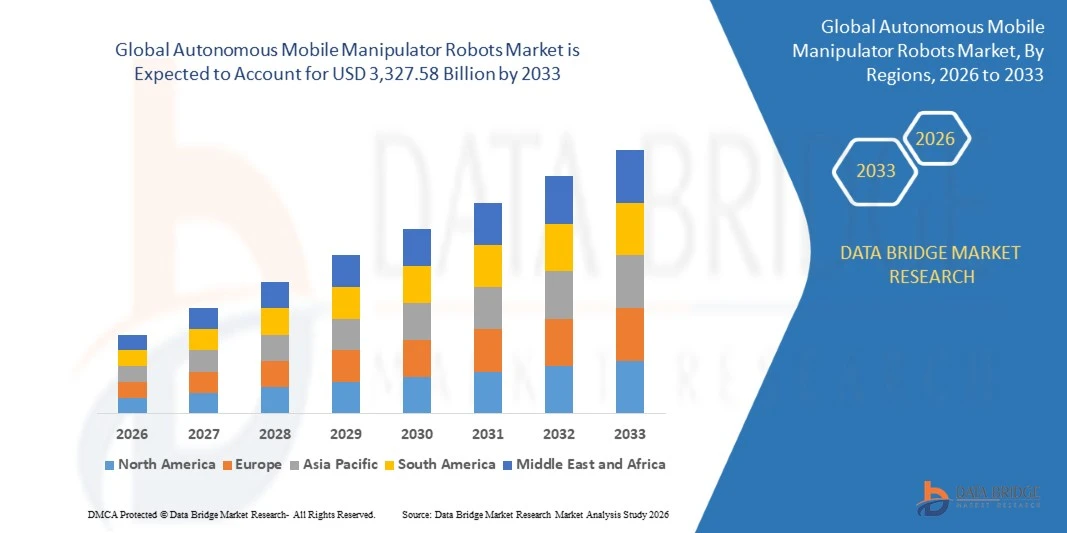
- As per Data Bridge Market Research analysis, the autonomous mobile manipulator robots market was valued at USD 591.50 billion in 2025 and is projected to reach USD 3,327.58 billion by 2033, growing at a CAGR of 24.10% from 2026 to 2033.
- The market is experiencing consistent growth driven by rising demand for flexible automation solutions, rapid advancements in robotic arms and autonomous mobile platforms, and expanding applications across manufacturing, logistics, warehousing, and electronics production.
- The increasing need to address labor shortages, improve workplace safety, and enhance operational efficiency is compelling manufacturers, logistics providers, and warehouse operators to adopt autonomous mobile manipulator robots. These systems combine autonomous navigation with robotic arms to perform material handling, picking and placing, assembly, and inspection tasks, enabling flexible, productive, and increasingly automated industrial operations.
Market Size & Forecast
- Global Market Value (2025): USD 591.50 Billion
- Expected Market Value (2033): USD 3,327.58 Billion
- Forecast CAGR (2026–2033): 24.10%
- Leading Region in 2025: North America
- Fastest Growing Region: Asia Pacific
What are the Major Takeaways of the Autonomous Mobile Manipulator Robots Market?
- North America dominated the autonomous mobile manipulator robots market with the largest revenue share of 35.0% in 2025, supported by advanced industrial automation infrastructure, strong investments in robotics, and increasing adoption across manufacturing and logistics operations.
- Asia-Pacific is expected to be the fastest-growing region at a CAGR of 27.5% from 2026 to 2033, fueled by rapid industrialization, expanding warehouse automation, rising labor costs, and growing adoption across China, Japan, South Korea, and India.
- The differential mobile manipulator robots segment led the market with a 58.5% share in 2025, driven by its cost-effectiveness, relatively simple mechanical design, and suitability for structured industrial environments
- Omni-directional mobile manipulator robots are the fastest-growing system type, projected to register a CAGR of 26.0%, reflecting the surge in demand for immersive, interactive driver training environments.
- The laser/LiDAR-based navigation segment dominated the navigation technology category with a 35.0% revenue share in 2025, led by its ability to measure distances accurately and detect obstacles in industrial environments
- Assembly accounted for 30.0% of the market share in 2025, preferred by increasing automation across automotive, electronics, and industrial manufacturing.
- The sorting segment is the fastest-growing application category, with a CAGR of 28.0%, driven by increasing requirements for automated order fulfillment and efficient product handling.
Report Scope and Autonomous Mobile Manipulator Robots Market Segmentation
|
Attributes |
Autonomous Mobile Manipulator Robots Key Market Insights |
|
Segments Covered |
|
|
Countries Covered |
North America
Europe
Asia-Pacific
Middle East and Africa
South America
|
|
Key Market Players |
|
|
Market Opportunities |
|
|
Value Added Data Infosets |
In addition to the market insights such as market value, growth rate, market segments, geographical coverage, market players, and market scenario, the market report curated by the Data Bridge Market Research team includes in-depth expert analysis, import/export analysis, pricing analysis, production consumption analysis, and pestle analysis. |
What is the Key Trend in the Autonomous Mobile Manipulator Robots Market?
- Manufacturers and logistics providers are increasingly adopting autonomous mobile manipulator robots to combine autonomous transportation with robotic picking, handling, and assembly, improving flexibility and reducing dependence on fixed automation systems.
- For instance, in March 2024, Siemens and NVIDIA expanded their collaboration to advance industrial AI and digitalization, supporting the development of more intelligent and flexible industrial automation environments.
- AI-powered perception and machine vision enable robots to identify objects, navigate dynamic environments, and perform manipulation tasks with greater precision.
- Warehouses and manufacturing facilities are increasingly integrating mobile manipulators with existing automation systems to improve material flow, picking accuracy, and operational flexibility.
- For instance, in March 2024, BMW Group announced the expansion of its collaboration with Figure to explore humanoid robot deployment in automotive production, demonstrating growing interest in flexible robotic automation.
- As industrial organizations prioritize flexible production, intelligent material handling, and reduced manual intervention, autonomous mobile manipulator robots are expected to become increasingly important in connected manufacturing and warehouse automation.
What are the Key Drivers of the Autonomous Mobile Manipulator Robots Market?
- The rapid advancement of artificial intelligence, machine vision, and autonomous navigation has significantly increased demand for mobile manipulator robots capable of performing complex material handling, picking, and assembly tasks in dynamic industrial environments.
- For instance, in March 2025, Robotnik introduced the RB-ROBOUT+ an omnidirectional mobile manipulator designed for heavy and long-reach loads, capable of handling payloads of up to 35 kg with a robotic arm reach of 1,300 mm.
- Manufacturing companies, warehouse operators, and logistics providers are integrating autonomous mobile manipulators into their operations to reduce repetitive manual work, improve productivity, and increase flexibility across production and fulfillment processes.
- For instance, in August 2024, BMW Group reported successful trials of Figure 02 robots at its Spartanburg plant where the robots inserted sheet-metal parts into fixtures for chassis assembly, demonstrating the potential of advanced robotic manipulation in automotive manufacturing.
- With industries increasingly prioritizing labor efficiency, flexible automation, and intelligent material handling, autonomous mobile manipulator robots are expected to play an increasingly important role in modernizing industrial operations and improving manufacturing productivity.
What Factors are Challenging the Growth of the Autonomous Mobile Manipulator Robots Market?
- Autonomous mobile manipulator robots require significant upfront investment due to the integration of robotic arms, mobile platforms, sensors, navigation systems, machine vision, and advanced control software.
- For instance, in August 2024, Control Engineering reported findings from a global survey of 300 mobile robot buyers and users. High prices or a perceived lack of return on investment were the most common reasons for not adopting mobile robots, while integration difficulties and facility constraints also limited deployment
- These high costs, combined with system integration complexity and the need for skilled technical personnel, can limit adoption among small and medium-sized manufacturers, warehouses, and organizations with limited automation budgets.
- For instance, in October 2023, an article published in Sensors examined mobile manipulators in Industry 4.0 applications and highlighted integration requirements involving safety, human–robot interaction, and cybersecurity.
- The high capital investment, integration requirements, and recurring maintenance costs associated with autonomous mobile manipulator robots continue to restrict adoption, particularly among smaller organizations and first-time automation users. These barriers can slow deployment in cost-sensitive industries despite increasing demand for flexible and intelligent automation solutions.
How is the Autonomous Mobile Manipulator Robots Market Segmented?
The autonomous mobile manipulator robots market is segmented on the basis of system type, navigation technology, application, and end user.
- By System Type
On the basis of system type, the autonomous mobile manipulator robots market is segmented into differential mobile manipulator robots and omni-directional mobile manipulator robots. The differential mobile manipulator robots segment dominated the market with 58.5% share in 2025, owing to its cost-effectiveness, relatively simple mechanical design, and suitability for structured industrial environments. These robots use independently controlled wheels to move forward, backward, and turn within manufacturing facilities and warehouses. Their straightforward navigation architecture supports easier maintenance and integration with existing automation systems. They are widely suited for material transportation, machine tending, and repetitive handling tasks.
The omni-directional mobile manipulator robots segment is expected to witness the fastest growth, with an estimated CAGR of 26.0% from 2026 to 2033, driven by increasing demand for flexible movement in congested industrial environments. These systems can move laterally and diagonally without requiring large turning spaces. Their maneuverability supports precise positioning of robotic arms near machines, shelves, and assembly stations. Increasing warehouse density and the need to optimize factory floor space are encouraging adoption. Advances in motion control, sensor fusion, and autonomous navigation are improving their operational performance. Growing demand for flexible manufacturing and collaborative robotic applications is further supporting the segment's expansion.
- By Navigation Technology
On the basis of navigation technology, the autonomous mobile manipulator robots market is segmented into laser/LiDAR-based navigation, vision-based navigation, simultaneous localization and mapping (SLAM), magnetic guidance, natural feature navigation, and other navigation technologies. The laser/LiDAR-based navigation segment is expected to represent a leading share of 35.0% in 2025, supported by its ability to measure distances accurately and detect obstacles in industrial environments. LiDAR sensors help robots map factory floors, warehouse aisles, and manufacturing workspaces. These systems support reliable positioning and collision avoidance when robots operate alongside workers and equipment. Integration with SLAM algorithms improves localization and route planning in changing environments.
The natural feature navigation segment is expected to witness the fastest growth, with an estimated CAGR of 27.0% from 2026 to 2033, driven by increasing demand for flexible, infrastructure-independent automation. Natural navigation enables robots to use onboard sensors, cameras, and AI to navigate without relying on fixed magnetic strips or dedicated floor markers. This capability reduces the need for costly infrastructure modifications when factory layouts change. Advances in environmental mapping and localization are improving operational flexibility. Integration with AI-powered perception systems enables robots to adapt to changing workspaces. Growing demand for scalable automation in warehouses and manufacturing facilities is expected to support further adoption.
- By Application
On the basis of application, the autonomous mobile manipulator robots market is segmented into assembly, sorting, material handling and transportation, machine tending, inventory management, inspection and quality control, picking and placing, and other applications. The assembly segment dominated the market with 30.0% share in 2025, supported by increasing automation across automotive, electronics, and industrial manufacturing. Mobile manipulators transport components between workstations and use robotic arms to position parts for assembly. Their mobility enables manufacturers to automate multiple workstations without relying entirely on fixed robotic installations. Precise manipulation and repeatable movement help reduce manual handling and improve production consistency.
The sorting segment is expected to experience the fastest growth, with an estimated CAGR of 28.0% from 2026 to 2033, driven by increasing requirements for automated order fulfillment and efficient product handling. Autonomous mobile manipulators can identify, collect, and sort items across warehouses and production facilities. Integration with vision systems enables robots to distinguish products based on size, shape, labels, and location. These capabilities support mixed-SKU handling and dynamic order processing. The growth of e-commerce and omnichannel distribution is increasing demand for flexible sorting solutions. Improvements in gripping technology and AI-powered object recognition are further expanding the potential applications of mobile manipulators in logistics operations.
- By End User
On the basis of end user, the autonomous mobile manipulator robots market is segmented into automotive, electronics and semiconductors, logistics and warehousing, fast-moving consumer goods (FMCG), healthcare and pharmaceuticals, aerospace and defense, food and beverage, and other industries. The logistics and warehousing segment dominated the market with 31.6% share in 2025, supported by rising demand for automated fulfillment, inventory movement, and order processing. Mobile manipulators can transport goods while using robotic arms to pick and place items across warehouse operations. Their ability to combine mobility and manipulation reduces the need for separate transportation and handling systems. Growing e-commerce volumes are encouraging warehouse operators to improve throughput and operational flexibility.
The healthcare and pharmaceuticals segment is expected to witness the fastest growth, with an estimated CAGR of 27.0% from 2026 to 2033, driven by increasing demand for automation in hospitals, laboratories, and pharmaceutical manufacturing facilities. Mobile manipulators can support the movement and handling of laboratory supplies, medical equipment, and pharmaceutical materials. Their ability to navigate indoor environments and manipulate objects creates opportunities for automating repetitive material-handling tasks. Healthcare facilities are increasingly exploring robotics to improve workflow efficiency and reduce staff involvement in routine transport activities. Pharmaceutical manufacturers can also use robotic systems for controlled handling and production support. Advances in autonomous navigation, precise gripping, and safety technologies are expected to encourage further adoption in healthcare-related environments.
Which Region Holds the Largest Share of the Autonomous Mobile Manipulator Robots Market?
- North America dominated the autonomous mobile manipulator robots market with the largest revenue share of 35.0% in 2025, supported by advanced industrial automation infrastructure, strong investments in robotics, and increasing adoption across manufacturing and logistics operations.
- The region also benefits from increasing labor costs, growing adoption of autonomous warehouse systems, and rising integration of mobile manipulators across manufacturing, electronics, and fulfillment operations. Continued investment in intelligent robotics, machine vision, and flexible automation technologies is expected to strengthen North America's position in the global market.
U.S. Autonomous Mobile Manipulator Robots Market Insight
The U.S. autonomous mobile manipulator robots market is witnessing strong growth due to rising investments in industrial automation, warehouse robotics, and AI-powered manufacturing technologies. The country’s advanced automotive, logistics, and technology ecosystem, along with increasing adoption of autonomous navigation and robotic manipulation systems, is driving demand across manufacturing, distribution, and research applications. In addition, growing emphasis on addressing labor shortages, improving workplace safety, and enhancing operational efficiency is accelerating the adoption of mobile manipulator robots across industrial facilities.
Asia-Pacific Autonomous Mobile Manipulator Robots Market Insight
The Asia-Pacific autonomous mobile manipulator robots market is expected to witness rapid growth, driven by expanding manufacturing operations, increasing industrial automation, and rising investments in smart factories across countries such as China, Japan, South Korea, and India. Growing demand for flexible material handling, automated assembly, and warehouse management solutions is supporting regional market expansion. In addition, the strong presence of electronics manufacturers, automotive producers, and robotics technology companies is accelerating the adoption of autonomous mobile manipulators across industrial and commercial applications.
Japan Autonomous Mobile Manipulator Robots Market Insight
The Japan autonomous mobile manipulator robots market is witnessing consistent growth due to rising investments in advanced robotics, industrial automation, and intelligent manufacturing technologies. Automotive manufacturers, electronics companies, and research institutes are increasingly adopting mobile manipulators for component handling, machine tending, assembly, and inspection activities. Moreover, the country’s established robotics industry, emphasis on manufacturing precision, and growing need to address workforce shortages are further contributing to market growth.
China Autonomous Mobile Manipulator Robots Market Insight
The China autonomous mobile manipulator robots market is growing rapidly, driven by expanding manufacturing capacity, increasing warehouse automation, and rising government support for intelligent manufacturing. Growing adoption of AI-enabled robotics, machine vision, and autonomous navigation systems across automotive, electronics, and logistics industries is significantly boosting market demand. In addition, increasing investments in smart factories, rising labor costs, and rapid advancements in domestic robotics technologies are positioning China as a major growth market for autonomous mobile manipulator robots.
U.K. Autonomous Mobile Manipulator Robots Market Insight
The U.K. autonomous mobile manipulator robots market is experiencing steady growth, supported by rising adoption of flexible automation in manufacturing, logistics, and distribution operations. Increasing investments in robotics research and development, combined with demand for efficient material handling and automated production processes, are contributing to market expansion. Furthermore, integration of AI, machine vision, and autonomous navigation technologies is improving robotic flexibility and operational efficiency, strengthening the U.K.’s position in the autonomous robotics industry.
Germany Autonomous Mobile Manipulator Robots Market Insight
The Germany autonomous mobile manipulator robots market is expanding steadily due to the country’s strong automotive manufacturing base, advanced engineering capabilities, and increasing adoption of Industry 4.0 technologies. Automotive companies, industrial manufacturers, and logistics operators are increasingly utilizing mobile manipulators for assembly, machine tending, material transportation, and quality inspection. Continuous advancements in robotic control, sensor integration, and autonomous navigation, along with growing emphasis on production efficiency and flexible manufacturing, are further driving market growth in Germany.
Which are the Top Companies in Autonomous Mobile Manipulator Robots Market?
The autonomous mobile manipulator robots industry is primarily led by well-established companies, including:
- KUKA SE & Co. KGaA (Germany)
- Robotnik Automation S.L. (Spain)
- OMRON Corporation (Japan)
- ABB Ltd (Switzerland)
- FANUC CORPORATION (Japan)
- Yaskawa Electric Corporation (Japan)
- Kawasaki Heavy Industries, Ltd. (Japan)
- Siemens AG (Germany)
- Teradyne, Inc. (U.S.)
- Universal Robots A/S (Denmark)
- Mobile Industrial Robots A/S (Denmark)
- Bosch Rexroth AG (Germany)
- Toyota Industries Corporation (Japan)
- Mitsubishi Electric Corporation (Japan)
- Stäubli International AG (Switzerland)
- DENSO CORPORATION (Japan)
- Rethink Robotics GmbH (Germany)
- Rainbow Robotics (South Korea)
- Wonik Robotics Co., Ltd. (South Korea)
- ANSCER Robotics (India)
What are Latest Developments in Autonomous Mobile Manipulator Robots Market?
- In October 2025, Diligent Robotics unveiled Moxi 2.0, its next-generation AI-powered mobile manipulation robot platform designed for healthcare environments. The development builds on real-world deployment data from more than 1.25 million deliveries and aims to improve autonomy in hospitals, where robots assist with routine tasks such as delivering medications and laboratory samples. The announcement highlights the growing role of AI-enabled mobile manipulators in automating workflows in human-centered environments.
- In June 2025, KUKA introduced the KMR iisy CR autonomous mobile manipulator for cleanroom applications. The system combines an autonomous mobile platform with a six-axis LBR iisy CR robot arm and is designed for semiconductor and electronics manufacturing. Its cleanroom certification, low-particle characteristics, and electrostatic discharge protection support sensitive production processes. The development expands the use of mobile manipulation in environments that require stringent contamination control and precise material handling.
- In September 2024, Rethink Robotics launched the Rethink Riser mobile manipulator robot at IMTS 2024. The system combines a Rethink Ryder autonomous mobile robot with a Rethink Reacher collaborative robot arm, allowing a mobile platform to serve multiple stationary collaborative robot applications. The modular design supports flexible automation across manufacturing operations and helps businesses move robotic capabilities between workstations. This launch demonstrates the growing demand for adaptable mobile manipulation systems that can perform tasks beyond fixed robotic cells.
- In May 2024, Rainbow Robotics began pre-orders for its RB-Y1 bimanual mobile manipulator. The research platform features two robotic arms and a mobile base designed to support advanced robotics and artificial intelligence research. Its dual-arm configuration enables researchers to investigate coordinated manipulation, object handling, and human-like robotic movements. The launch supports the development of mobile manipulation technologies for research institutions and future industrial applications.
- In July 2023, KUKA expanded its mobile robotics portfolio with the KMR iisy mobile cobot and KMP 1500P mobile platform. The KMR iisy combines a collaborative robot arm with an autonomous mobile platform to support assembly and intralogistics, while the KMP 1500P is designed for transporting materials and workpieces. These developments demonstrate the increasing integration of mobile navigation and robotic manipulation to support flexible production workflows and automated material supply.

- Interactive Data Analysis Dashboard
- Company Analysis Dashboard for high growth potential opportunities
- Research Analyst Access for customization & queries
- Competitor Analysis with Interactive dashboard
- Latest News, Updates & Trend analysis
- Harness the Power of Benchmark Analysis for Comprehensive Competitor Tracking
Data collection and base year analysis are done using data collection modules with large sample sizes. The stage includes obtaining market information or related data through various sources and strategies. It includes examining and planning all the data acquired from the past in advance. It likewise envelops the examination of information inconsistencies seen across different information sources. The market data is analysed and estimated using market statistical and coherent models. Also, market share analysis and key trend analysis are the major success factors in the market report. To know more, please request an analyst call or drop down your inquiry.
The key research methodology used by DBMR research team is data triangulation which involves data mining, analysis of the impact of data variables on the market and primary (industry expert) validation. Data models include Vendor Positioning Grid, Market Time Line Analysis, Market Overview and Guide, Company Positioning Grid, Patent Analysis, Pricing Analysis, Company Market Share Analysis, Standards of Measurement, Global versus Regional and Vendor Share Analysis. To know more about the research methodology, drop in an inquiry to speak to our industry experts.
Data Bridge Market Research is a leader in advanced formative research. We take pride in servicing our existing and new customers with data and analysis that match and suits their goal. The report can be customized to include price trend analysis of target brands understanding the market for additional countries (ask for the list of countries), clinical trial results data, literature review, refurbished market and product base analysis. Market analysis of target competitors can be analyzed from technology-based analysis to market portfolio strategies. We can add as many competitors that you require data about in the format and data style you are looking for. Our team of analysts can also provide you data in crude raw excel files pivot tables (Fact book) or can assist you in creating presentations from the data sets available in the report.