What is the Autonomous Oilfield Operations Market Size and Overview?
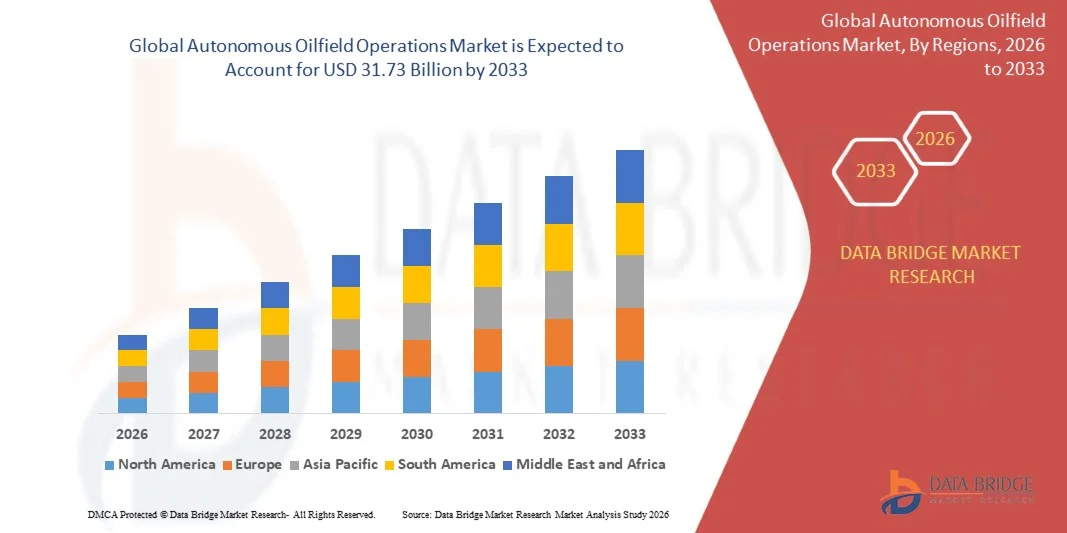
As per Data Bridge Market Research analysis The autonomous oilfield operations market was valued at USD 8.50 billion in 2025 and is projected to reach USD 31.73 billion by 2033, growing at a CAGR of 17.90% from 2026 to 2033. The market is experiencing consistent growth driven by increasing adoption of artificial intelligence (AI), industrial IoT, robotics, and autonomous drilling technologies across upstream oil and gas operations. Rising investments in digital oilfields, real-time data analytics, and automated asset management are further accelerating market expansion by improving operational efficiency, reducing downtime, and enhancing production performance.
The growing need to improve worker safety, lower operational costs, and optimize drilling and production activities is encouraging oil and gas companies to deploy autonomous oilfield solutions. AI-powered drilling systems, remote monitoring platforms, digital twins, and predictive maintenance technologies are increasingly replacing conventional field operations, enabling continuous, data-driven, and low-risk management of onshore and offshore assets while supporting autonomous well construction and production optimization.
Market Size & Forecast
- Global Market Value (2025): USD 8.50 Billion
- Expected Market Value (2033): USD 31.73 Billion
- Forecast CAGR (2026–2033): 17.90%
- Leading Region in 2025: North America
- Fastest Growing Region: Asia Pacific
Key Market Trends & Insights
- North America dominated the autonomous oilfield operations market with an estimated revenue share of 38.6% in 2025, supported by early adoption of digital oilfield technologies, extensive shale oil and gas activities, and strong investments in automation, AI, and remote monitoring systems across the United States and Canada.
- The production optimization segment led the market with a 31.2% share in 2025, driven by increasing demand to maximize hydrocarbon recovery, improve operational efficiency, and reduce production costs across mature and new oilfields.
- Asia- Pacific is expected to be the fastest-growing region at a CAGR of 9.4% from 2026 to 2033, fueled by expanding upstream exploration activities, growing digital transformation initiatives, and increasing investments in smart oilfield infrastructure across China, India, and Southeast Asia.
- Reservoir optimization are the fastest-growing operation type segment, projected to register a CAGR of 7.1%, reflecting the surge in adoption of advanced reservoir modeling, real-time subsurface monitoring, and AI-driven decision support systems.
- The asset optimization segment dominated the application category with a 36.4% revenue share in 2025, led by the extensive deployment of sensors, controllers, edge devices, communication infrastructure, and intelligent field equipment across autonomous oilfield operations.
- Internet of things (IoT) accounted for 28.4% of the market, preferred by its foundational role in enabling autonomous oilfield operations through real-time data collection, remote monitoring, and equipment connectivity.
- The artificial intelligence (AI) segment is the fastest-growing technology category, with a CAGR of 9.2%, driven by increasing use of machine learning algorithms for drilling optimization, predictive maintenance, production forecasting, and autonomous decision-making.
Report Scope and Autonomous Oilfield Operations Market Segmentation
|
Attributes |
Autonomous Oilfield Operations Key Market Insights |
|
Segments Covered |
|
|
Countries Covered |
North America
Europe
Asia-Pacific
Middle East and Africa
South America
|
|
Key Market Players |
|
|
Market Opportunities |
|
|
Value Added Data Infosets |
In addition to the insights on market scenarios such as market value, growth rate, segmentation, geographical coverage, and major players, the market reports curated by the Data Bridge Market Research also include in-depth expert analysis, geographically represented company-wise production and capacity, network layouts of distributors and partners, detailed and updated price trend analysis and deficit analysis of supply chain and demand. |
Autonomous Oilfield Operations Market Trends
Trend: Transition Toward Closed-Loop Autonomous Drilling and Production Optimization
Oil and gas operators are increasingly moving beyond conventional digital oilfields toward closed-loop autonomous operations that combine artificial intelligence, machine learning, edge computing, and real-time subsurface analytics to automate drilling, well placement, and production optimization decisions with minimal human intervention. The integration of autonomous control systems enables continuous interpretation of geological data, automatic adjustment of drilling parameters, and predictive response to changing reservoir conditions. Energy companies are similarly deploying remote operation centers and digital twins to synchronize drilling, completion, and production activities across geographically dispersed assets, while cloud-connected autonomous platforms create intelligent operating environments that continuously learn from field performance and optimize recovery outcomes. For instance, in January 2024, SLB and Equinor announced that 99% of a 2.6-kilometer well section at the Peregrino C platform offshore Brazil was drilled autonomously using DrillOps, Neuro, and DrillPilottechnologies, resulting in a 60% increase in drilling rate of penetration compared with offset wells while continuously adjusting drilling parameters through real-time downhole data and automated decision-making workflows.
Autonomous Oilfield Operations Market Dynamics
Key Market Driver: Rising Demand for Operational Efficiency Through Autonomous and Data-Driven Oilfield Management
Upstream operators are accelerating investments in autonomous oilfield technologies as persistent cost pressures, workforce constraints, and complex reservoir environments increase the need for higher operational efficiency and lower non-productive time. Autonomous drilling systems, predictive maintenance platforms, and AI-based production optimization tools enable operators to reduce equipment failures, improve drilling consistency, minimize manual intervention, and maximize asset utilization across both onshore and offshore fields. The ability to continuously monitor operations and execute data-driven adjustments in real time is becoming a critical competitive advantage for companies seeking to improve profitability while maintaining production targets in volatile energy markets. For instance, in February 2025, Halliburton and Sekal deployed the world's first automated on-bottom drilling system for Equinor on the Norwegian Continental Shelf. The closed-loop system automatically optimized drilling parameters in real time, reducing human intervention, improving drilling consistency, and enhancing operational efficiency, highlighting the industry's growing focus on lowering non-productive time and reducing overall well construction costs through autonomous operations.
Key Restraint/Challenge: Limited Interoperability Across Legacy Systems and Digital Platforms
The deployment of autonomous oilfield operations remains constrained by the complexity of integrating advanced automation technologies with aging field infrastructure, proprietary control systems, and fragmented data architectures developed over decades of operation. Many upstream assets continue to rely on heterogeneous equipment supplied by multiple vendors, creating interoperability challenges that can limit real-time data exchange and autonomous decision-making capabilities. In addition, large-scale implementation often requires significant investments in connectivity, cybersecurity, workforce training, and digital infrastructure modernization, increasing project timelines and deployment risks for operators. For instance, the Open Group established the Open Subsurface Data Universe (OSDU®) Forum after major operators including BP, Chevron, ConocoPhillips, Devon, Equinor, ExxonMobil, Shell, and TotalEnergies identified that critical upstream data was trapped in siloed legacy systems, duplicated across proprietary applications, and difficult to access. The OSDU platform was specifically developed to overcome these interoperability barriers and enable standardized data exchange across multi-vendor environments, highlighting one of the industry's biggest obstacles to implementing autonomous oilfield operations at scale.
Key Market Opportunity: Increasing Focus on Maximizing Value from Existing Oilfield Infrastructure
Oil and gas companies are increasingly utilizing autonomous oilfield platforms to maximize recovery from mature and brownfield assets, creating significant opportunities for digital twin providers, AI developers, and advanced automation vendors. By combining real-time reservoir monitoring, predictive analytics, and autonomous production optimization, operators can identify untapped reserves, improve well performance, and extend asset life without major capital-intensive field redevelopment. The growing focus on extracting greater value from existing infrastructure is accelerating demand for intelligent systems capable of continuously optimizing production strategies and reducing operational inefficiencies across aging oilfields. For instance, Equinor reported that digital technologies deployed at its mature Johan Sverdrup field including digital twins, automated production optimization, integrated operations, and predictive maintenance generated more than NOK 2 billion in additional earnings during the field's first year of operation. The company attributed these gains to higher stable production, improved reservoir understanding, more efficient maintenance, and better production optimization, demonstrating the significant opportunity for autonomous digital technologies to maximize value from existing oilfield assets.
Autonomous Oilfield Operations Market Scope
The autonomous oilfield operations market is segmented on the basis of operation type, application, technology, and end user.
- By Operation Type
On the basis of operation type, the autonomous oilfield operations market is segmented into drilling optimization, production optimization, reservoir optimization, safety management, and asset management. The production optimization segment dominated the market with the largest share of 31.2% in 2025, driven by increasing demand to maximize hydrocarbon recovery, improve operational efficiency, and reduce production costs across mature and new oilfields. Operators are increasingly deploying AI-powered analytics, real-time monitoring systems, and automated production control platforms to optimize well performance and reservoir output. Production optimization solutions enable continuous evaluation of production parameters, helping companies minimize downtime and enhance asset utilization. The growing focus on extracting maximum value from existing assets is further supporting adoption. Integration with digital twins and predictive analytics platforms is strengthening operational decision-making capabilities. The segment continues to benefit from the industry's emphasis on operational excellence and production efficiency.
The reservoir optimization segment is projected to register the fastest growth at a CAGR of 7.1% during the forecast period, driven by increasing adoption of advanced reservoir modeling, real-time subsurface monitoring, and AI-driven decision support systems. Oil and gas companies are investing heavily in technologies that improve reservoir characterization and recovery planning. Autonomous reservoir management enables continuous analysis of geological and production data, improving recovery rates and reducing uncertainty. The growing complexity of unconventional reservoirs is accelerating demand for intelligent optimization platforms. Integration of machine learning and digital twin technologies is enhancing predictive reservoir performance analysis. Rising investments in maximizing recovery from mature fields are expected to further accelerate segment growth.
- By Application
On the basis of application, the autonomous oilfield operations market is segmented into asset optimization, intelligent drilling, AI-driven decision making, and digital carbon management. The asset optimization segment dominated the market with an estimated share of 36.4% in 2025, driven by increasing focus on maximizing equipment performance, reducing unplanned downtime, and extending asset life cycles. Oil and gas operators are increasingly deploying predictive maintenance systems, condition monitoring platforms, and remote operational technologies to improve field productivity. Asset optimization solutions enable continuous monitoring of critical equipment and support proactive maintenance planning. Growing operational complexity across upstream assets is further supporting adoption. The segment also benefits from increasing investments in digital transformation initiatives across oilfield operations. The ability to deliver measurable cost savings and operational efficiency continues to support its market leadership.
The AI-driven decision making segment is expected to witness the fastest growth at a CAGR of 14.1% from 2026 to 2033, driven by growing adoption of artificial intelligence for operational planning, production forecasting, and automated decision support. These platforms enable operators to analyze vast volumes of operational data and identify optimization opportunities in real time. Increasing implementation of machine learning algorithms is significantly improving predictive capabilities and operational accuracy. Growing demand for autonomous workflows and reduced human intervention is further accelerating adoption. AI-driven systems also improve response times during complex operational events. The increasing maturity of industrial AI technologies continues to strengthen segment growth.
- By Technology
On the basis of technology, the autonomous oilfield operations market is segmented into artificial intelligence (AI), internet of things (IoT), robotics & automation, big data & analytics, cloud computing, and digital twin. The internet of things (IoT) segment dominated the market in 2025 with the largest market share of 28.4%, owing to its foundational role in enabling autonomous oilfield operations through real-time data collection, remote monitoring, and equipment connectivity. IoT sensors and connected devices facilitate continuous monitoring of drilling rigs, wells, pipelines, and production facilities. The technology supports predictive maintenance, operational transparency, and faster decision-making. Increasing deployment of connected infrastructure across upstream operations is driving market expansion. IoT platforms also enable seamless integration between field assets and centralized control centers. Their ability to provide continuous operational visibility makes them essential for autonomous oilfield ecosystems.
The artificial intelligence (AI) segment is projected to register the fastest growth at a CAGR of 9.2% during the forecast period, driven by increasing use of machine learning algorithms for drilling optimization, predictive maintenance, production forecasting, and autonomous decision-making. AI technologies are enabling oilfield operators to analyze vast volumes of operational and geological data in real time. Advanced AI models improve drilling precision, reduce non-productive time, and optimize production strategies. Growing industry focus on reducing operational costs and maximizing asset performance is accelerating deployment. Integration of AI with digital twins and automation systems is creating new opportunities for intelligent field management. The technology is expected to play a central role in the evolution of fully autonomous oilfield operations.
- By End User
On the basis of end user, the autonomous oilfield operations market is segmented into national oil companies (NOCs), international oil companies (IOCs), independent E&P companies, and oilfield service providers. The international oil companies (IOCs) segment dominated the market with the largest share of 38.1% in 2025, driven by substantial investments in digital transformation, automation technologies, and advanced upstream operations. Major international operators possess the financial resources and technical expertise required to deploy autonomous oilfield platforms at scale. These companies are actively implementing AI, digital twins, and remote operations centers to improve efficiency and safety. Their extensive global asset portfolios create significant demand for centralized monitoring and optimization solutions. Increasing pressure to reduce operational costs and improve production performance is further driving adoption. The segment continues to lead innovation in autonomous oilfield technologies.
The Independent E&P Companies segment is expected to be the fastest-growing at a CAGR of 7.4% during the forecast period, supported by increasing accessibility of cloud-based platforms, AI-driven analytics, and subscription-based autonomous operation solutions. Independent operators are leveraging digital technologies to improve competitiveness and optimize production from smaller asset portfolios. Autonomous solutions enable these companies to operate more efficiently with leaner workforces and lower operating costs. Advances in software-as-a-service models are reducing implementation barriers. The need to maximize recovery from mature and unconventional assets is accelerating technology adoption. Growing availability of scalable autonomous solutions is expected to drive strong growth across this segment.
Autonomous Oilfield Operations Market Regional Analysis
North America dominated the autonomous oilfield operations market with an estimated revenue share of 38.6% in 2025, supported by early adoption of digital oilfield technologies, extensive shale oil and gas activities, and strong investments in automation, AI, and remote monitoring systems across the United States and Canada. The region also benefits from stringent road safety regulations, high adoption of VR- and AI-enabled simulation platforms, and growing use of simulators across automotive R&D, professional training, and vehicle testing applications. Increasing focus on immersive training experiences and autonomous vehicle development continues to strengthen Europe’s leadership position in the global market.
U.S. Autonomous Oilfield Operations Market Insight
The U.S. autonomous oilfield operations market is witnessing strong growth due to rising investments in digital oilfield technologies, drilling automation platforms, and artificial intelligence-driven production optimization systems. The country’s extensive shale development activities, along with increasing adoption of IoT-enabled monitoring, predictive maintenance, and remote operations technologies, are driving demand across upstream oil and gas operations. In addition, growing emphasis on reducing operational costs, improving worker safety, and minimizing non-productive time is accelerating autonomous oilfield deployment across major operators and oilfield service companies. For instance, in 2024, SLB and Equinor successfully drilled 99% of a 2.6-km well section autonomously, achieving a 60% increase in drilling rate of penetration through AI-enabled drilling technologies.
Europe Autonomous Oilfield Operations Market Insight
The Europe autonomous oilfield operations market remains a major contributor to global revenue, driven by strong digital transformation initiatives, offshore automation investments, and increasing demand for intelligent operational technologies. The widespread use of digital twins, advanced analytics, and autonomous drilling solutions across North Sea operations is supporting market expansion throughout the region. Increasing investments in operational efficiency technologies, coupled with stringent environmental standards and highly advanced offshore infrastructure, continue to enhance adoption of autonomous oilfield solutions across Europe. For instance, in 2025, Halliburton and Sekal deployed the world's first automated on-bottom drilling system for Equinor on the Norwegian Continental Shelf, enabling closed-loop drilling optimization and autonomous control.
U.K. Autonomous Oilfield Operations Market Insight
The U.K. autonomous oilfield operations market is experiencing steady growth, supported by rising adoption of digital technologies in offshore operations, asset monitoring, and production optimization activities. Increasing investments in advanced automation infrastructure and growing demand for cost-effective, remotely managed operational solutions are contributing to market growth. Furthermore, integration of artificial intelligence, cloud computing, and digital twin technologies is improving operational visibility and production efficiency, positioning the U.K. as a key innovation hub in offshore oilfield digitalization. For instance, Equinor's Krafla field development utilizes ABB's automation technologies to support remote-controlled offshore operations through integrated digital twin platforms.
Germany Autonomous Oilfield Operations Market Insight
The Germany autonomous oilfield operations market is expanding steadily due to the country's strong industrial automation expertise, advanced engineering capabilities, and increasing adoption of next-generation digital technologies. Energy companies and technology providers are increasingly utilizing AI-powered analytics, industrial IoT systems, and automation platforms for operational optimization and asset management activities. Continuous advancements in industrial software, predictive maintenance technologies, and intelligent monitoring solutions, along with growing focus on industrial innovation, are further driving market growth in Germany. For instance, German automation providers including Siemens continue supplying industrial digitalization and automation solutions that support intelligent oilfield operations across global upstream projects.
Asia-Pacific Autonomous Oilfield Operations Market Insight
The Asia-Pacific autonomous oilfield operations market is expected to witness rapid growth, driven by increasing upstream investments, expanding digital oilfield deployment, and rising adoption of automation technologies across countries such as China, India, and Australia. Growing focus on production efficiency, operational reliability, and asset optimization is supporting adoption of intelligent monitoring systems and autonomous operational platforms throughout the region. In addition, increasing energy demand and ongoing modernization of oilfield infrastructure are accelerating deployment of advanced digital technologies across upstream operations. For instance, ONGC has implemented integrated operations centers utilizing real-time data from thousands of field sensors to improve asset utilization and optimize production performance across Indian oilfields.
Japan Autonomous Oilfield Operations Market Insight
The Japan autonomous oilfield operations market is witnessing consistent growth due to rising investments in industrial automation technologies, digital infrastructure development, and advanced operational intelligence systems. Energy companies and technology providers are increasingly adopting predictive analytics, remote monitoring platforms, and AI-driven decision support tools for operational efficiency enhancement. Moreover, increasing integration of intelligent automation technologies and the country's focus on industrial digital transformation are further contributing to market growth. For instance, Japanese energy companies are expanding collaboration with global oilfield technology providers to integrate advanced analytics and automation capabilities into upstream operational workflows.
China Autonomous Oilfield Operations Market Insight
The China autonomous oilfield operations market is growing rapidly, driven by increasing digitalization of upstream assets, expanding energy infrastructure, and rising government support for industrial automation technologies. Growing adoption of AI-enabled analytics, IoT-connected monitoring systems, and cloud-based operational platforms across oil and gas operations is significantly boosting market demand. In addition, rising investments in intelligent oilfield development, increasing focus on production optimization, and rapid technological advancements are positioning China as one of the fastest-growing markets for autonomous oilfield operations globally. For instance, China's ongoing implementation of industrial digitalization initiatives under advanced manufacturing programs continues to accelerate deployment of intelligent oilfield technologies across major state-owned energy companies.
Autonomous Oilfield Operations Market Share
The autonomous oilfield operations industry is primarily led by well-established companies, including:
- SLB (U.S.)
- Halliburton Company (U.S.)
- Baker Hughes Company (U.S.)
- Weatherford International plc (U.S.)
- NOV Inc. (U.S.)
- TechnipFMC plc (U.K.)
- Nabors Industries Ltd. (Bermuda)
- Helmerich & Payne, Inc. (U.S.)
- Patterson-UTI Energy, Inc. (U.S.)
- Expro Group Holdings N.V. (U.K.)
- Archer Limited (Bermuda)
- Kongsberg Digital AS (Norway)
- Siemens Energy Global GmbH & Co. KG (Germany)
- ABB Ltd (Switzerland)
- Emerson Electric Co. (U.S.)
- Honeywell International Inc. (U.S.)
- Schneider Electric SE (France)
- Rockwell Automation, Inc. (U.S.)
- AVEVA Group Limited (U.K.)
- CGG (France)
Latest Developments in Autonomous Oilfield Operations Market
- In May 2025, ADNOC Drilling reported strong growth in its oilfield services business, supported by expanding AI-driven drilling activities through its Turnwell and Enersol joint ventures. The company confirmed plans to drill more than 80 unconventional wells during 2025 while expanding integrated drilling services and increasing investment in advanced automation and digital technologies to improve operational efficiency.
- In February 2025, Halliburton and Sekal announced the successful deployment of the world's first automated on-bottom drilling system for Equinor on the Norwegian Continental Shelf. The solution integrates Halliburton's LOGIXautomation platform, Sekal's DrillTronics®, and rig automation controls to enable closed-loop autonomous drilling, real-time optimization of drilling parameters, and precise well placement with minimal human intervention. The development represents a major milestone toward fully autonomous drilling operation
- In December 2024, ADNOC Drilling completed the formation of Turnwell Industries, a joint venture with SLB and Patterson-UTI to accelerate unconventional oil and gas development in the UAE. The venture will leverage AI-powered smart drilling design, completions engineering, and advanced production technologies to improve drilling efficiency and support autonomous oilfield operations. The initiative is expected to play a key role in unlocking Abu Dhabi's unconventional hydrocarbon resources
- In May 2024, SLB stated that autonomous oil and gas wells are expected to reach commercial deployment before fully autonomous passenger vehicles. During the Offshore Technology Conference, the company emphasized that AI-driven drilling automation is already being adopted by major national and international oil companies to improve well quality, enhance operational safety, reduce onsite personnel requirements, and lower drilling costs through autonomous workflows
- In January 2024, SLB announced that it had successfully partnered with Equinor to drill 99% of a 2.6-kilometer well section autonomously at the Peregrino C platform offshore Brazil. Using DrillOps, Neuro, and DrillPilottechnologies, the project increased drilling rate of penetration by 60%, resulting in faster well delivery while reducing operational costs and carbon emissions. The achievement marked one of the industry's most advanced demonstrations of AI-enabled autonomous drilling

- Interactive Data Analysis Dashboard
- Company Analysis Dashboard for high growth potential opportunities
- Research Analyst Access for customization & queries
- Competitor Analysis with Interactive dashboard
- Latest News, Updates & Trend analysis
- Harness the Power of Benchmark Analysis for Comprehensive Competitor Tracking
Data collection and base year analysis are done using data collection modules with large sample sizes. The stage includes obtaining market information or related data through various sources and strategies. It includes examining and planning all the data acquired from the past in advance. It likewise envelops the examination of information inconsistencies seen across different information sources. The market data is analysed and estimated using market statistical and coherent models. Also, market share analysis and key trend analysis are the major success factors in the market report. To know more, please request an analyst call or drop down your inquiry.
The key research methodology used by DBMR research team is data triangulation which involves data mining, analysis of the impact of data variables on the market and primary (industry expert) validation. Data models include Vendor Positioning Grid, Market Time Line Analysis, Market Overview and Guide, Company Positioning Grid, Patent Analysis, Pricing Analysis, Company Market Share Analysis, Standards of Measurement, Global versus Regional and Vendor Share Analysis. To know more about the research methodology, drop in an inquiry to speak to our industry experts.
Data Bridge Market Research is a leader in advanced formative research. We take pride in servicing our existing and new customers with data and analysis that match and suits their goal. The report can be customized to include price trend analysis of target brands understanding the market for additional countries (ask for the list of countries), clinical trial results data, literature review, refurbished market and product base analysis. Market analysis of target competitors can be analyzed from technology-based analysis to market portfolio strategies. We can add as many competitors that you require data about in the format and data style you are looking for. Our team of analysts can also provide you data in crude raw excel files pivot tables (Fact book) or can assist you in creating presentations from the data sets available in the report.