


What is the Global Autonomous Ships Size and Growth Rate?
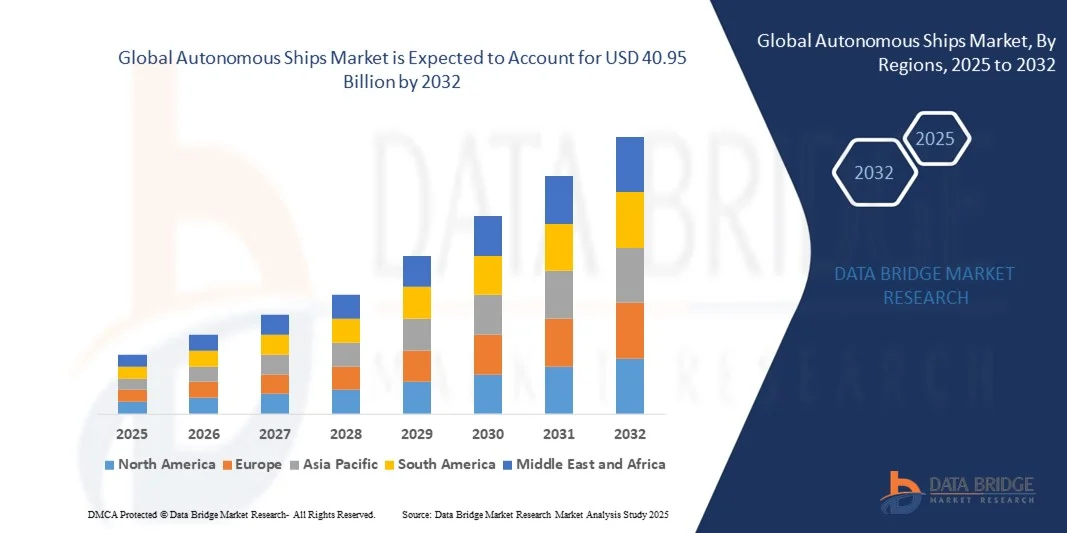
- As per Data Bridge Market Research Analysis the global Autonomous Ships Market size was valued at USD 20.25 billion in 2024 and is projected to reach USD 40.95 billion by 2032, growing at a CAGR of 9.20% during the forecast period
- Market expansion is driven by rapid advancements in AI, sensor technology, and maritime connectivity, enabling increased automation, efficiency, and safety in naval operations
- Additionally, the rising focus on reducing human error, improving fuel efficiency, and enhancing maritime security is positioning autonomous ships as a transformative solution, fueling strong industry momentum
Market Size & Forecast
- Global Market Value (2024): USD 20.25 billion
- Expected Market Value (2032): USD 40.95 billion
- Forecast CAGR (2024–2032): 9.20%
What are the Major Takeaways of Global Autonomous Ships?
- Autonomous ships, leveraging advanced technologies such as AI, sensors, GPS, and IoT, are emerging as crucial innovations in modern maritime operations, offering enhanced safety, reduced human error, lower operational costs, and improved fuel efficiency across both commercial and military applications
- The growing adoption of unmanned and remotely operated vessels is primarily fueled by the maritime industry's push toward digital transformation, increased demand for efficient logistics, and stricter regulations on crew safety and emissions
- Asia-Pacific dominated the autonomous ships market with the largest revenue share of 41.2% in 2024, driven by strong government support, major naval investments, and the presence of leading maritime technology companies, particularly in countries like Norway and Finland spearheading autonomous shipping trials and deployments
- Europe is expected to be the fastest growing region in the autonomous ships market during the forecast period due to rapid expansion of maritime trade, technological advancements, and increasing defense budgets in countries such as China, Japan, and South Korea
- The Partial Automation segment held the largest market share of 54.6% in 2024, driven by the rising adoption of onboard digital systems such as advanced radar, autopilot, and sensor-based navigation.
Report Scope and Global Autonomous Ships Market Segmentation
|
Attributes |
Autonomous Ships Key Market Insights |
|
Segments Covered |
|
|
Countries Covered |
North America
Europe
Asia-Pacific
Middle East and Africa
South America
|
|
Key Market Players |
|
|
Market Opportunities |
|
|
Value Added Data Infosets |
|
What is the Key Trend in the Global Autonomous Ships?
Enhanced Operational Efficiency Through AI and Autonomous Navigation
- A significant and accelerating trend in the Global Autonomous Ships Market is the deeper integration of artificial intelligence (AI), machine learning (ML), and autonomous navigation technologies, which are transforming maritime operations by increasing efficiency, reducing costs, and enhancing safety. These systems enable vessels to perform critical tasks such as collision avoidance, route optimization, and real-time decision-making without human intervention.
- For example, Kongsberg’s autonomous vessels use a combination of AI, radar, lidar, and advanced sensor fusion to interpret environmental data and make autonomous navigational decisions. Similarly, Sea Machines Robotics’ SM300 system allows for remote and autonomous command of workboats and commercial ships, offering advanced situational awareness and intelligent control.
- AI integration in autonomous ships enables predictive maintenance, fuel consumption optimization, and behavioral analytics based on vessel performance and environmental conditions. For instance, some systems can automatically adjust routes to avoid adverse weather or traffic congestion, reducing risk and saving operational time.
- The seamless integration of autonomous systems with shore-based control centers and maritime traffic management platforms supports coordinated operations, fleet monitoring, and regulatory compliance, enabling centralized management of multiple vessels. This approach enhances scalability and reduces the reliance on onboard crew.
- This trend toward intelligent, connected, and self-navigating vessels is fundamentally reshaping the maritime industry's expectations for shipping and naval operations. Companies like Wärtsilä and Rolls-Royce are leading developments in AI-enabled marine technologies that support fully autonomous and remotely operated ships, with applications spanning cargo transport, offshore operations, and defense.
- The demand for vessels that offer seamless AI integration and autonomous capabilities is rapidly growing across both commercial and defense sectors, as stakeholders increasingly prioritize safety, cost-efficiency, and operational resilience in global maritime logistics.
Global Autonomous Ships Market Dynamics
Driver
Growing Need Due to Rising Safety, Efficiency Demands, and Maritime Automation
-
The growing emphasis on maritime safety, operational efficiency, and reduced human dependency is significantly driving demand for autonomous ships. Increasing global trade, labor shortages in the shipping industry, and rising pressure to reduce emissions are pushing stakeholders toward autonomous maritime solutions.
- For Instance, in March 2024, Wärtsilä Voyage launched its next-generation NaviFleet platform, designed to optimize fleet performance and enable smarter navigation decisions through AI-driven insights. These developments illustrate how key industry players are accelerating automation in maritime operations.
- Autonomous ships offer compelling advantages such as reduced crew costs, enhanced navigational precision, and improved safety through real-time monitoring and predictive maintenance capabilities. These benefits are becoming increasingly attractive in both commercial and military applications.
- Furthermore, the rise in port congestion, demand for sustainable shipping practices, and integration of digital systems across fleets are positioning autonomous vessels as central to the future of maritime logistics. The ability to remotely operate or fully automate vessels also helps in high-risk environments such as Arctic shipping routes or military reconnaissance.
- The trend towards smarter, AI-powered vessel operations is gaining momentum across both developed and developing maritime economies, with nations like Norway, Japan, and South Korea investing heavily in autonomous marine technology. These investments, combined with growing regulatory support for autonomous navigation trials, are fostering rapid adoption across the industry.
Restraint/Challenge
Cybersecurity Risks and Regulatory Uncertainty Pose Significant Challenges
- Cybersecurity vulnerabilities present a major challenge to the widespread adoption of autonomous ships. As these vessels rely heavily on digital systems, satellite communication, and AI-driven navigation, they are inherently susceptible to cyber threats, including GPS spoofing, data breaches, and system hijacking.
- For instance, several maritime incidents involving jamming or spoofing of GPS signals have raised concerns about the reliability and safety of autonomous operations in open waters. This has prompted global maritime authorities to reassess cyber resilience protocols for unmanned ships.
- Addressing these risks requires robust cybersecurity frameworks, including end-to-end encryption, real-time threat detection, secure command systems, and regular software updates. Companies like Northrop Grumman and Sea Machines Robotics are investing in AI-based cybersecurity features to mitigate operational risks.
- Additionally, regulatory uncertainty surrounding autonomous vessels is hindering faster market adoption. Current maritime laws, including SOLAS and COLREGs, are built around crewed ships, and do not yet fully accommodate unmanned or remotely operated vessels.
- The lack of standardized global regulations for autonomous shipping results in operational restrictions, limits on long-distance deployment, and hesitancy among shipping companies to invest heavily in unproven frameworks.
- To overcome these hurdles, greater international collaboration between maritime authorities, technology providers, and shipbuilders is essential. Establishing clear safety standards, updating international conventions, and demonstrating successful pilot deployments will be key to unlocking the full potential of the autonomous ships market.
How is the Global Autonomous Ships Segmented?
The market is segmented on the basis of autonomy, solution, ship type, and end user.
- By Autonomy
On the basis of autonomy, the autonomous ships market is segmented into partial automation, fully autonomous, and remotely operated. The partial automation segment held the largest market share of 54.6% in 2024, driven by the rising adoption of onboard digital systems such as advanced radar, autopilot, and sensor-based navigation. Partial automation allows ship operators to enhance safety and reduce human error without fully removing crew members, making it the most viable and compliant option under current maritime regulations.
The Fully Autonomous segment is projected to witness the fastest CAGR of 22.9% from 2025 to 2032, fueled by increasing advancements in AI, remote sensing, and machine learning. These vessels operate entirely without onboard human presence, offering long-term cost savings and efficiency, especially in high-risk and long-distance cargo operations. Several pilot projects in Norway and Asia are accelerating development and regulatory support for fully autonomous vessels.
- By Solution
By solution, the market is segmented into hardware and software. In 2024, the hardware segment dominated the market with the largest revenue share of 62.8%, supported by strong demand for physical systems including propulsion units, autonomous navigation sensors, control systems, and maritime communication devices. These components are essential for real-time data acquisition and ship operation, making hardware the backbone of any autonomous maritime system.
The Software segment is expected to grow at the fastest CAGR of 23.6% from 2025 to 2032, owing to the increasing need for advanced navigation algorithms, AI-based decision-making platforms, fleet management dashboards, and cybersecurity systems. With growing digitization, software plays a critical role in optimizing routes, monitoring vessel health, predicting maintenance, and enabling shore-based remote operations. Rising investment in maritime analytics and autonomous AI systems is propelling this segment’s growth.
- By Ship Type
Based on ship type, the market is categorized into commercial (bulk carriers, tankers, dry cargo, containers, others) and defense. The commercial segment accounted for the largest market share of 68.4% in 2024, driven by the global need to enhance logistics efficiency, reduce operational costs, and improve vessel safety. Commercial operators are increasingly adopting autonomous technologies for cargo ships, tankers, and container vessels to streamline long-haul operations and overcome crew shortages.
The Defense segment is projected to grow at the fastest CAGR of 21.4% from 2025 to 2032, propelled by rising government investments in autonomous naval systems. Defense applications include unmanned surveillance vessels, autonomous mine countermeasure ships, and high-speed interceptors. Key defense contractors and navies in the U.S., U.K., and China are prioritizing maritime autonomy to enhance mission capability, reduce risk to personnel, and enable round-the-clock patrol and reconnaissance operations.
- By End User
On the basis of end user, the autonomous ships market is segmented into line fit and retrofit. The line fit segment held the largest market share of 57.9% in 2024, due to growing demand for newly built vessels equipped with fully integrated autonomous systems. Shipbuilders are increasingly collaborating with tech firms to offer ships pre-equipped with intelligent navigation, communication, and propulsion systems, ensuring better design optimization and operational reliability from the outset.
The retrofit segment is expected to register the fastest CAGR of 22.1% from 2025 to 2032, driven by the need to modernize aging fleets and comply with emerging regulatory and operational standards. Retrofitting allows existing vessels to be upgraded with autonomous capabilities like remote monitoring, collision avoidance systems, and advanced analytics without the cost of full replacement. This approach is especially popular among operators looking to extend the life and efficiency of their current fleets.
Which Region Holds the Largest Share of the How is Global Autonomous Ships Segmented?
- Asia-Pacific dominated the global autonomous ships market with the largest revenue share of 41.2% in 2024, supported by strong maritime heritage, early regulatory initiatives, and significant investments in maritime autonomy research and development. Countries like Norway, Finland, and the Netherlands are at the forefront of deploying and testing autonomous vessel technologies in real-world commercial and research operations
- The region has seen rapid adoption of semi-autonomous and fully autonomous systems, particularly in short-sea shipping, inland waterways, and cargo transport, driven by goals to reduce emissions, improve operational efficiency, and address crew shortages
- Additionally, government-backed programs, collaborations between shipbuilders and tech firms, and supportive regulations from the European Maritime Safety Agency (EMSA) have accelerated innovation. The combination of environmental mandates, digital infrastructure, and a skilled maritime workforce positions Europe as a key hub for autonomous shipping advancements across both commercial and defense sectors
Japan Autonomous Ships Market Insight
Japan’s autonomous ships market is gaining momentum, driven by its technologically advanced maritime industry and government incentives promoting smart shipping. The country’s aging maritime workforce and focus on labor safety intensify demand for autonomous and remotely operated vessels. Integration of autonomous technology with Japan’s smart port infrastructure and IoT systems facilitates operational efficiency and enhanced safety. Moreover, Japan’s leadership in robotics and AI supports the development of sophisticated autonomous navigation systems, making it a significant contributor to the global market’s growth trajectory.
China Autonomous Ships Market Insight
China accounted for the largest market revenue share in Asia-Pacific in 2024, attributed to its vast commercial shipping fleet and aggressive investments in autonomous maritime technologies. The Chinese government’s strategic initiatives promoting smart shipping, digital ports, and green shipping solutions accelerate the adoption of autonomous vessels. China’s domestic shipbuilding industry and technology providers are rapidly innovating autonomous navigation, sensor systems, and remote operation platforms. Rising demand from commercial shipping companies to reduce costs, improve safety, and comply with environmental regulations positions China as a dominant force in the global autonomous ships market.
U.S. Autonomous Ships Market Insight
The U.S. global autonomous ships market captured the largest revenue share of 38% in North America in 2024, driven by significant investments in autonomous maritime technology and strong government support for unmanned vessel deployment. The rapid adoption of digital navigation systems, AI-powered ship controls, and remotely operated vessels in commercial shipping and defense sectors is accelerating market growth. Additionally, U.S.-based technology firms and shipbuilders are leading innovations in sensor fusion, cybersecurity, and data analytics, enhancing vessel safety and operational efficiency. Increasing concerns about crew safety and environmental regulations further fuel the shift towards autonomous and remotely operated ships, positioning the U.S. as a key player in the global market.
Europe Autonomous Ships Market Insight
Europe dominated the global autonomous ships market with the largest revenue share of 39.8% in 2024, supported by stringent maritime safety regulations and ambitious decarbonization goals. Countries like Norway, Finland, and the Netherlands are pioneering full-scale trials and commercial deployments of autonomous vessels, especially in short-sea shipping and offshore operations. The European Maritime Safety Agency’s regulatory framework and collaborative projects between governments, academia, and industry are accelerating the adoption of fully autonomous and partially automated ships. Increasing investments in green technologies and digital infrastructure also support the region’s strong position in the market.
U.K. Autonomous Ships Market Insight
The U.K. autonomous ships market is expected to grow at a notable CAGR through 2032, driven by strong government backing, innovative maritime startups, and a focus on smart port technologies. The country’s strategic emphasis on digitalizing shipping operations and enhancing port efficiency is fostering the development and deployment of autonomous shipping solutions. Furthermore, concerns over maritime safety, crew welfare, and operational cost reduction motivate stakeholders to adopt autonomous navigation and remote operation technologies. The U.K.’s robust maritime heritage and regulatory support continue to promote market expansion in both commercial and defense segments.
Germany Autonomous Ships Market Insight
Germany’s global autonomous ships market is projected to witness considerable growth, fueled by its advanced shipbuilding industry and commitment to Industry 4.0 technologies. The integration of IoT, AI, and big data analytics into vessel operations is gaining traction, particularly within commercial shipping and offshore sectors. Germany’s focus on sustainable maritime practices and emissions reduction is encouraging the adoption of partially and fully autonomous vessels. Collaboration between shipbuilders, technology providers, and research institutions fosters innovation, with a growing preference for secure, efficient, and eco-friendly autonomous shipping solutions aligned with stringent EU regulations.
Which are the Top Companies in Global Autonomous Ships?
The autonomous ships industry is primarily led by well-established companies, including:
- ABB (Switzerland)
- ASELSAN A.Ş. (Turkey)
- BAE Systems (U.K.)
- Fugro (Netherlands)
- GE (General Electric) (U.S.)
- Honeywell International Inc. (U.S.)
- Kongsberg Gruppen Maritime (Norway)
- L3 ASV (U.S.)
- Northrop Grumman (U.S.)
- Rolls-Royce plc (U.K.)
- Siemens Energy (Germany)
- Wärtsilä (Finland)
- Marine Technologies LLC (U.S.)
- Ulstein Group ASA (Norway)
- Mitsui (Japan)
- Sea Machines Robotics Inc. (U.S.)
- Neptec Technologies Corp. (Canada)
What are the Recent Developments in Global Autonomous Ships Market?
- In April 2023, Kongsberg Gruppen ASA, a global leader in maritime automation and defense solutions, launched a strategic initiative in South Africa to advance autonomous shipping technologies tailored for regional commercial and offshore applications. This effort underscores Kongsberg’s commitment to delivering cutting-edge autonomous navigation systems and remote operation capabilities, addressing local maritime safety and efficiency challenges while strengthening its position in the expanding global autonomous ships market.
- In March 2023, Sea Machines Robotics, a U.S.-based pioneer in autonomous vessel control systems, unveiled its new SM400 autonomous navigation system designed specifically for coastal and inland commercial vessels. The system enhances safety and operational efficiency by enabling advanced remote control and autonomous maneuvering, reflecting Sea Machines’ dedication to innovation in autonomous maritime technology for commercial shipping and defense sectors.
- In March 2023, Mitsubishi Heavy Industries (MHI) successfully deployed the Yokohama Autonomous Ship Project in Japan, aiming to revolutionize urban port logistics through fully autonomous vessel operations. This initiative leverages AI and IoT-enabled systems to optimize shipping efficiency and safety in busy port environments, highlighting MHI’s leadership in integrating smart technologies into sustainable maritime transport.
- In February 2023, Wärtsilä Corporation, a leading provider of smart marine solutions, announced a strategic partnership with the Singapore Maritime and Port Authority (MPA) to develop an autonomous vessel testing corridor. This collaboration facilitates real-world trials of autonomous navigation and remote operation technologies, underscoring Wärtsilä’s commitment to accelerating innovation and regulatory development in autonomous shipping.
- In January 2023, Rolls-Royce Marine, under the leadership of its autonomous shipping division, introduced the next-generation remote-operated vessel platform at the Nor-Shipping Conference 2023. Equipped with advanced sensor fusion, AI navigation, and cybersecurity features, the platform empowers shipping operators to conduct remote monitoring and control with enhanced safety and efficiency. This launch reinforces Rolls-Royce’s strategic focus on integrating cutting-edge automation technologies in the global autonomous ships market.

- Interactive Data Analysis Dashboard
- Company Analysis Dashboard for high growth potential opportunities
- Research Analyst Access for customization & queries
- Competitor Analysis with Interactive dashboard
- Latest News, Updates & Trend analysis
- Harness the Power of Benchmark Analysis for Comprehensive Competitor Tracking
Data collection and base year analysis are done using data collection modules with large sample sizes. The stage includes obtaining market information or related data through various sources and strategies. It includes examining and planning all the data acquired from the past in advance. It likewise envelops the examination of information inconsistencies seen across different information sources. The market data is analysed and estimated using market statistical and coherent models. Also, market share analysis and key trend analysis are the major success factors in the market report. To know more, please request an analyst call or drop down your inquiry.
The key research methodology used by DBMR research team is data triangulation which involves data mining, analysis of the impact of data variables on the market and primary (industry expert) validation. Data models include Vendor Positioning Grid, Market Time Line Analysis, Market Overview and Guide, Company Positioning Grid, Patent Analysis, Pricing Analysis, Company Market Share Analysis, Standards of Measurement, Global versus Regional and Vendor Share Analysis. To know more about the research methodology, drop in an inquiry to speak to our industry experts.
Data Bridge Market Research is a leader in advanced formative research. We take pride in servicing our existing and new customers with data and analysis that match and suits their goal. The report can be customized to include price trend analysis of target brands understanding the market for additional countries (ask for the list of countries), clinical trial results data, literature review, refurbished market and product base analysis. Market analysis of target competitors can be analyzed from technology-based analysis to market portfolio strategies. We can add as many competitors that you require data about in the format and data style you are looking for. Our team of analysts can also provide you data in crude raw excel files pivot tables (Fact book) or can assist you in creating presentations from the data sets available in the report.













