


What is the Autonomous Shuttle Market Size and Growth Rate?
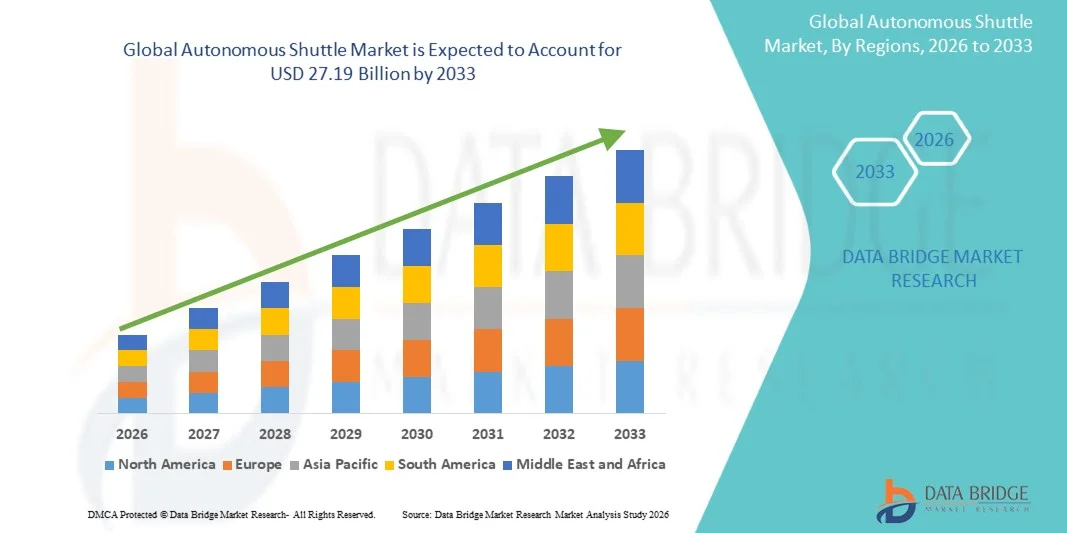
- As per Data Bridge Market Research analysis, the autonomous shuttle market was valued at USD 6.20 billion in 2025 and is projected to reach USD 27.19 billion by 2033, growing at a CAGR of 20.30% from 2026 to 2033.
- The market is experiencing consistent growth driven by rising demand for autonomous and shared mobility solutions, rapid advancements in artificial intelligence, LiDAR, sensor technologies, and vehicle-to-everything connectivity, and expanding applications across public transportation, airports, corporate campuses, and smart cities.
- The increasing focus on reducing transportation-related emissions, improving road safety, and addressing driver shortages, combined with growing investments in smart-city infrastructure and autonomous mobility programs, is compelling transportation authorities, mobility operators, and private organizations to adopt autonomous shuttle technologies. Electric and Level 4 autonomous shuttles are increasingly being deployed in controlled and fixed-route environments, offering cost-effective, flexible, and safer mobility solutions while supporting the transition toward connected and sustainable transportation.
Market Size & Forecast
- Global Market Value (2025): USD 6.20 Billion
- Expected Market Value (2033): USD 27.19 Billion
- Forecast CAGR (2026–2033): 20.30%
- Leading Region in 2025: North America
- Fastest Growing Region: Asia Pacific
What are the Major Takeaways of the Autonomous Shuttle Market?
- North America dominated the autonomous shuttle market with the largest revenue share of 41.2% in 2025, supported by advanced autonomous technology infrastructure, strong investments in research and development, and favorable regulatory frameworks.
- Asia-Pacific is expected to be the fastest-growing region at a CAGR of 18.6% from 2026 to 2033, fueled by rapid urbanization, smart-city initiatives, expanding mobility infrastructure, and increasing deployment of autonomous shuttle services across China, Japan, South Korea, and India.
- The passenger autonomous shuttles segment led the market with a 70% share in 2025, driven by increasing deployment of autonomous mobility solutions for public transportation, campuses, airports, and last-mile connectivity
- Cargo autonomous shuttles are the fastest-growing shuttle type, projected to register a CAGR of 20%, reflecting the surge in demand for automated goods movement across airports, logistics facilities, industrial parks, and commercial campuses.
- The LiDAR-based systems segment dominated the technology category with a 44.8% revenue share in 2025, led by its ability to provide highly accurate three-dimensional mapping, object detection, and environmental perception.
- Public transportation accounted for 34% of the market share in 2025, preferred by increasing government interest in autonomous mobility and the need to improve first-mile and last-mile connectivity
- The on-demand mobility services segment is the fastest-growing service model category, with a CAGR of 25%, driven by growing demand for flexible transportation that can respond to passenger needs rather than relying exclusively on fixed schedules.
Report Scope and Autonomous Shuttle Market Segmentation
|
Attributes |
Autonomous Shuttle Key Market Insights |
|
Segments Covered |
|
|
Countries Covered |
North America
Europe
Asia-Pacific
Middle East and Africa
South America
|
|
Key Market Players |
|
|
Market Opportunities |
|
|
Value Added Data Infosets |
In addition to the market insights such as market value, growth rate, market segments, geographical coverage, market players, and market scenario, the market report curated by the Data Bridge Market Research team includes in-depth expert analysis, import/export analysis, pricing analysis, production consumption analysis, and pestle analysis. |
What is the Key Trend in the Autonomous Shuttle Market?
- Public transportation agencies and mobility operators are increasingly deploying autonomous shuttles for first-mile and last-mile connectivity, particularly on fixed routes where predictable operating conditions support safer and more reliable autonomous operation.
- For instance, in April 2026, Singapore opened fixed-route autonomous shuttle rides to the public in Punggol, connecting residential estates with key amenities such as MRT stations and polyclinics and complementing the existing public transport network.
- The integration of autonomous shuttles with existing public transport networks enables flexible route coverage, improves accessibility to underserved areas, and reduces dependence on conventional driver-operated services.
- Airports, campuses, industrial sites, hospitals, and residential communities are increasingly adopting autonomous shuttles because controlled or semi-controlled environments simplify route validation and autonomous fleet management.
- For instance, in September 2025, Zurich Airport reported that its autonomous shuttle pilot had progressed to Level 3 automation, with employee passenger testing underway and remote monitoring planned as the next step toward Level 4 operation.
- As cities and transportation operators continue prioritizing sustainable mobility, last-mile connectivity, and automated public transportation, deployment of autonomous shuttles across fixed-route and controlled environments is expected to accelerate, reinforcing autonomous mobility as an important component of next-generation urban transportation.
What are the Key Drivers of the Autonomous Shuttle Market?
- The growing need for efficient last-mile transportation and the increasing shortage of transportation personnel are significantly increasing demand for autonomous shuttles capable of complementing conventional public transit services.
- For instance, in September 2025, Singapore's ComfortDelGro announced plans to introduce autonomous shuttle services with Pony.ai in Punggol, citing the need to supplement shortages of drivers, routes, and buses in the community. The company began training safety operators, including former taxi drivers, for the autonomous shuttle operation.
- Transportation authorities, municipalities, and mobility operators are integrating autonomous shuttles into public transport networks to expand coverage, improve service flexibility, and provide sustainable mobility without requiring a driver for every vehicle.
- For instance, in July 2025, the Jacksonville Transportation Authority launched the first autonomous public-transit shuttle service in the U.S., deploying 14 electric autonomous vehicles along a 3.5-mile route with 12 designated stations in downtown Jacksonville, demonstrating the use of autonomous shuttles to expand public transportation services.
- With governments increasingly pursuing automated, connected, and sustainable transportation systems, autonomous shuttles will remain an important solution for addressing first-mile and last-mile mobility requirements and improving the efficiency of future public transit networks.
Which Factors are Challenging the Growth of the Autonomous Shuttle Market
- Autonomous shuttle deployment requires significant investment in sensors, vehicle-control systems, connectivity infrastructure, mapping, fleet supervision, and safety validation, increasing the cost and complexity of commercial deployment.
- These requirements can limit adoption among smaller transportation operators and municipalities, particularly where dedicated infrastructure, technical expertise, and autonomous-vehicle regulatory frameworks are still developing.
- For instance, in November 2025, Singapore's Ministry of Transport stated that autonomous-vehicle pilots would help determine whether additional infrastructure, including dedicated pickup and drop-off points or sensors, would be required for future deployment.
- Regulatory approval and passenger-safety requirements also create operational challenges because autonomous shuttles operating on public roads require authorization, route assessment, risk analysis, and safety validation before commercial service.
- For instance, in June 2025, the U.K. Department for Transport published research examining driver roles and passenger inclusivity in automated passenger services, highlighting challenges such as wheelchair assistance and support for visually impaired passengers when no driver or onboard attendant is present.
- The combination of high deployment costs, infrastructure requirements, regulatory complexity, and passenger-safety considerations continues to slow large-scale commercialization, particularly for autonomous shuttle operations on complex public-road environments.
How is the Autonomous Shuttle Market Segmented?
The autonomous shuttle market is segmented on the basis of shuttle type, technology, application, and service model.
- By Shuttle Type
On the basis of shuttle type, the autonomous shuttle market is segmented into passenger autonomous shuttles, cargo autonomous shuttles, and mixed-use shuttles. The passenger autonomous shuttles segment dominated the market with 70% share in 2025, owing to increasing deployment of autonomous mobility solutions for public transportation, campuses, airports, and last-mile connectivity. Passenger shuttles are particularly suitable for short-distance routes where predictable travel patterns and frequent stops support autonomous operation. Municipalities and transportation operators are increasingly evaluating these vehicles to complement conventional buses and address first-mile and last-mile transportation gaps. Growing urbanization and demand for sustainable shared mobility are further supporting passenger shuttle adoption. The segment also benefits from increasing deployment of electric autonomous shuttles in controlled urban and institutional environments.
The cargo autonomous shuttles segment is projected to register the fastest growth at 20% CAGR from 2026 to 2033, driven by increasing demand for automated goods movement across airports, logistics facilities, industrial parks, and commercial campuses. Cargo shuttles can operate repetitive routes with limited human intervention, making them suitable for environments where predictable transportation cycles are required. Growing e-commerce activity and the expansion of automated logistics operations are creating additional demand for autonomous movement of packages, supplies, and materials. Labor shortages and rising transportation operating costs are also encouraging businesses to evaluate driverless cargo transportation. Integration of LiDAR, cameras, radar, artificial intelligence, and fleet-management platforms is improving navigation and operational reliability.
- By Technology
On the basis of technology, the global autonomous shuttle market is segmented into LiDAR-based systems, camera-based systems, radar-based systems, and V2X communication systems. The LiDAR-based systems segment dominated the market with a 44.8% share in 2025, owing to its ability to provide highly accurate three-dimensional mapping, object detection, and environmental perception. LiDAR enables autonomous shuttles to identify pedestrians, vehicles, road boundaries, and obstacles with high spatial precision. The technology is particularly valuable for shuttles operating on campuses, airports, dedicated routes, and urban environments where reliable perception is essential. Manufacturers are increasingly combining LiDAR with artificial intelligence and other sensor technologies to improve autonomous navigation and redundancy. Growing emphasis on passenger safety and reliable autonomous operation is further supporting LiDAR adoption.
The V2X communication systems segment is projected to register the fastest growth at an 25% CAGR from 2026 to 2033, driven by increasing demand for connected and coordinated autonomous transportation. V2X enables shuttles to communicate with other vehicles, traffic infrastructure, pedestrians, and network systems in real time. This connectivity can provide autonomous vehicles with information beyond what onboard sensors can independently detect, supporting safer and more efficient navigation. Increasing deployment of smart traffic infrastructure and connected-road systems is creating favorable conditions for V2X-enabled shuttles. The expansion of advanced wireless networks is also improving the speed and reliability of vehicle-to-infrastructure communication.
- By Application
On the basis of application, the autonomous shuttle market is segmented into public transportation, airport transportation, university & corporate campuses, smart cities, tourism & hospitality, industrial facilities, healthcare campuses, and residential communities. The public transportation segment dominated the market with 34% share in 2025, supported by increasing government interest in autonomous mobility and the need to improve first-mile and last-mile connectivity. Public transit agencies are using autonomous shuttles to complement conventional bus networks and serve routes where traditional buses may be inefficient. Fixed-route operations also provide relatively predictable environments for deploying autonomous technology and validating safety performance. Growing urban congestion, driver shortages, and pressure to provide sustainable transportation are further encouraging transit authorities to evaluate autonomous shuttles. The technology can also improve connectivity between major transit stations and surrounding neighborhoods.
The airport transportation segment is projected to witness the fastest growth at 10% CAGR from 2026 to 2033, driven by airports' need for efficient and reliable movement of passengers and employees between terminals, parking areas, rental-car facilities, and other airport amenities. Airport environments commonly feature predetermined routes and operating zones, making them suitable for autonomous shuttle deployment. Autonomous operations can also reduce dependence on human drivers and potentially improve fleet utilization throughout the day. Increasing passenger volumes are encouraging airports to invest in technologies that improve terminal connectivity and reduce waiting times. The ability to operate electric autonomous shuttles also aligns with airports' broader emissions-reduction objectives. Autonomous shuttles can further reduce labor requirements while improving transportation efficiency across large airport premises.
- By Service Model
On the basis of service model, the global autonomous shuttle market is segmented into public transport, intercity transportation, corporate shuttle services, and on-demand mobility services. The public transport segment dominated the market with a 45.5% share in 2025, supported by increasing integration of autonomous shuttles into public transportation networks. Transit agencies are deploying autonomous vehicles to provide first-mile and last-mile connectivity and extend coverage to areas that may not justify conventional bus services. Public transport deployments also benefit from fixed routes, established stops, and centralized fleet management systems. Growing government investments in smart mobility and sustainable transportation infrastructure are strengthening demand for autonomous public transit. Driver shortages and increasing operating costs are providing additional incentives for transit operators to automate repetitive shuttle routes.
The on-demand mobility services segment is projected to register the fastest growth at 25% CAGR from 2026 to 2033, driven by growing demand for flexible transportation that can respond to passenger needs rather than relying exclusively on fixed schedules. On-demand autonomous shuttles can dynamically adjust routes or pickup points based on passenger requests, improving vehicle utilization and reducing unnecessary trips. These services are particularly relevant for residential communities, business districts, campuses, airports, and underserved urban areas. Integration with smartphone applications, cloud-based dispatch platforms, real-time fleet monitoring, and digital payment systems is making demand-responsive mobility increasingly feasible. The model can also complement existing public transit by providing flexible connections to major stations and mobility hubs.
Which Region Holds the Largest Share of the Autonomous Shuttle Market?
- North America dominated the autonomous shuttle market with the largest revenue share of 41.2% in 2025, supported by advanced autonomous technology infrastructure, strong investments in research and development, and favorable regulatory frameworks.
- The region also benefits from the presence of major autonomous vehicle technology companies, established mobility ecosystems, extensive testing programs, and growing adoption of autonomous shuttles across public transportation, airports, campuses, and corporate environments. Increasing investment in smart mobility infrastructure, connected transportation systems, and sustainable last-mile solutions continues to strengthen North America’s leadership position in the global market.
U.S. Autonomous Shuttle Market Insight
The U.S. autonomous shuttle market is witnessing strong growth due to rising investments in autonomous public transportation, smart mobility infrastructure, and driverless vehicle testing programs. The country’s mature technology ecosystem, along with increasing adoption of artificial intelligence, LiDAR, connected-vehicle systems, and electric autonomous shuttles, is driving demand across public transit, airports, campuses, and corporate facilities. In addition, growing emphasis on addressing driver shortages, improving last-mile connectivity, and developing safer and more sustainable transportation solutions is accelerating autonomous shuttle deployment across municipalities and mobility operators.
Asia-Pacific Autonomous Shuttle Market Insight
The Asia-Pacific autonomous shuttle market is expected to witness rapid growth, driven by increasing urbanization, expanding smart-city initiatives, and rising investments in autonomous transportation infrastructure across countries such as China, Japan, South Korea, and India. Growing demand for efficient last-mile mobility, increasing adoption of electric vehicles, and government support for intelligent transportation systems are supporting regional market expansion. In addition, the growing presence of automotive technology companies, autonomous driving testing programs, and connected mobility infrastructure is accelerating autonomous shuttle adoption across public and private transportation applications.
Japan Autonomous Shuttle Market Insight
The Japan autonomous shuttle market is witnessing consistent growth due to rising investments in automated mobility technologies, transportation innovation, and solutions addressing mobility challenges in aging and underserved communities. Transportation operators, municipalities, and technology companies are increasingly deploying autonomous shuttles for local public transportation, community mobility, and last-mile connectivity. Moreover, increasing integration of artificial intelligence, LiDAR, vehicle-to-everything technologies, and electric powertrains, along with the country’s focus on safe and efficient transportation solutions, is further contributing to market growth.
China Autonomous Shuttle Market Insight
The China autonomous shuttle market is growing rapidly, driven by increasing urbanization, expanding intelligent transportation infrastructure, and strong government support for autonomous driving and smart-city development. Growing adoption of artificial intelligence, LiDAR, 5G connectivity, and vehicle-to-everything technologies across public transportation and commercial mobility applications is significantly boosting market demand. In addition, rising investments in autonomous vehicle research and development, expanding pilot zones, and increasing deployment of driverless mobility services are positioning China as one of the fastest-growing markets for autonomous shuttles globally.
U.K. Autonomous Shuttle Market Insight
The U.K. autonomous shuttle market is experiencing steady growth, supported by rising adoption of automated passenger transportation, smart mobility technologies, and autonomous vehicle testing programs. Increasing investments in autonomous shuttle infrastructure and growing demand for flexible, sustainable, and cost-effective public transportation solutions are contributing to market growth. Furthermore, integration of artificial intelligence, advanced sensors, connectivity, and remote fleet-monitoring technologies is improving autonomous shuttle performance and operational efficiency, positioning the U.K. as a key innovation market in the autonomous mobility industry.
Germany Autonomous Shuttle Market Insight
The Germany autonomous shuttle market is expanding steadily due to the country’s strong automotive manufacturing base, advanced research capabilities, and increasing adoption of next-generation autonomous mobility technologies. Automotive companies, transportation operators, municipalities, and research institutions are increasingly utilizing autonomous shuttles for public transportation, testing, passenger mobility, and smart-city applications. Continuous advancements in artificial intelligence, sensor technologies, connectivity, and electric vehicle platforms, along with strong government focus on sustainable transportation and autonomous driving innovation, are further driving market growth in Germany.
Which are the Top Companies in Autonomous Shuttle Market?
The autonomous shuttle industry is primarily led by well-established companies, including:
- EasyMile SAS (France)
- Navya Mobility (France)
- May Mobility (U.S.)
- Perrone Robotics, Inc. (U.S.)
- Ohmio (New Zealand)
- Auve Tech (Estonia)
- Aurrigo International plc (U.K.)
- Karsan Otomotiv San. ve Tic. A.Ş. (Turkey)
- BENTELER (Germany)
- WeRide Inc. (China)
- Pony AI Inc. (China)
- Hyundai Motor Company (South Korea)
- Toyota Motor Corporation (Japan)
- Mobileye Global Inc. (Israel)
- ZF Friedrichshafen AG (Germany)
- Oxa Autonomy (U.K.)
- TIER IV, Inc. (Japan)
- Beep, Inc. (U.S.)
- Volvo Group (Sweden)
- Ridecell, Inc. (U.S.)
What are Latest Developments in Autonomous Shuttle Market?
- In September 2025, Zurich Airport announced that its autonomous shuttle bus pilot had reached Level 3 automation, following testing that began in March 2025. Employees had been using the shuttles since June, while the project team prepared a remote-monitoring system to enable future operation without a safety driver. The technology, supplied by WeRide, is being tested on airport premises to establish the technical, operational, and regulatory foundations for higher-level autonomous passenger transportation
- In July 2025, WeRide launched fully driverless Robobus operations at Resorts World Sentosa in Singapore, marking Southeast Asia’s first autonomous vehicle operation without a safety officer onboard. The deployment represented a significant step toward commercial autonomous shuttle services in controlled environments and demonstrated the use of driverless technology for passenger transportation. The operation builds on WeRide’s autonomous driving technology and Singapore’s efforts to expand automated mobility services.
- In June 2025, the Jacksonville Transportation Authority launched the NAVI autonomous public transportation service, becoming the first public transportation autonomous vehicle revenue service in the United States. The initial service uses a fleet of 14 customized electric Ford E-Transit vehicles equipped with Oxa’s automated driving system. The vehicles can accommodate passengers and include accessibility features, demonstrating how autonomous technology can be incorporated into regular public transportation.
- In August 2024, Hong Kong began preparations for a trial of two autonomous shuttle light buses at Fairview Park in Yuen Long. The vehicles were equipped with artificial intelligence, 15 radars, recognition cameras, high-definition electronic maps, and 5G connectivity for real-time monitoring. The approximately seven-month trial was designed to evaluate driverless passenger transportation on a 2.5-kilometre residential loop.
- In March 2022, Volkswagen unveiled the ID. Buzz as a vehicle platform intended to support future autonomous mobility concepts, including MOIA’s app-based electric shuttle and ride-pooling services. Volkswagen highlighted the vehicle’s role in future urban transportation and its compatibility with autonomous-driving development. The ID. Buzz combined an all-electric powertrain with connected vehicle technologies, including Car2X communication, creating a foundation for future automated mobility applications.

- Interactive Data Analysis Dashboard
- Company Analysis Dashboard for high growth potential opportunities
- Research Analyst Access for customization & queries
- Competitor Analysis with Interactive dashboard
- Latest News, Updates & Trend analysis
- Harness the Power of Benchmark Analysis for Comprehensive Competitor Tracking
Data collection and base year analysis are done using data collection modules with large sample sizes. The stage includes obtaining market information or related data through various sources and strategies. It includes examining and planning all the data acquired from the past in advance. It likewise envelops the examination of information inconsistencies seen across different information sources. The market data is analysed and estimated using market statistical and coherent models. Also, market share analysis and key trend analysis are the major success factors in the market report. To know more, please request an analyst call or drop down your inquiry.
The key research methodology used by DBMR research team is data triangulation which involves data mining, analysis of the impact of data variables on the market and primary (industry expert) validation. Data models include Vendor Positioning Grid, Market Time Line Analysis, Market Overview and Guide, Company Positioning Grid, Patent Analysis, Pricing Analysis, Company Market Share Analysis, Standards of Measurement, Global versus Regional and Vendor Share Analysis. To know more about the research methodology, drop in an inquiry to speak to our industry experts.
Data Bridge Market Research is a leader in advanced formative research. We take pride in servicing our existing and new customers with data and analysis that match and suits their goal. The report can be customized to include price trend analysis of target brands understanding the market for additional countries (ask for the list of countries), clinical trial results data, literature review, refurbished market and product base analysis. Market analysis of target competitors can be analyzed from technology-based analysis to market portfolio strategies. We can add as many competitors that you require data about in the format and data style you are looking for. Our team of analysts can also provide you data in crude raw excel files pivot tables (Fact book) or can assist you in creating presentations from the data sets available in the report.













