


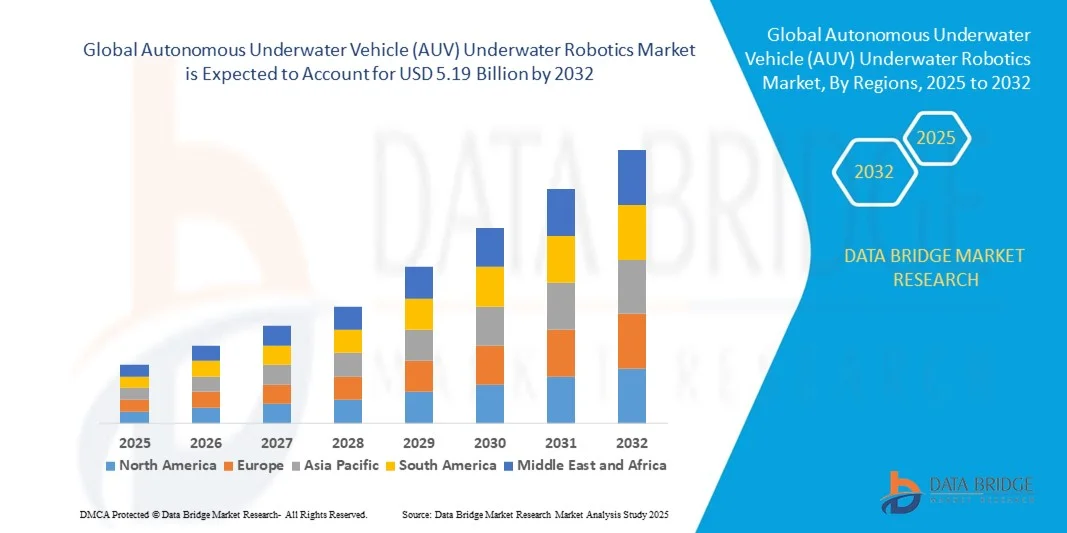
Autonomous Underwater Vehicle (AUV) Underwater Robotics Market Size
- The global autonomous underwater vehicle (AUV) underwater robotics market size was valued at USD 1.76 billion in 2024 and is expected to reach USD 5.19 billion by 2032, at a CAGR of 14.50% during the forecast period
- The market growth is largely fueled by the rising adoption of autonomous technologies and advancements in underwater robotics, enabling efficient exploration, inspection, and monitoring in deep-sea and offshore environments. Increasing investments from defense, energy, and research sectors are driving demand for AUVs capable of operating independently in complex underwater missions with enhanced accuracy and reduced human intervention
- Furthermore, growing emphasis on oceanographic research, environmental monitoring, and offshore oil and gas development is accelerating the deployment of AUVs across commercial and governmental applications. These converging factors are significantly enhancing operational efficiency, data precision, and safety, thereby propelling the market’s expansion
Autonomous Underwater Vehicle (AUV) Underwater Robotics Market Analysis
- AUVs, designed for autonomous underwater navigation and data collection, are becoming integral to marine research, defense surveillance, and offshore industrial operations due to their ability to operate efficiently in hazardous and deep-water environments without direct human control
- The growing demand for AUVs is primarily driven by expanding offshore exploration activities, technological advancements in sensors, batteries, and navigation systems, and increasing investments in marine robotics aimed at improving subsea mapping, environmental monitoring, and defense capabilities
- North America dominated the autonomous underwater vehicle (AUV) underwater robotics market with a share of 34.12% in 2024, due to increasing investments in offshore exploration, defense, and scientific research initiatives
- Asia-Pacific is expected to be the fastest growing region in the autonomous underwater vehicle (AUV) underwater robotics market during the forecast period due to expanding offshore exploration, defense initiatives, and ocean research in countries such as China, Japan, and India
- Commercial exploration segment dominated the market with a market share of 45.8% in 2024, due to increasing demand for offshore oil and gas surveys, underwater mining, and subsea infrastructure inspections. Businesses prefer AUVs for their ability to conduct cost-effective, high-precision underwater mapping and data collection, reducing the need for manned operations in challenging marine environments. Integration with advanced sonar and imaging systems enhances operational efficiency and data reliability
Report Scope and Autonomous Underwater Vehicle (AUV) Underwater Robotics Market Segmentation
|
Attributes |
Autonomous Underwater Vehicle (AUV) Underwater Robotics Key Market Insights |
|
Segments Covered |
|
|
Countries Covered |
North America
Europe
Asia-Pacific
Middle East and Africa
South America
|
|
Key Market Players |
|
|
Market Opportunities |
|
|
Value Added Data Infosets |
In addition to the insights on market scenarios such as market value, growth rate, segmentation, geographical coverage, and major players, the market reports curated by the Data Bridge Market Research also include in-depth expert analysis, geographically represented company-wise production and capacity, network layouts of distributors and partners, detailed and updated price trend analysis and deficit analysis of supply chain and demand. |
Autonomous Underwater Vehicle (AUV) Underwater Robotics Market Trends
AI-enabled Autonomous Navigation
- The Autonomous Underwater Vehicle (AUV) underwater robotics market is witnessing rapid technological advancements with the integration of AI-enabled autonomous navigation systems. These innovations enhance mission efficiency by enabling real-time decision-making, adaptive route planning, and intelligent obstacle avoidance without human intervention
- For instance, Kongsberg Gruppen has deployed AUVs integrated with AI-based navigation algorithms for offshore survey missions, allowing precise seabed mapping and inspection in challenging underwater environments. Similarly, Ocean Infinity utilizes AI-driven autonomy in its HUGIN AUV fleet to optimize data collection from deepwater exploration and subsea infrastructure inspections
- AI-enabled navigation allows AUVs to interpret sensor data and dynamically adjust mission paths based on evolving environmental conditions. This capability improves operational safety, quality of data acquisition, and mission completion rates, particularly in low-visibility or high-pressure underwater settings
- The growing role of AI in autonomous navigation is enhancing efficiency in applications such as pipeline inspection, environmental monitoring, and undersea mapping. AUVs can operate over extended durations with minimal operator input, reducing manpower requirements and enabling more complex survey missions
- Integration of AI with machine learning models enables predictive maintenance and intelligent processing of gathered data, allowing faster identification of anomalies in subsea assets. This development supports proactive servicing and operational readiness, particularly for offshore energy and defense sectors
- The expansion of AI-enabled autonomous navigation in AUVs marks a transformative phase in underwater robotics, combining autonomy with advanced analytics. This convergence offers substantial improvements in mission reliability, operational cost-effectiveness, and adaptability in both commercial and defense marine operations
Autonomous Underwater Vehicle (AUV) Underwater Robotics Market Dynamics
Driver
Increasing Offshore Exploration
- Rising global demand for offshore resource discovery and monitoring is a significant driver for the AUV underwater robotics market. Expanding activities in oil and gas prospecting, renewable energy deployment, and marine scientific research are fueling the need for advanced underwater exploration systems capable of covering large areas with precision
- For instance, Fugro has deployed AUVs for seabed mapping and geophysical surveys to support offshore wind farm developments. These operations utilize autonomous capabilities to gather high-resolution data while reducing operational timelines in complex marine environments
- AUVs equipped for offshore exploration can conduct detailed inspections of undersea landscapes, drilling sites, and subsea infrastructure. Their ability to operate at extreme depths without tethered connections makes them invaluable for missions requiring long-range endurance and minimal human intervention
- Increased offshore energy investments are boosting the use of AUVs for monitoring subsea assets, identifying pipeline integrity issues, and assessing structural stability. This capability ensures operational safety and regulatory compliance in high-value industrial projects
- As offshore exploration diversifies into emerging sectors such as deep-sea mining and marine biodiversity surveys, AUV adoption is set to rise. Their capacity to deliver precise, repeatable, and high-quality data supports informed decision-making and strengthens operational efficiency across industries reliant on underwater intelligence
Restraint/Challenge
High Operational Costs
- The high operational costs associated with deploying and maintaining AUVs present a notable challenge to market growth. Expenses include procurement, system integration, specialized crew training, and ongoing maintenance of complex sensors and navigation systems designed for extreme underwater conditions
- For instance, SAAB Seaeye’s advanced AUV models require substantial capital investment along with periodic servicing of propulsion units, sonar arrays, and battery systems. These cost factors can deter smaller operators or research organizations with limited budgets from fully adopting AUV technologies
- Operational costs are heightened by the need for dedicated support vessels, advanced mission planning, and post-processing of acquired data. These requirements contribute to increased logistical complexity and resource allocation, especially for remote offshore missions
- The durability demands of underwater robotics necessitate the use of high-grade, corrosion-resistant materials and robust electronics, further raising manufacturing and replacement costs. In addition, software licensing for specialized AI and imaging applications adds to operational expenditure
- Addressing the cost challenge will depend on advances in modular design, improved energy efficiency, and shared-service operational models. Expanding leasing arrangements and collaborative mission operations could help mitigate high investment barriers, enabling broader access to AUV technologies across marine industries
Autonomous Underwater Vehicle (AUV) Underwater Robotics Market Scope
The market is segmented on the basis of type, application, and end-user.
- By Type
On the basis of type, the AUV market is segmented into shallow AUV, medium AUV, and large AUV. The shallow AUV segment dominated the market with the largest market revenue share in 2024, driven by its versatility, lower operational costs, and suitability for coastal mapping, environmental monitoring, and shallow-water inspections. Shallow AUVs are preferred due to their ease of deployment, quick turnaround times, and compatibility with various sensor packages, making them ideal for both commercial and research applications. Their lightweight design and adaptability for autonomous operations further reinforce their market dominance.
The medium AUV segment is anticipated to witness the fastest growth rate from 2025 to 2032, fueled by increasing demand in offshore energy exploration, mid-depth oceanographic surveys, and underwater infrastructure inspections. Medium AUVs strike a balance between operational range and payload capacity, providing enhanced mission flexibility. Growing adoption by defense and commercial sectors for complex underwater tasks, coupled with technological advancements in battery efficiency and navigation systems, is expected to drive the rapid growth of this segment.
- By Application
On the basis of application, the AUV market is segmented into commercial exploration, defense and security, and scientific research. The commercial exploration segment dominated the market with the largest revenue share of 45.8% in 2024, driven by increasing demand for offshore oil and gas surveys, underwater mining, and subsea infrastructure inspections. Businesses prefer AUVs for their ability to conduct cost-effective, high-precision underwater mapping and data collection, reducing the need for manned operations in challenging marine environments. Integration with advanced sonar and imaging systems enhances operational efficiency and data reliability.
The defense and security segment is expected to witness the fastest growth rate from 2025 to 2032, driven by rising investments in maritime surveillance, anti-submarine warfare, and border security operations. AUVs provide stealth, long-duration underwater missions, and real-time intelligence, making them invaluable for military and national security applications. Technological advancements in autonomous navigation, payload versatility, and remote control systems further support the increasing adoption of AUVs in defense sectors worldwide.
- By End User
On the basis of end user, the AUV market is segmented into industries, governments, scientific and research organizations, and others. The industrial segment dominated the market with the largest revenue share in 2024, owing to extensive use in offshore energy, underwater mining, and subsea infrastructure monitoring. Industries benefit from AUVs’ efficiency, reduced operational risks, and ability to operate in harsh underwater environments, ensuring cost-effective and reliable data collection for commercial decision-making. Integration with AI-driven analytics enhances their precision and operational value.
The scientific and research organizations segment is anticipated to witness the fastest growth rate from 2025 to 2032, fueled by rising investments in oceanographic studies, marine biodiversity research, and environmental monitoring. Research institutions increasingly adopt AUVs for their ability to conduct long-duration missions, collect high-resolution data, and explore previously inaccessible underwater regions. Advancements in sensor technology, modular payloads, and autonomous navigation systems further accelerate adoption in the scientific community.
Autonomous Underwater Vehicle (AUV) Underwater Robotics Market Regional Analysis
- North America dominated the autonomous underwater vehicle (AUV) underwater robotics market with the largest revenue share of 34.12% in 2024, driven by increasing investments in offshore exploration, defense, and scientific research initiatives
- Organizations and enterprises in the region are leveraging AUVs for subsea mapping, environmental monitoring, and underwater infrastructure inspections, valuing their efficiency, precision, and reduced operational risks
- Widespread adoption is further supported by strong R&D capabilities, advanced technological infrastructure, and favorable funding for defense and energy sectors, establishing AUVs as preferred solutions for commercial, governmental, and research applications
U.S. Autonomous Underwater Vehicle (AUV) Underwater Robotics Market Insight
The U.S. autonomous underwater vehicle (AUV) underwater robotics Market captured the largest revenue share in North America in 2024, driven by high utilization in naval defense, offshore oil & gas surveys, and scientific exploration. Robust government funding, rapid advancements in sensor technology, and increased demand for autonomous underwater operations are fueling market growth. Integration of AUVs with artificial intelligence and data analytics platforms further enhances mission efficiency and underwater mapping precision.
Europe Autonomous Underwater Vehicle (AUV) Underwater Robotics Market Insight
The Europe autonomous underwater vehicle (AUV) underwater robotics Market is projected to grow at a substantial CAGR during the forecast period, supported by growing investments in marine research, offshore renewable energy projects, and defense modernization programs. Stringent maritime safety standards and the region’s strong focus on sustainable ocean development are boosting the adoption of AUVs across research and commercial applications.
U.K. Autonomous Underwater Vehicle (AUV) Underwater Robotics Market Insight
The U.K. autonomous underwater vehicle (AUV) underwater robotics Market is expected to register a notable CAGR during the forecast period, driven by increasing offshore energy activities, marine ecosystem studies, and defense-related underwater missions. The country’s advanced marine research infrastructure and commitment to innovation in autonomous systems continue to encourage AUV adoption across both industrial and governmental operations.
Germany Autonomous Underwater Vehicle (AUV) Underwater Robotics Market Insight
The Germany autonomous underwater vehicle (AUV) underwater robotics Market is projected to expand at a considerable CAGR during the forecast period, fueled by the country’s engineering excellence, emphasis on sustainability, and growing focus on marine research. Germany’s advancements in robotics and precision instrumentation support the integration of AUVs in environmental monitoring, renewable energy surveys, and subsea inspection projects.
Asia-Pacific Autonomous Underwater Vehicle (AUV) Underwater Robotics Market Insight
The Asia-Pacific autonomous underwater vehicle (AUV) underwater robotics Market is expected to grow at the fastest CAGR from 2025 to 2032, driven by expanding offshore exploration, defense initiatives, and ocean research in countries such as China, Japan, and India. Rising investments in marine infrastructure, government-backed digital ocean programs, and local AUV manufacturing are accelerating regional growth. Increasing cost efficiency and accessibility are further boosting AUV adoption across diverse end-use sectors.
Japan Autonomous Underwater Vehicle (AUV) Underwater Robotics Market Insight
The Japan autonomous underwater vehicle (AUV) underwater robotics Market is witnessing strong growth driven by extensive marine exploration, technological innovation, and national programs promoting oceanographic research. Japan’s expertise in robotics, coupled with integration of AUVs into AI-enabled marine observation networks, supports precise underwater mapping and disaster management applications.
China Autonomous Underwater Vehicle (AUV) Underwater Robotics Market Insight
The China autonomous underwater vehicle (AUV) underwater robotics Market accounted for the largest revenue share in Asia-Pacific in 2024, supported by rapid advancements in underwater robotics, large-scale offshore development projects, and defense modernization. Strong government initiatives promoting smart ocean technologies and robust domestic manufacturing capabilities make China a key hub for AUV production and deployment across commercial, defense, and research applications
Autonomous Underwater Vehicle (AUV) Underwater Robotics Market Share
The autonomous underwater vehicle (AUV) underwater robotics industry is primarily led by well-established companies, including:
- ATLAS ELEKTRONIK GmbH (Germany)
- Deep Ocean Engineering, Inc. (U.S.)
- Bluebird Marine Systems Ltd. (U.K.)
- ECA GROUP (France)
- International Submarine Engineering Limited (Canada)
- Oceaneering International, Inc. (U.S.)
- Saab Seaeye Ltd. (U.K.)
- Soil Machine Dynamics Ltd. (U.K.)
- General Dynamics Mission Systems, Inc. (U.S.)
- Eddyfi (Canada)
- TechnipFMC plc (U.K. / France)
- Subsea Tech (France)
- Mariscope Meerestechnik (Germany)
- Future Robot Lu (China)
- Planys Technologies (India)
- Modus Seabed Intervention Limited (U.K.)
- ROVOP (U.K.)
- Fugro (Netherlands)
- Innova STEM Education (U.S.)
- KONGSBERG (Norway)
Latest Developments in Global Autonomous Underwater Vehicle (AUV) Underwater Robotics Market
- In February 2025, Nauticus Robotics entered a strategic partnership with Leidos to jointly develop advanced autonomous underwater vehicles capable of performing complex subsea missions. This collaboration combines Nauticus’s robotics innovation with Leidos’s expertise in autonomy and system integration, accelerating the evolution of next-generation AUVs. The partnership is expected to strengthen market competitiveness by enhancing mission adaptability, improving operational efficiency, and broadening applications across commercial, scientific, and defense sectors
- In October 2024, Oceaneering was awarded a major contract by the U.S. Department of Defense’s Defense Innovation Unit (DIU) to design and develop the Freedom AUV and an Onshore Remote Operations Center (OROC) for the U.S. Navy. This initiative represents a significant leap toward integrating AUVs into naval operations for autonomous surveillance, data gathering, and maintenance missions. The project’s focus on remote management and real-time mission control highlights the growing importance of automation and connectivity in underwater defense robotics
- In September 2021, Fugro received a contract from TotalEnergies to conduct a geohazard site investigation in Suriname, which included the collection of geophysical data and geotechnical soil samples. This project strengthened Fugro’s position as a leading provider of underwater robotics solutions for offshore energy exploration. The deployment of AUVs in this mission demonstrated their value in enhancing operational safety, data precision, and efficiency in deepwater environments
- In April 2021, Fugro was awarded a contract by Equinor to carry out a deep-water site investigation in the Canadian Flemish Pass using the Echo Surveyor VIII, one of its most advanced AUVs. The project underscored the growing reliance on autonomous technologies for deep-sea exploration and subsea mapping. The enhanced capability of AUVs to deliver high-resolution data in extreme marine conditions contributed to expanding their adoption across global offshore projects
- In December 2020, South Korea’s Defense Acquisition Program Administration (DAPA) signed an USD 11 million contract with LIG Nex1 to develop autonomous underwater robots capable of precise navigation and collision avoidance. The initiative aimed to strengthen the Republic of Korea Navy’s mine countermeasure capabilities and boost the country’s technological self-reliance in defense robotics. This development significantly contributed to advancing AUV technology in military applications, reflecting the broader shift toward unmanned systems for naval operations

- Interactive Data Analysis Dashboard
- Company Analysis Dashboard for high growth potential opportunities
- Research Analyst Access for customization & queries
- Competitor Analysis with Interactive dashboard
- Latest News, Updates & Trend analysis
- Harness the Power of Benchmark Analysis for Comprehensive Competitor Tracking
Global Autonomous Underwater Vehicle Auv Underwater Robotics Market, Supply Chain Analysis and Ecosystem Framework
To support market growth and help clients navigate the impact of geopolitical shifts, DBMR has integrated in-depth supply chain analysis into its Global Autonomous Underwater Vehicle Auv Underwater Robotics Market research reports. This addition empowers clients to respond effectively to global changes affecting their industries. The supply chain analysis section includes detailed insights such as Global Autonomous Underwater Vehicle Auv Underwater Robotics Market consumption and production by country, price trend analysis, the impact of tariffs and geopolitical developments, and import and export trends by country and HSN code. It also highlights major suppliers with data on production capacity and company profiles, as well as key importers and exporters. In addition to research, DBMR offers specialized supply chain consulting services backed by over a decade of experience, providing solutions like supplier discovery, supplier risk assessment, price trend analysis, impact evaluation of inflation and trade route changes, and comprehensive market trend analysis.
Data collection and base year analysis are done using data collection modules with large sample sizes. The stage includes obtaining market information or related data through various sources and strategies. It includes examining and planning all the data acquired from the past in advance. It likewise envelops the examination of information inconsistencies seen across different information sources. The market data is analysed and estimated using market statistical and coherent models. Also, market share analysis and key trend analysis are the major success factors in the market report. To know more, please request an analyst call or drop down your inquiry.
The key research methodology used by DBMR research team is data triangulation which involves data mining, analysis of the impact of data variables on the market and primary (industry expert) validation. Data models include Vendor Positioning Grid, Market Time Line Analysis, Market Overview and Guide, Company Positioning Grid, Patent Analysis, Pricing Analysis, Company Market Share Analysis, Standards of Measurement, Global versus Regional and Vendor Share Analysis. To know more about the research methodology, drop in an inquiry to speak to our industry experts.
Data Bridge Market Research is a leader in advanced formative research. We take pride in servicing our existing and new customers with data and analysis that match and suits their goal. The report can be customized to include price trend analysis of target brands understanding the market for additional countries (ask for the list of countries), clinical trial results data, literature review, refurbished market and product base analysis. Market analysis of target competitors can be analyzed from technology-based analysis to market portfolio strategies. We can add as many competitors that you require data about in the format and data style you are looking for. Our team of analysts can also provide you data in crude raw excel files pivot tables (Fact book) or can assist you in creating presentations from the data sets available in the report.













