


B2C E-Commerce Market Size
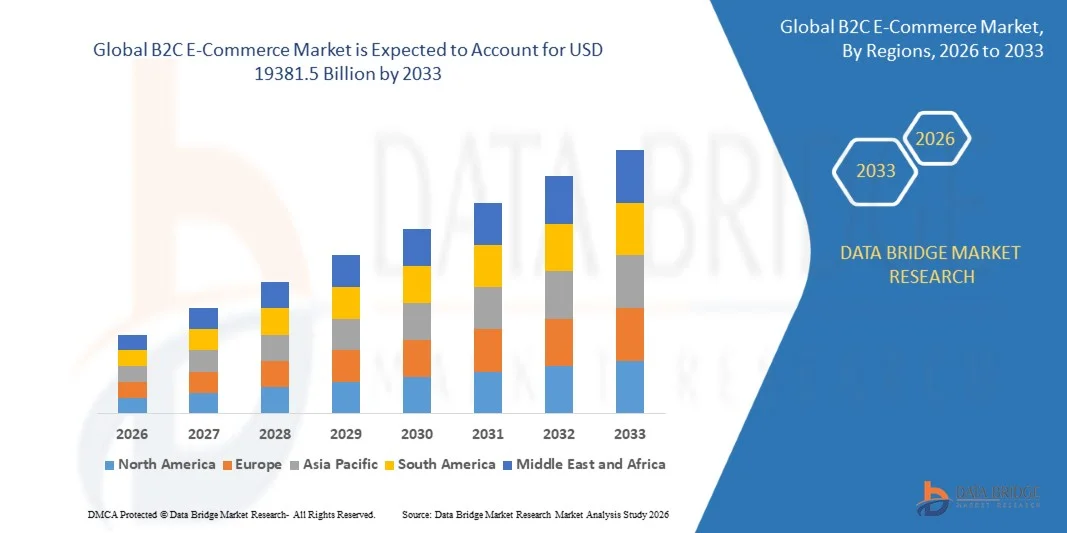
- The global B2C e-commerce market size was valued at USD 6235.38 billion in 2025 and is expected to reach USD 19381.5 billion by 2033, at a CAGR of 15.23% during the forecast period
- The market growth is largely fueled by the rapid digitalization of retail and the increasing adoption of online shopping platforms, leading to expanded access for consumers across both urban and semi-urban regions
- Furthermore, rising consumer demand for convenience, personalized shopping experiences, and seamless payment solutions is establishing B2C e-commerce as the preferred mode of retail. These converging factors are accelerating the uptake of online shopping platforms, thereby significantly boosting the industry's growth
B2C E-Commerce Market Analysis
- B2C e-commerce refers to the sale of products and services directly from online retailers to consumers via websites, mobile apps, and marketplaces. These platforms offer a wide range of product categories, from electronics and fashion to groceries and personal care, enabling consumers to browse, compare, and purchase items conveniently from anywhere
- The escalating demand for B2C e-commerce is primarily fueled by increasing internet and smartphone penetration, rising preference for contactless shopping, and growing trust in online payment systems. Enhanced logistics, faster delivery options, and AI-driven personalization are further contributing to robust market expansion across global regions
- Asia-Pacific dominated the B2C e-commerce market with a share of 59.8% in 2025, due to rising internet penetration, increasing smartphone adoption, and growing preference for online shopping across both urban and semi-urban regions
- North America is expected to be the fastest growing region in the B2C e-commerce market during the forecast period due to technological advancements, high internet penetration, and evolving consumer shopping behavior
- B2C retailers segment dominated the market with a market share of 69% in 2025, due to its direct-to-consumer sales model and widespread adoption across multiple product categories. Consumers prefer B2C retailers due to the convenience of home delivery, wide product variety, and reliable return policies. The segment also benefits from strong brand recognition and trust, with established players offering seamless online shopping experiences through web and mobile platforms
Report Scope and B2C E-Commerce Market Segmentation
|
Attributes |
B2C E-Commerce Key Market Insights |
|
Segments Covered |
|
|
Countries Covered |
North America
Europe
Asia-Pacific
Middle East and Africa
South America
|
|
Key Market Players |
|
|
Market Opportunities |
|
|
Value Added Data Infosets |
In addition to the market insights such as market value, growth rate, market segments, geographical coverage, market players, and market scenario, the market report curated by the Data Bridge Market Research team includes in-depth expert analysis, import/export analysis, pricing analysis, production consumption analysis, and pestle analysis. |
B2C E-Commerce Market Trends
“Rapid Growth of Mobile Commerce and Social Shopping”
- A significant trend in the B2C e-commerce market is the rapid growth of mobile commerce and social shopping, driven by increasing smartphone penetration, faster internet connectivity, and evolving consumer shopping behaviors toward online platforms. Consumers are increasingly using mobile apps and social media channels to browse, compare, and purchase products, which is reshaping the retail experience and driving digital sales growth
- For instance, Amazon and Alibaba have heavily invested in mobile platforms and social commerce features such as live streaming and in-app shopping, enabling seamless user experiences that boost customer engagement and conversion rates. These initiatives are accelerating the adoption of mobile-first shopping habits and strengthening brand loyalty across global markets
- The expansion of social media marketplaces and integration with e-commerce platforms is facilitating impulse purchases and peer-influenced buying decisions. This trend is positioning B2C e-commerce companies to capture younger demographics who prefer interactive and socially connected shopping experiences
- Personalization technologies and recommendation engines are being increasingly employed to enhance mobile shopping experiences, offering tailored product suggestions, dynamic pricing, and curated promotions. This approach is improving customer satisfaction and increasing repeat purchase rates
- The adoption of omnichannel strategies is growing, allowing consumers to transition seamlessly between online and offline channels. Retailers that leverage mobile commerce alongside physical stores are experiencing improved customer retention and higher average order values
- Cross-border mobile commerce is also rising, with consumers exploring international brands through apps and social platforms. This is contributing to market expansion and offering new revenue streams for e-commerce players targeting global audiences
B2C E-Commerce Market Dynamics
Driver
“Increasing Internet Penetration and Digital Payment Adoption”
- The growing internet penetration and widespread adoption of digital payment solutions are major drivers of the B2C e-commerce market, enabling more consumers to access online shopping conveniently and securely. The availability of mobile wallets, UPI systems, and contactless payment options is facilitating seamless transactions, thereby reducing friction and boosting consumer confidence
- For instance, PayPal and Stripe are enabling millions of merchants globally to accept digital payments efficiently, supporting faster checkout processes and expanding the reach of online commerce. These solutions enhance customer convenience and foster trust in digital shopping environments
- The surge in smartphone ownership and affordable data plans is contributing to higher online engagement and expanding the addressable consumer base for e-commerce platforms. Increased connectivity is allowing companies to offer personalized promotions and targeted marketing campaigns to potential buyers
- The integration of secure payment gateways and fraud detection mechanisms is encouraging hesitant users to adopt e-commerce platforms. This security assurance strengthens customer trust and supports repeated online purchasing behavior
- Growing government initiatives promoting digital economies and cashless transactions are further encouraging online commerce adoption. These policies are creating an enabling environment for B2C e-commerce growth and supporting sustainable expansion across multiple regions
Restraint/Challenge
“Rising Cybersecurity Threats and Data Privacy Concerns”
- The B2C e-commerce market faces challenges due to rising cybersecurity threats and concerns over data privacy, which can negatively affect consumer confidence and deter online transactions. High-profile data breaches and identity theft incidents have highlighted vulnerabilities in digital retail systems, prompting stricter regulatory oversight and the need for enhanced security measures
- For instance, eBay and Shopify have implemented advanced encryption, multi-factor authentication, and real-time fraud detection tools to protect user data and maintain platform integrity. While these measures improve security, they also increase operational costs and require continuous technological updates
- Compliance with global data protection regulations such as GDPR and CCPA adds complexity to data management and increases the administrative burden on e-commerce businesses. Non-compliance risks fines and reputational damage, limiting operational flexibility
- The proliferation of phishing, malware, and ransomware attacks continues to pose challenges for retailers managing sensitive consumer information. Companies must constantly monitor, detect, and mitigate such threats to safeguard customer trust
- Balancing data-driven personalization with privacy concerns is an ongoing challenge for e-commerce platforms. Ensuring transparency in data usage while delivering tailored experiences is critical for maintaining customer loyalty and sustaining market growth
B2C E-Commerce Market Scope
The market is segmented on the basis of type and product category.
• By Type
On the basis of type, the B2C e-commerce market is segmented into B2C Retailers and Classifieds. The B2C Retailers segment dominated the largest market revenue share of 69% in 2025, driven by its direct-to-consumer sales model and widespread adoption across multiple product categories. Consumers prefer B2C retailers due to the convenience of home delivery, wide product variety, and reliable return policies. The segment also benefits from strong brand recognition and trust, with established players offering seamless online shopping experiences through web and mobile platforms. B2C retailers are increasingly integrating AI-driven recommendations and personalized offers, further strengthening consumer engagement and retention.
The Classifieds segment is anticipated to witness the fastest growth rate from 2026 to 2033, fueled by the rising popularity of peer-to-peer selling platforms and niche marketplaces. Classified platforms provide cost-effective access to both buyers and sellers, making them attractive for used goods, automobiles, and electronics. Their flexible listing options and local targeting enhance transaction speed and reach, particularly in emerging markets. The growing smartphone penetration and ease of mobile app usage also accelerate the adoption of classifieds for quick and convenient trading.
• By Product Category
On the basis of product category, the B2C e-commerce market is segmented into Automotive, Beauty & Personal Care, Books & Stationery, Consumer Electronics, Clothing & Footwear, Home Décor & Electronics, Sports & Leisure, Travel & Tourism, Media & Entertainment, Information Technology (Software), and Others. The Consumer Electronics segment held the largest market revenue share in 2025, driven by high consumer demand for smartphones, laptops, wearable devices, and smart home products. Consumers increasingly prefer online platforms for electronics purchases due to competitive pricing, detailed product reviews, and quick home delivery options. The segment also benefits from frequent product launches and technology upgrades, motivating repeat purchases and upgrades.
The Beauty & Personal Care segment is expected to witness the fastest CAGR from 2026 to 2033, driven by increasing online demand for skincare, cosmetics, and personal grooming products. For instance, companies such as Sephora have leveraged e-commerce platforms to offer personalized recommendations, subscription models, and loyalty programs. The segment’s growth is further fueled by rising awareness of wellness and personal grooming trends, coupled with social media influence and influencer-driven marketing. Mobile app integration, virtual try-on features, and easy payment solutions also enhance consumer engagement and conversion rates.
B2C E-Commerce Market Regional Analysis
- Asia-Pacific dominated the B2C e-commerce market with the largest revenue share of 59.8% in 2025, driven by rising internet penetration, increasing smartphone adoption, and growing preference for online shopping across both urban and semi-urban regions
- The region’s cost-effective logistics, expanding digital payment infrastructure, and supportive government initiatives for e-commerce adoption are accelerating market expansion
- Availability of a large consumer base, favorable policies for startups, and rapid digitalization across developing economies are contributing to increased online retail penetration
China B2C E-Commerce Market Insight
China held the largest share in the Asia-Pacific B2C e-commerce market in 2025, owing to its mature online retail ecosystem, high internet penetration, and presence of major e-commerce giants. Strong logistics networks, advanced digital payment adoption, and government support for digital economy initiatives are major growth drivers. Consumer demand for convenience, competitive pricing, and fast delivery further bolsters market expansion.
India B2C E-Commerce Market Insight
India is witnessing the fastest growth in the Asia-Pacific region, fueled by rapid smartphone adoption, rising internet penetration in tier-2 and tier-3 cities, and increasing online retail awareness. Government initiatives such as Digital India and e-commerce-friendly policies are strengthening the market. In addition, growing preference for online payments, expansion of domestic logistics infrastructure, and increasing availability of regional language platforms are driving robust market growth.
Europe B2C E-Commerce Market Insight
The Europe B2C e-commerce market is expanding steadily, supported by high consumer purchasing power, strong internet infrastructure, and growing preference for cross-border online shopping. Countries are emphasizing secure digital transactions, privacy compliance, and sustainable delivery practices. Demand for fashion, electronics, and health & beauty products through online channels is further enhancing market growth.
Germany B2C E-Commerce Market Insight
Germany’s market is driven by its strong retail sector, advanced logistics infrastructure, and growing adoption of omnichannel strategies. Consumers increasingly prefer online platforms for electronics, fashion, and home products due to convenience and competitive pricing. Retailers are investing in mobile apps, AI-driven recommendations, and efficient last-mile delivery to capture consumer demand, strengthening the market position.
U.K. B2C E-Commerce Market Insight
The U.K. market is supported by high digital adoption, mature online retail platforms, and growing investments in logistics and distribution networks. Consumers are increasingly favoring online purchases for groceries, electronics, and apparel, supported by fast delivery and easy returns. E-commerce companies are leveraging personalization, mobile commerce, and loyalty programs to enhance user engagement and drive growth.
North America B2C E-Commerce Market Insight
North America is projected to grow at the fastest CAGR from 2026 to 2033, driven by technological advancements, high internet penetration, and evolving consumer shopping behavior. A strong focus on mobile commerce, omnichannel integration, and advanced digital marketing strategies are boosting demand. In addition, increasing adoption of AI, AR, and VR technologies for personalized shopping experiences is supporting market expansion.
U.S. B2C E-Commerce Market Insight
The U.S. accounted for the largest share in the North America market in 2025, underpinned by its mature e-commerce ecosystem, high smartphone penetration, and widespread digital payment adoption. Retailers are investing heavily in personalized shopping experiences, fast delivery, and loyalty programs to capture consumer spending. Presence of major online retail players and robust logistics networks further solidify the U.S.'s leading position in the region.
B2C E-Commerce Market Share
The B2C e-commerce industry is primarily led by well-established companies, including:
- Shopee (Singapore)
- Flipkart.com (India)
- Rakuten Group, Inc. (Japan)
- ASOS (U.K.)
- MercadoLibre SRL (Argentina)
- Amazon.com, Inc. (U.S.)
- JD.com, Inc. (China)
- Walmart (U.S.)
- FirstCry.com (India)
- FARFETCH UK Limited (U.K.)
- Rappi Inc. (Colombia)
- Alibaba Group Holding Limited (China)
- Zalando (Germany)
- Jumia (Nigeria)
- eBay Inc. (U.S.)
Latest Developments in Global B2C E-Commerce Market
- In February 2026, Rakuten Group, Inc. partnered with Google in Japan to enhance the online shopping experience on its Rakuten Ichiba marketplace through YouTube integration. This collaboration allows viewers to explore and purchase products directly from videos by tapping the “View Products” option, displaying product names and prices on the same screen. This initiative is expected to significantly boost user engagement and conversion rates by creating a seamless, interactive shopping experience, positioning Rakuten Ichiba as a more integrated platform for content-driven commerce in the competitive Japanese e-commerce market
- In November 2025, Amazon.com, Inc. expanded its low-cost e-commerce platform, Amazon Bazaar (known in the U.S. as Amazon Haul), to 14 additional international markets, including Hong Kong, the Philippines, Nigeria, and Taiwan. This expansion strengthens Amazon’s presence in price-sensitive and high-growth e-commerce markets while intensifying competition in the budget retail segment. By offering a standalone platform with affordable product assortments, Amazon aims to attract cost-conscious consumers and increase market penetration globally, reinforcing its strategy to dominate emerging online retail spaces
- In October 2025, Walmart collaborated with OpenAI to launch AI-driven shopping experiences, enabling customers to complete purchases directly within ChatGPT. This initiative allows AI systems to anticipate user needs, recommend products proactively, and personalize the shopping journey. The adoption of AI across Walmart and Sam’s Club operations, including catalog management and faster customer service, is expected to improve operational efficiency and enhance customer satisfaction. This development positions Walmart as a pioneer in integrating generative AI into retail, potentially reshaping consumer expectations in the B2C e-commerce market
- In May 2025, Shopify introduced its “Summer ’25 Edition,” featuring over 150 updates designed to empower merchants in the global B2C e-commerce market. Key enhancements included “Horizon,” a flexible design system for storefront customization, and upgraded AI assistant “Sidekick,” now capable of handling voice commands for business operations. Shopify also introduced AI shopping agents to personalize customer interactions and support cross-border commerce. These innovations are expected to accelerate merchant scalability, improve customer engagement, and solidify Shopify’s competitive position as a leading enabler of modern online retail experiences worldwide
- In August 2024, Flipkart launched “Flipkart Minutes” in Bengaluru, entering the quick commerce sector to deliver products ranging from groceries to electronics within 10–15 minutes. By leveraging a network of dark stores for rapid fulfillment, this initiative addresses growing consumer demand for instant delivery and convenience. The launch enhances Flipkart’s competitiveness in India’s fast-paced e-commerce market, allowing it to capture a larger share of on-demand consumers while strengthening its positioning against other quick commerce platforms

- Interactive Data Analysis Dashboard
- Company Analysis Dashboard for high growth potential opportunities
- Research Analyst Access for customization & queries
- Competitor Analysis with Interactive dashboard
- Latest News, Updates & Trend analysis
- Harness the Power of Benchmark Analysis for Comprehensive Competitor Tracking
Data collection and base year analysis are done using data collection modules with large sample sizes. The stage includes obtaining market information or related data through various sources and strategies. It includes examining and planning all the data acquired from the past in advance. It likewise envelops the examination of information inconsistencies seen across different information sources. The market data is analysed and estimated using market statistical and coherent models. Also, market share analysis and key trend analysis are the major success factors in the market report. To know more, please request an analyst call or drop down your inquiry.
The key research methodology used by DBMR research team is data triangulation which involves data mining, analysis of the impact of data variables on the market and primary (industry expert) validation. Data models include Vendor Positioning Grid, Market Time Line Analysis, Market Overview and Guide, Company Positioning Grid, Patent Analysis, Pricing Analysis, Company Market Share Analysis, Standards of Measurement, Global versus Regional and Vendor Share Analysis. To know more about the research methodology, drop in an inquiry to speak to our industry experts.
Data Bridge Market Research is a leader in advanced formative research. We take pride in servicing our existing and new customers with data and analysis that match and suits their goal. The report can be customized to include price trend analysis of target brands understanding the market for additional countries (ask for the list of countries), clinical trial results data, literature review, refurbished market and product base analysis. Market analysis of target competitors can be analyzed from technology-based analysis to market portfolio strategies. We can add as many competitors that you require data about in the format and data style you are looking for. Our team of analysts can also provide you data in crude raw excel files pivot tables (Fact book) or can assist you in creating presentations from the data sets available in the report.













