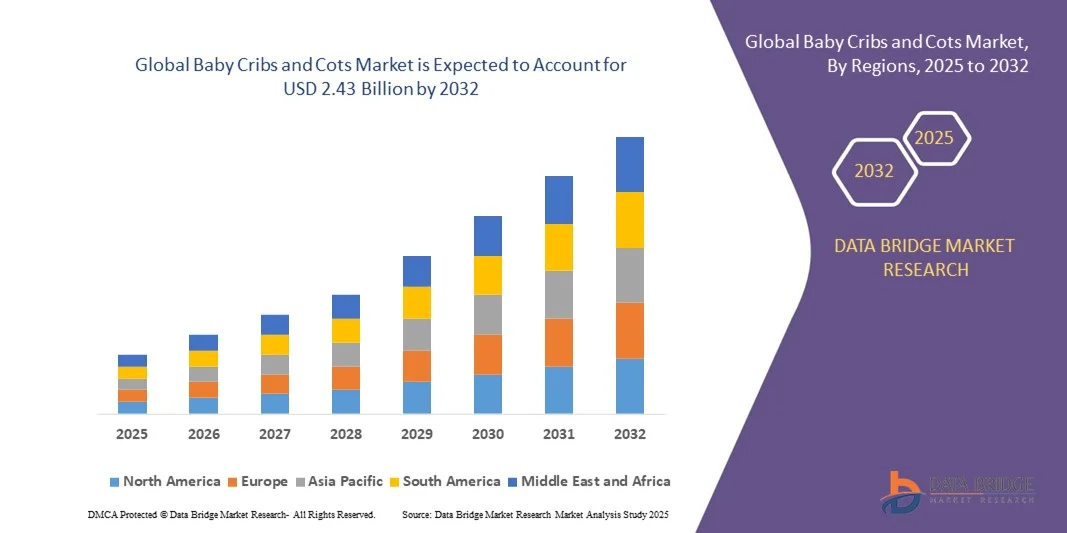
Baby Cribs and Cots Market Size
- The global baby cribs and cots market size was valued at USD 1.61 billion in 2024 and is expected to reach USD 2.43 billion by 2032, at a CAGR of 5.3% during the forecast period
- The market growth is largely fuelled by the rising awareness of infant safety, increasing disposable incomes, and the growing demand for ergonomic and multifunctional nursery furniture
- In addition, the surge in nuclear families, urbanization, and the trend of premium and eco-friendly baby products are further driving market expansion
Baby Cribs and Cots Market Analysis
- The market is witnessing increased investments in innovative designs, materials, and safety certifications, allowing brands to differentiate their offerings and gain consumer trust
- The rise of e-commerce platforms and online baby product retailers is improving product accessibility and providing consumers with greater variety, fueling market growth
- North America dominated the baby cribs and cots market with the largest revenue share of 38.5% in 2024, driven by rising parental awareness about infant safety, increasing adoption of multifunctional cribs, and a growing preference for ergonomic and smart baby furniture
- Asia-Pacific region is expected to witness the highest growth rate in the global baby cribs and cots market, driven by rapid population growth, expanding middle-class consumer base, and increasing adoption of multifunctional and space-saving baby furniture
- The Convertible segment held the largest market revenue share in 2024, driven by its adaptability, long-term usability, and multifunctional designs. Convertible cribs allow parents to adjust sleeping arrangements as the child grows, providing added value, convenience, and space-saving benefits, which contributes to their widespread adoption
Report Scope and Baby Cribs and Cots Market Segmentation
|
Attributes |
Baby Cribs and Cots Key Market Insights |
|
Segments Covered |
|
|
Countries Covered |
North America
Europe
Asia-Pacific
Middle East and Africa
South America
|
|
Key Market Players |
|
|
Market Opportunities |
|
|
Value Added Data Infosets |
In addition to the insights on market scenarios such as market value, growth rate, segmentation, geographical coverage, and major players, the market reports curated by the Data Bridge Market Research also include in-depth expert analysis, pricing analysis, brand share analysis, consumer survey, demography analysis, supply chain analysis, value chain analysis, raw material/consumables overview, vendor selection criteria, PESTLE Analysis, Porter Analysis, and regulatory framework. |
Baby Cribs and Cots Market Trends
Increasing Adoption of Convertible and Smart Baby Cribs
- The growing preference for convertible and smart baby cribs is transforming the infant furniture market by offering multifunctional and space-saving solutions. These cribs allow parents to easily adapt sleeping arrangements as the child grows, enhancing convenience and long-term usability. The integration of smart technology, such as motion sensors and sleep monitoring, further increases parental engagement and confidence in infant care, boosting overall market adoption. Manufacturers are also exploring eco-friendly materials and modular designs, which appeal to environmentally conscious consumers while promoting sustainable growth
- Rising demand for technologically integrated cribs, such as those with motion sensors, sleep monitoring, and soothing features, is accelerating the adoption of smart cribs. These features help parents track infant sleep patterns and improve overall care, making cribs more interactive and practical. In addition, smart cribs are increasingly compatible with mobile applications, allowing remote monitoring and alerts, which adds convenience for working parents and caregivers. The adoption of these advanced features is also fostering brand loyalty and driving competition among manufacturers to innovate further
- The affordability and ease of assembling modern cribs are making them attractive for both new and expecting parents. Consumers benefit from durable, safe, and ergonomic designs without compromising budget, supporting broader market penetration. Easy assembly and portability options also cater to small urban homes and rental properties, increasing usability across diverse living conditions. Retailers and e-commerce platforms are further enabling adoption through bundled accessories, tutorials, and after-sales support, improving overall consumer satisfaction
- For instance, in 2023, several parenting communities in North America and Europe reported improved sleep quality and convenience for infants after using smart and convertible cribs, increasing brand trust and product demand. Positive consumer reviews and social media recommendations have amplified awareness, prompting further market expansion. Retailers have noted increased repeat purchases and interest in related nursery products, highlighting the cascading effect of high-quality crib adoption on the broader infant care ecosystem
- While baby cribs and cots are enhancing infant care and convenience, their impact depends on continued innovation, adherence to safety standards, and quality. Manufacturers must focus on durable, ergonomic, and multifunctional designs to fully capitalize on growing market demand. Emphasis on sustainability, non-toxic finishes, and adaptable crib configurations will further strengthen market positioning and ensure compliance with evolving global safety regulations
Baby Cribs and Cots Market Dynamics
Driver
Rising Awareness About Infant Safety and Ergonomic Sleep Solutions
- Increasing parental awareness regarding infant safety and ergonomic sleep practices is driving demand for high-quality baby cribs and cots. Parents are prioritizing safe materials, proper ventilation, and secure construction when selecting cribs. The focus on child health and development, coupled with rising disposable incomes, is pushing families toward certified and premium crib products. Retailers are responding with specialized ranges targeting safety-conscious consumers, reinforcing market growth
- Growing trends in newborn care, including sleep monitoring and multifunctional furniture, are encouraging manufacturers to innovate with adjustable heights, convertible designs, and smart features to meet evolving consumer preferences. These innovations help in reducing furniture replacement costs and provide long-term value for parents. Manufacturers are also integrating app-based monitoring and IoT solutions, increasing the appeal of technologically advanced cribs and boosting adoption in urban and tech-savvy regions
- Government regulations and safety certifications promoting safe infant products further bolster adoption. Compliance with international standards reassures parents and increases trust in premium crib offerings. Awareness campaigns by pediatric associations and consumer safety agencies emphasize the benefits of certified cribs, creating a ripple effect that strengthens market credibility. Retailers and e-commerce platforms also highlight these certifications to differentiate products and enhance consumer confidence
- For instance, in 2022, several European countries updated child safety regulations requiring cribs to meet stringent safety standards, leading to higher demand for certified products and increased market activity. This regulatory push also encouraged local manufacturers to enhance quality and invest in research and development. Consequently, international brands have expanded into these regions, introducing innovative crib designs and boosting market competition
- While awareness and safety regulations are driving the market, maintaining affordability, design flexibility, and durability remains critical for sustained growth in the baby cribs and cots market. Manufacturers are also exploring eco-friendly and recyclable materials to align with consumer sustainability expectations. Continued innovation in smart features, ergonomic design, and multifunctional utility will ensure long-term market resilience
Restraint/Challenge
Rising Awareness About Infant Safety and Ergonomic Sleep Solutions
- High-priced premium cribs, featuring smart or multifunctional designs, can be inaccessible for cost-sensitive parents, limiting adoption in developing regions. Price sensitivity restricts market penetration and growth opportunities. In addition, import duties and local taxes on premium nursery products may increase costs further, deterring potential buyers. Manufacturers need to consider mid-range, high-value products to capture price-conscious segments
- In many emerging markets, lack of awareness about crib safety standards and long-term benefits of multifunctional designs reduces adoption. Traditional bedding practices or low-cost alternatives continue to dominate. Limited exposure to international brands and modern crib technologies also hinders market development. Awareness campaigns, educational initiatives, and partnerships with local retailers are essential to improve adoption rates and ensure child safety
- Supply chain challenges for specialized materials, such as certified wood, organic finishes, and electronic components for smart cribs, can result in production delays or higher prices, further limiting availability in certain regions. Logistical constraints in remote areas, coupled with fluctuating raw material costs, may affect delivery timelines and product affordability. Manufacturers need to optimize sourcing and distribution to maintain market competitiveness
- For instance, in 2023, parenting communities in Southeast Asia reported difficulties accessing certified cribs, leading some families to purchase low-quality alternatives that did not meet international safety standards. These gaps highlight the need for localized production and improved retail networks. Increased government support and NGO involvement could further expand access to safe crib options in underserved regions
- While crib and cot technology continues to evolve, addressing cost, accessibility, and safety awareness challenges is crucial. Manufacturers must focus on affordable, durable, and widely distributable solutions to unlock long-term market potential. Emphasizing educational campaigns, financing options, and community outreach will ensure broader adoption and reinforce market stability
Baby Cribs and Cots Market Scope
The baby cribs and cots market is segmented on the basis of product type, material, design, and sales channel.
- By Product Type
On the basis of product type, the baby cribs and cots market is segmented into Standard, Bassinet, Convertible, Portable, Travel, Multifunctional, Specialty, and Other. The Convertible segment held the largest market revenue share in 2024, driven by its adaptability, long-term usability, and multifunctional designs. Convertible cribs allow parents to adjust sleeping arrangements as the child grows, providing added value, convenience, and space-saving benefits, which contributes to their widespread adoption.
The Multifunctional segment is expected to witness the fastest growth rate from 2025 to 2032, driven by features such as integrated storage, adjustable heights, and embedded smart technology. Multifunctional cribs provide enhanced convenience for parents by combining multiple nursery functions in a single unit, making them highly attractive for urban households with limited space. These cribs are particularly popular among tech-savvy and modern consumers seeking long-term usability.
- By Material
On the basis of material, the market is segmented into Plastic, Metal, Wood, and Other Material Type. The Wood segment held the largest revenue share in 2024, due to its durability, aesthetic appeal, and safety compliance with international standards. Wooden cribs are preferred for their sturdiness, eco-friendly characteristics, and long lifespan, which makes them a popular choice among premium consumers.
The Plastic segment is expected to witness the fastest growth rate from 2025 to 2032, driven by its lightweight design, affordability, and ease of cleaning. Plastic cribs are ideal for portability, travel, and temporary nursery setups, appealing to cost-conscious and mobile households. Their customizable designs and vibrant colors further increase attractiveness for parents of infants and toddlers.
- By Design
On the basis of design, the market is segmented into Traditional, Contemporary, and Modern Style. The Modern Style segment held the largest market share in 2024, due to its sleek aesthetics, functional features, and compatibility with modern interiors. Modern cribs often incorporate smart technology, ergonomic design, and space-saving solutions, making them suitable for urban homes and contemporary nursery settings.
The Contemporary segment is expected to witness the fastest growth rate from 2025 to 2032, driven by evolving consumer preferences for stylish, multifunctional, and adaptable nursery furniture. Contemporary cribs offer innovative designs, modularity, and aesthetic versatility, appealing to parents seeking a balance of practicality and modern appeal.
- By Sales Channel
On the basis of sales channel, the market is segmented into Hypermarket/Supermarket, E-Commerce, Franchised Outlet, Departmental Stores, and Others. The E-Commerce segment held the largest revenue share in 2024, driven by convenience, wide product variety, competitive pricing, and home delivery services. Online platforms also provide detailed product information, reviews, and comparisons, which support informed purchase decisions.
The Franchised Outlet segment is expected to witness the fastest growth rate from 2025 to 2032, fueled by the expansion of branded baby furniture stores and showrooms in urban and semi-urban areas. Franchised outlets allow consumers to experience product quality firsthand, access expert guidance, and purchase certified cribs, driving adoption of premium and multifunctional products.
Baby Cribs and Cots Market Regional Analysis
- North America dominated the baby cribs and cots market with the largest revenue share of 38.5% in 2024, driven by rising parental awareness about infant safety, increasing adoption of multifunctional cribs, and a growing preference for ergonomic and smart baby furniture
- Consumers in the region highly value convenience, durability, and safety features in cribs, along with innovative designs such as convertible and smart cribs that adapt as the child grows
- This widespread adoption is further supported by high disposable incomes, increasing urbanization, and growing e-commerce penetration, establishing baby cribs and cots as a preferred choice for parents in both residential and institutional settings
U.S. Baby Cribs and Cots Market Insight
The U.S. baby cribs and cots market captured the largest revenue share in 2024 within North America, fueled by rising demand for smart and multifunctional cribs that combine safety, comfort, and convenience. Parents are increasingly seeking cribs with adjustable heights, sleep-monitoring features, and ergonomic designs. The growing trend of online shopping and the integration of technology into parenting products are further driving market growth. Moreover, compliance with stringent safety regulations and certifications enhances consumer trust and contributes significantly to market expansion.
Europe Baby Cribs and Cots Market Insight
The Europe baby cribs and cots market is expected to witness the fastest growth rate from 2025 to 2032, primarily driven by increasing parental focus on infant safety and comfort. Rising urbanization and the growing preference for multifunctional and space-saving cribs are encouraging adoption. European parents are also drawn to eco-friendly materials and certified products, leading to increased demand across residential, retail, and e-commerce channels. The market is seeing significant growth across both newborn and toddler segments, with cribs being incorporated into modern and contemporary nursery designs.
U.K. Baby Cribs and Cots Market Insight
The U.K. baby cribs and cots market is expected to witness the fastest growth rate from 2025 to 2032, driven by rising awareness regarding infant safety, ergonomic sleep solutions, and convenience for parents. Concerns about child health and well-being are prompting families to invest in high-quality, certified cribs. The country’s well-established e-commerce infrastructure and retail presence further stimulate market growth, making smart and multifunctional cribs widely accessible.
Germany Baby Cribs and Cots Market Insight
The Germany baby cribs and cots market is expected to witness steady growth from 2025 to 2032, fueled by increasing focus on infant safety, ergonomic designs, and high-quality materials. German parents favor durable, certified products that comply with international safety standards. The integration of multifunctional features, such as convertible cribs and space-saving designs, enhances adoption across urban households. Moreover, Germany’s emphasis on sustainability and eco-friendly materials supports the growing preference for modern and safe baby furniture solutions.
Asia-Pacific Baby Cribs and Cots Market Insight
The Asia-Pacific baby cribs and cots market is expected to witness the fastest growth rate from 2025 to 2032, driven by rising disposable incomes, urbanization, and increasing parental awareness about infant safety. Countries such as China, India, and Japan are witnessing strong demand for multifunctional and smart cribs that offer long-term usability and convenience. Government initiatives promoting child safety and the expansion of e-commerce platforms are further facilitating market penetration. The region is also emerging as a manufacturing hub for cost-effective and technologically advanced crib solutions, making high-quality products accessible to a wider consumer base.
Japan Baby Cribs and Cots Market Insight
The Japan baby cribs and cots market is expected to witness significant growth from 2025 to 2032 due to the country’s high awareness of infant safety, compact living spaces, and preference for multifunctional furniture. Japanese parents increasingly seek cribs with ergonomic designs, smart monitoring features, and adaptable sleeping solutions. The integration of modern technology, combined with high-quality materials, is driving demand in both residential and institutional segments. In addition, the aging population and dual-income households are fueling the need for convenient, space-efficient baby furniture solutions.
China Baby Cribs and Cots Market Insight
The China baby cribs and cots market accounted for the largest market revenue share in Asia Pacific in 2024, attributed to rapid urbanization, increasing middle-class population, and rising awareness about infant safety. Multifunctional and convertible cribs are increasingly popular in both urban and suburban households. The growing trend of online shopping, coupled with the expansion of domestic manufacturers offering affordable yet high-quality crib solutions, is propelling the market. Government regulations on child safety and certification programs further encourage adoption, making China a key growth market for baby cribs and cots.
Baby Cribs and Cots Market Share
The Baby Cribs and Cots industry is primarily led by well-established companies, including:
- Delta Children's Products Corp. (U.S.)
- Artsana Group (Italy)
- Storkcraft Manufacturing Inc. (Canada)
- Graco Children's Products Inc. (U.S.)
- Silver Cross Ltd (U.K.)
- Arm's Reach Concepts, Inc. (U.S.)
- Million Dollar Baby Co. (U.S.)
- Dream On Me, Inc. (U.S.)
- Sorelle Furniture (U.S.)
- Natart Juvenile, Inc. (Canada)
- Stokke LLC (U.S.)
- MeeMee (India)
- Mamas & Papas (U.K.)
- Kolcraft Enterprises Inc. (U.S.)
- East Coast Nursery (Australia)
- BabyBjörn AB (Sweden)
- Q Baby (China)
- Babeek (India)
- DaVinci Baby (U.S.)
- Cozi Cot (U.S.)
- Tutti Bambini (U.K.)
Latest Developments in Global Baby Cribs and Cots Market
- In January 2024, Stokke launched the Snoozi Bassinet, a premium infant sleep solution aimed at enhancing both baby comfort and parental convenience. The bassinet features advanced ergonomic design and soothing mechanisms to promote sound and uninterrupted sleep for infants. By combining safety, comfort, and ease of use, it allows parents to monitor and care for their babies more effectively. This innovative product is expected to boost adoption of high-end sleep solutions in the baby furniture market, setting new standards for infant comfort and convenience while supporting market growth.

- Interactive Data Analysis Dashboard
- Company Analysis Dashboard for high growth potential opportunities
- Research Analyst Access for customization & queries
- Competitor Analysis with Interactive dashboard
- Latest News, Updates & Trend analysis
- Harness the Power of Benchmark Analysis for Comprehensive Competitor Tracking
Data collection and base year analysis are done using data collection modules with large sample sizes. The stage includes obtaining market information or related data through various sources and strategies. It includes examining and planning all the data acquired from the past in advance. It likewise envelops the examination of information inconsistencies seen across different information sources. The market data is analysed and estimated using market statistical and coherent models. Also, market share analysis and key trend analysis are the major success factors in the market report. To know more, please request an analyst call or drop down your inquiry.
The key research methodology used by DBMR research team is data triangulation which involves data mining, analysis of the impact of data variables on the market and primary (industry expert) validation. Data models include Vendor Positioning Grid, Market Time Line Analysis, Market Overview and Guide, Company Positioning Grid, Patent Analysis, Pricing Analysis, Company Market Share Analysis, Standards of Measurement, Global versus Regional and Vendor Share Analysis. To know more about the research methodology, drop in an inquiry to speak to our industry experts.
Data Bridge Market Research is a leader in advanced formative research. We take pride in servicing our existing and new customers with data and analysis that match and suits their goal. The report can be customized to include price trend analysis of target brands understanding the market for additional countries (ask for the list of countries), clinical trial results data, literature review, refurbished market and product base analysis. Market analysis of target competitors can be analyzed from technology-based analysis to market portfolio strategies. We can add as many competitors that you require data about in the format and data style you are looking for. Our team of analysts can also provide you data in crude raw excel files pivot tables (Fact book) or can assist you in creating presentations from the data sets available in the report.