


What is the Baclofen Market Size and Growth Rate?
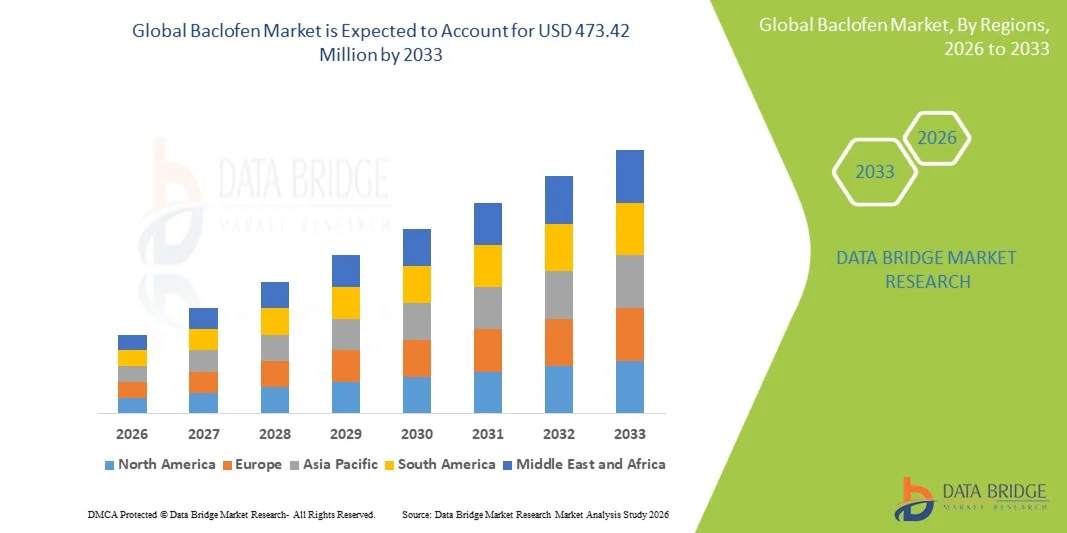
- As per Data Bridge Market Research analysis, the baclofen market was valued at USD 318.0 million in 2025 and is projected to reach USD 473.42 million by 2033, growing at a CAGR of 5.1% from 2026 to 2033.
- The market is experiencing steady growth driven by the rising global prevalence of multiple sclerosis, spinal cord injuries, and cerebral palsy, increasing off-label use of baclofen for alcohol use disorder management, and continued reliance on the molecule as a well-established, cost-effective skeletal muscle relaxant across both hospital and outpatient care settings.
- The growing burden of spasticity-related neurological disorders, combined with expanding access to rehabilitation and neurology care services, is compelling hospitals, rehabilitation centers, and homecare providers to maintain reliable supplies of baclofen across oral and intrathecal formulations. Intrathecal baclofen pump therapy is increasingly complementing oral treatment for patients with severe, treatment-resistant spasticity, offering more targeted symptom control with reduced systemic side effects.
- The molecule’s decades-long clinical track record and well-characterized safety and efficacy profile continue to support its inclusion in national essential medicines lists and standard neurology treatment guidelines across both developed and developing healthcare systems.
Market Size & Forecast
- Global Market Value (2025): USD 318.0 Million
- Expected Market Value (2033): USD 473.42 Million
- Forecast CAGR (2026–2033): 5.1%
- Leading Region in 2025: North America
- Fastest Growing Region: Asia-Pacific
What are the Major Takeaways of the Baclofen Market?
- North America dominated the global baclofen market with the largest revenue share of 38.17% in 2025, supported by high diagnosed prevalence of multiple sclerosis and spinal cord injury, well-established neurology and rehabilitation care infrastructure, and strong institutional adoption of intrathecal baclofen pump therapy.
- Asia-Pacific is expected to be the fastest-growing region at a CAGR of 7.2% from 2026 to 2033, fueled by improving neurological disease diagnosis rates, expanding rehabilitation care infrastructure, and growing generic pharmaceutical manufacturing capacity across China, India, and Japan.
- The oral tablets segment led the market with a 61.38% share in 2025, driven by its widespread use as a first-line treatment for mild-to-moderate spasticity and its convenience for long-term outpatient and homecare management.
- The intrathecal injection segment is the fastest-growing dosage form, projected to register a CAGR of 6.9%, reflecting rising adoption of implantable pump therapy for patients with severe spasticity unresponsive to oral treatment.
- The multiple sclerosis application segment dominated the application category with a 34.62% revenue share in 2025, led by baclofen’s established role as a first-line antispasmodic therapy across MS patient populations worldwide.
- Hospital pharmacies accounted for 44.73% of the market share among distribution channels in 2025, preferred due to their central role in supplying intrathecal formulations and managing pump implantation and refill procedures.
- The alcohol use disorder application segment is the fastest-growing category, with a CAGR of 7.8%, driven by increasing off-label prescribing and ongoing clinical research supporting baclofen’s use in reducing alcohol cravings and relapse rates.
- The oral route of administration accounted for 68.24% of the market share in 2025, reflecting its widespread use in first-line spasticity management and ease of self-administration among ambulatory patients.
- The adult patient demographic segment held the largest share of 56.31% in 2025, supported by the high prevalence of multiple sclerosis and spinal cord injury among the working-age population across both developed and emerging healthcare markets.
Report Scope and Baclofen Market Segmentation
|
Attributes |
Baclofen Key Market Insights |
|
Segments Covered |
|
|
Countries Covered |
North America
Europe
Asia-Pacific
Middle East and Africa
South America
|
|
Key Market Players |
|
|
Market Opportunities |
|
|
Value Added Data Infosets |
In addition to the insights on market scenarios such as market value, growth rate, segmentation, geographical coverage, and major players, the market reports curated by the Data Bridge Market Research also include in-depth expert analysis, patient epidemiology, pipeline analysis, pricing analysis, and regulatory framework. |
What is the Key Trend in the Baclofen Market?
- Neurology and rehabilitation specialists are increasingly incorporating structured spasticity management protocols that combine oral baclofen with physical therapy and, where appropriate, intrathecal baclofen therapy to optimize functional outcomes for patients with moderate-to-severe spasticity.
- For instance, in May 2024, the American Academy of Physical Medicine and Rehabilitation (AAPM&R) released consensus guidance on spasticity assessment and management, emphasizing early identification, individualized treatment planning, rehabilitation, oral medications, and intrathecal baclofen therapy as part of multimodal care.
- Growing clinical and research interest in baclofen’s potential role in alcohol use disorder treatment is driving continued investigation into its effects on alcohol craving, alcohol consumption, and abstinence.
- For instance, in January 2023, Cochrane published an updated systematic review evaluating baclofen for alcohol use disorder, reporting that baclofen may help reduce relapse risk and increase the percentage of abstinent days, particularly among detoxified patients.
- Medical device manufacturers are increasingly focused on improving programmable intrathecal drug-delivery systems, supporting individualized dosing and long-term management of severe spasticity.
- For instance, in 2024, Medtronic highlighted its SynchroMed™ III intrathecal pump for chronic intrathecal drug delivery, including Lioresal® Intrathecal (baclofen) for the management of severe spasticity.
- Healthcare providers and payers are increasingly focused on appropriate patient selection, documentation, and treatment pathways for intrathecal baclofen therapy, helping eligible patients with severe spasticity access advanced treatment options.
- For instance, in May 2024, AAPM&R’s consensus guidance emphasized goal-directed and individualized treatment planning, stepwise escalation of therapy, and intrathecal baclofen as an option for appropriately selected patients with severe spasticity.
- As neurologists, rehabilitation specialists, and addiction-medicine providers continue to prioritize individualized, protocol-driven treatment, baclofen is expected to retain its established role in neurological spasticity management, while research continues to evaluate its potential applications in alcohol use disorder.
What are the Key Drivers of the Baclofen Market?
- The rising global prevalence of multiple sclerosis, spinal cord injury, and cerebral palsy has significantly increased demand for effective, well-tolerated antispasmodic therapies capable of improving mobility and quality of life for affected patients.
- For instance, in April 2025, Sun Pharmaceutical Industries expanded its generic baclofen tablet manufacturing capacity to meet rising demand from hospitals and specialty neurology clinics managing growing spasticity patient populations.
- The continued affordability and long clinical track record of baclofen, compared to newer and more expensive antispasmodic agents, is supporting sustained prescribing volumes among healthcare providers in both developed and cost-constrained public healthcare systems.
- For instance, in December 2024, Teva Pharmaceutical Industries expanded distribution of its generic baclofen tablets to additional public hospital tender programs across Europe, supporting continued affordability of spasticity management therapies in publicly funded healthcare systems.
- The expanding global recognition of spinal cord injury and cerebral palsy as significant public health burdens is driving increased government and non-governmental organization investment in rehabilitation infrastructure, indirectly supporting greater access to spasticity management therapies including baclofen across underserved regions.
- For instance, in April 2024, the World Health Organization (WHO) highlighted the substantial unmet need for rehabilitation services in low- and middle-income countries and emphasized strengthening rehabilitation systems, workforce capacity, financing, and access to essential rehabilitation interventions, including medicines used to manage spasticity in conditions such as cerebral palsy and spinal cord injury.
- With rising neurological disease burden, growing off-label applications in addiction medicine, and continued reliance on generic, cost-effective therapies across public and private healthcare systems, baclofen will remain an important component of spasticity management and emerging addiction treatment protocols worldwide.
Which Factors are Challenging the Growth of the Baclofen Market?
- Baclofen faces increasing competition from newer antispasmodic agents and botulinum toxin injections that offer more targeted, longer-lasting symptom control with different side-effect profiles, particularly for focal spasticity applications.
- Abrupt discontinuation of baclofen, particularly intrathecal therapy, carries a risk of serious withdrawal symptoms, requiring careful clinical management and creating additional monitoring burden for prescribers and pump-management clinics.
- For instance, in September 2025, the U.S. Food and Drug Administration (FDA) reported a Medtronic SynchroMed II intrathecal pump malfunction involving a patient receiving baclofen, in which interruption of therapy was associated with increased spasticity and required clinical evaluation and pump management.
- Limited standardization of dosing protocols across different clinical guidelines and regional prescribing practices for off-label applications, such as alcohol use disorder management, creates uncertainty for physicians and can slow broader adoption despite growing supportive clinical evidence.
- The declining novelty and patent-free status of oral baclofen continues to limit premium pricing opportunities for manufacturers, while the high cost of intrathecal pump devices and implantation procedures restricts broader adoption of this delivery method. This cost and reimbursement barrier slows market penetration for intrathecal therapy in cost-constrained healthcare systems, limiting the pace of adoption despite its clinical benefits for severe spasticity cases.
How is the Baclofen Market Segmented?
The baclofen market is segmented on the basis of dosage form, route of administration, application, distribution channel, end user, and patient demographics.
- By Dosage Form
On the basis of dosage form, the global baclofen market is segmented into oral tablets, oral solution/suspension, and intrathecal injection. The oral tablets segment dominated the market with a 61.38% share in 2025, owing to its widespread use as a first-line treatment for mild-to-moderate spasticity and its convenience for long-term outpatient and homecare management. These products remain the preferred choice for physicians managing patients with manageable spasticity levels requiring consistent oral antispasmodic therapy.
The intrathecal injection segment is projected to register the fastest growth at a CAGR of 6.9% from 2026 to 2033, driven by rising adoption of implantable pump therapy for patients with severe spasticity unresponsive to oral treatment. Advances in pump technology offering improved reliability and reduced maintenance requirements are accelerating segment expansion.
- By Route of Administration
On the basis of route of administration, the global baclofen market is segmented into oral and intrathecal. The oral route led the market with a share of 68.24% in 2025, supported by its widespread use in first-line spasticity management and ease of self-administration among ambulatory patients. Established prescribing patterns and lower treatment costs continue to reinforce demand for oral baclofen across primary neurology and general practice settings.
The intrathecal route is expected to witness the fastest CAGR of 6.7% from 2026 to 2033, driven by continued specialist adoption of pump-delivered therapy for severe spasticity management, offering significantly lower effective doses and reduced systemic side effects compared to oral administration.
- By Application
On the basis of application, the global baclofen market is segmented into multiple sclerosis, spinal cord injury, cerebral palsy, alcohol use disorder, and others. The multiple sclerosis segment dominated the market with a share of 34.62% in 2025 due to baclofen’s established role as a first-line antispasmodic therapy across MS patient populations worldwide. high prescribing volumes are supported by the molecule’s long clinical history, affordability, and broad availability across generic manufacturers.
The alcohol use disorder segment is expected to witness the fastest CAGR of 7.8% from 2026 to 2033, this growth is driven by increasing off-label prescribing and ongoing clinical research supporting baclofen’s use in reducing alcohol cravings and relapse rates, particularly in markets where it has received specific regulatory recognition for this indication.
- By Distribution Channel
On the basis of distribution channel, the global baclofen market is segmented into hospital pharmacies, retail pharmacies, and online pharmacies. The hospital pharmacies segment dominated the market with a share of 44.73% in 2025 due to its central role in supplying intrathecal formulations and managing pump implantation and refill procedures for severe spasticity patients. additionally, established institutional procurement relationships and specialized neurology and rehabilitation department coordination continue to reinforce this segment’s leading position.
The online pharmacies segment is expected to witness the fastest CAGR of 7.4% from 2026 to 2033, driven by this growth is primarily driven by increasing consumer preference for convenient, home-delivered prescription refills for chronic oral maintenance therapy, alongside expanding e-pharmacy infrastructure in both developed and emerging markets.
- By End User
On the basis of end user, the global baclofen market is segmented into hospitals & clinics, homecare settings, and rehabilitation centers. The hospitals & clinics segment dominated the market with a share of 51.86% in 2025 due to its role as the primary site for spasticity diagnosis, intrathecal pump implantation, and ongoing dose titration management. the widespread availability of both oral and intrathecal formulations within hospital pharmacies is reinforcing strong demand from this segment.
The rehabilitation centers segment is expected to witness the fastest CAGR of 6.5% from 2026 to 2033, driven by the rising integration of baclofen therapy within structured, multidisciplinary spasticity rehabilitation programs combining pharmacological treatment with physical and occupational therapy. additionally, growing specialization of rehabilitation facilities in managing spinal cord injury and cerebral palsy patients is further accelerating adoption across this segment.
- By Patient Demographics
On the basis of patient demographics, the global baclofen market is segmented into pediatric, adult, and geriatric. The adult segment dominated the market with a share of 56.31% in 2025 due to the high prevalence of multiple sclerosis and spinal cord injury among the working-age population and consistent prescribing across both maintenance and acute-care settings. broad availability of oral and intrathecal formulations tailored for adult dosing continues to support this segment’s leading position.
The pediatric segment is expected to witness the fastest CAGR of 6.4% from 2026 to 2033, driven by rising diagnosis and treatment of cerebral palsy-related spasticity among children, particularly through specialized pediatric intrathecal pump programs designed to improve mobility and reduce muscle contracture progression.
Which Region Holds the Largest Share of the Baclofen Market?
- North America dominated the baclofen market and accounted for the largest revenue share of 38.17% in 2025, supported by high diagnosed prevalence of multiple sclerosis and spinal cord injury, well-established neurology and rehabilitation care infrastructure, and strong institutional adoption of intrathecal baclofen pump therapy.
- The region also benefits from established generic manufacturing capacity, extensive hospital and rehabilitation center networks, and continued research investment into expanded baclofen applications including alcohol use disorder management. Ongoing focus on multidisciplinary spasticity care continues to strengthen North America’s leadership position in the global market.
U.S. Baclofen Market Insight
The U.S. baclofen market holds the largest share within North America, driven by high prevalence of multiple sclerosis and spinal cord injury, well-established neurology and rehabilitation care infrastructure, and strong institutional adoption of intrathecal pump therapy for severe spasticity management. Rising off-label prescribing for alcohol use disorder and growing homecare-based oral therapy adoption are further supporting market growth. Additionally, continued device innovation by leading intrathecal pump manufacturers is reinforcing the country’s position as a key market for baclofen therapy.
Canada Baclofen Market Insight
Canada baclofen market is supported by established clinical use for managing spasticity associated with neurological and spinal cord disorders. Baclofen is available through multiple generic manufacturers in oral tablet and intrathecal formulations, supporting affordability and broad prescription access. Health Canada’s Drug Product Database lists several marketed baclofen products, including those from Apotex, Sanis Health, Pharmascience, Pro Doc, and Riva. Demand is expected to remain stable, although competition from alternative muscle relaxants and therapies may influence prescribing patterns.
Asia-Pacific Baclofen Market Insight
The Asia-Pacific baclofen market is expected to witness rapid growth, driven by improving neurological disease diagnosis rates, expanding rehabilitation care infrastructure, and growing generic pharmaceutical manufacturing capacity across countries such as China, India, and Japan. Increasing government investment in neurology and rehabilitation healthcare access, rising awareness of spasticity management options, and growing affordability of generic antispasmodic therapies are supporting regional market expansion. Additionally, the growing presence of domestic generic drug manufacturers is accelerating baclofen adoption across both hospital and retail pharmacy channels.
China Baclofen Market Insight
China is growing rapidly, driven by rising incidence of spinal cord injury and cerebral palsy, expanding neurology and rehabilitation healthcare access, and increasing government support for affordable generic medicines. Growing adoption of oral baclofen across public hospitals, supported by national centralized procurement programs that have significantly reduced medication costs, is significantly boosting market demand. In addition, rising domestic generic manufacturing capabilities and increasing rehabilitation infrastructure investment are positioning China as one of the fastest-growing markets for baclofen globally.
Japan Baclofen Market Insight
The Japan baclofen market is witnessing consistent growth due to the country’s aging population, rising prevalence of stroke-related and age-associated spasticity, and well-established hospital and rehabilitation care infrastructure. Healthcare providers continue to rely on baclofen as a familiar, cost-effective antispasmodic option within structured geriatric and rehabilitation care programs. Moreover, continued investment in advanced intrathecal pump technology and rehabilitation medicine research is further contributing to market growth in Japan.
Which are the Top Companies in Baclofen Market?
The baclofen industry is primarily led by well-established companies, including:
- Novartis AG (Switzerland)
- Teva Pharmaceutical Industries Ltd. (Israel)
- Viatris Inc. (U.S.)
- Medtronic plc (Ireland)
- Sun Pharmaceutical Industries Ltd. (India)
- Lupin Limited (India)
- Endo International plc (Par Pharmaceutical) (U.S.)
- Saol Therapeutics (Ireland/U.S.)
- Amneal Pharmaceuticals, Inc. (U.S.)
- Aurobindo Pharma Limited (India)
- Cipla Limited (India)
- Hikma Pharmaceuticals plc (U.K./Jordan)
- Fresenius Kabi AG (Germany)
- Piramal Pharma Limited (India)
- Zydus Lifesciences Limited (India)
- Alkem Laboratories Ltd. (India)
- Wockhardt Ltd. (India)
- Torrent Pharmaceuticals Ltd. (India)
- Perrigo Company plc (Ireland)
- Recordati Industria Chimica e Farmaceutica S.p.A. (Italy)
What are Latest Developments in Baclofen Market?
- In September 2025, Medtronic received regulatory clearance for an updated intrathecal drug delivery pump platform featuring extended battery life and enhanced wireless programming capabilities, aimed at reducing the frequency of clinic visits required for baclofen dose adjustments in spasticity management patients.
- In January 2025, Teva Pharmaceutical Industries expanded its generic baclofen tablet distribution agreements with public healthcare procurement bodies in Europe, strengthening its position within publicly funded neurology care programs.
- In November 2025, Saol Therapeutics introduced an updated oral baclofen solution formulation with improved stability for extended shelf-life storage, addressing supply-chain and homecare-access challenges for pediatric and dysphagia patients requiring liquid formulations.
- In November 2024, Sun Pharmaceutical Industries received approval for a new generic baclofen tablet product, expanding its neurology portfolio and strengthening its position within hospital and retail pharmacy procurement channels.
- In June 2023, Amneal Pharmaceuticals collaborated with several rehabilitation hospital networks to conduct field validation of its generic baclofen formulations, demonstrating consistent bioequivalence and supporting continued institutional confidence in generic substitution for spasticity management.
- In August 2024, Lupin Limited expanded its generic baclofen tablet manufacturing operations to increase production capacity and support growing demand from retail pharmacy chains across North America and Europe, strengthening its position within the oral antispasmodic therapy segment.

- Interactive Data Analysis Dashboard
- Company Analysis Dashboard for high growth potential opportunities
- Research Analyst Access for customization & queries
- Competitor Analysis with Interactive dashboard
- Latest News, Updates & Trend analysis
- Harness the Power of Benchmark Analysis for Comprehensive Competitor Tracking
Data collection and base year analysis are done using data collection modules with large sample sizes. The stage includes obtaining market information or related data through various sources and strategies. It includes examining and planning all the data acquired from the past in advance. It likewise envelops the examination of information inconsistencies seen across different information sources. The market data is analysed and estimated using market statistical and coherent models. Also, market share analysis and key trend analysis are the major success factors in the market report. To know more, please request an analyst call or drop down your inquiry.
The key research methodology used by DBMR research team is data triangulation which involves data mining, analysis of the impact of data variables on the market and primary (industry expert) validation. Data models include Vendor Positioning Grid, Market Time Line Analysis, Market Overview and Guide, Company Positioning Grid, Patent Analysis, Pricing Analysis, Company Market Share Analysis, Standards of Measurement, Global versus Regional and Vendor Share Analysis. To know more about the research methodology, drop in an inquiry to speak to our industry experts.
Data Bridge Market Research is a leader in advanced formative research. We take pride in servicing our existing and new customers with data and analysis that match and suits their goal. The report can be customized to include price trend analysis of target brands understanding the market for additional countries (ask for the list of countries), clinical trial results data, literature review, refurbished market and product base analysis. Market analysis of target competitors can be analyzed from technology-based analysis to market portfolio strategies. We can add as many competitors that you require data about in the format and data style you are looking for. Our team of analysts can also provide you data in crude raw excel files pivot tables (Fact book) or can assist you in creating presentations from the data sets available in the report.













