


What is the Bagging Machines Market Size and Growth Rate?
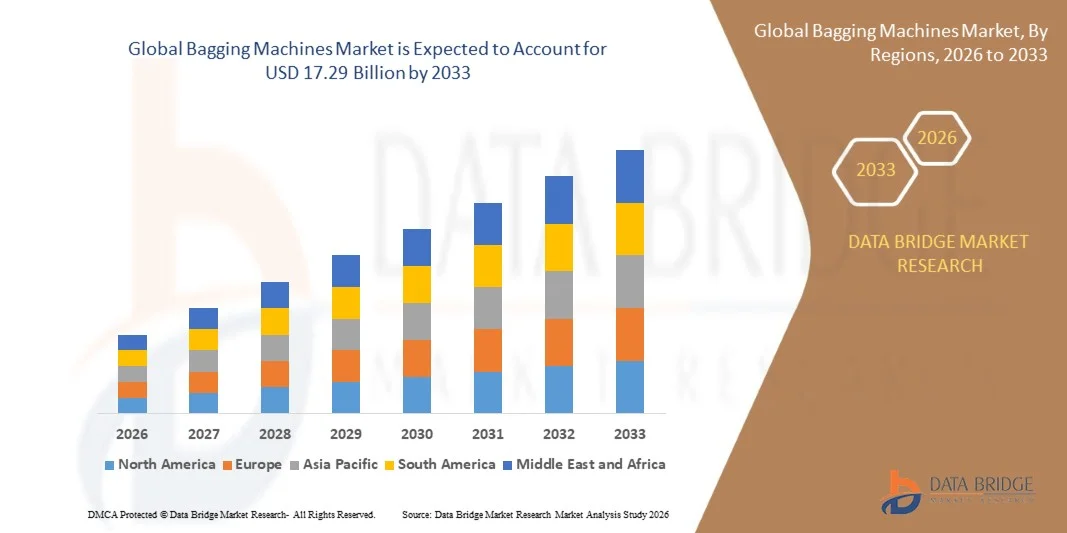
- As per Data Bridge Market Research analysis, the bagging machines market was valued at USD 11.27 billion in 2025 and is projected to reach USD 17.29 billion by 2033, growing at a CAGR of 5.50% from 2026 to 2033.
- The market is experiencing consistent growth driven by the increasing adoption of automation and Industry 4.0 technologies, rising demand for fast and accurate packaging, and expanding applications across food and beverage, pharmaceuticals, chemicals, construction, and consumer goods industries. Manufacturers are increasingly adopting automated bagging systems to improve efficiency, increase output, reduce costs, and accommodate diverse packaging requirements.
- The growing need for higher packaging productivity, reduced labor costs, improved precision, and flexible packaging solutions, combined with the integration of robotics, artificial intelligence, Internet of Things, and real-time monitoring technologies, is encouraging manufacturers to adopt advanced bagging machines. The shift toward sustainable packaging is also supporting demand for machines compatible with biodegradable and different packaging materials, while automation helps reduce manual intervention, production downtime, and packaging waste
Market Size & Forecast
- Global Market Value (2025): USD 11.27 Billion
- Expected Market Value (2033): USD 17.29 Billion
- Forecast CAGR (2026–2033): 5.50%
What are the Major Takeaways of the Bagging Machines Market?
- North America dominated the bagging machines market with the largest revenue share of 32.1% in 2025, supported by advanced manufacturing infrastructure, high automation adoption rates, stringent packaging regulations, and strong demand from food, pharmaceutical, and chemical industries.
- Asia-Pacific is expected to be the fastest-growing region at a CAGR of 8.5% from 2026 to 2033, fueled by rapid industrialization and e-commerce growth, which are increasing demand for efficient packaging solutions.
- The form fill seal machines segment led the market with a 40.5% share in 2025, driven by high-speed and high-productivity packaging capabilities
- Open mouth bagging machines are the fastest-growing product type, projected to register a CAGR of 4.7%, reflecting the surge in their flexibility in handling pre-formed bags and diverse product type
- The automatic segment dominated the technology type category with a 61.7% revenue share in 2025, led by increasing demand for automated packaging operations.
- Vertical bagging machines accounted for 60% of the market share in 2025, preferred by its versatility and ability to handle a broad range of products and packaging materials.
- The horizontal bagging machines segment is the fastest-growing machine type category, with a CAGR of 9.5%, driven by rising demand for bulk packaging and greater automation in packaging processes.
Report Scope and Bagging Machines Market Segmentation
|
Attributes |
Bagging Machines Key Market Insights |
|
Segments Covered |
|
|
Countries Covered |
North America
Europe
Asia-Pacific
Middle East and Africa
South America
|
|
Key Market Players |
|
|
Market Opportunities |
|
|
Value Added Data Infosets |
In addition to the insights on market scenarios such as market value, growth rate, segmentation, geographical coverage, and major players, the market reports curated by the Data Bridge Market Research also include import export analysis, production capacity overview, production consumption analysis, price trend analysis, climate change scenario, supply chain analysis, value chain analysis, raw material/consumables overview, vendor selection criteria, PESTLE Analysis, Porter Analysis, and regulatory framework. |
What is the Key Trend in the Bagging Machines Market?
- Manufacturers are increasingly adopting hybrid and flexible bagging machines that can handle multiple packaging materials and formats, helping fulfillment operations improve efficiency while responding to sustainability requirements.
- For instance, in September 2025, Sealed Air launched the AUTOBAG 850HB Hybrid Bagging Machine, which runs both poly and curbside-recyclable paper mailers, provides inline printing, and delivers speeds of up to 10 bags per minute, demonstrating the shift toward flexible, automated, and sustainable bagging systems.
- The integration of precision weighing, automatic sealing, digital interfaces, and remote monitoring is improving packaging accuracy, throughput, and operational consistency across automated bagging lines.
- Manufacturers are increasingly developing high-speed bagging systems that reduce labor dependency, minimize material waste, and support growing packaging volumes across food, pharmaceutical, retail, and industrial applications.
- IoT-enabled diagnostics and remote monitoring are gaining adoption as manufacturers seek to minimize unplanned maintenance, improve machine availability, and optimize production throughput.
- For instance, in August 2025, PAC Machinery announced two fully integrated bagging and robotic picking systems, including an AI-driven piece-picking solution integrated with its Rollbag R3200 Paper Bagging System, demonstrating the growing integration of robotics and AI with automated bagging equipment
- As packaging operations increasingly prioritize automation, sustainability, flexibility, and packaging consistency, the adoption of intelligent and multi-format bagging machines is expected to accelerate across high-volume manufacturing and fulfillment environments.
What are the Key Drivers of the Bagging Machines Market?
- The rapid expansion of food and beverage processing and packaged consumer goods is increasing demand for automated bagging machines capable of delivering consistent filling, sealing, weighing, and packaging at higher production volumes.
- For instance, in February 2025, Packaging World reported that 65% of surveyed consumer packaged goods companies planned to add automation equipment, cobots, or robotics to their packaging operations, with 61% citing reduced labor costs and return on investment as the leading reason.
- The growing emphasis on operational efficiency and labor productivity is encouraging manufacturers to replace manual packaging activities with fully automated systems that improve throughput, accuracy, and packaging consistency.
- Rising e-commerce and retail packaging volumes are further supporting demand for high-speed bagging equipment capable of handling flexible packaging formats and automated fulfillment requirements.
- For instance, in September 2025, PMMI reported that automation and robotics were increasingly being integrated into food, baking, snack, beverage, and consumer packaged goods packaging, where robots enable high-speed packaging, reduce human error, and maintain hygiene standards.
- With the packaging industry increasingly investing in smart machinery, automated quality control, precision weighing, and sustainable packaging materials, bagging machines are becoming an important component of integrated automated packaging lines.
Which Factors are Challenging the Growth of the Bagging Machines Market?
- Advanced bagging machines require substantial investment in automation components, servo drives, sensors, fabricated structures, integration, and specialized equipment, increasing the financial burden for manufacturers.
- For instance, in May 2026, Alligator Automations reported that a polymer manufacturer’s semi-automatic bagging operation experienced productivity variation across shifts because it depended heavily on manual labor, requiring automation to achieve consistent output.
- The operation and servicing of sophisticated bagging equipment require skilled technicians, while shortages of trained personnel can increase downtime and reduce equipment performance.
- These higher equipment and integration costs can restrict adoption among small and medium-sized manufacturers, particularly where packaging volumes are insufficient to justify fully automated systems.
- Integration with existing production lines can create compatibility issues, installation complexity, production downtime, and additional technical-service requirements, particularly for older manufacturing facilities.
- Supply-chain disruptions affecting sensors, motors, PLCs, servo drives, and other specialized components can extend equipment delivery times and increase manufacturing and installation costs.
- For instance, in May 2026, YPS reported that a pharmaceutical company required up to 12 vertical bagging machines to automate packing, while accurately feeding two different products into the small aperture of the bags added complexity to the automatic feeder system.
- The combination of higher equipment prices, longer procurement cycles, integration requirements, and dependence on specialized components can slow investment decisions and limit the deployment of advanced bagging systems in cost-sensitive markets.
How is the Bagging Machines Market Segmented?
The bagging machines market is segmented on the basis of product, technology type, machine type, and end users.
- By Product
On the basis of product, the bagging machines market is segmented into open mouth bagging machines, form fill seal machines, valve baggers machines, and FIBC machines. The form fill seal machines segment dominated the product category with 40.5% share in 2025, supported by high-speed and high-productivity packaging capabilities. These machines integrate bag forming, filling, and sealing into a continuous operation. They are widely used for food, chemicals, pharmaceuticals, and other bulk products. Their ability to reduce manual handling improves packaging efficiency and production consistency. Demand for automated flexible packaging is further supporting adoption.
The open mouth bagging machines segment is projected to register the fastest growth at a CAGR of 4.7% during forecast period, driven by their flexibility in handling pre-formed bags and diverse product types. These machines provide accurate filling and accommodate different bag sizes and sealing options. They are particularly suitable for granular and powdered materials. Fast changeovers and reduced downtime improve their suitability for production environments with varied packaging requirements. Their compatibility with both manual and automated filling lines further broadens their application. Increasing demand for flexible bulk-product packaging is expected to support segment growth through the forecast period.
- By Technology Type
On the basis of technology type, the bagging machines market is segmented into semi-automatic and automatic systems. The automatic segment dominated the technology category with 61.7% share in 2025, reflecting increasing demand for automated packaging operations. Automatic machines perform filling, weighing, bag handling, and sealing with limited operator intervention. They are particularly suitable for high-volume production environments requiring consistent output. Automation reduces labor dependency and improves packaging speed and accuracy. Compatibility with Industry 4.0 manufacturing facilities is further strengthening demand for automatic systems.
The semi-automatic segment is projected to register the fastest growth at a CAGR of 8.1% from 2026 to 2033, driven by its balance of efficiency, flexibility, and cost-effectiveness. Semi-automatic machines are particularly suitable for small and medium-sized enterprises that require improved packaging productivity without the high investment associated with fully automated systems. These machines provide greater operational flexibility while reducing manual packaging requirements. Increasing demand from food and beverage, pharmaceutical, chemical, and other industries is supporting adoption. Integration of IoT-enabled monitoring and improved automation features is further enhancing their efficiency. The growing emphasis on affordable automation and flexible packaging operations is expected to sustain rapid segment expansion.
- By Machine Type
On the basis of machine type, the bagging machines market is segmented into vertical bagging machines and horizontal bagging machines. The vertical bagging machines segment dominated the machine type category with 60% share in 2025, supported by its versatility and ability to handle a broad range of products and packaging materials. Vertical systems offer compact equipment configurations suitable for facilities with limited floor space. They are widely used for food, consumer products, chemicals, and other applications. Their compatibility with different filling mechanisms improves application flexibility. Increasing demand for efficient packaging of granular, powdered, and solid products continues to support adoption.
The horizontal bagging machines segment is projected to register the fastest growth at a CAGR of 9.5% during forecast period, driven by rising demand for bulk packaging and greater automation in packaging processes. Horizontal systems are increasingly adopted where speed and operational efficiency are important. They are particularly suitable for applications involving snacks, frozen foods, and other packaged products. Their configuration supports efficient product handling and continuous packaging operations. Improvements in automated feeding and sealing technologies are further enhancing their productivity. Increasing demand for high-speed packaging solutions is expected to sustain the segment's rapid expansion.
- By End Users
On the basis of end users, the bagging machines market is segmented into construction industry, food and beverage industry, pharmaceutical industry, household and personal care industry, cosmetic industry, and hardware industry. The food and beverage industry dominated the end-user category with 59.8% share, supported by extensive demand for efficient packaging of food products. Bagging machines are used for grains, flour, snacks, sugar, frozen foods, and other packaged products. The industry requires accurate filling, reliable sealing, and hygienic packaging operations. Increasing consumption of packaged and convenience foods is strengthening demand for automated bagging equipment. High production volumes further favor automated systems capable of maintaining consistent packaging performance.
The pharmaceutical industry is projected to be among the fastest-growing end-user segments at 9.0% CAGR during forecast period, supported by increasing requirements for accurate dosing, secure sealing, and hygienic packaging. Pharmaceutical manufacturers require reliable equipment that minimizes manual handling and contamination risks. Automated bagging systems can improve consistency and repeatability across packaging operations. Integration with inspection, weighing, and quality-control technologies further improves suitability for pharmaceutical applications. Increasing pharmaceutical production and stricter packaging-quality requirements are supporting investment in automated machinery. These factors are expected to accelerate adoption of advanced bagging equipment in pharmaceutical manufacturing.
Which Region Holds the Largest Share of the Bagging Machines Market?
- North America dominated the bagging machines market with the largest revenue share of 32.1% in 2025, supported by advanced manufacturing infrastructure, high automation adoption rates, stringent packaging regulations, and strong demand from food, pharmaceutical, and chemical industries.
- The region benefits from a strong presence of multinational corporations, extensive food-processing facilities, and a robust pharmaceutical manufacturing base, creating consistent demand for sophisticated bagging solutions. High investments in Industry 4.0, smart manufacturing, and sustainable packaging technologies are further supporting the adoption of advanced bagging equipment across the region.
U.S. Bagging Machines Market Insight
The U.S. bagging machines market is witnessing strong growth due to increasing automation across food and beverage, pharmaceutical, chemical, construction, and consumer-goods manufacturing. The country’s mature packaging industry is increasingly adopting automated filling, weighing, sealing, and bag-handling systems to improve throughput, reduce labor dependency, and maintain consistent package quality. Rising e-commerce activity is also increasing requirements for flexible and high-speed packaging equipment. PMMI reported in 2025 that 65% of surveyed consumer packaged goods companies planned to add automation equipment, cobots, or robotics to their packaging operations, while 61% cited labor-cost reduction and return on investment as leading drivers.
Asia-Pacific Bagging Machines Market Insight
The Asia-Pacific bagging machines market is expected to witness rapid growth, driven by rapid industrialization, expanding food and beverage manufacturing, e-commerce growth, rising labor costs, and increasing adoption of packaging automation across China, India, Japan, and other emerging economies. Manufacturers are increasingly adopting automated filling, form-fill-seal, weighing, and palletizing systems to improve throughput, packaging consistency, and labor productivity. The region also benefits from strong food-processing industries, expanding pharmaceutical manufacturing, organized retail development, and smart-manufacturing initiatives, which are increasing demand for efficient packaging equipment. Growing adoption of robotics, automated material handling, digital controls, and integrated packaging lines is helping manufacturers improve productivity and address workforce constraints.
Japan Bagging Machines Market Insight
The Japan bagging machines market is witnessing steady growth due to advanced manufacturing capabilities, high labor costs, workforce shortages, and strong adoption of robotics and factory automation. Food, pharmaceutical, chemical, and consumer-product manufacturers are increasingly adopting automated packaging systems to improve operational efficiency and compensate for labor constraints. Japan’s mature machinery industry also supports the development of high-precision weighing, filling, sealing, and inspection technologies. The International Federation of Robotics reported that Japan had approximately 435,299 industrial robots operating in 2023, demonstrating the country’s extensive automation infrastructure that supports automated packaging applications.
China Bagging Machines Market Insight
The China bagging machines market is expanding rapidly due to large-scale manufacturing, growing food and beverage production, increasing e-commerce activity, and accelerating industrial automation. Manufacturers are increasingly deploying automated packaging systems to improve production efficiency, reduce dependence on manual labor, and maintain consistent filling and sealing performance. Rising investment in smart factories is further supporting the integration of robotics, sensors, digital controls, and automated material handling into packaging operations. China’s National Bureau of Statistics reported that industrial robot output reached approximately 556,000 units in 2024, highlighting the country’s expanding industrial automation base and supporting the broader adoption of automated manufacturing and packaging equipment.
U.K. Bagging Machines Market Insight
The U.K. bagging machines market is experiencing steady growth, supported by increasing automation across food and drink manufacturing, pharmaceuticals, chemicals, personal care, and consumer products. Manufacturers are increasingly investing in automated packaging equipment to address labor shortages, improve production efficiency, and maintain consistent packaging standards. The shift toward sustainable packaging is also encouraging manufacturers to adopt machinery capable of processing different paper-based, recyclable, and flexible packaging materials. The Food and Drink Federation highlighted continuing labor and skills challenges within U.K. food and drink manufacturing, strengthening the need for productivity improvements and greater use of automation technologies.
Germany Bagging Machines Market Insight
The Germany bagging machines market is expanding steadily due to its strong machinery-manufacturing base, advanced food-processing sector, and high adoption of industrial automation. German manufacturers increasingly use automated filling, weighing, bagging, sealing, and downstream packaging systems to increase productivity and address workforce constraints. The country’s established engineering capabilities also encourage integration of robotics, sensors, machine vision, and digital controls into packaging machinery. The International Federation of Robotics reported approximately 429,000 industrial robots in operation in Germany in 2023, demonstrating the country’s high level of industrial automation and providing a strong technological base for automated packaging equipment.
Which are the Top Companies in Bagging Machines Market?
The bagging machines industry is primarily led by well-established companies, including:
- Concetti S.p.A. (Italy)
- Premier Tech Ltd. (Canada)
- PAYPER S.A. (Spain)
- HAVER & BOECKER OHG (Germany)
- Formost Fuji Corp. (U.S.)
- STATEC BINDER GmbH (Austria)
- Arodo BV (Belgium)
- PAGLIERANI s.r.l. (Italy)
- Nichrome Packaging Solutions (India)
- Mamta Machinery Limited. (India)
- Hastamat Verpackungstechnik GmbH + Co. KG (Germany)
- ROVEMA GmbH (Germany)
- Universal Pack S.r.l. (Italy)
- Turpack Makine Sanayi ve Ticaret Ltd. (Turkey)
- PAKONA ENGINEERS (INDIA) PRIVATE LIMITED (India)
- VELTEKO s.r.o. (Czech Republic)
- Mentpack (Turkey)
- I.M.A. Industria Macchine Automatiche S.p.A. (Italy)
- SN Maschinenbau GmbH (Germany)
- OMAG S.p.A. (Italy)
What are Latest Developments in Bagging Machines Market?
- In September 2025, Sealed Air launched the AUTOBAG 850HB Hybrid Bagging Machine, a high-speed automated system designed to process both poly and curbside-recyclable paper mailers on the same machine. The system provides quick material changeover, inline printing, and speeds of up to 10 bags per minute, supporting flexible and sustainable fulfillment operations
- In July 2024, PAC Machinery launched the Rollbag R3200 Fulfillment Paper Automatic Bagger, including an XL version, designed to package products using either sustainable poly mailers or Fiberflex curbside-recyclable paper mailers. The system allows operators to switch between packaging materials within minutes, providing greater flexibility for automated fulfillment operations.
- In February 2023, WeighPack Systems introduced a sanitary version of its VF-1200 continuous-motion vertical bagging machine, designed for applications requiring high-pressure washdown and enhanced hygiene. The machine incorporates stainless-steel construction and continuous-motion technology for higher production rates, strengthening its suitability for food-processing applications.
- In June 2022, WeighPack introduced a turnkey coffee bagging system for premade box-gusset bags, integrating a powder weigher, Swifty Bagger, product-rejection system, and checkweigher. The automated system was designed to improve weight accuracy and automate filling, sealing, and quality-control operations for ground coffee packaging
- In March 2021, Premier Tech and Bühler’s Chinese joint venture launched the CHRONOS OML-1060, a fully automatic bagging station for the food, grain, and animal-feed industries. The machine was developed as a cost-effective automated solution based on Premier Tech’s established bagging technologies, expanding access to automated packaging equipment in emerging markets.

- Interactive Data Analysis Dashboard
- Company Analysis Dashboard for high growth potential opportunities
- Research Analyst Access for customization & queries
- Competitor Analysis with Interactive dashboard
- Latest News, Updates & Trend analysis
- Harness the Power of Benchmark Analysis for Comprehensive Competitor Tracking
Global Bagging Machines Market, Supply Chain Analysis and Ecosystem Framework
To support market growth and help clients navigate the impact of geopolitical shifts, DBMR has integrated in-depth supply chain analysis into its Global Bagging Machines Market research reports. This addition empowers clients to respond effectively to global changes affecting their industries. The supply chain analysis section includes detailed insights such as Global Bagging Machines Market consumption and production by country, price trend analysis, the impact of tariffs and geopolitical developments, and import and export trends by country and HSN code. It also highlights major suppliers with data on production capacity and company profiles, as well as key importers and exporters. In addition to research, DBMR offers specialized supply chain consulting services backed by over a decade of experience, providing solutions like supplier discovery, supplier risk assessment, price trend analysis, impact evaluation of inflation and trade route changes, and comprehensive market trend analysis.
Data collection and base year analysis are done using data collection modules with large sample sizes. The stage includes obtaining market information or related data through various sources and strategies. It includes examining and planning all the data acquired from the past in advance. It likewise envelops the examination of information inconsistencies seen across different information sources. The market data is analysed and estimated using market statistical and coherent models. Also, market share analysis and key trend analysis are the major success factors in the market report. To know more, please request an analyst call or drop down your inquiry.
The key research methodology used by DBMR research team is data triangulation which involves data mining, analysis of the impact of data variables on the market and primary (industry expert) validation. Data models include Vendor Positioning Grid, Market Time Line Analysis, Market Overview and Guide, Company Positioning Grid, Patent Analysis, Pricing Analysis, Company Market Share Analysis, Standards of Measurement, Global versus Regional and Vendor Share Analysis. To know more about the research methodology, drop in an inquiry to speak to our industry experts.
Data Bridge Market Research is a leader in advanced formative research. We take pride in servicing our existing and new customers with data and analysis that match and suits their goal. The report can be customized to include price trend analysis of target brands understanding the market for additional countries (ask for the list of countries), clinical trial results data, literature review, refurbished market and product base analysis. Market analysis of target competitors can be analyzed from technology-based analysis to market portfolio strategies. We can add as many competitors that you require data about in the format and data style you are looking for. Our team of analysts can also provide you data in crude raw excel files pivot tables (Fact book) or can assist you in creating presentations from the data sets available in the report.













