


Balsamic Vinegar Market Overview
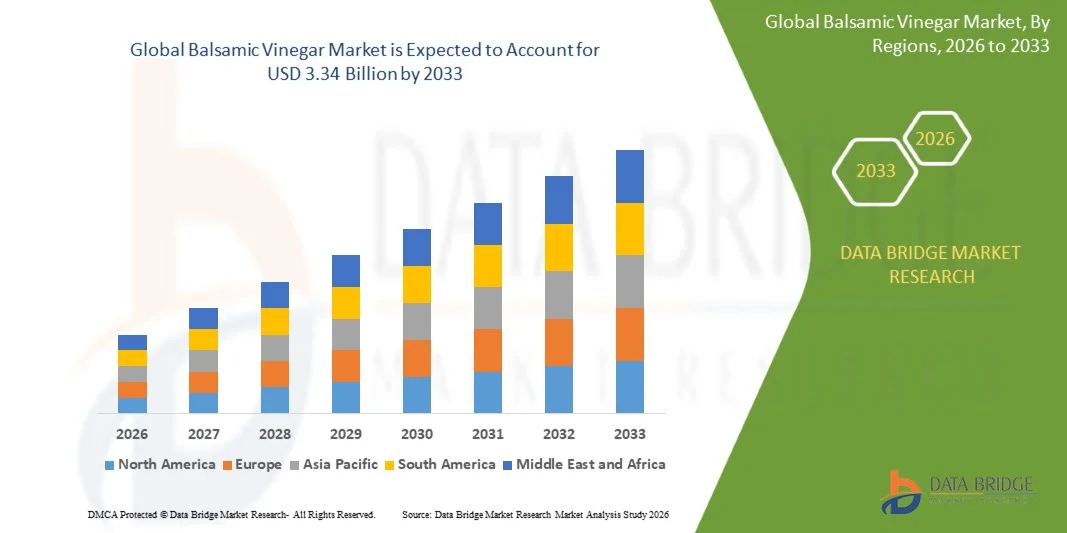
As per Data Bridge Market Research analysis the balsamic vinegar market was valued at USD 2.62 billion in 2025 and is projected to reach USD 3.34 billion by 2033, growing at a CAGR of 3.10% from 2026 to 2033. The market is witnessing steady growth driven by increasing consumer preference for premium and gourmet food products, rising awareness regarding the health benefits associated with vinegar consumption, and expanding applications across foodservice, retail, and food processing industries.
The growing popularity of Mediterranean cuisine worldwide, coupled with increasing demand for natural condiments and clean-label ingredients, is encouraging manufacturers and retailers to expand their balsamic vinegar offerings. Traditional and flavored balsamic vinegars are gaining traction among consumers seeking authentic culinary experiences, while premium variants with geographical indications continue to strengthen their presence across developed and emerging markets. In addition, the expansion of e-commerce channels and the increasing use of balsamic vinegar in salad dressings, marinades, glazes, and ready-to-eat products are further supporting market growth during the forecast period.
Market Size & Forecast
- Market Value (2025): USD 2.62 Billion
- Expected Market Value (2033): USD 3.34 Billion
- Forecast CAGR (2026–2033): 3.10%
- Leading Region in 2025: North America
- Fastest Growing Region: Asia-Pacific
Key Market Trends & Insights
- North America dominated the balsamic vinegar market with the largest revenue share in 2025, supported by growing consumer demand for premium food ingredients, increasing adoption of Mediterranean dietary patterns, and expanding consumption of gourmet condiments.
- Asia-Pacific balsamic vinegar market is expected to witness the fastest growth rate from 2026 to 2033, supported by rapid urbanization, rising disposable incomes, and growing exposure to international cuisines across countries such as China, Japan, India, and South Korea.
- The dark balsamic vinegars segment accounted for the largest market share in 2025, driven by its widespread consumption across households, restaurants, and food processing applications. Its rich flavor profile, traditional production process, and strong association with Mediterranean cuisine continue to support demand across major regional markets. The segment also benefits from strong consumer recognition and premium positioning, particularly in Europe and North America. In addition, manufacturers continue to introduce aged and flavored variants to cater to evolving consumer preferences. Growing exports of Balsamic Vinegar of Modena PGI to more than 130 countries are further supporting segment dominance.
- The white balsamic vinegars segment is projected to register the fastest growth during the forecast period of 2026 to 2033, driven by increasing consumer preference for lighter-colored condiments in salads, seafood dishes, and gourmet food preparations. Growing adoption in premium foodservice establishments and increasing use in contemporary cuisine are further supporting segment expansion.
- The dark balsamic vinegar segment held the dominant position in 2025 owing to its versatility across marinades, glazes, dressings, and gourmet recipes. Consumers continue to favor its sweet and tangy flavor profile, making it a staple ingredient across several international cuisines. The segment is also witnessing strong demand from packaged food manufacturers incorporating balsamic vinegar into ready-to-eat products and sauces. Rising popularity of Mediterranean dietary patterns is expected to sustain long-term demand.
- The white balsamic vinegar segment is anticipated to witness robust growth throughout the forecast period due to growing consumer preference for milder flavors and visually appealing food presentations. Increasing applications in fruits, beverages, and specialty dishes are contributing to segment growth, particularly among younger consumers and premium dining establishments.
Report Scope and Balsamic Vinegar Market Segmentation
|
Attributes |
Balsamic Vinegar Key Market Insights |
|
Segments Covered |
|
|
Countries Covered |
North America
Europe
Asia-Pacific
Middle East and Africa
South America
|
|
Key Market Players |
|
|
Market Opportunities |
|
|
Value Added Data Infosets |
In addition to the insights on market scenarios such as market value, growth rate, segmentation, geographical coverage, and major players, the market reports curated by the Data Bridge Market Research also include in-depth expert analysis, pricing analysis, brand share analysis, consumer survey, demography analysis, supply chain analysis, value chain analysis, raw material/consumables overview, vendor selection criteria, PESTLE Analysis, Porter Analysis, and regulatory framework. |
Balsamic Vinegar Market Trends
Trend: Growing Consumer Preference For Premium, Authentic, And Clean-Label Condiments
Increasing consumer interest in gourmet foods, premium culinary experiences, and clean-label ingredients is accelerating demand for balsamic vinegar across retail and foodservice channels. Consumers are increasingly seeking authentic products with protected geographical indications (PGI/PDO), particularly Balsamic Vinegar of Modena, due to its heritage, quality, and versatility in both home cooking and professional applications. Rising awareness regarding natural ingredients and Mediterranean dietary patterns is further supporting adoption across developed and emerging markets.
The rapid expansion of premium food retailing, specialty stores, and e-commerce platforms is creating sustained demand for balsamic vinegar across salads, marinades, glazes, ready-to-eat meals, and gourmet applications. For instance, the Consorzio Tutela Aceto Balsamico di Modena reported that Balsamic Vinegar of Modena PGI exports increased by 2.57% in 2025 despite economic challenges, with the product reaching consumers in more than 130 countries and generating an estimated consumer value of approximately EUR 1 billion. This performance reflects the continued appetite for authentic Italian condiments and premium food products.
The growing shift toward premium and authentic food products, combined with expanding international distribution networks, is expected to reinforce long-term demand for balsamic vinegar, positioning manufacturers to benefit from increasing consumption of gourmet condiments and clean-label food ingredients.
Balsamic Vinegar Market Dynamics
Key Market Driver: Increasing Demand For Mediterranean Cuisine And Premium Food Ingredients
The food industry continues to experience rising demand for Mediterranean and gourmet food products due to increasing health consciousness, changing dietary preferences, and greater consumer willingness to pay for premium ingredients. Consumers are increasingly incorporating balsamic vinegar into everyday meals, encouraging producers to expand capacity and introduce differentiated product offerings across retail and foodservice segments.
Leading industry organizations continue to report strong market fundamentals. According to the the Consortium for the Protection of Balsamic Vinegar of Modena, certified production of Balsamic Vinegar of Modena PGI ranges between 95 million and 100 million liters annually, with more than 90% of production exported globally. The supply chain encompasses approximately 2,400 farms, over 14,000 hectares of vineyards, and 61 vinegar factories, highlighting the scale and economic significance of the industry.
As consumption of Mediterranean cuisine and premium condiments continues to expand, balsamic vinegar manufacturers are expected to benefit from sustained demand driven by culinary diversification, premiumization trends, and increasing investments in specialty food production.
Key Restraint/Challenge: Volatility In Grape Production And Agricultural Supply Chains
Balsamic vinegar manufacturers remain heavily dependent on agricultural inputs such as grapes and wine vinegar, exposing production costs to fluctuations in crop yields, climate conditions, energy prices, and supply chain disruptions. Variability in grape harvests, transportation expenses, and changing weather patterns continues to affect production planning and profitability, particularly for producers of premium and aged balsamic vinegar.
In addition, manufacturers must manage raw material sourcing risks while maintaining product quality and regulatory compliance associated with PGI and PDO certifications. Industry stakeholders have noted that rising energy costs, shipping disruptions, and geopolitical uncertainties affected supply chain dynamics throughout 2025, creating additional pressures across the balsamic vinegar value chain. These market conditions continue to present operational challenges for producers seeking to maintain stable supply and pricing.
Despite robust market demand, volatility in agricultural production and ongoing supply chain uncertainties are expected to remain significant restraints, increasing production costs, pressuring profit margins, and limiting long-term market stability throughout the forecast period.
Key Market Opportunity: Expansion Of Premium, Organic, And Specialty Balsamic Vinegar Products
Consumers, retailers, and foodservice operators are increasingly embracing premium, organic, and specialty condiments as part of broader health and sustainability trends. This is creating significant long-term opportunities for balsamic vinegar manufacturers to diversify product portfolios through organic certifications, flavored variants, aged offerings, and premium packaging formats.
Industry participants are also benefiting from strong international demand for authentic products. According to Federvini data cited by Great Italian Food Trade, exports of Italian vinegars recorded particularly strong growth during the first nine months of 2025, including South Korea (+33.9%), China (+29.9%), and Canada (+20.1%). These developments underscore the growing opportunity for producers to expand into high-growth international markets and capitalize on rising demand for premium Italian food products.
As consumers continue to prioritize premium, authentic, and sustainably produced food products, increasing demand for specialty balsamic vinegar and expanding international market penetration are expected to create substantial long-term growth opportunities for the balsamic vinegar market.
Balsamic Vinegar Market Scope
The market is segmented on the basis of product type, flavor, grade, category, type of wood for aging, ageing, application, distribution channel, and end use.
- By Product Type
On the basis of product type, the balsamic vinegar market is segmented into dark balsamic vinegars and white balsamic vinegars. The dark balsamic vinegars segment accounted for the largest market share in 2025, driven by its widespread consumption across households, restaurants, and food processing applications. Its rich flavor profile, traditional production process, and strong association with Mediterranean cuisine continue to support demand across major regional markets. The segment also benefits from strong consumer recognition and premium positioning, particularly in Europe and North America. In addition, manufacturers continue to introduce aged and flavored variants to cater to evolving consumer preferences. Growing exports of Balsamic Vinegar of Modena PGI to more than 130 countries are further supporting segment dominance.
The white balsamic vinegars segment is projected to register the fastest growth during the forecast period of 2026 to 2033, driven by increasing consumer preference for lighter-colored condiments in salads, seafood dishes, and gourmet food preparations. Growing adoption in premium foodservice establishments and increasing use in contemporary cuisine are further supporting segment expansion.
- By Flavor
On the basis of flavor, the market is segmented into dark balsamic vinegar and white balsamic vinegar. The dark balsamic vinegar segment held the dominant position in 2025 owing to its versatility across marinades, glazes, dressings, and gourmet recipes. Consumers continue to favor its sweet and tangy flavor profile, making it a staple ingredient across several international cuisines. The segment is also witnessing strong demand from packaged food manufacturers incorporating balsamic vinegar into ready-to-eat products and sauces. Rising popularity of Mediterranean dietary patterns is expected to sustain long-term demand.
The white balsamic vinegar segment is anticipated to witness robust growth throughout the forecast period due to growing consumer preference for milder flavors and visually appealing food presentations. Increasing applications in fruits, beverages, and specialty dishes are contributing to segment growth, particularly among younger consumers and premium dining establishments.
- By Grade
On the basis of grade, the market is segmented into traditional grade balsamic vinegar, commercial grade balsamic vinegar, and condiment grade balsamic vinegar. The commercial grade balsamic vinegar segment dominated the market in 2025 owing to its affordability, broad retail availability, and extensive use across foodservice and packaged food applications. Its cost-effectiveness makes it highly attractive for large-scale consumption across restaurants, hotels, and catering businesses. In addition, manufacturers continue to expand production capacities to meet increasing demand from emerging markets. Strong penetration across supermarkets and convenience stores further reinforces the segment's leading position.
The traditional grade balsamic vinegar segment is expected to witness the fastest growth from 2026 to 2033, supported by rising demand for authentic and premium products, increasing consumer awareness of geographical indication certifications, and growing interest in artisanal food products.
- By Category
On the basis of category, the market is segmented into organic and conventional. The conventional segment dominated the market in 2025 due to its established supply chain, competitive pricing, and broad availability across supermarkets, hypermarkets, and foodservice channels. Conventional balsamic vinegar remains the preferred choice among price-sensitive consumers and commercial buyers. The segment also benefits from consistent product availability and a well-developed distribution network. Furthermore, established manufacturers continue to invest in marketing and promotional activities to strengthen brand visibility.
The organic segment is anticipated to register the fastest growth during the forecast period, driven by increasing consumer preference for clean-label products, sustainable farming practices, and organic food ingredients. Growing regulatory support for organic food production is also expected to create favorable growth opportunities for market participants.
- By Type Of Wood For Aging
On the basis of type of wood for aging, the market is segmented into oak, chestnut, mulberry, and others. The oak segment accounted for the largest market share in 2025 owing to its traditional use in balsamic vinegar production and its ability to impart balanced flavor, aroma, and texture characteristics. Oak barrels are widely utilized by premium producers due to their durability and established role in traditional aging processes. The segment continues to benefit from strong consumer preference for authentic and heritage food products. Moreover, oak-aged balsamic vinegar is increasingly being positioned as a premium offering across international markets.
The mulberry segment is expected to witness notable growth through 2033 due to rising demand for specialty and premium balsamic vinegar products offering differentiated sensory profiles and enhanced culinary appeal.
- By Ageing
On the basis of ageing, the market is segmented into aged, semi-aged, and matured. The semi-aged segment held the largest market share in 2025 as it offers an optimal balance between affordability and flavor complexity, making it suitable for both household and commercial applications. Consumers increasingly prefer semi-aged products due to their versatility and accessible price points. In addition, the segment benefits from strong demand across retail channels and foodservice establishments. Manufacturers are also introducing innovative packaging formats to improve product appeal and accessibility.
The aged segment is projected to grow at the fastest pace during the forecast period, supported by increasing demand for premium gourmet products, authentic culinary experiences, and luxury food gifting trends across developed economies.
- By Applications
On the basis of applications, the market is segmented into salad dressings, desserts, boiled vegetables, cheese, soups, marinades, fruits, lemonade, meat products, and others. The salad dressings segment dominated the market in 2025 due to the extensive use of balsamic vinegar as a flavor enhancer in healthy and Mediterranean-inspired food preparations. Rising consumer focus on healthy eating habits and fresh food consumption continues to strengthen demand. The segment is also benefiting from increasing sales of packaged salad kits and ready-to-use dressings. Furthermore, growing adoption across quick-service restaurants and premium cafés is contributing to segment growth.
The marinades segment is anticipated to register the fastest growth from 2026 to 2033, driven by growing consumer interest in gourmet cooking and increasing utilization across meat, seafood, and plant-based food products.
- By Distribution Channel
On the basis of distribution channel, the market is segmented into store-based retailing and non-store retailing. The store-based retailing segment accounted for the largest market share in 2025, supported by strong sales through supermarkets, hypermarkets, specialty food stores, and gourmet retail outlets. Consumers continue to prefer physical retail channels due to the ability to compare brands, packaging, and product quality before purchase. The segment also benefits from established relationships between manufacturers and large retail chains. In addition, in-store promotional campaigns and premium product displays continue to drive sales growth.
The non-store retailing segment is expected to witness the fastest growth during the forecast period owing to expanding e-commerce penetration, increasing online grocery purchases, and greater availability of premium imported balsamic vinegar products through digital channels.
- By End Use
On the basis of end use, the market is segmented into household and commercial. The household segment held the largest market share in 2025, driven by increasing home cooking activities, rising awareness of Mediterranean diets, and growing use of balsamic vinegar in everyday meal preparation. Consumers are increasingly incorporating balsamic vinegar into salads, roasted vegetables, and gourmet dishes as part of healthier eating habits. The segment is also benefiting from growing exposure to international cuisines through digital media and cooking programs. Rising disposable incomes and premium food consumption trends are expected to further support household demand.
The commercial segment is projected to register the fastest growth from 2026 to 2033, supported by increasing demand from restaurants, hotels, catering services, and food manufacturers seeking premium ingredients to enhance product offerings and improve menu differentiation.
Balsamic Vinegar Market Regional Analysis
North America Balsamic Vinegar Market Insight
North America dominated the balsamic vinegar market with the largest revenue share in 2025, supported by growing consumer demand for premium food ingredients, increasing adoption of Mediterranean dietary patterns, and expanding consumption of gourmet condiments. Consumers across the region highly value the versatility, authenticity, and perceived health benefits associated with balsamic vinegar, particularly in salad dressings, marinades, and ready-to-eat meals. This widespread adoption is further supported by high disposable incomes, a well-established specialty food retail sector, and increasing preference for clean-label and organic products, establishing balsamic vinegar as a favored condiment across both household and commercial applications.
U.S. Balsamic Vinegar Market Insight
The U.S. balsamic vinegar market captured the largest revenue share in 2025 within North America, fueled by the growing popularity of premium cooking ingredients and the expanding trend of home-based gourmet meal preparation. Consumers are increasingly prioritizing healthier and more natural flavoring options, contributing to strong demand for authentic balsamic vinegar products. The increasing influence of Mediterranean cuisine, combined with robust demand from restaurants, foodservice operators, and packaged food manufacturers, further propels market expansion. Moreover, the growing availability of imported Italian balsamic vinegar through supermarkets and e-commerce platforms is significantly contributing to industry growth.
Europe Balsamic Vinegar Market Insight
The Europe balsamic vinegar market is expected to witness substantial growth from 2026 to 2033, primarily driven by the region's deep-rooted culinary heritage and strong demand for authentic and geographically protected food products. The increasing consumer preference for premium condiments, coupled with rising awareness regarding sustainable and artisanal food production, is fostering market expansion. Europe continues to experience strong demand across retail, foodservice, and food manufacturing applications, with balsamic vinegar being incorporated into both traditional and contemporary cuisines throughout the region.
U.K. Balsamic Vinegar Market Insight
The U.K. balsamic vinegar market is expected to witness notable growth from 2026 to 2033, driven by increasing interest in international cuisines and heightened consumer demand for premium pantry staples. In addition, rising health consciousness is encouraging consumers to adopt natural and minimally processed condiments. The country's strong retail and e-commerce infrastructure, alongside growing demand for organic and specialty food products, is expected to continue supporting market development throughout the forecast period.
Germany Balsamic Vinegar Market Insight
The Germany balsamic vinegar market is expected to witness significant growth from 2026 to 2033, fueled by increasing demand for premium food products and the country's growing emphasis on quality, authenticity, and sustainable consumption. Germany's well-developed food retail infrastructure, combined with rising interest in Mediterranean diets, promotes the adoption of balsamic vinegar across household and commercial applications. The market is also benefiting from increasing demand for organic and clean-label food products, aligning with local consumer preferences for transparency and product quality.
Asia-Pacific Balsamic Vinegar Market Insight
The Asia-Pacific balsamic vinegar market is expected to witness the fastest growth rate from 2026 to 2033, supported by rapid urbanization, rising disposable incomes, and growing exposure to international cuisines across countries such as China, Japan, India, and South Korea. The region's expanding middle-class population and increasing demand for premium imported food products are driving balsamic vinegar adoption. Furthermore, the proliferation of modern retail formats and online grocery platforms is improving product accessibility and expanding the consumer base throughout Asia-Pacific.
Japan Balsamic Vinegar Market Insight
The Japan balsamic vinegar market is expected to witness notable growth from 2026 to 2033 due to the country's appreciation for premium food ingredients and increasing demand for healthy, flavor-enhancing condiments. Japanese consumers place significant emphasis on quality and authenticity, supporting the adoption of imported balsamic vinegar products across households and foodservice establishments. The growing integration of Western culinary influences into domestic food culture, combined with rising demand for gourmet and specialty foods, is expected to continue fueling market growth in Japan.
China Balsamic Vinegar Market Insight
The China balsamic vinegar market accounted for the largest market revenue share in Asia-Pacific in 2025, attributed to the country's expanding middle class, rapid urbanization, and increasing consumption of imported premium food products. China has emerged as one of the fastest-growing markets for gourmet condiments, with balsamic vinegar gaining popularity across restaurants, cafés, and retail channels. The expansion of e-commerce platforms, growing consumer awareness regarding Mediterranean cuisine, and increasing availability of international food brands are among the key factors propelling market growth in China.
Balsamic Vinegar Market Share
The balsamic vinegar industry is primarily led by well-established companies, including:
- Acetum S.p.A. (Italy)
- De Nigris 1889 S.r.l. (Italy)
- Galletti S.p.A. (Italy)
- Giusti 1605 S.r.l. (Italy)
- Ponti S.p.A. (Italy)
- Fattorie Giacobazzi S.r.l. (Italy)
- Mengazzoli S.r.l. (Italy)
- Mizkan Holdings Co., Ltd. (Japan)
- Marukan Vinegar (U.S.A.) Inc. (U.S.)
- Fleischmann's Vinegar Company, Inc. (U.S.)
- The Kraft Heinz Company (U.S.)
- Australian Vinegar Pty Ltd (Australia)
- Carl Kühne KG (GmbH & Co.) (Germany)
- Burg Groep B.V. (Netherlands)
- Aspall Cyder Limited (U.K.)
Latest Developments in Balsamic Vinegar Market
- In July 2026, De Nigris 1889 launched its “A Summer of Italian Taste” campaign at the Summer Fancy Food Show in New York, featuring new culinary collaborations centered around its balsamic vinegar and glaze portfolio. The initiative aims to expand consumer awareness of premium Italian balsamic vinegar in North America and strengthen the company's position in the gourmet condiments segment.
- In May 2026, the Consortium for the Protection of Balsamic Vinegar of Modena PGI announced that exports of Balsamic Vinegar of Modena PGI increased by 2.57%, with products being sold in more than 130 countries. The development highlights the continued globalization of authentic balsamic vinegar products and rising demand across international markets.

- Interactive Data Analysis Dashboard
- Company Analysis Dashboard for high growth potential opportunities
- Research Analyst Access for customization & queries
- Competitor Analysis with Interactive dashboard
- Latest News, Updates & Trend analysis
- Harness the Power of Benchmark Analysis for Comprehensive Competitor Tracking
Global Balsamic Vinegar Market, Supply Chain Analysis and Ecosystem Framework
To support market growth and help clients navigate the impact of geopolitical shifts, DBMR has integrated in-depth supply chain analysis into its Global Balsamic Vinegar Market research reports. This addition empowers clients to respond effectively to global changes affecting their industries. The supply chain analysis section includes detailed insights such as Global Balsamic Vinegar Market consumption and production by country, price trend analysis, the impact of tariffs and geopolitical developments, and import and export trends by country and HSN code. It also highlights major suppliers with data on production capacity and company profiles, as well as key importers and exporters. In addition to research, DBMR offers specialized supply chain consulting services backed by over a decade of experience, providing solutions like supplier discovery, supplier risk assessment, price trend analysis, impact evaluation of inflation and trade route changes, and comprehensive market trend analysis.
Data collection and base year analysis are done using data collection modules with large sample sizes. The stage includes obtaining market information or related data through various sources and strategies. It includes examining and planning all the data acquired from the past in advance. It likewise envelops the examination of information inconsistencies seen across different information sources. The market data is analysed and estimated using market statistical and coherent models. Also, market share analysis and key trend analysis are the major success factors in the market report. To know more, please request an analyst call or drop down your inquiry.
The key research methodology used by DBMR research team is data triangulation which involves data mining, analysis of the impact of data variables on the market and primary (industry expert) validation. Data models include Vendor Positioning Grid, Market Time Line Analysis, Market Overview and Guide, Company Positioning Grid, Patent Analysis, Pricing Analysis, Company Market Share Analysis, Standards of Measurement, Global versus Regional and Vendor Share Analysis. To know more about the research methodology, drop in an inquiry to speak to our industry experts.
Data Bridge Market Research is a leader in advanced formative research. We take pride in servicing our existing and new customers with data and analysis that match and suits their goal. The report can be customized to include price trend analysis of target brands understanding the market for additional countries (ask for the list of countries), clinical trial results data, literature review, refurbished market and product base analysis. Market analysis of target competitors can be analyzed from technology-based analysis to market portfolio strategies. We can add as many competitors that you require data about in the format and data style you are looking for. Our team of analysts can also provide you data in crude raw excel files pivot tables (Fact book) or can assist you in creating presentations from the data sets available in the report.













