


What is the Bamboo Construction Materials Market Size and Growth Rate?
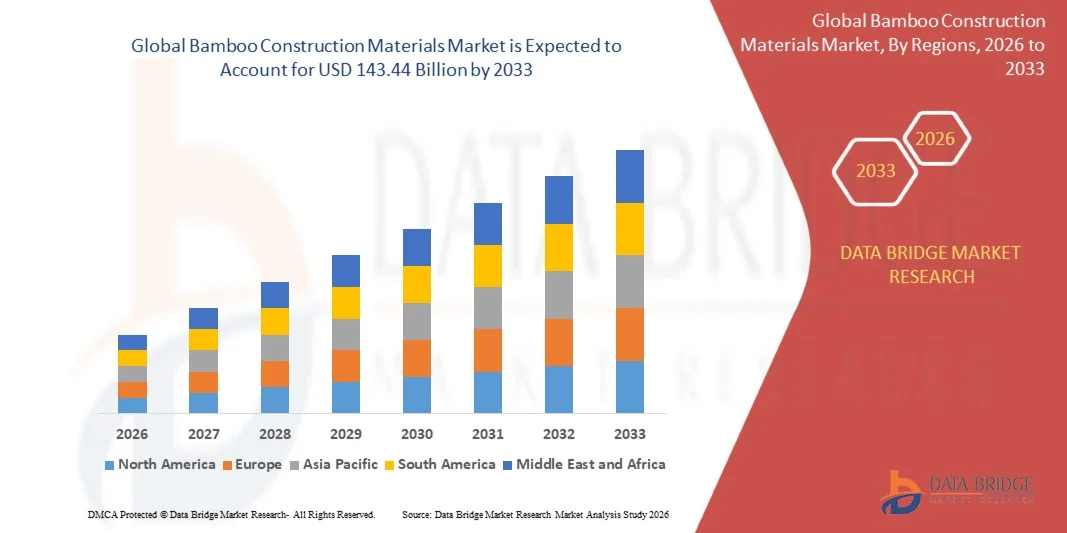
- As per Data Bridge Market Research analysis, the bamboo construction market was valued at USD 100.86 billion in 2025 and is projected to reach USD 143.44 billion by 2033, growing at a CAGR of 4.50% from 2026 to 2033.
- The market is experiencing consistent growth driven by the increasing global emphasis on sustainable construction practices, climate change concerns, and the depletion of non-renewable resources. Bamboo is an eco-friendly alternative to conventional building materials such as steel, concrete, and traditional timber due to its rapid renewability (harvestable in 3-5 years), high carbon sequestration capacity, and low environmental footprint.
- The increasing incidence of deforestation and the urgent need to reduce carbon emissions in the construction sector, combined with stricter government regulations on sustainable building practices, is compelling construction companies, architects, and developers to adopt advanced bamboo-based materials. Engineered bamboo products, such as Laminated Bamboo Lumber (LBL), bamboo glulam, and bamboo scrimber, are replacing traditional materials in many markets, offering renewable, lightweight, durable, and carbon-negative solutions for structural and finishing applications.
Market Size & Forecast
- Market Value (2025): USD 100.86 Billion
- Expected Market Value (2033): USD 143.44 Billion
- Forecast CAGR (2026–2033): 4.50%
- Leading Region in 2025: Asia-Pacific
- Fastest Growing Region: North America
What are the Major Takeaways of the Bamboo Construction Materials Market?
- Asia-Pacific dominated the bamboo construction materials market in 2025, holding an estimated 45.20% revenue share, supported by abundant bamboo resources, rapid urbanization, and expanding construction activities across countries such as China, India, and Southeast Asia.
- Europe bamboo construction materials market is expected to witness the fastest growth rate from 2026 to 2033, primarily driven by stringent carbon reduction policies and increasing emphasis on sustainable construction practices. Rising investments in energy-efficient buildings, circular economy initiatives, and eco-friendly infrastructure projects are encouraging the use of bamboo-based materials
- The bamboo lumber & panels segment dominated the market, accounting for the largest revenue share of 37.50% in 2025. This growth is primarily attributed to the increasing use of engineered bamboo products as sustainable substitutes for traditional timber and plywood. Technological advancements, including cross-lamination, resin infusion, and heat treatment, have enhanced bamboo’s structural strength, dimensional stability, and resistance to warping.
- The bamboo flooring segment is projected to register the fastest CAGR of 5.6% during the forecast period driven by increasing consumer preference for natural, renewable, and aesthetically appealing flooring solutions. Bamboo flooring offers the appearance of hardwood while providing greater sustainability and cost-effectiveness, making it highly attractive for residential and commercial interiors.
- The segment's growth is driven by the increasing demand for sustainable, energy-efficient, and environmentally friendly housing solutions. Builders and homeowners are increasingly adopting bamboo as a renewable and cost-effective alternative for applications such as flooring, roofing, wall panels, and structural framing. Its excellent tensile strength, durability, and natural thermal insulation properties make it well suited for residential buildings across both tropical and temperate regions.
- The interior applications segment is projected to register the fastest during the forecast period. This growth is driven by the increasing use of bamboo in contemporary architecture and interior design due to its versatility, sustainability, and aesthetic appeal. Its natural grain, diverse color options, and design flexibility make it an ideal material for wall cladding, ceiling panels, furniture, cabinetry, and decorative applications.
Report Scope and Bamboo Construction Materials Market Segmentation
|
Attributes |
Bamboo Construction Materials Key Market Insights |
|
Segments Covered |
|
|
Countries Covered |
North America
Europe
Asia-Pacific
Middle East and Africa
South America
|
|
Key Market Players |
|
|
Market Opportunities |
|
|
Value Added Data Infosets |
In addition to the insights on market scenarios such as market value, growth rate, segmentation, geographical coverage, and major players, the market reports curated by the Data Bridge Market Research also include import export analysis, production capacity overview, production consumption analysis, price trend analysis, climate change scenario, supply chain analysis, value chain analysis, raw material/consumables overview, vendor selection criteria, PESTLE Analysis, Porter Analysis, and regulatory framework. |
What is the Key Trend in the Bamboo Construction Materials Market?
- The construction industry is increasingly adopting engineered bamboo materials, including laminated bamboo lumber, bamboo panels, flooring, and structural components, as sustainable alternatives to conventional timber, steel, and concrete. Growing emphasis on reducing embodied carbon, improving resource efficiency, and achieving green building certifications is driving the use of bamboo in residential, commercial, and institutional construction.
- For instance, in August 2025, Veribambu introduced its outdoor anti-slip bamboo decking series for gardens, patios, balconies, and commercial outdoor spaces. Manufactured from high-strength natural bamboo with specialized weather-resistant and anti-slip treatment, the product reflects the industry's growing focus on durable, sustainable, and high-performance bamboo solutions for exterior construction applications.
- Continuous advancements in bamboo processing technologies, including strand-woven manufacturing, heat treatment, resin impregnation, and lamination, are enhancing the material's structural strength, durability, moisture resistance, and dimensional stability. These innovations are expanding bamboo's applications in load-bearing structures, flooring, wall panels, roofing, and prefabricated building systems.
- As governments strengthen green building regulations and developers increasingly prioritize renewable, low-carbon construction materials, the adoption of engineered bamboo is expected to accelerate globally, positioning bamboo as a key material for sustainable construction and climate-resilient infrastructure.
What are the Key Drivers of the Bamboo Construction Materials Market?
- Increasing global emphasis on reducing carbon emissions and promoting sustainable construction is driving the adoption of bamboo construction materials as renewable alternatives to conventional timber, steel, and concrete. Bamboo offers rapid renewability, high tensile strength, carbon sequestration benefits, and a lower environmental footprint, making it an attractive material for residential, commercial, and infrastructure projects.
- For instance, in November 2025 – INBAR and RILEM launched the "2025 International Online Seminar – Towards Mainstreaming Bamboo Construction: Research and Practice," focusing on life-cycle assessment, engineering standards, architectural innovation, and scaling the adoption of bamboo as a low-carbon construction material. The initiative highlights bamboo's growing role in sustainable buildings and climate-resilient construction.
- Advances in engineered bamboo technologies, including laminated bamboo lumber, strand-woven bamboo, and treated structural bamboo products, are improving strength, durability, moisture resistance, and dimensional stability. These innovations are expanding bamboo's applications in flooring, wall systems, roofing, structural framing, and prefabricated buildings while enabling compliance with modern construction standards.
- For instance, in February 2025, ISO published the world's first international standard for glued laminated bamboo. The International Organization for Standardization (ISO) released ISO 7567:2024 – Bamboo Structures – Glued Laminated Bamboo – Product Specifications, establishing global requirements for structural glued laminated bamboo. The standard, proposed by INBAR, is expected to accelerate the use of engineered bamboo in modern construction by improving quality, durability, and compliance with international building standards.
- As governments strengthen green building regulations, encourage the use of renewable construction materials, and support net-zero development initiatives, demand for bamboo construction materials is expected to grow steadily. Continued investments in engineered bamboo products and sustainable building technologies will further accelerate market expansion and reinforce bamboo's role in the transition toward environmentally responsible construction.
Which Factors are Challenging the Growth of the Bamboo Construction Materials Market?
- Bamboo construction materials require specialized processing technologies, including preservation treatment, lamination, resin impregnation, heat treatment, and precision manufacturing to meet structural performance and building code requirements. These advanced production processes increase manufacturing costs compared to conventional construction materials, limiting adoption in cost-sensitive markets.
- The relatively limited availability of standardized engineered bamboo products, certified manufacturing facilities, and harmonized building codes further constrains market growth. Many developers, architects, and contractors continue to favor traditional materials such as timber, steel, and concrete due to their well-established supply chains and regulatory acceptance.
- For instance, in August 2025, Veribambu introduced its outdoor anti-slip bamboo decking series featuring specialized weather-resistant and anti-slip treatment technologies for exterior applications. The product highlights the advanced processing and material treatment required to achieve the durability, safety, and long-term performance expected in modern construction, which contributes to higher production costs.
- The combination of high manufacturing costs, limited standardized building regulations, fragmented supply chains, and relatively low awareness among construction professionals continues to restrain the widespread adoption of bamboo construction materials. These challenges are particularly significant in emerging markets, where conventional building materials remain more readily available and economically competitive despite the growing demand for sustainable construction solutions.
How is the Bamboo Construction Materials Market Segmented?
The bamboo construction materials market is segmented on the basis of product and end use.
- By Product Type
On the basis of product type, the bamboo construction materials market is segmented into bamboo lumber & panels, bamboo flooring, bamboo plywood & boards, and others. The bamboo lumber & panels segment dominated the market, accounting for the largest revenue share of 37.50% in 2025. This growth is primarily attributed to the increasing use of engineered bamboo products as sustainable substitutes for traditional timber and plywood. Technological advancements, including cross-lamination, resin infusion, and heat treatment, have enhanced bamboo’s structural strength, dimensional stability, and resistance to warping.
The bamboo flooring segment is projected to register the fastest CAGR of 5.6% during the forecast period driven by increasing consumer preference for natural, renewable, and aesthetically appealing flooring solutions. Bamboo flooring offers the appearance of hardwood while providing greater sustainability and cost-effectiveness, making it highly attractive for residential and commercial interiors. Technological advancements in strand-woven bamboo flooring have significantly improved its hardness, durability, and moisture resistance, while the growing trend toward eco-conscious home renovation, particularly in North America and Europe, is further accelerating segment growth.
- By End Use
On the basis of end use, the bamboo construction materials market is segmented into residential construction, non-residential construction, and interior applications. The residential construction segment held the largest market share, accounting for 50.1% of total revenue in 2025. The segment's growth is driven by the increasing demand for sustainable, energy-efficient, and environmentally friendly housing solutions. Builders and homeowners are increasingly adopting bamboo as a renewable and cost-effective alternative for applications such as flooring, roofing, wall panels, and structural framing. Its excellent tensile strength, durability, and natural thermal insulation properties make it well suited for residential buildings across both tropical and temperate regions. In addition, government initiatives promoting green building practices, affordable housing, and carbon-neutral construction are further accelerating the adoption of bamboo in residential construction projects.
The interior applications segment is projected to register the fastest during the forecast period. This growth is driven by the increasing use of bamboo in contemporary architecture and interior design due to its versatility, sustainability, and aesthetic appeal. Its natural grain, diverse color options, and design flexibility make it an ideal material for wall cladding, ceiling panels, furniture, cabinetry, and decorative applications. Rising demand for eco-friendly interior solutions, along with the growing popularity of biophilic and minimalist design concepts, is further supporting market expansion. In addition, manufacturers are introducing advanced treated and laminated bamboo products with enhanced moisture resistance, durability, and pest protection, making them well suited for a wide range of interior applications.
Which Region Holds the Largest Share of the Bamboo Construction Materials Market?
- Asia-Pacific dominated the bamboo construction materials market in 2025, holding an estimated 45.20% revenue share, supported by abundant bamboo resources, rapid urbanization, and expanding construction activities across countries such as China, India, and Southeast Asia.
- The region also benefits from extensive bamboo resources in countries such as India, Indonesia, and Vietnam, which are integrating bamboo into housing and infrastructure projects due to its cost-effectiveness and local availability.
China Bamboo Construction Materials Market Insight
China is the dominated bamboo construction materials in the market, driven by its vast bamboo forest resources (nearly 8 million hectares) and sophisticated processing industry. The government actively promotes bamboo use through policies such as the "Bamboo as a Substitute for Plastic" initiative, which encourages its application in products ranging from bridge decking to public facades. The output of China's bamboo industry is substantial, reflecting its central role in global production and consumption.
Japan Bamboo Construction Materials Market Insight
Japan bamboo construction materials is expected to witness the fastest growth rate from 2026 to 2033, driven by increasing demand for sustainable building materials, renewable resources, and low-carbon construction solutions. The country’s long-standing bamboo cultivation practices and focus on environmentally responsible architecture are supporting the adoption of bamboo-based materials in residential, commercial, and interior construction applications. Growing interest in green buildings, circular economy practices, and alternatives to conventional construction materials is encouraging architects and developers to explore engineered bamboo solutions.
North America Bamboo Construction Materials Market Insight
North America is expected to witness the fastest growth rate from 2026 to 2033, supported by the growing adoption of sustainable and renewable building materials across residential and commercial construction. Increasing awareness of green building practices, coupled with stringent environmental regulations and rising demand for low-carbon construction solutions, is encouraging the use of engineered bamboo products. The region also benefits from expanding green infrastructure investments, favorable certification standards, and increasing consumer preference for eco-friendly construction materials.
U.S. Bamboo Construction Materials Market Insight
The U.S. is expected to witness the fastest growth rate from 2026 to 2033, fueled by rising investments in sustainable building projects and the increasing adoption of environmentally responsible construction materials. Builders and developers are incorporating bamboo flooring, panels, decking, and structural components into residential and commercial projects to meet green building standards. Moreover, growing demand for LEED-certified buildings and increasing consumer preference for renewable materials continue to support market expansion.
Europe Bamboo Construction Materials Market Insight
The Europe bamboo construction materials market is expected to witness the fastest growth rate from 2026 to 2033, primarily driven by stringent carbon reduction policies and increasing emphasis on sustainable construction practices. Rising investments in energy-efficient buildings, circular economy initiatives, and eco-friendly infrastructure projects are encouraging the use of bamboo-based materials. The growing popularity of engineered bamboo products across residential, commercial, and public construction is further strengthening market growth throughout the region.
U.K. Bamboo Construction Materials Market Insight
The U.K. bamboo construction materials market is expected to witness the fastest growth rate from 2026 to 2033, driven by increasing demand for low-carbon building materials and the country's commitment to achieving net-zero emissions. Rising adoption of sustainable housing developments, green commercial buildings, and environmentally certified construction projects is accelerating the use of bamboo products. In addition, growing awareness of renewable construction materials and modern building techniques is expected to continue supporting market growth.
Germany Bamboo Construction Materials Market Insight
The Germany bamboo construction materials market is expected to witness the fastest growth rate from 2026 to 2033, fueled by strong environmental regulations and increasing investments in sustainable infrastructure. Germany's focus on energy-efficient buildings, resource-efficient construction, and innovative bio-based materials is encouraging the adoption of bamboo construction products. The growing integration of engineered bamboo into residential and commercial applications is further contributing to market expansion.
Which are the Top Companies in Bamboo Construction Materials Market?
The bamboo construction materials industry is primarily led by well-established companies, including:
- MOSO International B.V. (Netherlands)
- Dasso Group (China)
- Smith & Fong Co., Inc. (Plyboo) (U.S.)
- Teragren LLC (U.S.)
- Cali Bamboo, Inc. (U.S.)
- Bamboo Australia Pty Ltd. (Australia)
- Xiamen Yusheng Bamboo Products Co., Ltd. (China)
- Guangxi Fenglin Wood Industry Group (China)
- Yibin Yifeng Bamboo Industry Co., Ltd. (China)
- US Bamboo, LLC (U.S.)
- Hangzhou Fuyang Muye Group Co., Ltd. (China)
- Epitome Bamboo Wood Products (Mutha Industries) (India)
- Jiangxi Feiyu Bamboo Industry Group Co., Ltd. (China)
- Bamboo Village Company Limited (Vietnam)
- EcoPlanet Bamboo Group (U.S.)
What are Latest Developments in Bamboo Construction Materials Market?
- In August 2025, Veribambu launched its outdoor anti-slip bamboo decking series, specifically designed for exterior applications such as gardens, patios, balconies, and commercial outdoor spaces. Manufactured using high-strength natural bamboo, the decking undergoes specialized treatment to enhance weather resistance, slip resistance, and long-term durability, providing improved safety and performance in demanding outdoor environments. This product launch reinforces Veribambu's commitment to expanding sustainable bamboo solutions for modern outdoor construction and landscaping applications.
- In August 2025, Veribambu introduced its outdoor anti-slip bamboo decking series featuring specialized weather-resistant and anti-slip treatment technologies for exterior applications. The product highlights the advanced processing and material treatment required to achieve the durability, safety, and long-term performance expected in modern construction, which contributes to higher production costs
- In November 2025 – INBAR and RILEM launched the "2025 International Online Seminar – Towards Mainstreaming Bamboo Construction: Research and Practice," focusing on life-cycle assessment, engineering standards, architectural innovation, and scaling the adoption of bamboo as a low-carbon construction material. The initiative highlights bamboo's growing role in sustainable buildings and climate-resilient construction.

- Interactive Data Analysis Dashboard
- Company Analysis Dashboard for high growth potential opportunities
- Research Analyst Access for customization & queries
- Competitor Analysis with Interactive dashboard
- Latest News, Updates & Trend analysis
- Harness the Power of Benchmark Analysis for Comprehensive Competitor Tracking
Global Bamboo Construction Materials Market, Supply Chain Analysis and Ecosystem Framework
To support market growth and help clients navigate the impact of geopolitical shifts, DBMR has integrated in-depth supply chain analysis into its Global Bamboo Construction Materials Market research reports. This addition empowers clients to respond effectively to global changes affecting their industries. The supply chain analysis section includes detailed insights such as Global Bamboo Construction Materials Market consumption and production by country, price trend analysis, the impact of tariffs and geopolitical developments, and import and export trends by country and HSN code. It also highlights major suppliers with data on production capacity and company profiles, as well as key importers and exporters. In addition to research, DBMR offers specialized supply chain consulting services backed by over a decade of experience, providing solutions like supplier discovery, supplier risk assessment, price trend analysis, impact evaluation of inflation and trade route changes, and comprehensive market trend analysis.
Data collection and base year analysis are done using data collection modules with large sample sizes. The stage includes obtaining market information or related data through various sources and strategies. It includes examining and planning all the data acquired from the past in advance. It likewise envelops the examination of information inconsistencies seen across different information sources. The market data is analysed and estimated using market statistical and coherent models. Also, market share analysis and key trend analysis are the major success factors in the market report. To know more, please request an analyst call or drop down your inquiry.
The key research methodology used by DBMR research team is data triangulation which involves data mining, analysis of the impact of data variables on the market and primary (industry expert) validation. Data models include Vendor Positioning Grid, Market Time Line Analysis, Market Overview and Guide, Company Positioning Grid, Patent Analysis, Pricing Analysis, Company Market Share Analysis, Standards of Measurement, Global versus Regional and Vendor Share Analysis. To know more about the research methodology, drop in an inquiry to speak to our industry experts.
Data Bridge Market Research is a leader in advanced formative research. We take pride in servicing our existing and new customers with data and analysis that match and suits their goal. The report can be customized to include price trend analysis of target brands understanding the market for additional countries (ask for the list of countries), clinical trial results data, literature review, refurbished market and product base analysis. Market analysis of target competitors can be analyzed from technology-based analysis to market portfolio strategies. We can add as many competitors that you require data about in the format and data style you are looking for. Our team of analysts can also provide you data in crude raw excel files pivot tables (Fact book) or can assist you in creating presentations from the data sets available in the report.













