What is the Bar Code Sticker Labeling Machine Market Size and Growth Rate?
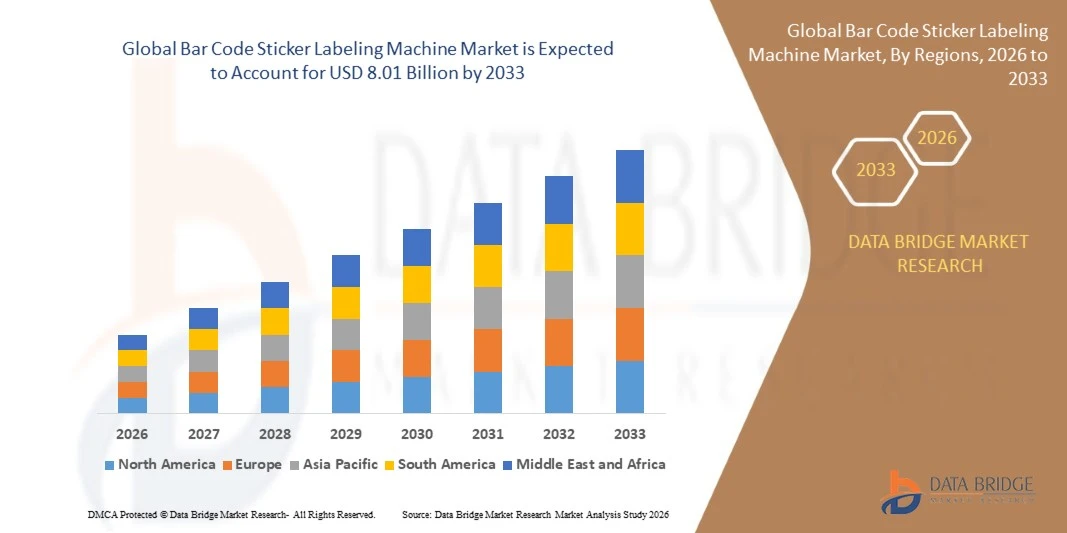
- As per Data Bridge Market Research analysis, the bar code sticker labeling machine market was valued at USD 5.44 billion in 2025 and is projected to reach USD 8.01 billion by 2033, growing at a CAGR of 4.96% from 2026 to 2033.
- The market is experiencing consistent growth driven by rising demand for automated packaging and labeling solutions, advancements in labeling technologies, and expanding applications across food and beverages, pharmaceuticals, retail, and logistics.
- The increasing need for accurate product identification and supply chain traceability, combined with stricter labeling and product safety requirements, is encouraging manufacturers and distributors to adopt advanced barcode sticker labeling machines. Automated and print-and-apply systems are gaining traction by improving labeling speed, reducing manual errors, and supporting efficient inventory management across diverse industries.
Market Size & Forecast
- Global Market Value (2025): USD 5.44 Billion
- Expected Market Value (2033): USD 8.01 Billion
- Forecast CAGR (2026–2033): 4.96%
- Leading Region in 2025: North America
- Fastest Growing Region: Asia Pacific
What are the Major Takeaways of the Bar Code Sticker Labeling Machine Market?
- North America dominated the bar code sticker labeling machine market with the largest revenue share of 38% in 2025, supported by advanced manufacturing infrastructure and widespread adoption of packaging automation.
- Asia-Pacific is expected to be the fastest-growing region at a CAGR of 7.8% from 2026 to 2033, fueled by expanding manufacturing activities and increasing investments in automated packaging across China, India, and Japan.
- The thermal transfer labels segment led the market with a 38.0% share in 2025, driven by its durability, print quality, and suitability for long-lasting barcode identification.
- Direct thermal labels are the fastest-growing product type, projected to register a CAGR of 6.5%, reflecting the surge in demand for cost-effective and convenient barcode printing solutions.
- The 1D barcode labels segment dominated the technology category with a 52.0% revenue share in 2025, led by widespread use in retail, inventory management, and product identification
- Shipping and logistics labelling accounted for 37.0% of the market share in 2025, preferred by increasing parcel volumes, e-commerce expansion, and growing requirements for shipment visibility.
- The compliance and traceability labelling segment is the fastest-growing application category, with a CAGR of 7.5%, driven by increasing regulatory requirements and the need to track products throughout their supply chains
Report Scope and Bar Code Sticker Labeling Machine Market Segmentation
|
Attributes |
Bar Code Sticker Labeling Machine Key Market Insights |
|
Segments Covered |
|
|
Countries Covered |
North America
Europe
Asia-Pacific
Middle East and Africa
South America
|
|
Key Market Players |
|
|
Market Opportunities |
|
|
Value Added Data Infosets |
|
What is the Key Trend in the Bar Code Sticker Labeling Machine Market?
- Manufacturers are increasingly adopting automated barcode sticker labeling machines to improve labeling accuracy, increase packaging throughput, and reduce manual intervention across production lines.
- For instance, in January 2022, GS1 US announced the availability of barcode capability test kits to help retailers prepare for the transition from traditional UPC barcodes to data-rich 2D barcodes on product packaging by 2027, increasing the need for compatible barcode printing, labeling, and scanning systems.
- Integration of barcode printing, label application, and verification systems enables manufacturers to maintain consistent product identification and reduce labeling errors.
- Retailers and consumer goods manufacturers are increasingly exploring two-dimensional barcodes to accommodate richer product information and improve supply chain visibility.
- For instance, in April 2025, GS1 published solution-provider readiness criteria for implementing 2D barcodes at retail point of sale, emphasizing reliable barcode printing, placement, scanning, and verification to support the industry's transition toward next-generation barcode labeling.
- As manufacturers prioritize connected packaging operations, high-speed labeling, and reliable traceability, demand for flexible and digitally integrated barcode sticker labeling machines is expected to increase.
What are the Key Drivers of the Bar Code Sticker Labeling Machine Market?
- The expansion of e-commerce, organized retail, and high-volume manufacturing is increasing demand for barcode labeling machines that support faster product identification, accurate inventory control, and efficient distribution.
- For instance, in April 2021, GS1 US published an implementation guideline to help pharmaceutical companies meet Drug Supply Chain Security Act (DSCSA) requirements through product serialization, standardized product identifiers, and 2D barcode labeling, supporting demand for accurate barcode printing and labeling systems.
- Pharmaceutical serialization requirements are encouraging manufacturers to adopt precise barcode printing and labeling systems capable of encoding product identifiers, batch numbers, and serial numbers.
- For instance, in June 2021, the U.S. Food and Drug Administration (FDA) issued guidance clarifying product identifier requirements for certain prescription drug packages and cases, reinforcing the need for machine-readable barcodes to support pharmaceutical product identification and traceability
- With manufacturers facing growing requirements for product traceability, packaging efficiency, and regulatory compliance, barcode sticker labeling machines are becoming increasingly important across industrial and consumer goods supply chains.
What Factors are Challenging the Growth of the Bar Code Sticker Labeling Machine Market?
- Advanced automatic barcode sticker labeling machines require substantial upfront investment, particularly when integrated with conveyors, printing systems, sensors, and barcode inspection technologies.
- For instance, in March 2022, Harpak-ULMA highlighted that unplanned packaging-line downtime can result in lost productivity, delayed order fulfillment, and wasted labor, illustrating the operational costs associated with equipment interruptions.
- These costs can limit adoption among small and medium-sized manufacturers operating with limited capital budgets and lower production volumes.
- Frequent product changes, different container dimensions, and label specifications can also increase setup time, maintenance requirements, and operational complexity for manufacturers handling multiple product lines.
- For instance, in August 2023, Loftware reported that 69% of surveyed businesses used multiple vendors for marking and coding operations, while 41% identified label errors caused by manual processes as a major challenge, highlighting integration complexity and the risk of costly labeling errors.
- The initial investment, ongoing maintenance, and need for skilled operators can constrain adoption among smaller manufacturers, particularly where production volumes do not justify fully automated equipment. These barriers encourage businesses to compare semi-automatic and automatic systems before investing in advanced labeling solutions.
How is the Bar Code Sticker Labeling Machine Market Segmented?
The bar code sticker labeling machine market is segmented on the basis of product type, technology, application, and end-use industry
- By Product Type
On the basis of product type, the bar code sticker labeling machine market is segmented into thermal transfer labels, direct thermal labels, laser sheet labels, and inkjet labels. The thermal transfer labels segment is estimated to dominate the market with 38.0% share in 2025, owing to its durability, print quality, and suitability for long-lasting barcode identification. These labels use heat to transfer ink from a ribbon onto the label surface, producing sharp and durable barcodes. They are widely used in pharmaceutical packaging, industrial manufacturing, logistics, and warehouse operations. Their resistance to smudging, moisture, and environmental exposure supports reliable scanning throughout the product lifecycle. Increasing demand for durable product identification and shipping labels further strengthens adoption.
The direct thermal labels segment is expected to witness the fastest growth at CAGR of 6.5% from 2026 to 2033, driven by increasing demand for cost-effective and convenient barcode printing solutions. These labels use heat-sensitive materials and do not require ink ribbons, reducing consumable costs and simplifying machine maintenance. They are widely used for shipping labels, retail price tags, warehouse labels, and short-term product identification. The expansion of e-commerce and parcel delivery operations is increasing demand for rapid label production. Their simple printing mechanism supports high-speed labeling in distribution centers and retail environments. However, sensitivity to heat, light, and abrasion can limit their suitability for long-term applications.
- By Technology
On the basis of technology, the bar code sticker labeling machine market is segmented into 1D barcode labels, 2D barcode labels, HD barcode labels, and holographic transparent barcode labels. The 1D barcode labels segment is estimated to dominate the market with 52.0% share in 2025, supported by widespread use in retail, inventory management, and product identification. These barcodes encode information using parallel lines and spaces that can be read by conventional barcode scanners. They remain widely used for product codes, pricing, shipping, and stock management. Their relatively simple production and scanning requirements make them cost-effective for high-volume labeling operations. Established retail systems and warehouse infrastructure continue to support their use.
The 2D barcode labels segment is expected to witness the fastest growth at CAGR of 8.0% from 2026 to 2033, driven by increasing demand for data-rich product identification and traceability. Two-dimensional barcodes, including QR Codes and Data Matrix codes, can store substantially more information than conventional linear barcodes. They support applications such as pharmaceutical serialization, component tracking, product authentication, and digital product information. Growing adoption of connected packaging and standardized product identification is further increasing demand. Advances in imaging-based barcode scanners are improving the readability of complex barcode formats. The transition toward 2D barcodes in retail and manufacturing is encouraging businesses to upgrade printing and labeling equipment.
- By Application
On the basis of application, the bar code sticker labeling machine market is segmented into product identification and tracking, packaging and carton labeling, shipping and logistics labeling, inventory and warehouse management, batch number and expiry date labeling, and compliance and traceability labeling. The shipping and logistics labeling segment is estimated to dominate the market with 37.0% share in 2025, supported by increasing parcel volumes, e-commerce expansion, and growing requirements for shipment visibility. Barcode labels enable logistics providers to identify packages, track shipments, and automate sorting operations. They are extensively used at distribution centers, courier facilities, fulfillment warehouses, and transportation hubs. Automated labeling machines help improve throughput and reduce errors in high-volume shipping environments. The growth of cross-border commerce is increasing the need for standardized shipment identification.
The compliance and traceability labeling segment is expected to witness the fastest growth at CAGR of 7.5% from 2026 to 2033, driven by increasing regulatory requirements and the need to track products throughout their supply chains. Barcode labels enable manufacturers to link products with batch details, serial numbers, manufacturing records, and distribution information. Pharmaceutical companies use barcode-based identification to support serialization and product verification requirements. Food producers also rely on traceability systems to improve product recalls, quality control, and supply chain transparency. Increasing focus on counterfeit prevention is further encouraging adoption across regulated industries. Integration with enterprise resource planning and manufacturing execution systems strengthens traceability capabilities.
- By End-Use Industry
On the basis of end-use industry, the bar code sticker labeling machine market is segmented into food and beverages, pharmaceuticals, households, electronics and electricals, consumer goods, textiles, and others. The food and beverages segment is estimated to dominate the market with 25.0% share in 2025, driven by high-volume packaging operations and the need for accurate product identification. Manufacturers use barcode labels to manage product codes, batch information, manufacturing dates, expiry dates, and distribution records. Automated labeling machines help maintain consistent label placement and improve production-line efficiency. The expansion of packaged food, ready-to-eat products, and beverage manufacturing is increasing labeling requirements. Retail distribution also depends on scannable product codes for inventory management and checkout operations.
The pharmaceuticals segment is expected to witness the fastest growth at CAGR of 8.2% from 2026 to 2033, supported by increasing requirements for product serialization, authentication, and traceability. Pharmaceutical manufacturers require accurate barcode printing and placement to support product identification and distribution controls. Data Matrix codes and other machine-readable identifiers are used on medicine packaging to connect products with relevant batch and serial information. Regulatory requirements in major markets are encouraging investments in compliant labeling and verification equipment. Increasing pharmaceutical production and the expansion of biologics and specialty medicines are further supporting demand. Automated systems can improve labeling consistency while reducing manual errors during packaging.
Which Region Holds the Largest Share of the Bar Code Sticker Labeling Machine Market?
- North America dominated the bar code sticker labeling machine market with the largest revenue share of 38% in 2025, supported by advanced manufacturing infrastructure and widespread adoption of packaging automation.
- The region also benefits from established e-commerce networks, increasing emphasis on product traceability, and growing adoption of automated barcode printing and labeling systems. Rising investments in smart manufacturing, inventory management, and regulatory-compliant product identification continue to strengthen North America's position in the global market.
U.S. Bar Code Sticker Labeling Machine Market Insight
The U.S. bar code sticker labeling machine market is witnessing steady growth due to rising investments in packaging automation, e-commerce fulfillment, and advanced manufacturing technologies. The country’s mature retail and pharmaceutical sectors, along with increasing adoption of automated barcode printing, inspection, and labeling systems, are driving demand across industrial and commercial applications. In addition, growing emphasis on inventory accuracy, product traceability, and regulatory compliance is accelerating the adoption of advanced labeling solutions across manufacturing facilities, distribution centers, and warehouses.
Asia-Pacific Bar Code Sticker Labeling Machine Market Insight
The Asia-Pacific bar code sticker labeling machine market is expected to witness rapid growth, driven by expanding manufacturing activities, rising packaged goods production, and increasing investments in automated packaging infrastructure across China, India, and Japan. Growing e-commerce operations, increasing demand for efficient warehouse management, and rising adoption of automated labeling technologies are supporting regional market expansion. In addition, the growth of pharmaceutical manufacturing, food processing, and organized retail is accelerating the adoption of barcode labeling systems across industrial and commercial sectors.
Japan Bar Code Sticker Labeling Machine Market Insight
The Japan bar code sticker labeling machine market is witnessing consistent growth due to rising investments in advanced manufacturing, packaging automation, and product traceability technologies. Electronics manufacturers, pharmaceutical companies, and food processing businesses are increasingly adopting automated labeling systems to improve production efficiency, barcode accuracy, and inventory management. Moreover, the integration of machine vision, robotics, and intelligent production controls, along with the country's focus on manufacturing precision and operational efficiency, is further contributing to market growth.
China Bar Code Sticker Labeling Machine Market Insight
The China bar code sticker labeling machine market is growing rapidly, driven by expanding manufacturing capacity, increasing e-commerce activity, and rising demand for automated packaging solutions. Growing adoption of barcode labeling systems across food and beverages, pharmaceuticals, electronics, and consumer goods industries is significantly boosting market demand. In addition, increasing investments in smart factories, warehouse automation, and digital supply chain management are strengthening the adoption of high-speed labeling equipment and positioning China as a major market for barcode labeling technologies.
U.K. Bar Code Sticker Labeling Machine Market Insight
The U.K. bar code sticker labeling machine market is experiencing steady growth, supported by rising adoption of packaging automation, expanding e-commerce fulfillment operations, and increasing demand for accurate product identification. Manufacturers, retailers, and logistics providers are increasingly implementing barcode labeling systems to improve inventory visibility, shipment tracking, and operational efficiency. Furthermore, growing emphasis on pharmaceutical traceability, food product labeling, and integrated warehouse management technologies is encouraging businesses to adopt flexible and automated labeling solutions across the country.
Germany Bar Code Sticker Labeling Machine Market Insight
The Germany bar code sticker labeling machine market is expanding steadily due to the country's strong manufacturing base, advanced packaging industry, and increasing adoption of Industry 4.0 technologies. Automotive suppliers, pharmaceutical manufacturers, food processors, and industrial goods producers are increasingly utilizing barcode labeling systems for product identification, quality control, and supply chain traceability. Continuous advancements in automated packaging lines, machine vision, and connected production systems, along with strong demand for manufacturing efficiency and precision, are further driving market growth in Germany.
Which are the Top Companies in Bar Code Sticker Labeling Machine Market?
The bar code sticker labeling machine industry is primarily led by well-established companies, including:
- Domino Printing Sciences plc (U.K.)
- Videojet Technologies Inc. (U.S.)
- HERMA GmbH (Germany)
- Weber Packaging Solutions, Inc. (U.S.)
- Toshiba Tec Corporation (Japan)
- SATO CORPORATION (Japan)
- Zebra Technologies Corp. (U.S.)
- Seiko Epson Corporation (Japan)
- Brother Industries, Ltd. (Japan)
- TSC Auto ID Technology Co., Ltd. (Taiwan)
- cab Produkttechnik GmbH & Co KG (Germany)
- Label-Aire, Inc. (U.S.)
- ALTECH Srl (Italy)
- Maharshi Udyog (India)
- Interpack Technologies (India)
- Quadrel Labeling Systems (U.S.)
- Nita Labeling Systems (Canada)
- Krones AG (Germany)
- Newman Labelling Systems Ltd. (U.K.)
- PDC International Corp. (U.S.)
What are Latest Developments in Bar Code Sticker Labeling Machine Market?
- In December 2025, Toshiba America Business Solutions announced the expansion of its industrial barcode labeling printer portfolio with the launch of the BX420 Series and BX430 models. The new printers support direct PDF printing, variable-data barcode production, and cloud-connected workflows, helping businesses improve labeling efficiency across transportation, warehousing, manufacturing, and retail operations. The launch strengthens Toshiba’s portfolio of intelligent industrial labeling solutions.
- In November 2024, Toshiba Tec Europe introduced its A-BRID intelligent platform for next-generation barcode and label printers. The platform was developed to improve connectivity, integrate different printing environments, and simplify label production workflows. The development supports businesses seeking greater flexibility in barcode printing and more efficient integration with connected manufacturing and logistics systems
- In January 2024, Domino Printing Sciences announced the launch of its Mx-Series print-and-apply labeling machines, designed to automate traceability coding for products and pallets. The systems feature high-speed variable-data printing, machine-vision inspection, and connectivity with manufacturing execution and enterprise resource planning systems. These capabilities help manufacturers improve barcode accuracy, automate packaging operations, and enhance supply chain visibility.
- In January 2022, Epson announced the launch of its ColorWorks C4000 compact on-demand color label printer. The printer introduced enhanced connectivity, improved image quality, remote management tools, and increased ink capacity for businesses requiring flexible label production. Its applications include food and beverages, retail, healthcare, and pharmaceuticals, where clear product information and reliable label printing are essential.
- In January 2021, SATO Corporation launched the PV4 mobile barcode label printer in North America and Europe to support high-volume e-commerce and warehouse operations. The printer offers flexible connectivity, substantial media capacity, and portable label printing capabilities, helping workers print labels closer to inventory and reduce unnecessary movement during warehouse activities. The launch highlighted the growing role of mobile barcode printing in improving order fulfillment and shipment accuracy.
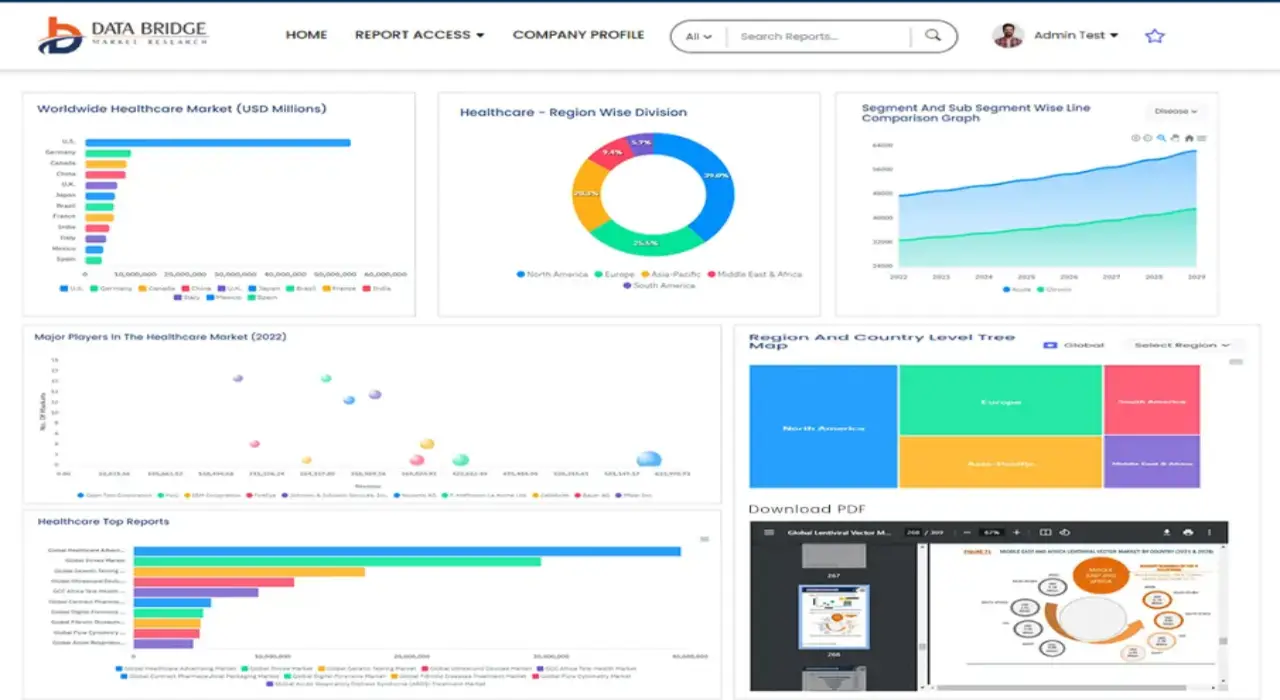
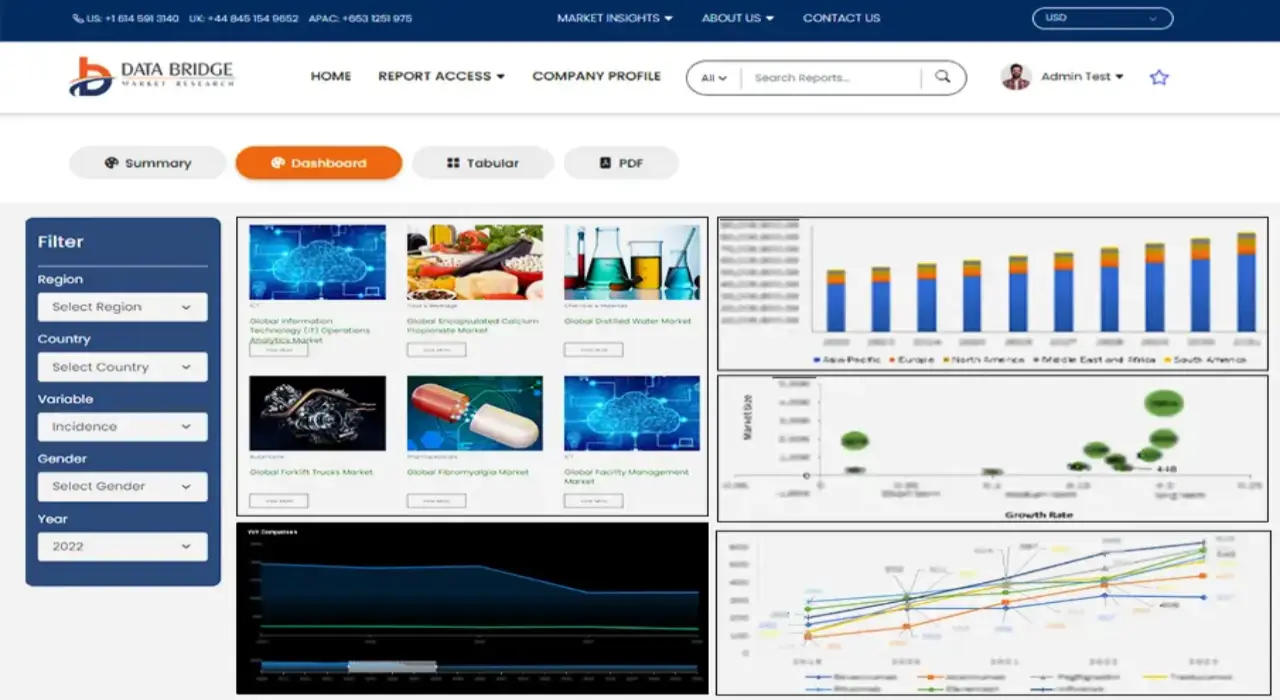
- Interactive Data Analysis Dashboard
- Company Analysis Dashboard for high growth potential opportunities
- Research Analyst Access for customization & queries
- Competitor Analysis with Interactive dashboard
- Latest News, Updates & Trend analysis
- Harness the Power of Benchmark Analysis for Comprehensive Competitor Tracking
Global Bar Code Sticker Labeling Machine Market, Supply Chain Analysis and Ecosystem Framework
To support market growth and help clients navigate the impact of geopolitical shifts, DBMR has integrated in-depth supply chain analysis into its Global Bar Code Sticker Labeling Machine Market research reports. This addition empowers clients to respond effectively to global changes affecting their industries. The supply chain analysis section includes detailed insights such as Global Bar Code Sticker Labeling Machine Market consumption and production by country, price trend analysis, the impact of tariffs and geopolitical developments, and import and export trends by country and HSN code. It also highlights major suppliers with data on production capacity and company profiles, as well as key importers and exporters. In addition to research, DBMR offers specialized supply chain consulting services backed by over a decade of experience, providing solutions like supplier discovery, supplier risk assessment, price trend analysis, impact evaluation of inflation and trade route changes, and comprehensive market trend analysis.
Data collection and base year analysis are done using data collection modules with large sample sizes. The stage includes obtaining market information or related data through various sources and strategies. It includes examining and planning all the data acquired from the past in advance. It likewise envelops the examination of information inconsistencies seen across different information sources. The market data is analysed and estimated using market statistical and coherent models. Also, market share analysis and key trend analysis are the major success factors in the market report. To know more, please request an analyst call or drop down your inquiry.
The key research methodology used by DBMR research team is data triangulation which involves data mining, analysis of the impact of data variables on the market and primary (industry expert) validation. Data models include Vendor Positioning Grid, Market Time Line Analysis, Market Overview and Guide, Company Positioning Grid, Patent Analysis, Pricing Analysis, Company Market Share Analysis, Standards of Measurement, Global versus Regional and Vendor Share Analysis. To know more about the research methodology, drop in an inquiry to speak to our industry experts.
Data Bridge Market Research is a leader in advanced formative research. We take pride in servicing our existing and new customers with data and analysis that match and suits their goal. The report can be customized to include price trend analysis of target brands understanding the market for additional countries (ask for the list of countries), clinical trial results data, literature review, refurbished market and product base analysis. Market analysis of target competitors can be analyzed from technology-based analysis to market portfolio strategies. We can add as many competitors that you require data about in the format and data style you are looking for. Our team of analysts can also provide you data in crude raw excel files pivot tables (Fact book) or can assist you in creating presentations from the data sets available in the report.