


Barcode Printers Market Overview
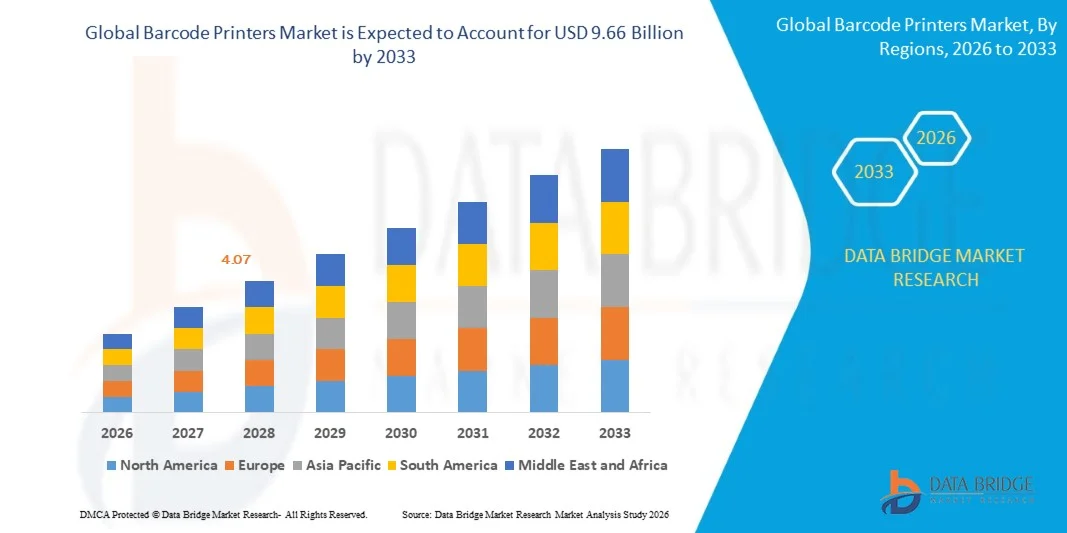
The Barcode Printers Market was valued at USD 4.78 Billion in 2025 and is projected to reach USD 9.66 Billion by 2033, growing at a CAGR of 9.20% from 2026 to 2033. The market is experiencing consistent growth driven by rising demand for automated labeling solutions, increasing adoption of barcode-based tracking systems across supply chain operations, and rapid growth of e-commerce and retail logistics. Expanding deployment of industrial automation, smart warehousing systems, and real-time inventory management solutions is further supporting market growth across global industries.
The increasing focus on operational efficiency, supply chain transparency, and error-free inventory management is accelerating adoption of barcode printing technologies across manufacturing, healthcare, transportation, and retail sectors. Growing integration of mobile, cloud-connected, and high-speed industrial printers is enabling real-time label generation and improved workflow automation. In addition, advancements in printing technologies such as thermal transfer and ink-jet systems are enhancing print quality, durability, and application flexibility, further strengthening market demand.
Key Market Trends & Insights
- Europe dominated the Barcode Printers Market with the largest revenue share of 31.5% in 2025, supported by strong industrial automation adoption, advanced manufacturing infrastructure, and widespread deployment of barcode-based tracking systems across logistics and retail sectors
- The industrial printers segment led the market with a 46.2% share in 2025, driven by high demand from large-scale manufacturing, logistics hubs, and warehouse operations requiring continuous, high-volume barcode printing
- Asia-Pacific is expected to be the fastest-growing region at a CAGR of 5.22% from 2026 to 2033, fueled by rapid industrialization, expanding e-commerce sector, and increasing adoption of automation technologies across manufacturing and logistics industries
- Ink-Jet is the fastest-growing technology type, projected to register a CAGR of 14.2% from 2026 to 2033, supported by increasing demand for high-quality color barcode printing and flexible labeling solutions
- The thermal transfer segment dominated the technology category with a 41.5% revenue share in 2025, led by its ability to produce durable, high-resolution labels suitable for long-term tracking in industrial and logistics environments
- Retail & E-commerce accounted for 34.7% of the market in 2025, preferred by rapid expansion of online shopping platforms and increasing need for efficient inventory labeling and order fulfillment systems
- The mobile printers segment is the fastest-growing product category, with a CAGR of 13.8% from 2026 to 2033, driven by rising demand for on-the-go printing solutions across field services, retail floor operations, and logistics delivery networks
Market Size & Forecast
- Global Market Value (2025): USD 4.78 Billion
- Expected Market Value (2033): USD 9.66 Billion
- Forecast CAGR (2026–2033): 9.20%
- Leading Region in 2025: Europe
- Fastest Growing Region: Asia-Pacific
Report Scope and Barcode Printers Market Segmentation
|
Attributes |
Barcode Printers Key Market Insights |
|
Segments Covered |
|
|
Countries Covered |
North America · U.S. · Canada · Mexico Europe · Germany · France · U.K. · Netherlands · Switzerland · Belgium · Russia · Italy · Spain · Turkey · Rest of Europe Asia-Pacific · China · Japan · India · South Korea · Singapore · Malaysia · Australia · Thailand · Indonesia · Philippines · Rest of Asia-Pacific Middle East and Africa · Saudi Arabia · U.A.E. · South Africa · Egypt · Israel · Rest of Middle East and Africa South America · Brazil · Argentina · Rest of South America |
|
Key Market Players |
· TSC Auto ID Technology Co. Ltd. (Taiwan) · Honeywell International Inc. (U.S.) · Godex International Co. Ltd. (Taiwan) · Seiko Epson Corporation (Japan) · Zebra Technologies Corporation (U.S.) · Domino Printing Sciences plc (U.K.) · Cab Produkttechnik GmbH and Co KG (Germany) · Bixolon Co. Ltd. (South Korea) · Avery Dennison Corporation (U.S.) · Citizen Systems Japan Co. Ltd. (Japan) · Brother Industries Ltd. (Japan) · Datamax (U.S.) · Sato Holdings Corporation (Japan) · Postek Electronics Co. Ltd. (China) · Printronix Auto ID Inc. (U.S.) · Wasp Barcode Technologies (U.S.) · Toshiba Tec Corporation (Japan) · IDPRT (Xiamen Hanin Co. Ltd.) (China) · Gainscha Technology Group Ltd. (China) · Primera Technology Inc. (U.S.) |
|
Market Opportunities |
· Expansion of E-Commerce Fulfillment Infrastructure and Warehouse Automation Systems · Growing Adoption of Industry 4.0 and Smart Manufacturing Technologies · Rising Demand for High-Speed, Durable Labeling Solutions in Healthcare and Pharmaceutical Sectors |
|
Value Added Data Infosets |
In addition to the insights on market scenarios such as market value, growth rate, segmentation, geographical coverage, and major players, the market reports curated by the Data Bridge Market Research also include in-depth expert analysis, geographically represented company-wise production and capacity, network layouts of distributors and partners, detailed and updated price trend analysis and deficit analysis of supply chain and demand. |
Barcode Printers Market Trends
Trend: Growth of Mobile and Cloud Barcode Printing Adoption
The Barcode Printers market is witnessing strong adoption of mobile and cloud-connected printing solutions, driven by the need for real-time labeling, remote accessibility, and improved operational flexibility across logistics, retail, and field services. Enterprises are increasingly shifting from standalone printers to network-enabled systems that support centralized management and faster label generation. This trend is further supported by rising e-commerce fulfillment volumes and demand for agile supply chain operations.
Companies such as Zebra Technologies Corporation have strengthened this shift through advanced mobile printing solutions such as the ZQ series printers, widely used in retail and warehouse environments for on-the-go labeling and inventory tracking.
Barcode Printers Market Dynamics
Key Market Driver: Rising Demand for Supply Chain Automation and Tracking
The increasing need for efficient inventory management, real-time tracking, and end-to-end supply chain visibility is a major driver of the Barcode Printers market. Industries such as manufacturing, healthcare, and logistics are rapidly deploying barcode-based systems to reduce errors, improve traceability, and enhance workflow efficiency. Growing globalization of trade and expansion of automated warehouses are further accelerating adoption.
Companies such as Honeywell International Inc. are actively contributing through integrated scanning and printing solutions used in large-scale distribution centers and healthcare supply chains to improve accuracy and operational efficiency.
Key Restraint/Challenge: High Cost of Advanced Industrial Printers
The high initial investment and maintenance costs associated with advanced industrial barcode printers remain a key challenge for market expansion, particularly for small and medium-sized enterprises. Industrial-grade printers require durable components, specialized consumables, and continuous technical support, increasing total cost of ownership. In addition, integration with automated production and warehouse systems further adds to deployment expenses.
Organizations such as Avery Dennison Corporation highlight this challenge through the adoption gap observed in cost-sensitive retail and logistics operators, where businesses often delay upgrades to advanced printing systems due to budget constraints.
Key Market Opportunity: Growing Adoption of Industry 4.0 and Smart Manufacturing Technologies
The rising implementation of Industry 4.0 technologies and smart manufacturing systems is creating significant opportunities for advanced barcode printing solutions. Connected factories, automated production lines, and digital supply chains are driving demand for high-speed, intelligent, and integrated printing systems capable of seamless data exchange. This shift is enhancing productivity and enabling real-time product traceability across industrial ecosystems.
Companies such as Seiko Epson Corporation are actively expanding their industrial printer portfolios to support smart factory environments, enabling seamless integration of barcode printing into automated production and logistics systems.
Barcode Printers Market Scope
The barcode printers market is segmented on the basis of product, technology, and end-use.
- By Product
On the basis of product, the Barcode Printers Market is segmented into desktop printers, mobile printers, and industrial printers. The Industrial Printers segment dominated the market with the largest share of 46.2% in 2025, driven by high demand from large-scale manufacturing, logistics hubs, and warehouse operations requiring continuous, high-volume barcode printing. These printers offer superior durability, high-speed output, and resistance to harsh industrial environments, making them suitable for mission-critical applications. Strong adoption in automated production lines and supply chain tracking systems further strengthens their leadership position. Expanding deployment in Industry 4.0-enabled facilities continues to support segment dominance.
The Mobile Printers segment is projected to register the fastest growth at a CAGR of 13.8% from 2026 to 2033, driven by rising demand for on-the-go printing solutions across field services, retail floor operations, and logistics delivery networks. Increasing use of handheld devices integrated with wireless connectivity is enabling real-time label generation at the point of service. Growing e-commerce fulfillment activities and last-mile delivery expansion are accelerating adoption. Improvements in battery efficiency and compact printer design are enhancing operational flexibility across multiple industries.
- By Technology
On the basis of technology, the Barcode Printers Market is segmented into thermal transfer, direct transfer, laser, impact, and ink-jet. The Thermal Transfer segment dominated the market with a share of 41.5% in 2025, supported by its ability to produce durable, high-resolution labels suitable for long-term tracking in industrial and logistics environments. This technology is widely used in applications requiring resistance to heat, chemicals, and abrasion, ensuring reliable barcode readability. Strong adoption across manufacturing and healthcare supply chains reinforces its leading position. Cost efficiency and compatibility with a wide range of label materials further drive segment growth.
The Ink-Jet segment is projected to register the fastest growth at a CAGR of 14.2% from 2026 to 2033, driven by increasing demand for high-quality color barcode printing and flexible labeling solutions. Advancements in ink formulations and printhead precision are improving print speed and accuracy across diverse substrates. Rising adoption in retail branding, pharmaceuticals, and customized packaging is accelerating usage. Integration with digital printing workflows and on-demand production systems is further enhancing scalability across end-use industries.
- By End-use
On the basis of end-use, the Barcode Printers Market is segmented into healthcare, manufacturing, retail & e-commerce, transportation & logistics, government, and others. The Retail & E-commerce segment dominated the market with the largest share of 34.7% in 2025, driven by rapid expansion of online shopping platforms and increasing need for efficient inventory labeling and order fulfillment systems. Barcode printers play a critical role in warehouse automation, product tracking, and shipping label generation across distribution centers. High transaction volumes and demand for fast order processing further reinforce segment leadership. Continuous growth of omnichannel retail infrastructure strengthens adoption across global markets.
The Transportation & Logistics segment is projected to register the fastest growth at a CAGR of 15.1% from 2026 to 2033, driven by rising global trade volumes and expansion of integrated supply chain networks. Increasing adoption of real-time tracking systems and automated sorting facilities is boosting demand for high-speed barcode printing solutions. Growth in courier, express, and parcel services is further accelerating deployment across hubs and last-mile delivery points. Advancements in warehouse automation and smart logistics technologies are enhancing operational efficiency and supporting rapid segment expansion.
Barcode Printers Market Regional Analysis
Europe dominated the barcode printers market and accounted for the largest revenue share of 31.5% in 2025, supported by strong industrial automation adoption, advanced manufacturing infrastructure, and widespread deployment of barcode-based tracking systems across logistics and retail sectors. The region benefits from high penetration of Industry 4.0 technologies, where barcode printers play a critical role in real-time inventory management and supply chain optimization. Increasing demand from automotive, pharmaceuticals, and retail industries further strengthens regional dominance. Continuous investment in smart warehousing and digital labeling solutions continues to support Europe’s leadership position in the global market.
U.K. Barcode Printers Market Insight
The U.K. Barcode Printers market is witnessing steady growth, driven by rapid expansion of e-commerce logistics and increasing automation in retail distribution networks. Businesses are increasingly adopting barcode printing solutions to improve inventory accuracy, order fulfillment speed, and warehouse efficiency. Strong presence of advanced logistics providers and growing investments in smart supply chain infrastructure are supporting market expansion. Furthermore, rising adoption of mobile and cloud-connected printing systems is enhancing operational flexibility across retail and transportation sectors.
Germany Barcode Printers Market Insight
The Germany Barcode Printers market is expanding steadily due to strong manufacturing base, high adoption of industrial automation, and increasing use of barcode systems in production tracking and quality control. German industries are heavily focused on precision-driven operations, where barcode printers enable efficient traceability across automotive and engineering supply chains. Growing integration of smart factory systems and digital production lines is further supporting demand. In addition, rising investments in logistics optimization and warehouse automation are accelerating market growth across the country.
North America Barcode Printers Market Insight
The North America Barcode Printers market is growing steadily, driven by increasing adoption of advanced supply chain management systems and rapid expansion of e-commerce and retail distribution networks. Organizations across the region are investing in automated labeling and tracking solutions to enhance operational efficiency and reduce errors in inventory management. Technological advancements in wireless and mobile printing solutions are further supporting adoption across logistics and field operations. In addition, strong presence of large-scale retail and manufacturing companies is accelerating demand for high-performance barcode printing systems.
U.S. Barcode Printers Market Insight
The U.S. Barcode Printers market is experiencing strong growth due to rapid expansion of e-commerce fulfillment centers, advanced warehouse automation, and increasing adoption of real-time tracking technologies. Companies are heavily investing in barcode-enabled systems to improve supply chain visibility and operational speed across retail, healthcare, and logistics sectors. Growing deployment of mobile and industrial barcode printers in distribution hubs is further supporting market expansion. In addition, continuous technological innovation in printing speed, durability, and connectivity is strengthening adoption across large enterprises.
Asia-Pacific Barcode Printers Market Insight
The Asia-Pacific Barcode Printers market is projected to register the fastest growth rate of 5.22% from 2026 to 2033, driven by rapid industrialization, expanding e-commerce sector, and increasing adoption of automation technologies across manufacturing and logistics industries. Countries such as China, India, Japan, and South Korea are witnessing strong demand for barcode-based tracking systems to improve supply chain efficiency and inventory management. Rising investments in smart warehouses and digital retail infrastructure are further supporting regional growth. In addition, increasing foreign investments in manufacturing and logistics expansion are accelerating adoption of barcode printing solutions across the region.
Japan Barcode Printers Market Insight
The Japan Barcode Printers market is witnessing steady growth due to strong emphasis on precision manufacturing, advanced logistics systems, and widespread adoption of automation technologies. Japanese industries are increasingly integrating barcode printers into production lines to enhance traceability and quality control. Growing investments in smart factories and robotics-enabled warehousing are further supporting demand. In addition, rising focus on digital transformation across retail and healthcare sectors is strengthening adoption of high-performance barcode printing solutions.
China Barcode Printers Market Insight
The China Barcode Printers market is expanding rapidly, driven by large-scale manufacturing activities, booming e-commerce industry, and strong government support for industrial digitalization. Chinese companies are increasingly adopting barcode printing systems to enhance supply chain efficiency and improve product traceability across domestic and export markets. Rapid development of smart logistics infrastructure and automated warehouses is further accelerating demand. In addition, continuous investments in industrial automation and digital retail transformation are positioning China as one of the fastest-growing markets globally.
Barcode Printers Market Share
The barcode printers industry is primarily led by well-established companies, including:
- TSC Auto ID Technology Co. Ltd. (Taiwan)
- Honeywell International Inc. (U.S.)
- Godex International Co. Ltd. (Taiwan)
- Seiko Epson Corporation (Japan)
- Zebra Technologies Corporation (U.S.)
- Domino Printing Sciences plc (U.K.)
- Cab Produkttechnik GmbH and Co KG (Germany)
- Bixolon Co. Ltd. (South Korea)
- Avery Dennison Corporation (U.S.)
- Citizen Systems Japan Co. Ltd. (Japan)
- Brother Industries Ltd. (Japan)
- Datamax (U.S.)
- Sato Holdings Corporation (Japan)
- Postek Electronics Co. Ltd. (China)
- Printronix Auto ID Inc. (U.S.)
- Wasp Barcode Technologies (U.S.)
- Toshiba Tec Corporation (Japan)
- IDPRT (Xiamen Hanin Co. Ltd.) (China)
- Gainscha Technology Group Ltd. (China)
- Primera Technology Inc. (U.S.)
Latest Developments in Barcode Printers Market
- In January 2026, Canon Inc. launched the LG-P800 full-color label printer, designed to deliver high-quality 8-inch-wide labels with high-resolution output for diverse labeling applications. This development strengthens Canon’s position in the premium industrial and commercial labeling segment by addressing rising demand for wide-format, high-precision printing in retail, logistics, and manufacturing. The introduction enhances product differentiation in the market and supports the shift toward visually rich, full-color labeling solutions for branding and traceability applications
- In January 2026, Toshiba Tec Corporation introduced a new series of industrial label printers, including the BX610T and BX620T models, targeting high-demand environments such as warehousing, manufacturing, transportation, horticulture, and retail. These rugged 6-inch thermal printers offer high-speed, high-resolution output and advanced features such as PDF direct printing, cloud-based device management through A-BRID, and compatibility with multiple legacy systems. This launch strengthens Toshiba Tec’s competitiveness in the industrial barcode printing market by improving interoperability and operational efficiency, supporting broader adoption of connected and automated printing ecosystems
- In July 2025, Xerox completed its USD 1.5 billion acquisition of Lexmark, forming a stronger global print solutions provider with expanded scale across 125 facilities in 16 countries. This consolidation significantly enhances Xerox’s market presence in enterprise printing and labeling solutions by broadening its product portfolio and strengthening its global distribution network. The acquisition is expected to increase competitive pressure in the barcode and label printing ecosystem by improving cost efficiency, accelerating innovation, and expanding service capabilities across commercial and industrial segments
- In April 2025, Zebra Technologies and Merck launched the M-Trust platform integrating Zebra’s TC58 mobile computer with Merck’s authentication technology to combat counterfeiting in supply chains. This collaboration strengthens secure barcode and traceability solutions by enhancing product verification capabilities across pharmaceutical and high-value supply chains. The initiative reinforces Zebra’s leadership in intelligent tracking solutions while supporting growing demand for secure, connected labeling systems in regulated industries
- In January 2025, SATO Holdings acquired Checkpoint’s BCS Group, increasing its annual turnover to USD 220 million and expanding its operational footprint across North America and Oceania. This acquisition enhances SATO’s market reach and strengthens its capabilities in retail labeling, loss prevention, and barcode printing solutions. The integration improves its competitive positioning in global barcode printer markets by expanding its customer base and reinforcing its presence in high-growth regional markets with increasing demand for advanced labeling systems

- Interactive Data Analysis Dashboard
- Company Analysis Dashboard for high growth potential opportunities
- Research Analyst Access for customization & queries
- Competitor Analysis with Interactive dashboard
- Latest News, Updates & Trend analysis
- Harness the Power of Benchmark Analysis for Comprehensive Competitor Tracking
Global Barcode Printers Market, Supply Chain Analysis and Ecosystem Framework
To support market growth and help clients navigate the impact of geopolitical shifts, DBMR has integrated in-depth supply chain analysis into its Global Barcode Printers Market research reports. This addition empowers clients to respond effectively to global changes affecting their industries. The supply chain analysis section includes detailed insights such as Global Barcode Printers Market consumption and production by country, price trend analysis, the impact of tariffs and geopolitical developments, and import and export trends by country and HSN code. It also highlights major suppliers with data on production capacity and company profiles, as well as key importers and exporters. In addition to research, DBMR offers specialized supply chain consulting services backed by over a decade of experience, providing solutions like supplier discovery, supplier risk assessment, price trend analysis, impact evaluation of inflation and trade route changes, and comprehensive market trend analysis.
Data collection and base year analysis are done using data collection modules with large sample sizes. The stage includes obtaining market information or related data through various sources and strategies. It includes examining and planning all the data acquired from the past in advance. It likewise envelops the examination of information inconsistencies seen across different information sources. The market data is analysed and estimated using market statistical and coherent models. Also, market share analysis and key trend analysis are the major success factors in the market report. To know more, please request an analyst call or drop down your inquiry.
The key research methodology used by DBMR research team is data triangulation which involves data mining, analysis of the impact of data variables on the market and primary (industry expert) validation. Data models include Vendor Positioning Grid, Market Time Line Analysis, Market Overview and Guide, Company Positioning Grid, Patent Analysis, Pricing Analysis, Company Market Share Analysis, Standards of Measurement, Global versus Regional and Vendor Share Analysis. To know more about the research methodology, drop in an inquiry to speak to our industry experts.
Data Bridge Market Research is a leader in advanced formative research. We take pride in servicing our existing and new customers with data and analysis that match and suits their goal. The report can be customized to include price trend analysis of target brands understanding the market for additional countries (ask for the list of countries), clinical trial results data, literature review, refurbished market and product base analysis. Market analysis of target competitors can be analyzed from technology-based analysis to market portfolio strategies. We can add as many competitors that you require data about in the format and data style you are looking for. Our team of analysts can also provide you data in crude raw excel files pivot tables (Fact book) or can assist you in creating presentations from the data sets available in the report.













