


What is the Barrier Coatings for Packaging Market Size and Growth Rate?
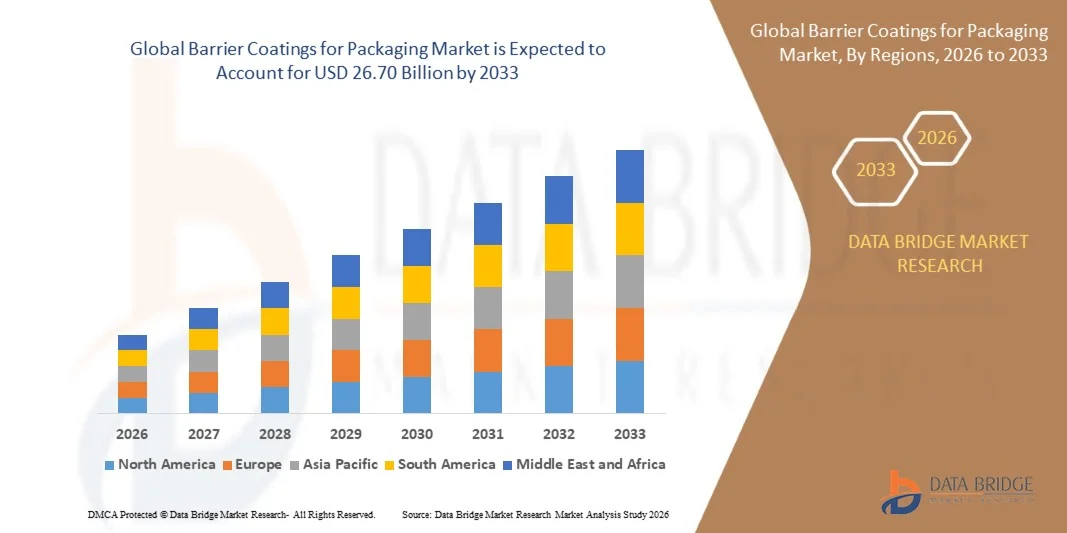
- As per Data Bridge Market Research analysis, the barrier coatings for packaging market was valued at USD 13.40 billion in 2025 and is projected to reach USD 26.70 billion by 2033, growing at a CAGR of 9.0% from 2026 to 2033.
- The market is experiencing consistent growth driven by rising demand for extended product shelf life, increasing adoption of sustainable and recyclable packaging solutions, and expanding applications across food and beverage, pharmaceutical, personal care, and industrial packaging.
- The increasing emphasis on reducing plastic waste globally, combined with stricter sustainability regulations and growing consumer preference for eco-friendly packaging, is compelling packaging manufacturers and brand owners to adopt advanced barrier coating technologies. Water-based, bio-based, and recyclable coatings are increasingly replacing conventional plastic films and multilayer structures, offering improved barrier performance while supporting recyclable and fiber-based packaging formats.
Market Size & Forecast
- Global Market Value (2025): USD 13.40 Billion
- Expected Market Value (2033): USD 26.70 Billion
- Forecast CAGR (2026–2033): 9.0%
- Leading Region in 2025: North America
- Fastest Growing Region: Asia Pacific
What are the Major Takeaways of the Barrier Coatings for Packaging Market?
- North America dominated the barrier coatings for packaging market with the largest revenue share of 35% in 2025, supported by a mature packaging industry, strong demand for sustainable packaging, and widespread adoption of advanced barrier coating technologies.
- Asia-Pacific is expected to be the fastest-growing region at a CAGR of 7.38% from 2026 to 2033, fueled by rapid industrialization, urbanization, stringent environmental regulations, and increasing adoption of sustainable, low-VOC barrier coating solutions across China, India, Japan, and Southeast Asia.
- The water-based coatings segment led the market with a 48.2% share in 2025, driven by its lower volatile organic compound emissions, environmental advantages, and compatibility with sustainable packaging formats.
- Bio-based coatings are the fastest-growing coating type, projected to register a CAGR of 10.4%, reflecting the surge in demand for renewable and environmentally friendly coating materials.
- The polyethylene (PE) segment dominated the material type category with a 36.0% revenue share in 2025, led by its strong moisture-barrier performance, flexibility, cost efficiency, and extensive use in packaging structure
- Flexible packaging accounted for 42% of the market share in 2025, preferred by the extensive use of pouches, bags, films, wraps, and other lightweight packaging formats.
- The paper & paperboard packaging segment is the fastest-growing packaging type category, with a CAGR of 9.0%, driven by increasing demand for recyclable, lightweight, and fiber-based packaging solutions.
Report Scope and Barrier Coatings for Packaging Market Segmentation
|
Attributes |
Barrier Coatings for Packaging Key Market Insights |
|
Segments Covered |
|
|
Countries Covered |
North America
Europe
Asia-Pacific
Middle East and Africa
South America
|
|
Key Market Players |
|
|
Market Opportunities |
|
|
Value Added Data Infosets |
In addition to the insights on market scenarios such as market value, growth rate, segmentation, geographical coverage, and major players, the market reports curated by the Data Bridge Market Research also include import export analysis, production capacity overview, production consumption analysis, price trend analysis, climate change scenario, supply chain analysis, value chain analysis, raw material/consumables overview, vendor selection criteria, PESTLE Analysis, Porter Analysis, and regulatory framework. |
What is the Key Trend in the Barrier Coatings for Packaging Market?
- Packaging manufacturers are increasingly adopting high-barrier, recyclable paper coatings to replace conventional plastic and aluminum-based multilayer structures while maintaining protection against oxygen, moisture, grease, and other contaminants.
- For instance, in June 2025, Mondi launched its re/cycle PaperPlus Bag Advanced, a high-barrier paper bag designed for humidity-sensitive products that uses a 20 µm film, reducing plastic usage by up to 60% compared with a 50 µm film while maintaining moisture protection and recyclability.
- Advances in functional coating technologies are enabling paper-based packaging to achieve increasingly high oxygen and water-vapor barrier performance without relying on conventional aluminum laminates.
- Packaging producers and brand owners are increasingly developing fiber-based and mono-material packaging formats that combine barrier performance with recyclability to comply with evolving sustainability requirements.
- For instance, in August 2025, Mondi ramped up production of FunctionalBarrier Paper Ultimate, a paper-based ultra-high-barrier solution providing protection against oxygen, water vapor, and grease, with both oxygen transmission rate (OTR) and water vapor transmission rate (WVTR) below 0.5, offering an alternative to conventional plastic- and aluminum-based multilayer structures.
- As brands and packaging converters continue prioritizing recyclability, reduced plastic usage, and high product protection, the adoption of advanced barrier coatings is expected to accelerate, reinforcing coated paper and fiber-based formats as important alternatives to conventional packaging structures.
What are the Key Drivers of the Barrier Coatings for Packaging Market?
- The increasing demand for sustainable and recyclable packaging has significantly increased adoption of barrier coatings capable of providing moisture, oxygen, grease, and water resistance while maintaining paper-based packaging recyclability
- For instance, in December 2025, Mitsubishi Chemical Corporation developed a technology for coating paper packaging with its SoarnoL gas-barrier resin, providing high gas-barrier and oil-resistant properties while helping preserve food quality and reduce food loss
- Packaging manufacturers, food producers, and consumer brands are integrating advanced water-based, bio-based, and functional coatings to reduce dependence on plastic films and aluminum structures while maintaining required packaging performance.
- For instance, in April 2024, Siegwerk announced a fully recyclable mono-PE pet-food bag using its CIRKIT functional barrier coatings, delivering the required barrier and processing performance of conventional multi-material packaging while supporting the shift toward recyclable packaging.
- With packaging industries increasingly prioritizing circularity, regulatory compliance, and material efficiency, barrier coatings will remain essential for developing recyclable and high-performance packaging solutions across food, beverage, healthcare, and consumer goods applications.
Which Factors are Challenging the Growth of the Barrier Coatings for Packaging Market?
- Advanced barrier coatings require sophisticated formulations and application processes to achieve high moisture, oxygen, grease, and heat-sealing performance without compromising recyclability, printability, or packaging strength.
- For instance, in July 2025, H.B. Fuller highlighted that integrating barrier coatings can affect adhesive performance, potentially causing packaging to open during production and transportation; redesigning packaging to ensure coating–adhesive compatibility can increase costs, production time, and packaging waste.
- These technical requirements can increase formulation complexity and production costs, particularly for manufacturers transitioning from established plastic laminates toward newer water-based, bio-based, and fiber-based barrier systems.
- For instance, in July 2026, Reuters reported that barrier coatings remain a major technical obstacle to scaling paper-based packaging, particularly for wet and oily products, because effective recyclable or biodegradable coatings are difficult to develop; the higher cost of fiber-based packaging also continues to complicate commercialization.
- The need to balance barrier performance, recyclability, cost, food-contact compliance, and compatibility with existing packaging equipment continues to challenge manufacturers, potentially slowing adoption where conventional multilayer structures remain more economical or technically established.
How is the Barrier Coatings for Packaging Market Segmented?
The barrier coatings for packaging market is segmented on the basis of coating type, material, packaging type, and end user
- By Coating Type
On the basis of coating type, the barrier coatings for packaging market is segmented into water-based coatings, solvent-based coatings, wax-based coatings, polymer-based coatings, bio-based coatings, and nanocoatings. The water-based coatings segment dominated the market 48.2% share in 2025, owing to its lower volatile organic compound emissions, environmental advantages, and compatibility with sustainable packaging formats. These coatings are increasingly used across food and beverage, pharmaceutical, personal care, and industrial packaging applications. Their ability to provide moisture, grease, and oxygen resistance while supporting recyclable paper and paperboard structures is strengthening demand. Increasing environmental regulations and sustainability targets are also encouraging converters to shift toward water-based formulations.
The bio-based coatings segment is projected to register the fastest growth at 10.4% CAGR during forecast period, driven by increasing demand for renewable and environmentally friendly coating materials. These coatings use renewable materials such as cellulose, starch, chitosan, lignin, and other bio-derived materials. Growing pressure to reduce fossil-based plastics is accelerating their development across packaging applications. Bio-based coatings can provide moisture, oxygen, and grease resistance while improving the sustainability profile of packaging. Brand owners are increasingly evaluating these formulations for recyclable and compostable paper-based packaging.
- By Material
On the basis of material, the market is segmented into polyethylene (PE), polypropylene (PP), polyethylene terephthalate (PET), polyvinyl chloride (PVC), aluminum, and paper & paperboard. The polyethylene (PE) segment dominated the market with 36.0% share in 2025, supported by its strong moisture-barrier performance, flexibility, cost efficiency, and extensive use in packaging structures. PE coatings are particularly suitable for food packaging requiring protection against moisture and grease. Their compatibility with established coating and converting processes also supports widespread adoption. PE provides useful sealing and mechanical properties while maintaining relatively low material costs.
The paper & paperboard segment is expected to witness the fastest growth at 9.8% CAGR during forecast period, driven by the transition toward recyclable and fiber-based packaging. Increasing sustainability commitments and regulations aimed at reducing plastic waste are encouraging packaging manufacturers to develop coated paper alternatives. Barrier coatings enable paper and paperboard to obtain moisture, oxygen, grease, and heat-sealing properties that are otherwise difficult to achieve. Foodservice packaging, cartons, takeaway containers, and flexible paper formats are important applications for coated fiber substrates. Improvements in water-based and bio-based coating technologies are further expanding the performance range of paper packaging.
- By Packaging Type
On the basis of packaging type, the market is segmented into flexible packaging, rigid packaging, paper & paperboard packaging, and corrugated packaging. The flexible packaging segment dominated the market with 42% share in 2025, driven by the extensive use of pouches, bags, films, wraps, and other lightweight packaging formats. Flexible packaging provides material efficiency, portability, and transportation advantages compared with many rigid formats. Barrier coatings are essential for protecting packaged products from moisture, oxygen, grease, aroma, and other external factors. Rising consumption of packaged food, snacks, beverages, and convenience products is strengthening demand for flexible barrier structures. The increasing shift toward recyclable mono-material and paper-based flexible formats is also creating additional demand for advanced coating technologies.
The paper & paperboard packaging segment is expected to witness the fastest growth at 9.0% CAGR during forecast period, supported by increasing demand for recyclable, lightweight, and fiber-based packaging solutions. Paper-based packaging is gaining traction as brands seek alternatives to conventional plastic-heavy structures. Barrier coatings improve the resistance of paper packaging against moisture, grease, oxygen, and other external factors. Growing adoption in foodservice, bakery, confectionery, takeaway, and consumer-product packaging is expanding its application base. Advances in water-based and specialty coating technologies are improving barrier performance without compromising recyclability. Regulatory pressure to reduce plastic packaging is further encouraging converters to invest in coated paper and paperboard formats.
- By End User
On the basis of end user, the market is segmented into the food & beverage industry, pharmaceutical industry, personal care industry, industrial sector, and others. The food & beverage industry dominated the market with 41.0% share in 2025, supported by the extensive requirement for packaging that protects products from moisture, oxygen, grease, contamination, and aroma loss. Barrier coatings help extend shelf life and preserve the quality of packaged food and beverages. Rising consumption of convenience foods, snacks, frozen foods, ready-to-eat meals, and packaged beverages is strengthening demand. Food manufacturers also increasingly require coatings that meet food-contact and sustainability requirements.
The pharmaceutical industry is expected to witness the fastest growth at 9.8% CAGR during forecast period, supported by increasing demand for high-barrier packaging that protects medicines from moisture, oxygen, light, and contamination. Pharmaceutical products require stringent barrier performance to maintain stability, quality, and shelf life. Growing pharmaceutical production and expanding healthcare consumption are increasing demand for specialized coated packaging materials. Barrier coatings are increasingly incorporated into pouches, sachets, cartons, and other protective pharmaceutical packaging formats. The sector is also evaluating recyclable and lower-impact packaging solutions in response to sustainability requirements.
Which Region Holds the Largest Share of the Barrier Coatings for Packaging Market?
- North America dominated the barrier coatings for packaging market with the largest revenue share of 35% in 2025, supported by a mature packaging industry, strong demand for sustainable packaging, and widespread adoption of advanced barrier coating technologies
- The region also benefits from stringent environmental regulations, increasing adoption of recyclable and bio-based packaging materials, and strong demand for high-performance barrier coatings across food & beverage, pharmaceutical, and consumer goods applications. Growing investments in sustainable packaging technologies and advancements in coating formulations continue to strengthen North America’s leadership position in the global market.
U.S. Barrier Coatings for Packaging Market Insight
The U.S. barrier coatings for packaging market is witnessing strong growth due to rising demand for sustainable packaging, increasing adoption of recyclable coating technologies, and growing investments in advanced packaging solutions. The country’s mature food & beverage, pharmaceutical, and consumer goods industries, along with increasing adoption of water-based and bio-based barrier coatings, is driving demand across diverse packaging applications. In addition, growing emphasis on reducing plastic waste and improving packaging recyclability is accelerating the adoption of high-performance barrier coatings across manufacturers and packaging converters.
Asia-Pacific Barrier Coatings for Packaging Market Insight
The Asia-Pacific barrier coatings for packaging market is expected to witness rapid growth, driven by expanding food & beverage industries, rising e-commerce activities, and increasing investments in modern packaging infrastructure across countries such as China, India, and Japan. Growing demand for sustainable packaging, rising adoption of water-based and bio-based coating technologies, and increasing consumption of packaged products are supporting regional market expansion. In addition, the growing presence of packaging manufacturers and increasing focus on recyclable and high-performance packaging solutions are accelerating barrier coating adoption across the region.
Japan Barrier Coatings for Packaging Market Insight
The Japan barrier coatings for packaging market is witnessing consistent growth due to rising investments in advanced packaging technologies, sustainable materials, and high-performance coating solutions. Food & beverage manufacturers, pharmaceutical companies, and packaging producers are increasingly adopting barrier coatings to improve moisture, oxygen, grease, and other protective properties of packaging materials. Moreover, increasing integration of water-based and bio-based coating technologies and the country’s focus on recyclable and resource-efficient packaging solutions are further contributing to market growth.
China Barrier Coatings for Packaging Market Insight
The China barrier coatings for packaging market is growing rapidly, driven by expanding food & beverage production, rising e-commerce activities, and increasing demand for advanced packaging solutions. Growing adoption of water-based, bio-based, and high-performance barrier coatings across food, pharmaceutical, consumer goods, and industrial applications is significantly boosting market demand. In addition, rising investments in sustainable packaging technologies, increasing environmental awareness, and rapid development of the domestic packaging industry are positioning China as one of the fastest-growing markets for barrier coatings for packaging globally.
U.K. Barrier Coatings for Packaging Market Insight
The U.K. barrier coatings for packaging market is experiencing steady growth, supported by rising adoption of sustainable packaging technologies, recyclable paper-based packaging, and advanced coating solutions. Increasing investments in water-based and bio-based barrier coatings and growing demand for plastic-reduction solutions are contributing to market growth. Furthermore, the integration of innovative coating technologies to improve moisture, grease, and oxygen resistance while maintaining recyclability is strengthening the U.K.’s position as a key market for sustainable barrier packaging solutions.
Germany Barrier Coatings for Packaging Market Insight
The Germany barrier coatings for packaging market is expanding steadily due to the country’s strong packaging manufacturing base, advanced material research capabilities, and increasing adoption of next-generation sustainable coating technologies. Food & beverage manufacturers, pharmaceutical companies, and packaging converters are increasingly utilizing barrier coatings to enhance packaging protection, shelf life, and recyclability. Continuous advancements in water-based, bio-based, and high-performance coating formulations, along with strong environmental focus and growing demand for circular packaging solutions, are further driving market growth in Germany.
Which are the Top Companies in Barrier Coatings for Packaging Market?
The barrier coatings for packaging industry is primarily led by well-established companies, including:
- BASF SE (Germany)
- Dow (U.S.)
- Solenis (U.S.)
- Kemira Oyj (Finland)
- Stora Enso (Finland)
- UPM (Finland)
- Mondi plc (U.K.)
- Siegwerk Druckfarben AG & Co. KGaA (Germany)
- Flint Group (Luxembourg)
- Henkel AG & Co. KGaA (Germany)
- Michelman, Inc. (U.S.)
- PPG Industries, Inc. (U.S.)
- Archroma (Switzerland)
- Wacker Chemie AG (Germany)
- Evonik Industries AG (Germany)
- Eastman Chemical Company (U.S.)
- Kuraray Co., Ltd. (Japan)
- Covestro AG (Germany)
- DIC Corporation (Japan)
- Nouryon (U.S.)
What are Latest Developments in Barrier Coatings for Packaging Market?
- In December 2025, Tetra Pak, in collaboration with García Carrión, launched the first-ever paper-based barrier technology for juice packaging, introducing a new aseptic carton that replaces the conventional aluminum barrier layer. The technology is designed to increase the paper content of beverage cartons while maintaining the protection required for juice products. The solution was rolled out across multiple markets under García Carrión’s Don Simón brand. This development highlights the packaging industry’s shift toward paper-based barrier technologies that reduce reliance on fossil-based materials while maintaining product protection
- In August 2025, Mondi announced the ramp-up of its FunctionalBarrier Paper Ultimate solution, an ultra-high-barrier paper-based packaging material designed to protect products against oxygen, water vapor, and grease. The solution provides an alternative to conventional multilayer plastic and aluminum structures that can be difficult to recycle. Mondi developed the technology to support recyclable paper-based packaging while maintaining high product-protection performance. The development strengthens the use of advanced barrier coatings in applications such as food, beverages, and home and personal care packaging.
- In June 2024, Solenis and PhaBuilder announced a global agreement to develop PHA-based materials for sustainable paper-based packaging applications. The collaboration combines PhaBuilder’s polyhydroxyalkanoate technology with Solenis’ expertise in specialty chemicals and packaging coatings. The companies aimed to develop more sustainable barrier solutions capable of supporting the transition toward fiber-based packaging. This partnership reflects increasing industry efforts to develop bio-based coating technologies that can provide functional protection while improving the sustainability profile of paper packaging
- In August 2022, BASF and Nippon Paint China jointly launched an eco-friendly industrial packaging solution using BASF’s water-based Joncryl High-Performance Barrier dispersion as the barrier material. The solution was commercialized for Nippon Paint’s dry-mixed mortar products and represented the first use of BASF’s water-based barrier coatings in industrial packaging in China. The coating provided vapor and water resistance while enabling paper-based packaging to replace conventional plastic packaging. This development demonstrated the growing application of water-based barrier coatings in industrial packaging and supported the shift toward more recyclable paper-based formats.
- In June 2021, Stora Enso started a new dispersion barrier coating production line at its Forshaga site in Sweden to support more sustainable packaging solutions. The technology enables paperboard packaging to use renewable wood-fiber materials in demanding applications such as food packaging. The resulting barrier-coated products are designed to be easier to handle in recycling processes, have a lower carbon footprint, and can be composted in industrial facilities. The development marked an important step toward replacing conventional plastic-based barrier layers with more sustainable dispersion coating technologies

- Interactive Data Analysis Dashboard
- Company Analysis Dashboard for high growth potential opportunities
- Research Analyst Access for customization & queries
- Competitor Analysis with Interactive dashboard
- Latest News, Updates & Trend analysis
- Harness the Power of Benchmark Analysis for Comprehensive Competitor Tracking
Global Barrier Coatings For Packaging Market, Supply Chain Analysis and Ecosystem Framework
To support market growth and help clients navigate the impact of geopolitical shifts, DBMR has integrated in-depth supply chain analysis into its Global Barrier Coatings For Packaging Market research reports. This addition empowers clients to respond effectively to global changes affecting their industries. The supply chain analysis section includes detailed insights such as Global Barrier Coatings For Packaging Market consumption and production by country, price trend analysis, the impact of tariffs and geopolitical developments, and import and export trends by country and HSN code. It also highlights major suppliers with data on production capacity and company profiles, as well as key importers and exporters. In addition to research, DBMR offers specialized supply chain consulting services backed by over a decade of experience, providing solutions like supplier discovery, supplier risk assessment, price trend analysis, impact evaluation of inflation and trade route changes, and comprehensive market trend analysis.
Data collection and base year analysis are done using data collection modules with large sample sizes. The stage includes obtaining market information or related data through various sources and strategies. It includes examining and planning all the data acquired from the past in advance. It likewise envelops the examination of information inconsistencies seen across different information sources. The market data is analysed and estimated using market statistical and coherent models. Also, market share analysis and key trend analysis are the major success factors in the market report. To know more, please request an analyst call or drop down your inquiry.
The key research methodology used by DBMR research team is data triangulation which involves data mining, analysis of the impact of data variables on the market and primary (industry expert) validation. Data models include Vendor Positioning Grid, Market Time Line Analysis, Market Overview and Guide, Company Positioning Grid, Patent Analysis, Pricing Analysis, Company Market Share Analysis, Standards of Measurement, Global versus Regional and Vendor Share Analysis. To know more about the research methodology, drop in an inquiry to speak to our industry experts.
Data Bridge Market Research is a leader in advanced formative research. We take pride in servicing our existing and new customers with data and analysis that match and suits their goal. The report can be customized to include price trend analysis of target brands understanding the market for additional countries (ask for the list of countries), clinical trial results data, literature review, refurbished market and product base analysis. Market analysis of target competitors can be analyzed from technology-based analysis to market portfolio strategies. We can add as many competitors that you require data about in the format and data style you are looking for. Our team of analysts can also provide you data in crude raw excel files pivot tables (Fact book) or can assist you in creating presentations from the data sets available in the report.













