


What is the Battery-Free Implants Market Size and Growth Rate?
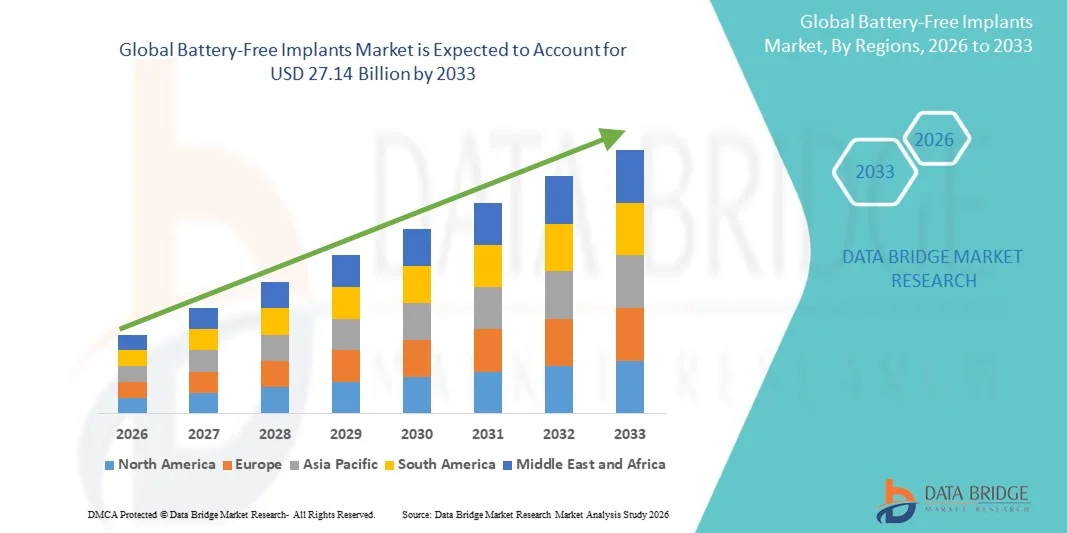
- As per Data Bridge Market Research analysis, the battery-free implants market was valued at USD 7.99 billion in 2025 and is projected to reach USD 27.14 billion by 2033, growing at a CAGR of 16.52% from 2026 to 2033.
- The market is experiencing consistent growth driven by advancements in wireless power transfer and energy harvesting technologies, increasing demand for minimally invasive medical devices, and the development of implantable electronics that eliminate conventional battery replacement procedures.
- The increasing need for long-term, maintenance-free implantable devices, combined with advances in inductive coupling, ultrasound power transfer, and triboelectric energy harvesting, is supporting the adoption of battery-free implants in applications such as neurostimulation, cardiac monitoring, drug delivery, and other implantable medical technologies. Research has demonstrated wireless powering of implanted devices without conventional batteries, helping reduce device size and the need for surgical battery replacement.
Market Size & Forecast
- Global Market Value (2025): USD 7.99 Billion
- Expected Market Value (2033): USD 27.14 Billion
- Forecast CAGR (2026–2033): 16.52%
- Leading Region in 2025: North America
- Fastest Growing Region: Asia Pacific
What are the Major Takeaways of the Battery-Free Implants Market?
- North America dominated the battery-free implants market with the largest market share of 38% in 2025, supported by sophisticated healthcare systems, rapid assimilation of smart medical devices, and growing bioelectronics research and development investments.
- Asia-Pacific is expected to be the fastest-growing region at a CAGR of 19.2% from 2026 to 2033, fueled by increasing hospital capacity, advanced manufacturing facilities, government health initiatives, and growing adoption of wireless power transfer and energy-harvesting technologies.
- The passive implants segment led the market with a 40% share in 2025, driven by the absence of conventional batteries and the simplified architecture of passive implantable systems.
- Energy harvesting implants are the fastest-growing implant type, projected to register a CAGR of 16%, reflecting the surge in advances in technologies that convert energy from external or physiological sources into electrical power.
- The inductive coupling segment dominated the technology category with a 30% revenue share in 2025, led by its ability to transfer energy between external and implanted coils without physical connectors.
- Cardiovascular accounted for 37% of the market share in 2025, preferred by the high demand for implantable technologies used in cardiac monitoring and management of cardiovascular conditions.
- The neurological segment is the fastest-growing implant location category, with a CAGR of 17%, driven by increasing demand for wireless neurostimulation, neural sensing, and brain-machine-interface technologies
Report Scope and Battery-Free Implants Market Segmentation
|
Attributes |
Battery-Free Implants Key Market Insights |
|
Segments Covered |
|
|
Countries Covered |
North America
Europe
Asia-Pacific
Middle East and Africa
South America
|
|
Key Market Players |
|
|
Market Opportunities |
|
|
Value Added Data Infosets |
In addition to the insights on market scenarios such as market value, growth rate, segmentation, geographical coverage, and major players, the market reports curated by the Data Bridge Market Research also include in-depth expert analysis, patient epidemiology, pipeline analysis, pricing analysis, and regulatory framework. |
What is the Key Trend in the Battery-Free Implants Market?
- Battery-free implants are increasingly shifting toward wireless, miniaturized, and fully implantable bioelectronic systems, reducing dependence on conventional batteries and supporting long-term medical monitoring and stimulation.
- For instance, in May 2024, researchers reported lead-free dual-frequency ultrasound implants for wireless, battery-free deep-brain stimulation, demonstrating wireless power delivery and programmable stimulation in an animal model.
- Advances in wireless power transfer and energy harvesting are enabling implants to receive energy through biological tissue, supporting smaller device designs and reducing the need for battery-replacement procedures.
- Research is also moving toward distributed battery-free implants, allowing multiple implantable devices to operate through improved wireless power-transfer networks rather than relying on individual internal batteries.
- For instance, in December 2025, researchers reported wireless, battery-free ultrathin implantable devices for continuous physiological monitoring, including intracranial pressure sensing, using an ultrathin lithium-niobate resonator and inductive coupling.
- As implantable technologies increasingly prioritize miniaturization, wireless operation, and long-term functionality, battery-free architectures are expected to become increasingly important across neurological, cardiovascular, drug-delivery, and monitoring applications.
What are the Key Drivers of the Battery-Free Implants Market?
- The growing need for long-term implantable medical devices without frequent battery replacement surgeries is increasing demand for wireless power transfer and energy-harvesting technologies.
- For instance, in August 2025, researchers developed a battery-free, RF-powered implantable microdevice for intravesical chemotherapy delivery, demonstrating how wireless power can enable implantable drug-delivery systems without relying on conventional internal batteries. The study highlights the potential of RF energy transfer to support long-term implantable therapeutic applications.
- Rising prevalence of cardiovascular and neurological disorders, combined with demand for minimally invasive treatment and continuous monitoring, is expanding the potential applications for battery-free implantable electronics.
- Advances in magnetoelectric, inductive, RF, ultrasound, and triboelectric technologies are improving the ability to deliver power to compact implants while supporting increasingly sophisticated therapeutic and monitoring functions.
- For instance, in September 2025, researchers demonstrated wireless, battery-free, lightweight implantable devices for continuous physiological monitoring, including intracranial pressure and vital signs, using an ultrathin lithium-niobate resonator. The approach addresses the limitations of bulky batteries, tethers, and percutaneous wires in implantable monitoring systems.
- With continued advances in wireless powering, energy harvesting, miniaturization, and implantable electronics, battery-free systems are expected to expand across neural stimulation, cardiac monitoring, drug delivery, and other chronic-care applications.
Which Factors are Challenging the Growth of the Battery-Free Implants Market?
- Battery-free implants face significant technical challenges related to reliable wireless power delivery, implant misalignment, limited energy availability, communication efficiency, and maintaining stable operation within dynamic physiological environments.
- For instance, in December 2024, researchers reported that wireless power-transfer efficiency in millimetric battery-free implants can degrade significantly because of misalignment caused by body movement, respiration, heartbeat, and limited control of implant orientation, highlighting the challenge of maintaining reliable power delivery in real-world physiological conditions
- The effectiveness of wireless power transfer can decline when implants change orientation because of body movement, respiration, heartbeat, or variations in implant positioning, creating challenges for consistent device operation.
- Power-delivery systems must also balance implant size, energy-transfer efficiency, operating distance, and safety constraints, making the development of reliable miniature systems technically complex.
- For instance, in November 2024, researchers demonstrated that angular rotation of implanted microstimulators could cause up to an additional 2 dB loss in wireless power-transfer efficiency, demonstrating how implant positioning and movement can reduce the reliability of battery-free systems.
- These technical limitations, together with high development costs, complex regulatory requirements, and the need for extensive biological and clinical validation, can slow commercialization and broader adoption of battery-free implant technologies.
How is the Battery-Free Implants Market Segmented?
The battery-free implants market is segmented on the basis of implant type, technology, implant location, and end user.
- By Implant Type
On the basis of implant type, the battery-free implants market is segmented into passive implants, energy harvesting implants, wirelessly powered implants, and biofuel cell powered implants. The passive implants segment dominated the market with an estimated 40% share in 2025, supported by the absence of conventional batteries and the simplified architecture of passive implantable systems. These implants can reduce concerns associated with battery depletion and replacement procedures. Their relatively simple design can also support long-term implantation and integration with biological tissues. Growing demand for smaller and maintenance-free implantable devices is strengthening their potential across medical applications. Increasing research into passive sensing and wireless identification technologies is further supporting development.
The energy harvesting implants segment is projected to register the fastest growth at an estimated CAGR of 16% from 2026 to 2033, driven by advances in technologies that convert energy from external or physiological sources into electrical power. Energy harvesting can enable implants to operate for extended periods without conventional battery replacement. Technologies including radiofrequency, piezoelectric, thermoelectric, and bioelectric energy harvesting are expanding the range of potential applications. Increasing miniaturization of implantable electronics is making integration of energy-harvesting components increasingly practical. Growing demand for self-powered monitoring and therapeutic devices is further supporting adoption. Research into energy harvesting is also expanding across cardiovascular, neurological, orthopedic, and sensing applications
- ·By Technology
On the basis of technology, the market is segmented into inductive coupling, RF wireless power transfer, ultrasound power transfer, light-based power transfer, piezoelectric energy harvesting, thermoelectric energy harvesting, triboelectric energy harvesting, and biofuel cell energy. The inductive coupling segment dominated the market with an estimated 30% share in 2025, owing to its ability to transfer energy between external and implanted coils without physical connectors. The technology can provide reliable power over relatively short distances and is suitable for implants positioned close to the body's surface. It can also support compact implantable designs by eliminating conventional batteries. Growing application of wireless power transfer in neurological and cardiovascular implants is strengthening demand. Improvements in coil design and energy-transfer efficiency are further supporting adoption.
The energy harvesting technology segment is projected to register the fastest growth at an estimated CAGR of 15.9% from 2026 to 2033, driven by increasing development of self-powered implantable technologies. Energy harvesting enables implants to utilize external or physiological energy sources rather than relying on conventional batteries. Piezoelectric systems can convert mechanical movement into electrical energy, while thermoelectric systems can utilize temperature differences within the body. Biofuel cells can generate electricity from biochemical reactions occurring within physiological environments. These technologies can support long-term operation while reducing battery-replacement requirements.
- By Implant Location
On the basis of implant location, the market is segmented into cardiovascular, neurological, cochlear, ophthalmic, gastrointestinal, orthopedic, dental, and dermal implants. The cardiovascular segment dominated the market with an estimated 37% share in 2025, supported by the high demand for implantable technologies used in cardiac monitoring and management of cardiovascular conditions. Battery-free architectures can reduce dependence on conventional batteries in long-term cardiovascular applications. Wireless power transfer and energy-harvesting technologies can support continuous operation of implantable cardiac electronics. The high prevalence of cardiovascular disorders creates a substantial underlying need for long-term monitoring and therapeutic technologies. Growing development of smart cardiac implants is further expanding opportunities for battery-free technologies.
The neurological segment is projected to register the fastest growth at an estimated CAGR of 17% from 2026 to 2033, driven by increasing demand for wireless neurostimulation, neural sensing, and brain-machine-interface technologies. Battery-free neurological systems can reduce implant size and dependence on conventional battery-powered devices. Advances in wireless power transfer are enabling increasingly sophisticated neural implants. Growing research into Parkinson's disease, epilepsy, chronic pain, and other neurological conditions is expanding potential applications. Continuous neural monitoring and stimulation are also creating demand for long-term implantable electronics. Increasing focus on minimally invasive neurological treatment is supporting technological development.
- By End User
On the basis of end user, the battery-free implants market is segmented into hospitals, specialty clinics, ambulatory surgical centers, research institutes, and universities. The hospitals segment dominated the market with an estimated 45% share in 2025, supported by advanced clinical infrastructure, high patient volumes, and the availability of specialized surgical and medical teams. Hospitals provide the facilities required for implantation, monitoring, and long-term management of advanced medical devices. They also serve as important centers for clinical evaluation and validation of emerging implantable technologies. Increasing adoption of innovative medical devices is strengthening hospital demand for battery-free implant technologies. Advanced cardiology, neurology, orthopedic, and surgical capabilities further support integration into clinical workflows.
The research institutes and universities segment is projected to witness the fastest growth at an estimated CAGR of 15% from 2026 to 2033, driven by their central role in developing and validating emerging battery-free implant technologies. These institutions conduct research into wireless power transfer, energy harvesting, miniaturized electronics, biocompatible materials, and implantable sensors. Universities and research institutes also provide important environments for preclinical testing and proof-of-concept development. Increasing collaboration between academic institutions, medical-device companies, and healthcare organizations is accelerating technology commercialization. Growing investment in bioelectronics and implantable medical-device research is expanding experimental applications.
Which Region Holds the Largest Share of the Battery-Free Implants Market?
- North America dominated the battery-free implants market with the largest market share of 38% in 2025, supported by sophisticated healthcare systems, rapid assimilation of smart medical devices, and growing bioelectronics research and development investments.
- The region also benefits from high adoption of advanced medical technologies, increasing investments in wireless power transfer and energy-harvesting technologies, and growing research into implantable bioelectronics. Strong clinical research capabilities and increasing development of minimally invasive, battery-free implantable devices continue to strengthen North America's leadership position in the global market.
U.S. Battery-Free Implants Market Insight
The U.S. battery-free implants market is witnessing strong growth due to advanced healthcare infrastructure, substantial biomedical research activity, and increasing development of wireless and battery-free implantable technologies. The country’s strong ecosystem of universities, medical-device companies, and research institutions is supporting innovation in implantable bioelectronics and wireless power transfer. Increasing research into implantable neural interfaces, physiological monitoring, and wireless stimulation is further expanding the potential application base. The availability of advanced clinical research facilities and sophisticated medical-device development capabilities is supporting the transition of battery-free technologies from laboratory research toward potential clinical applications. In December 2024, U.S. researchers reported an omnidirectional wireless power-transfer system for millimetric magnetoelectric biomedical implants, demonstrating improved power delivery despite changes in implant orientation
Asia-Pacific Battery-Free Implants Market Insight
The Asia-Pacific battery-free implants market is expected to witness rapid growth, driven by expanding healthcare infrastructure, increasing biomedical research, and rising development of wireless implantable medical technologies across countries such as China, Japan, and South Korea. Growing research into energy harvesting, wireless power transfer, and miniaturized bioelectronics is supporting regional technological development. The region’s expanding electronics and semiconductor manufacturing capabilities also provide an important technological foundation for developing smaller implantable components and wireless systems. Increasing investment in advanced healthcare technologies and growing academic-industry collaboration are further supporting research into next-generation implantable devices. In December 2024, researchers reported an ultrathin, wireless, battery-free implantable system capable of monitoring physiological parameters, demonstrating the region’s progress in miniaturized implantable electronics
Japan Battery-Free Implants Market Insight
The Japan battery-free implants market is witnessing consistent growth due to the country’s advanced medical-device industry, strong electronics capabilities, and increasing research into wireless and energy-efficient implantable technologies. Japanese research institutions are increasingly developing miniature bioelectronic systems designed to operate without conventional batteries. In November 2024, researchers published work on a wireless network of implantable microdevices, demonstrating wireless powering and communication for distributed implantable devices. Research into distributed implants is also creating opportunities for multiple miniature devices to operate within the body while receiving power and communicating wirelessly. This approach can reduce the physical size of individual implants and potentially improve the flexibility of implantable therapeutic systems
China Battery-Free Implants Market Insight
The China battery-free implants market is growing rapidly, driven by expanding medical-device research, advances in wireless power transfer, and increasing development of minimally invasive implantable electronics. Chinese research institutions are actively developing battery-free systems for neural stimulation, physiological monitoring, and therapeutic applications. In May 2024, researchers reported lead-free dual-frequency ultrasound implants for wireless deep-brain stimulation, demonstrating wireless energy delivery and programmable stimulation in an animal model. Research into ultrasound-based power transfer is particularly important because ultrasound can deliver energy to implants located deeper within biological tissue while supporting wireless operation. Increasing research activity in neural interfaces and bioelectronic medicine is further expanding the potential applications for battery-free systems.
U.K. Battery-Free Implants Market Insight
The U.K. battery-free implants market is experiencing steady growth, supported by advanced biomedical research, strong academic institutions, and increasing development of wireless implantable healthcare technologies. Research activity is increasingly focused on eliminating conventional batteries through wireless power transfer and energy-harvesting approaches. Researchers at University College London developed a battery-free implantable device that uses ultrasound energy harvesting, demonstrating the potential for wireless operation of miniature biomedical implants without conventional batteries. The U.K.’s established biomedical research ecosystem also supports collaboration between engineering, medical, and life-science researchers, helping translate laboratory innovations into potential healthcare applications. Increasing interest in minimally invasive monitoring and long-duration implantable devices is creating additional opportunities for battery-free technologies.
Germany Battery-Free Implants Market Insight
The Germany battery-free implants market is expanding steadily due to the country’s strong medical-engineering ecosystem, advanced research capabilities, and increasing investment in implantable bioelectronics. German research institutions are contributing to the development of wireless power-transfer technologies that can enable smaller and longer-lasting implants. Research into magnetoelectric technologies is particularly relevant because these systems can transfer power wirelessly to millimeter-scale implants while supporting compact device architectures. Improving wireless power-transfer efficiency can help address one of the major limitations of battery-free implants maintaining reliable power delivery despite changes in implant position. Research published in 2024 demonstrated wireless powering of millimeter-scale magnetoelectric implants, addressing challenges associated with powering miniature biomedical devices and supporting the development of battery-free implantable systems.
Which are the Top Companies in Battery-Free Implants Market?
The battery-free implants industry is primarily led by well-established companies, including:
- Neuspera Medical, Inc. (U.S.)
- Nyxoah SA. (Belgium)
- BlueWind Medical (U.S.)
- Nalu Medical, Inc. (U.S.)
- EBR Systems, Inc. (U.S.)
- Abbott (U.S.)
- Medtronic (Ireland)
- Boston Scientific Corporation (U.S.)
- BIOTRONIK SE & Co. KG (Germany)
- Cochlear Limited (Australia)
- LivaNova PLC (U.K.)
- Profusa, Inc. (U.S.)
- SetPoint Medical (U.S.)
- Starfish Neuroscience, Inc. (U.S.)
- ABILITY Neurotech (Switzerland)
- Powercast Corporation (U.S.)
- Energous Corporation (U.S.)
- Ossia Inc. (U.S.)
- NeuroLux (U.S.)
- NeuroPace, Inc. (U.S.)
What are Latest Developments in Battery-Free Implants Market?
- In May 2025, Starfish Neuroscience unveiled the first details of its planned minimally invasive, distributed neural-interface chip, designed to operate wirelessly and without an implanted battery. The company stated that its processor was designed to consume approximately 1.1 mW and could enable simultaneous access to multiple brain regions. Starfish expected its first chips to arrive in late 2025 and was seeking collaborators for wireless power delivery, communications, and implanted neural interfaces. This represents a company-level product/technology launch directly relevant to the battery-free implants market.
- In February 2025, Neuspera Medical announced six-month pivotal clinical trial results for its battery-free percutaneous sacral neuromodulation system, reporting efficacy comparable with published rates for traditional sacral neuromodulation devices for urgency urinary incontinence. The system uses a small implanted device powered wirelessly from an external wearable, avoiding an implanted battery and supporting a minimally invasive treatment approach
- In November 2023, researchers developed a hybrid wireless power and communication system for medical implants, demonstrating an RF-powered implant operating at 401 MHz with wireless communication and power delivery through up to 8 cm of body tissue. The system was designed to support future wireless implant networks and reduce reliance on wired connections and conventional implant power sources
- In August 2023, Resonant Link launched a 15-minute wireless charger for implantable medical devices, designed to recharge implanted medical-device batteries through the skin, including titanium-can implants. Although the product primarily supports rechargeable implants rather than fully battery-free systems, its wireless power-transfer platform is directly relevant to the technology ecosystem enabling next-generation battery-free and externally powered implants.
- In April 2022, researchers reported a wireless-powering approach for deep-body implanted biomedical devices, analyzing wireless power-transfer efficiency in anatomical models and demonstrating that implant orientation and implantation depth significantly affect power delivery. The study also developed design guidelines for optimizing wireless powering of deeply implanted devices, including pacemaker applications.

- Interactive Data Analysis Dashboard
- Company Analysis Dashboard for high growth potential opportunities
- Research Analyst Access for customization & queries
- Competitor Analysis with Interactive dashboard
- Latest News, Updates & Trend analysis
- Harness the Power of Benchmark Analysis for Comprehensive Competitor Tracking
Data collection and base year analysis are done using data collection modules with large sample sizes. The stage includes obtaining market information or related data through various sources and strategies. It includes examining and planning all the data acquired from the past in advance. It likewise envelops the examination of information inconsistencies seen across different information sources. The market data is analysed and estimated using market statistical and coherent models. Also, market share analysis and key trend analysis are the major success factors in the market report. To know more, please request an analyst call or drop down your inquiry.
The key research methodology used by DBMR research team is data triangulation which involves data mining, analysis of the impact of data variables on the market and primary (industry expert) validation. Data models include Vendor Positioning Grid, Market Time Line Analysis, Market Overview and Guide, Company Positioning Grid, Patent Analysis, Pricing Analysis, Company Market Share Analysis, Standards of Measurement, Global versus Regional and Vendor Share Analysis. To know more about the research methodology, drop in an inquiry to speak to our industry experts.
Data Bridge Market Research is a leader in advanced formative research. We take pride in servicing our existing and new customers with data and analysis that match and suits their goal. The report can be customized to include price trend analysis of target brands understanding the market for additional countries (ask for the list of countries), clinical trial results data, literature review, refurbished market and product base analysis. Market analysis of target competitors can be analyzed from technology-based analysis to market portfolio strategies. We can add as many competitors that you require data about in the format and data style you are looking for. Our team of analysts can also provide you data in crude raw excel files pivot tables (Fact book) or can assist you in creating presentations from the data sets available in the report.













