


What is the Battery Management IC Market Size and Growth Rate?
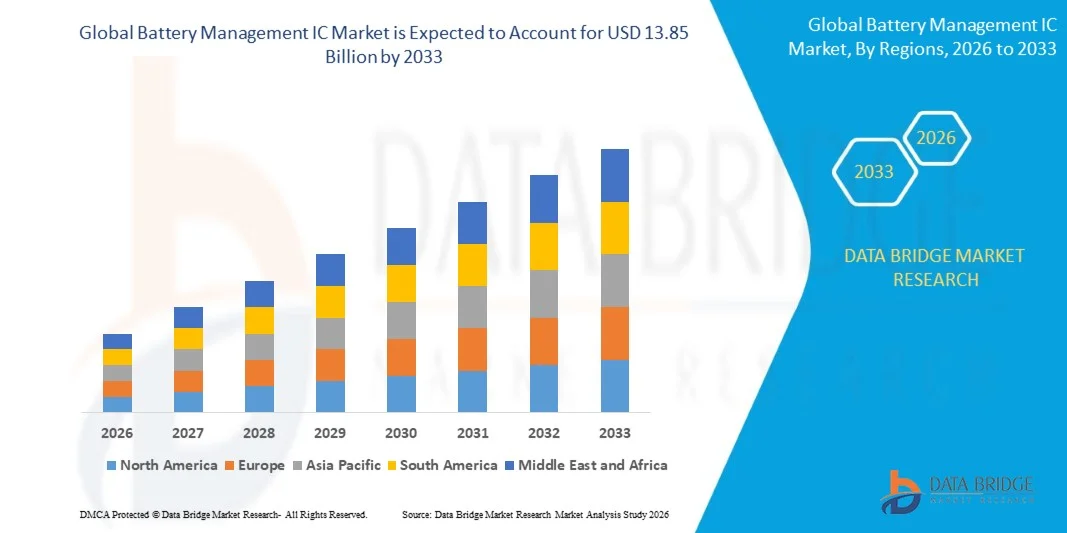
- As per Data Bridge Market Research analysis the battery management IC market was valued at USD 5.84 billion in 2025 and is projected to reach USD 13.85 billion by 2033, growing at a CAGR of 11.40% from 2026 to 2033.
- The market is experiencing strong growth driven by the increasing adoption of electric vehicles, rising demand for advanced battery-powered consumer electronics, and continuous advancements in battery management technologies that improve charging efficiency, safety, and battery lifespan.
- The rapid expansion of renewable energy storage systems, growing investments in lithium-ion and next-generation battery technologies, and increasing focus on battery safety, energy efficiency, and thermal management are accelerating the adoption of battery management ICs across automotive, industrial, healthcare, and consumer electronics applications.
Market Size & Forecast
- Market Value (2025): USD 5.84 Billion
- Expected Market Value (2033): USD 13.85 Billion
- Forecast CAGR (2026–2033): 11.40%
- Leading Region in 2025: North America
- Fastest Growing Region: Asia-Pacific
What are the Major Takeaways of the Battery Management IC Market?
- North America dominated the battery management IC market with the largest revenue share of 39.10% in 2025, supported by the strong presence of leading semiconductor manufacturers, growing electric vehicle adoption, and increasing investments in battery energy storage systems.
- Asia-Pacific battery management IC market is expected to witness the fastest growth rate from 2026 to 2033, supported by rapid industrialization, expanding electric vehicle production, and growing consumer electronics manufacturing across China, Japan, South Korea, and India.
- The battery charger ICs segment held the largest market revenue share of approximately 39.1% in 2025 driven by its extensive adoption in smartphones, laptops, electric vehicles, and portable electronic devices. Battery charger ICs are widely preferred due to their ability to ensure efficient charging, enhance battery lifespan, and improve overall power management across rechargeable battery-powered systems.
- The authentication ICs segment is projected to register the fastest growth at a CAGR of 12.8% from 2026 to 2033, driven by increasing demand for battery security, counterfeit prevention, and advanced battery identification technologies. Rising deployment in electric vehicles, medical devices, and premium consumer electronics is accelerating segment expansion.
- The lithium-ion segment held the largest market revenue share of approximately 72.2% in 2025 driven by its widespread use in electric vehicles, consumer electronics, energy storage systems, and industrial equipment. Lithium-ion batteries are preferred due to their high energy density, longer lifecycle, and superior charging efficiency.
- The solid-state segment is projected to register the fastest growth from 2026 to 2033, driven by increasing investments in next-generation battery technologies and the growing demand for safer, high-performance energy storage solutions. Rising research and commercialization activities are accelerating segment expansion.
Report Scope and Battery Management IC Market Segmentation
|
Attributes |
Battery Management IC Key Market Insights |
|
Segments Covered |
|
|
Countries Covered |
North America
Europe
Asia-Pacific
Middle East and Africa
South America
|
|
Key Market Players |
|
|
Market Opportunities |
|
|
Value Added Data Infosets |
In addition to the insights on market scenarios such as market value, growth rate, segmentation, geographical coverage, and major players, the market reports curated by the Data Bridge Market Research also include in-depth expert analysis, geographically represented company-wise production and capacity, network layouts of distributors and partners, detailed and updated price trend analysis and deficit analysis of supply chain and demand. |
What is the Key Trend in the Battery Management IC Market?
- The rapid integration of intelligent battery monitoring, wireless battery management systems (BMS), and advanced battery health diagnostics is emerging as a key trend, enabling improved battery performance, safety, and lifecycle management across electric vehicles and energy storage systems.
- For instance, in July 2025, NXP Semiconductors introduced its BMx7318/7518 battery cell controller IC family for electric vehicles and energy storage systems, featuring independent ADC architecture, high-current cell balancing, and functional safety compliance to improve battery efficiency and system reliability.
- Semiconductor manufacturers are increasingly developing highly integrated battery management ICs with advanced cell monitoring, battery balancing, and functional safety capabilities to reduce system complexity while supporting next-generation electrification platforms.
- For instance, in March 2025, Renesas Electronics introduced its Ready Battery Management System (R-BMS F) platform with pre-validated firmware, integrated fuel gauge ICs, and battery management software, enabling faster development of lithium-ion battery packs for consumer, industrial, medical, and e-mobility applications.
- As electric vehicle production, renewable energy storage deployment, and battery-powered electronic devices continue to expand globally, the adoption of advanced battery management ICs with intelligent monitoring and enhanced safety capabilities is expected to accelerate, reinforcing their role as a critical component of next-generation battery systems.
What are the Key Drivers of the Battery Management IC Market?
- The rapid adoption of electric vehicles, battery energy storage systems, and portable electronic devices has significantly increased demand for battery management ICs capable of improving battery safety, charging efficiency, and operational reliability.
- For instance, in November 2024, NXP Semiconductors announced the industry's first Ultra-Wideband (UWB) wireless battery management system solution, enabling simplified battery pack assembly, increased energy density, and faster electric vehicle development through reliable wireless communication.
- Automotive OEMs, battery manufacturers, and semiconductor companies are investing in highly integrated battery management platforms to reduce system complexity, improve battery lifespan, and support next-generation electrified vehicles and energy storage applications.
- For instance, in September 2024, NXP Semiconductors introduced the MC33777 battery junction box IC, integrating multiple battery pack monitoring functions into a single device and reducing component count by up to 80% while improving battery safety and accelerating EV development.
- With governments promoting transportation electrification and renewable energy deployment worldwide, battery management ICs will remain essential for delivering efficient, reliable, and safe battery systems across automotive, industrial, and consumer applications.
Which Factors are Challenging the Growth of the Battery Management IC Market?
- Battery management ICs require compliance with stringent automotive functional safety standards, high design complexity, and extensive validation processes, increasing development costs and extending product commercialization timelines.
- The integration of advanced battery monitoring, thermal management, and cybersecurity features further increases engineering complexity, particularly for electric vehicle and grid-scale energy storage applications.
- For instance, NXP Semiconductors stated in its July 2025 announcement that new battery management ICs are designed to meet ASIL C automotive and SIL 2 industrial functional safety requirements, highlighting the growing technical and certification challenges faced by manufacturers.
- The high cost of advanced semiconductor development, rigorous qualification requirements, and increasing demand for highly accurate battery monitoring continue to create barriers for smaller manufacturers and lengthen product development cycles, limiting rapid market expansion despite rising global demand for battery-powered technologies.
How is the Battery Management IC Market Segmented?
The market is segmented on the basis of IC type, battery chemistry, cell configuration, application, and end-use industry.
- By IC Type
On the basis of IC type, the battery management IC market is segmented into battery charger ICs, fuel gauge ICs, battery protection ICs, battery balancing ICs, authentication ICs, cell monitoring ICs, and others. The battery charger ICs segment held the largest market revenue share of approximately 39.1% in 2025 driven by its extensive adoption in smartphones, laptops, electric vehicles, and portable electronic devices. Battery charger ICs are widely preferred due to their ability to ensure efficient charging, enhance battery lifespan, and improve overall power management across rechargeable battery-powered systems.
The authentication ICs segment is projected to register the fastest growth at a CAGR of 12.8% from 2026 to 2033, driven by increasing demand for battery security, counterfeit prevention, and advanced battery identification technologies. Rising deployment in electric vehicles, medical devices, and premium consumer electronics is accelerating segment expansion.
- By Battery Chemistry
On the basis of battery chemistry, the battery management IC market is segmented into lithium-ion, lithium-polymer, nickel-metal hydride, lead-acid, and solid-state. The lithium-ion segment held the largest market revenue share of approximately 72.2% in 2025 driven by its widespread use in electric vehicles, consumer electronics, energy storage systems, and industrial equipment. Lithium-ion batteries are preferred due to their high energy density, longer lifecycle, and superior charging efficiency.
The solid-state segment is projected to register the fastest growth from 2026 to 2033, driven by increasing investments in next-generation battery technologies and the growing demand for safer, high-performance energy storage solutions. Rising research and commercialization activities are accelerating segment expansion.
- By Cell Configuration
On the basis of cell configuration, the battery management IC market is segmented into single-cell and multi-cell. The multi-cell segment held the largest market revenue share of approximately 65.2% in 2025 driven by its extensive use in electric vehicles, industrial battery packs, renewable energy storage systems, and high-capacity consumer electronics. Multi-cell configurations are preferred for their ability to deliver higher voltage, improved energy capacity, and enhanced battery performance.
The single-cell segment is projected to register the fastest growth from 2026 to 2033, driven by increasing demand for compact portable electronics, wearable devices, and IoT products. Growing adoption of lightweight and space-efficient battery-powered devices is accelerating segment expansion.
- By Application
On the basis of application, the battery management IC market is segmented into consumer electronics, electric vehicles, renewable energy systems, industrial applications, medical devices, military, and telecommunications. The consumer electronics segment held the largest market revenue share in 2025 driven by the growing demand for smartphones, laptops, tablets, wearables, and other rechargeable electronic devices. Battery management ICs are widely utilized to improve charging efficiency, battery safety, and device performance.
The electric vehicles segment is projected to register the fastest growth from 2026 to 2033, driven by rising global EV production, expanding charging infrastructure, and increasing investments in advanced battery technologies. Growing government support for electric mobility is accelerating segment expansion.
- By End-Use Industry
On the basis of end-use industry, the battery management IC market is segmented into automotive, consumer electronics, industrial, healthcare, aerospace, telecommunications, medical devices, military, and renewable energy. The automotive segment held the largest market revenue share of approximately 29.2% in 2025 driven by the rapid adoption of electric vehicles, hybrid vehicles, and advanced battery management systems. Battery management ICs are extensively used to improve battery efficiency, safety, and operational reliability in automotive applications.
The renewable energy segment is projected to register the fastest growth at a CAGR of 13.2% from 2026 to 2033, driven by increasing deployment of battery energy storage systems and renewable power infrastructure. Rising investments in grid-scale energy storage and sustainable energy projects are accelerating segment expansion.
Which Region Holds the Largest Share of the Battery Management IC Market?
- North America dominated the battery management IC market with the largest revenue share of 39.10% in 2025, supported by the strong presence of leading semiconductor manufacturers, growing electric vehicle adoption, and increasing investments in battery energy storage systems.
- The region benefits from robust research and development activities, widespread deployment of advanced lithium-ion batteries, and rising demand for battery-powered consumer electronics. Government initiatives promoting clean energy and transportation electrification further strengthen the adoption of battery management ICs across automotive, industrial, and renewable energy applications.
U.S. Battery Management IC Market Insight
The U.S. battery management IC market captured the largest revenue share in 2025 within North America, fueled by the rapid expansion of the electric vehicle industry and growing deployment of grid-scale battery energy storage systems. Increasing investments in advanced semiconductor technologies, coupled with the presence of major automotive OEMs and battery manufacturers, continue to support market growth. Furthermore, the increasing adoption of AI-enabled battery monitoring, fast-charging technologies, and next-generation battery management platforms is accelerating demand for battery management ICs across automotive, consumer electronics, and industrial applications.
Europe Battery Management IC Market Insight
Europe battery management IC market is expected to witness the fastest growth rate from 2026 to 2033, primarily driven by stringent vehicle emission regulations, ambitious electrification targets, and increasing investments in battery manufacturing facilities. The region is witnessing rapid adoption of electric vehicles and renewable energy storage systems, creating strong demand for advanced battery management technologies. Growing government incentives for sustainable mobility and battery innovation are further supporting market expansion across automotive and industrial sectors.
U.K. Battery Management IC Market Insight
The U.K. battery management IC market is expected to witness the fastest growth rate from 2026 to 2033, driven by rising electric vehicle adoption, increasing investments in battery research, and expanding renewable energy storage infrastructure. Government policies supporting net-zero emissions and domestic battery manufacturing continue to encourage technological innovation. In addition, increasing deployment of battery-powered industrial equipment and energy storage systems is expected to further stimulate market growth.
Germany Battery Management IC Market Insight
Germany battery management IC market is expected to witness the fastest growth rate from 2026 to 2033, fueled by the country's strong automotive manufacturing base and continuous investments in electric mobility technologies. The presence of leading automotive OEMs, battery manufacturers, and semiconductor companies supports the adoption of advanced battery management ICs. Increasing development of high-performance battery systems for electric vehicles and industrial automation is further contributing to market expansion.
Asia-Pacific Battery Management IC Market Insight
The Asia-Pacific battery management IC market is expected to witness the fastest growth rate from 2026 to 2033, supported by rapid industrialization, expanding electric vehicle production, and growing consumer electronics manufacturing across China, Japan, South Korea, and India. Rising investments in lithium-ion battery production, government support for clean energy initiatives, and increasing deployment of battery energy storage systems are accelerating market growth. The region's strong semiconductor manufacturing ecosystem also enhances the availability and affordability of battery management ICs.
Japan Battery Management IC Market Insight
Japan battery management IC market is expected to witness the fastest growth rate from 2026 to 2033 due to the country's leadership in battery innovation, advanced semiconductor manufacturing, and electric mobility technologies. Increasing investments in next-generation battery chemistries, including solid-state batteries, are driving demand for highly integrated battery management ICs. Moreover, growing adoption of battery-powered industrial equipment, robotics, and renewable energy storage solutions continues to support market growth.
China Battery Management IC Market Insight
The China battery management IC market accounted for the largest market revenue share in Asia-Pacific in 2025, attributed to the country's dominant electric vehicle production, large-scale lithium-ion battery manufacturing capacity, and strong government support for new energy vehicles. China remains one of the world's largest markets for battery-powered consumer electronics and energy storage systems, driving substantial demand for advanced battery management ICs. The expansion of domestic semiconductor manufacturing, combined with increasing investments in battery gigafactories and renewable energy infrastructure, continues to propel market growth in the country.
Which are the Top Companies in Battery Management IC Market?
The battery management IC industry is primarily led by well-established companies, including:
- Texas Instruments Incorporated (U.S.)
- Analog Devices, Inc. (U.S.)
- Infineon Technologies AG (Germany)
- Renesas Electronics Corporation (Japan)
- NXP Semiconductors N.V. (Netherlands)
- STMicroelectronics N.V. (Switzerland)
- onsemi (U.S.)
- Microchip Technology Incorporated (U.S.)
- ROHM Co., Ltd. (Japan)
- Monolithic Power Systems, Inc. (U.S.)
- Toshiba Electronic Devices and Storage Corporation (Japan)
- Diodes Incorporated (U.S.)
- Richtek Technology Corporation (Taiwan)
- Skyworks Solutions, Inc. (U.S.)
- ABLIC Inc. (Japan)
What are Latest Developments in Battery Management IC Market?
- In June 2026, Texas Instruments Incorporated launched the BQ79826Z-Q1 automotive battery monitor IC featuring an integrated electrochemical impedance spectroscopy (EIS) engine and support for up to 26 battery cells in series. The new IC enhances battery health diagnostics, improves functional safety, and simplifies EV battery pack design. The launch strengthens the company's battery management portfolio and supports the growing demand for intelligent and reliable battery management ICs.
- In December 2025, Texas Instruments Incorporated announced the expansion of its analog semiconductor manufacturing capacity in Richardson, Texas, to support automotive-grade battery management IC production. The investment is expected to improve semiconductor supply, reduce lead times, and strengthen supply chain resilience for electric vehicle manufacturers, supporting the increasing demand for battery management ICs.
- In November 2024, NXP Semiconductors N.V. introduced an Ultra-Wideband (UWB)-based wireless battery management system solution designed to eliminate wiring complexity within battery packs. The solution improves battery scalability, enhances secure wireless communication, and reduces vehicle weight and manufacturing costs, accelerating the adoption of advanced battery management technologies in electric vehicles.
- In January 2024, onsemi launched DC ultra-fast electric vehicle charging solutions to improve charging speed, power efficiency, and energy conversion performance for EV infrastructure. The development supports the expansion of fast-charging networks while increasing demand for advanced power management and battery management semiconductor solutions.
- In November 2023, NXP Semiconductors N.V. introduced a battery cell controller integrated circuit to improve battery monitoring accuracy, functional safety, and communication reliability in automotive battery management systems. The innovation enhances battery performance and reliability while strengthening the adoption of advanced battery management ICs across next-generation electric vehicles.

- Interactive Data Analysis Dashboard
- Company Analysis Dashboard for high growth potential opportunities
- Research Analyst Access for customization & queries
- Competitor Analysis with Interactive dashboard
- Latest News, Updates & Trend analysis
- Harness the Power of Benchmark Analysis for Comprehensive Competitor Tracking
Global Battery Management Ic Market, Supply Chain Analysis and Ecosystem Framework
To support market growth and help clients navigate the impact of geopolitical shifts, DBMR has integrated in-depth supply chain analysis into its Global Battery Management Ic Market research reports. This addition empowers clients to respond effectively to global changes affecting their industries. The supply chain analysis section includes detailed insights such as Global Battery Management Ic Market consumption and production by country, price trend analysis, the impact of tariffs and geopolitical developments, and import and export trends by country and HSN code. It also highlights major suppliers with data on production capacity and company profiles, as well as key importers and exporters. In addition to research, DBMR offers specialized supply chain consulting services backed by over a decade of experience, providing solutions like supplier discovery, supplier risk assessment, price trend analysis, impact evaluation of inflation and trade route changes, and comprehensive market trend analysis.
Data collection and base year analysis are done using data collection modules with large sample sizes. The stage includes obtaining market information or related data through various sources and strategies. It includes examining and planning all the data acquired from the past in advance. It likewise envelops the examination of information inconsistencies seen across different information sources. The market data is analysed and estimated using market statistical and coherent models. Also, market share analysis and key trend analysis are the major success factors in the market report. To know more, please request an analyst call or drop down your inquiry.
The key research methodology used by DBMR research team is data triangulation which involves data mining, analysis of the impact of data variables on the market and primary (industry expert) validation. Data models include Vendor Positioning Grid, Market Time Line Analysis, Market Overview and Guide, Company Positioning Grid, Patent Analysis, Pricing Analysis, Company Market Share Analysis, Standards of Measurement, Global versus Regional and Vendor Share Analysis. To know more about the research methodology, drop in an inquiry to speak to our industry experts.
Data Bridge Market Research is a leader in advanced formative research. We take pride in servicing our existing and new customers with data and analysis that match and suits their goal. The report can be customized to include price trend analysis of target brands understanding the market for additional countries (ask for the list of countries), clinical trial results data, literature review, refurbished market and product base analysis. Market analysis of target competitors can be analyzed from technology-based analysis to market portfolio strategies. We can add as many competitors that you require data about in the format and data style you are looking for. Our team of analysts can also provide you data in crude raw excel files pivot tables (Fact book) or can assist you in creating presentations from the data sets available in the report.













