


What is the Battery Separator Materials Market Size &?Overview
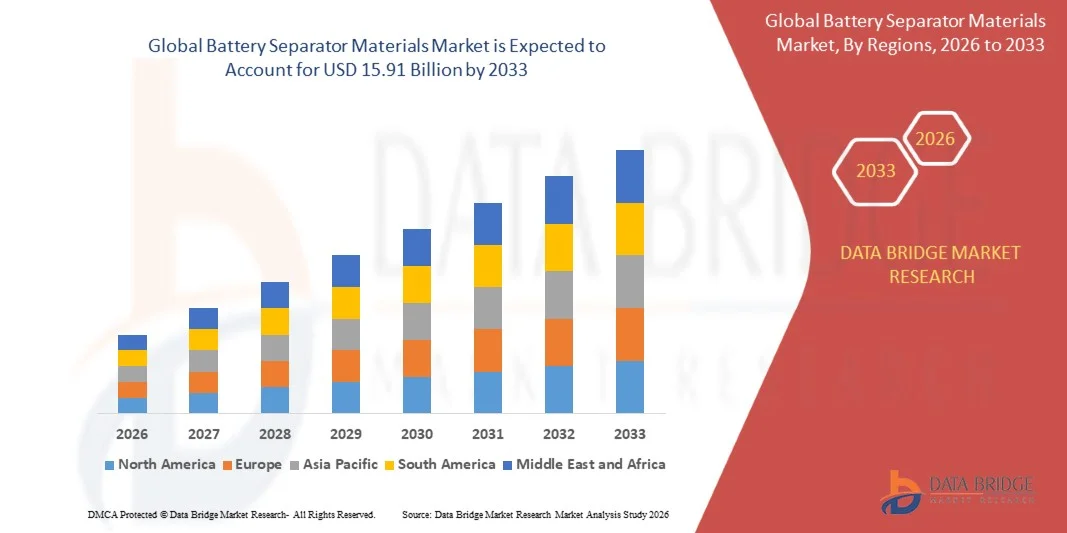
As per Data Bridge Market Research analysis the battery separator materials market was valued at USD 7.70 billion in 2025 and is projected to reach USD 15.91 billion by 2033, growing at a CAGR of 9.50% from 2026 to 2033. The market is witnessing strong growth driven by the rapid adoption of electric vehicles, expanding lithium-ion battery manufacturing, increasing investments in energy storage systems, and rising demand for high-performance battery components across automotive, consumer electronics, and industrial applications.
The growing transition toward clean energy, coupled with government incentives supporting electric mobility and renewable energy integration, is significantly increasing demand for advanced battery separator materials. Polyethylene (PE), polypropylene (PP), ceramic-coated separators, and other high-performance materials are being widely adopted to improve battery safety, thermal stability, cycle life, and energy density. Furthermore, continuous advancements in separator technologies, expansion of battery gigafactories, and increasing investments in next-generation solid-state and lithium-ion batteries are expected to accelerate market growth throughout the forecast period.
Market Size & Forecast
- Market Value (2025): USD 7.70 Billion
- Expected Market Value (2033): USD 15.91 Billion
- Forecast CAGR (2026–2033): 9.50%
- Leading Region in 2025: North America
- Fastest Growing Region: Asia-Pacific
Key Market Trends & Insights
- North America dominated the battery separator materials market with the largest revenue share in 2025, supported by expanding electric vehicle production, increasing investments in battery gigafactories, and growing deployment of grid-scale energy storage systems.
- Asia-Pacific battery separator materials market is expected to witness the fastest growth rate from 2026 to 2033, supported by expanding lithium-ion battery manufacturing, rising electric vehicle production, and increasing investments in renewable energy storage across China, Japan, South Korea, and India.
- The single layer segment held the largest market revenue share in 2025, driven by its widespread adoption in conventional lithium-ion batteries used in consumer electronics and cost-sensitive electric vehicle applications. Single-layer separators offer lower manufacturing costs, stable electrochemical performance, and compatibility with high-volume battery production, making them the preferred choice for mainstream battery manufacturers.
- The coated segment is projected to register the fastest growth at a CAGR from 2026 to 2033, driven by increasing demand for enhanced thermal stability, improved battery safety, and fast-charging capabilities in electric vehicles and energy storage systems. Growing adoption of ceramic-coated separators for next-generation lithium-ion batteries is accelerating segment growth.
- The lithium-ion segment held the largest market revenue share in 2025, driven by rapidly increasing production of electric vehicles, portable consumer electronics, battery energy storage systems, and power tools. Rising investments in battery gigafactories and growing demand for high-energy-density batteries continue to strengthen the dominance of lithium-ion battery separator materials.
- The nickel-based segment is projected to register the fastest growth at a CAGR from 2026 to 2033, supported by increasing adoption in aerospace, defense, medical equipment, and industrial backup power applications where high reliability and long service life remain essential.
- The electric vehicles segment held the largest market revenue share in 2025, driven by rapidly expanding EV production, government incentives supporting vehicle electrification, and growing investments in lithium-ion battery manufacturing. Increasing demand for high-performance battery separators capable of improving battery safety, cycle life, and fast-charging performance is further supporting segment growth.
- The energy storage system segment is projected to register the fastest growth at a CAGR from 2026 to 2033, driven by rising deployment of grid-scale battery storage, renewable energy integration, and increasing investments in utility-scale energy storage infrastructure worldwide.
What is Report Scope and Segmentation of Battery Separator Materials Market?
|
Attributes |
Battery Separator Materials Key Market Insights |
|
Segments Covered |
|
|
Countries Covered |
North America
Europe
Asia-Pacific
Middle East and Africa
South America
|
|
Key Market Players |
|
|
Market Opportunities |
|
|
Value Added Data Infosets |
In addition to the insights on market scenarios such as market value, growth rate, segmentation, geographical coverage, and major players, the market reports curated by the Data Bridge Market Research also include import export analysis, production capacity overview, production consumption analysis, price trend analysis, climate change scenario, supply chain analysis, value chain analysis, raw material/consumables overview, vendor selection criteria, PESTLE Analysis, Porter Analysis, and regulatory framework. |
What are the Battery Separator Materials Market Trends?
Trend: Growing Adoption Of Ceramic-Coated And High-Performance Battery Separator Materials
Increasing demand for safer, high-energy-density, and longer-lasting lithium-ion batteries is accelerating the adoption of advanced battery separator materials across electric vehicles, energy storage systems, and consumer electronics. Conventional polyolefin separators face limitations under high-temperature operating conditions, encouraging manufacturers to develop ceramic-coated, multilayer, and ultra-thin separator technologies with improved thermal stability, mechanical strength, and electrolyte wettability. These advanced materials significantly enhance battery safety while supporting higher energy density and longer cycle life.
In modern electric vehicles, battery manufacturers are increasingly integrating ceramic-coated separators to improve thermal stability and reduce the risk of internal short circuits during fast charging and high-load operation. For instance, in May 2025, Asahi Kasei announced plans to expand its Hipore lithium-ion battery separator business to meet growing demand from electric vehicle and energy storage battery manufacturers, strengthening production capacity for high-performance separator materials. The expansion supports increasing battery safety requirements and the rapid growth of EV battery manufacturing.
The rapid expansion of AI-enabled data centers, renewable energy storage systems, and high-performance consumer electronics is further increasing demand for separator materials capable of delivering superior thermal resistance and long-term electrochemical stability. In addition, ongoing investments in solid-state battery research and next-generation lithium-ion technologies are creating new opportunities for advanced separator manufacturers across North America, Europe, and Asia-Pacific.
What are the Battery Separator Materials Market Dynamics?
Key Market Driver: Rising Adoption Of Electric Vehicles And Energy Storage Systems
Growing electrification of transportation and increasing deployment of renewable energy storage systems are significantly driving demand for advanced battery separator materials worldwide. Governments are introducing stricter vehicle emission regulations while offering incentives for electric vehicle adoption, encouraging battery manufacturers to expand lithium-ion battery production. Battery separators play a critical role in preventing short circuits, maintaining ionic conductivity, and improving battery safety and performance.
Battery manufacturers are increasingly investing in high-performance separator technologies to support fast charging, longer battery life, and enhanced thermal stability. For instance, in September 2024, ENTEK announced the expansion of lithium-ion battery separator manufacturing capacity in the United States to support domestic EV battery production under growing demand from automotive manufacturers. The expansion strengthens regional battery supply chains while supporting North
Key Restraint/Challenge: High Manufacturing Costs And Raw Material Supply Constraints
The battery separator materials market faces challenges related to high production costs, raw material availability, and stringent manufacturing requirements. Advanced separator materials incorporating ceramic coatings, multilayer structures, and specialty polymers require sophisticated manufacturing technologies, increasing overall production costs compared with conventional separator materials.
In addition, maintaining consistent separator thickness, porosity, thermal stability, and mechanical strength during large-scale manufacturing remains technically challenging. Rising prices of polypropylene, polyethylene, specialty ceramics, and other separator raw materials further affect manufacturing economics, particularly during periods of supply chain disruption. These cost pressures remain significant for battery manufacturers seeking to balance safety, performance, and affordability across electric vehicle and energy storage applications.
Key Market Opportunity: Expansion Of Solid-State Batteries And Next-Generation Energy Storage
Rapid commercialization of solid-state batteries, high-capacity lithium-ion batteries, and grid-scale energy storage systems is creating significant opportunities for advanced battery separator materials. Next-generation batteries require separator materials with superior thermal resistance, enhanced mechanical durability, and improved compatibility with advanced electrolytes to support higher energy density and safer battery operation.
Battery manufacturers are increasingly investing in next-generation separator technologies for electric vehicles, aerospace, renewable energy storage, and advanced consumer electronics. For instance, in June 2024, SK IE Technology (SKIET) announced continued expansion of its lithium-ion battery separator production capacity to support growing demand from EV and battery manufacturers. The investment strengthens supply availability for premium separator materials while supporting expansion of battery manufacturing capacity.
In addition, continuous advancements in ceramic-coated separators, ultra-thin membranes, and separator recycling technologies are improving battery efficiency and enabling wider adoption across electric mobility, stationary energy storage, and next-generation solid-state battery applications. Growing investments in battery gigafactories across Asia-Pacific, North America, and Europe are expected to create substantial long-term opportunities for battery separator material manufacturers.
What is the Battery Separator Materials Market Scope?
The market is segmented on the basis of technology, battery chemistry, and end-user.
- By Technology
On the basis of technology, the battery separator materials market is segmented into single layer, multi-layer, coated, and others. The single layer segment held the largest market revenue share in 2025, driven by its widespread adoption in conventional lithium-ion batteries used in consumer electronics and cost-sensitive electric vehicle applications. Single-layer separators offer lower manufacturing costs, stable electrochemical performance, and compatibility with high-volume battery production, making them the preferred choice for mainstream battery manufacturers.
The coated segment is projected to register the fastest growth at a CAGR from 2026 to 2033, driven by increasing demand for enhanced thermal stability, improved battery safety, and fast-charging capabilities in electric vehicles and energy storage systems. Growing adoption of ceramic-coated separators for next-generation lithium-ion batteries is accelerating segment growth.
- By Battery Chemistry
On the basis of battery chemistry, the battery separator materials market is segmented into lithium-ion, lead acid, nickel-based, and others. The lithium-ion segment held the largest market revenue share in 2025, driven by rapidly increasing production of electric vehicles, portable consumer electronics, battery energy storage systems, and power tools. Rising investments in battery gigafactories and growing demand for high-energy-density batteries continue to strengthen the dominance of lithium-ion battery separator materials.
The nickel-based segment is projected to register the fastest growth at a CAGR from 2026 to 2033, supported by increasing adoption in aerospace, defense, medical equipment, and industrial backup power applications where high reliability and long service life remain essential.
- By End-User
On the basis of end-user, the battery separator materials market is segmented into electric vehicles, energy storage system, consumer electronics, industrial, automotive lead acid, and others. The electric vehicles segment held the largest market revenue share in 2025, driven by rapidly expanding EV production, government incentives supporting vehicle electrification, and growing investments in lithium-ion battery manufacturing. Increasing demand for high-performance battery separators capable of improving battery safety, cycle life, and fast-charging performance is further supporting segment growth.
The energy storage system segment is projected to register the fastest growth at a CAGR from 2026 to 2033, driven by rising deployment of grid-scale battery storage, renewable energy integration, and increasing investments in utility-scale energy storage infrastructure worldwide.
Which Region Holds the Largest Share of the Battery Separator Materials Market?
North America Battery Separator Materials Market Insight
North America dominated the battery separator materials market with the largest revenue share in 2025, supported by expanding electric vehicle production, increasing investments in battery gigafactories, and growing deployment of grid-scale energy storage systems. The region benefits from strong government support for domestic battery manufacturing, advanced research in battery technologies, and rising demand for high-performance lithium-ion batteries. Increasing investments in localized battery supply chains and advanced separator manufacturing continue to strengthen regional market growth.
U.S. Battery Separator Materials Market Insight
The U.S. battery separator materials market captured the largest revenue share in 2025 within North America, fueled by rapid expansion of electric vehicle manufacturing, large-scale battery production facilities, and increasing investments under clean energy initiatives. Growing domestic production of lithium-ion batteries, rising adoption of energy storage systems, and strong government incentives supporting battery localization are driving demand for advanced separator materials. Furthermore, increasing investments in battery recycling and next-generation battery technologies are accelerating market expansion.
Canada Battery Separator Materials Market Insight
The Canada battery separator materials market is expected to witness significant growth from 2026 to 2033, driven by increasing investments in battery manufacturing, abundant critical mineral resources, and expanding electric vehicle supply chains. Government initiatives supporting clean energy technologies, battery material processing, and domestic EV production are encouraging greater adoption of advanced separator materials. Growing investments in battery component manufacturing are further strengthening market development.
Europe Battery Separator Materials Market Insight
The Europe battery separator materials market is expected to witness the fastest growth rate from 2026 to 2033, primarily driven by stringent vehicle emission regulations, rapid expansion of electric vehicle production, and increasing investments in battery gigafactories across the region. Rising demand for high-performance lithium-ion batteries, coupled with strong government support for localized battery supply chains and sustainable battery manufacturing, is accelerating market growth. The region is witnessing increasing adoption of advanced separator technologies to improve battery safety and performance.
U.K. Battery Separator Materials Market Insight
The U.K. battery separator materials market is expected to witness significant growth from 2026 to 2033, driven by increasing investments in electric vehicle manufacturing, battery research, and energy storage infrastructure. Government initiatives promoting zero-emission transportation and domestic battery production are encouraging greater demand for high-performance separator materials. The country's growing focus on battery innovation and supply chain resilience is expected to further support market expansion.
Germany Battery Separator Materials Market Insight
The Germany battery separator materials market is expected to witness strong growth from 2026 to 2033, fueled by the country's leading automotive industry, expanding battery manufacturing capacity, and increasing investments in electric mobility. Germany's emphasis on advanced battery technologies, localized supply chains, and sustainable manufacturing is driving demand for high-quality separator materials. Rising production of premium electric vehicles and battery cells continues to strengthen market growth.
Asia-Pacific Battery Separator Materials Market Insight
The Asia-Pacific battery separator materials market is expected to witness the fastest growth rate from 2026 to 2033, supported by expanding lithium-ion battery manufacturing, rising electric vehicle production, and increasing investments in renewable energy storage across China, Japan, South Korea, and India. The region serves as the manufacturing hub for battery components, supported by well-established supply chains and strong government incentives for battery production. Growing investments in battery gigafactories are further accelerating market expansion.
Japan Battery Separator Materials Market Insight
The Japan battery separator materials market is expected to witness significant growth from 2026 to 2033 due to the country's strong presence in advanced battery technology, high-quality separator manufacturing, and continuous investments in next-generation batteries. Japanese manufacturers continue to focus on ceramic-coated separators, solid-state battery development, and high-performance lithium-ion batteries to improve battery safety and energy density. Increasing investments in automotive electrification and energy storage systems are supporting long-term market growth.
China Battery Separator Materials Market Insight
The China battery separator materials market accounted for the largest market revenue share in Asia-Pacific in 2025, attributed to the country's dominant lithium-ion battery manufacturing industry, expanding electric vehicle production, and large-scale investments in battery gigafactories. China remains the world's leading producer of battery materials and components, supported by strong government policies, integrated supply chains, and rapidly growing demand for electric mobility and renewable energy storage. Continuous expansion of domestic battery production capacity is further driving demand for advanced battery separator materials.
What are the Top Companies in Battery Separator Materials Market?
The battery separator materials industry is primarily led by well-established companies, including:
- Asahi Kasei Corporation (Japan)
- ENTEK International LLC (U.S.)
- SK ie technology Co., Ltd. (South Korea)
- Toray Industries, Inc. (Japan)
- UBE Corporation (Japan)
- Sumitomo Chemical Co., Ltd. (Japan)
- Freudenberg Performance Materials (Germany)
- W-SCOPE Corporation (Japan)
- Dreamweaver International (Taiwan)
- Shanghai Energy New Materials Technology Co., Ltd. (China)
- Cangzhou Mingzhu Plastic Co., Ltd. (China)
- Sinoma Lithium Battery Separator Co., Ltd. (China)
- SEMCORP Advanced Materials Group (China)
- Mitsubishi Paper Mills Limited (Japan)
- Teijin Limited (Japan)

- Interactive Data Analysis Dashboard
- Company Analysis Dashboard for high growth potential opportunities
- Research Analyst Access for customization & queries
- Competitor Analysis with Interactive dashboard
- Latest News, Updates & Trend analysis
- Harness the Power of Benchmark Analysis for Comprehensive Competitor Tracking
Global Battery Separator Materials Market, Supply Chain Analysis and Ecosystem Framework
To support market growth and help clients navigate the impact of geopolitical shifts, DBMR has integrated in-depth supply chain analysis into its Global Battery Separator Materials Market research reports. This addition empowers clients to respond effectively to global changes affecting their industries. The supply chain analysis section includes detailed insights such as Global Battery Separator Materials Market consumption and production by country, price trend analysis, the impact of tariffs and geopolitical developments, and import and export trends by country and HSN code. It also highlights major suppliers with data on production capacity and company profiles, as well as key importers and exporters. In addition to research, DBMR offers specialized supply chain consulting services backed by over a decade of experience, providing solutions like supplier discovery, supplier risk assessment, price trend analysis, impact evaluation of inflation and trade route changes, and comprehensive market trend analysis.
Data collection and base year analysis are done using data collection modules with large sample sizes. The stage includes obtaining market information or related data through various sources and strategies. It includes examining and planning all the data acquired from the past in advance. It likewise envelops the examination of information inconsistencies seen across different information sources. The market data is analysed and estimated using market statistical and coherent models. Also, market share analysis and key trend analysis are the major success factors in the market report. To know more, please request an analyst call or drop down your inquiry.
The key research methodology used by DBMR research team is data triangulation which involves data mining, analysis of the impact of data variables on the market and primary (industry expert) validation. Data models include Vendor Positioning Grid, Market Time Line Analysis, Market Overview and Guide, Company Positioning Grid, Patent Analysis, Pricing Analysis, Company Market Share Analysis, Standards of Measurement, Global versus Regional and Vendor Share Analysis. To know more about the research methodology, drop in an inquiry to speak to our industry experts.
Data Bridge Market Research is a leader in advanced formative research. We take pride in servicing our existing and new customers with data and analysis that match and suits their goal. The report can be customized to include price trend analysis of target brands understanding the market for additional countries (ask for the list of countries), clinical trial results data, literature review, refurbished market and product base analysis. Market analysis of target competitors can be analyzed from technology-based analysis to market portfolio strategies. We can add as many competitors that you require data about in the format and data style you are looking for. Our team of analysts can also provide you data in crude raw excel files pivot tables (Fact book) or can assist you in creating presentations from the data sets available in the report.













