


Battery Thermal System Market Overview
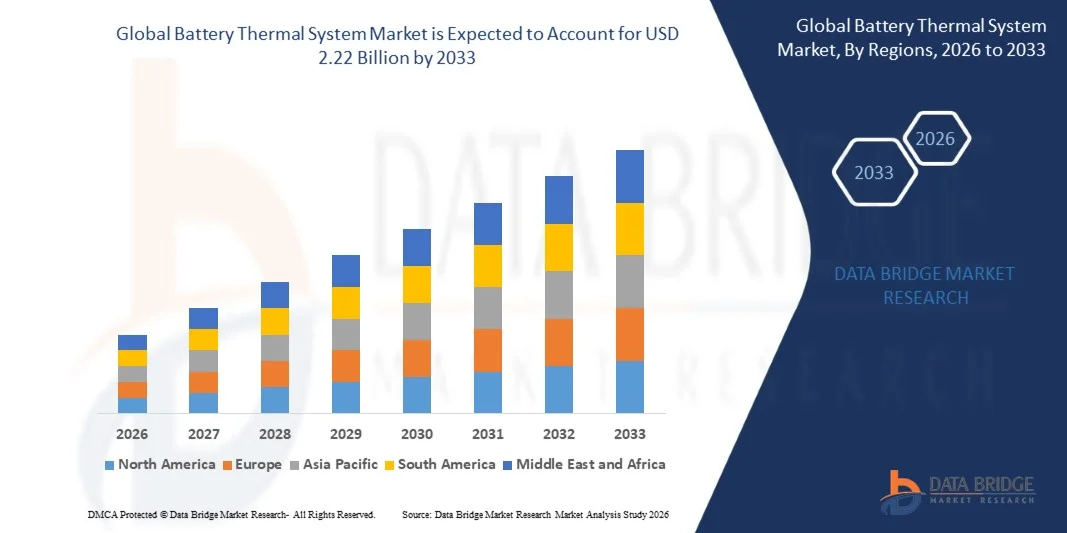
As per Data Bridge Market Research Analysis the battery thermal system market was valued at USD 1.69 billion in 2025 and is projected to reach USD 2.22 billion by 2033, growing at a CAGR of 3.50% from 2026 to 2033. The market is witnessing steady growth, driven by the rising production and adoption of electric vehicles (EVs), increasing demand for high-performance battery systems, and stringent regulations aimed at reducing vehicle emissions. Battery thermal systems play a critical role in maintaining optimal battery operating temperatures, enhancing battery efficiency, extending service life, improving charging performance, and ensuring vehicle safety under varying climatic conditions.
Furthermore, the rapid expansion of the electric mobility ecosystem, investments in fast-charging infrastructure, and advancements in lithium-ion and next-generation solid-state battery technologies are creating significant opportunities for market participants. Automakers and thermal management solution providers are increasingly focusing on developing advanced liquid cooling systems, intelligent thermal control technologies, lightweight heat exchangers, electric compressors, and energy-efficient thermal management components to improve vehicle range and battery durability. In addition, growing investments in battery manufacturing facilities, government incentives supporting EV adoption, and continuous technological innovations in thermal management systems are expected to strengthen market growth throughout the forecast period. The increasing integration of battery thermal systems in battery electric vehicles (BEVs), plug-in hybrid electric vehicles (PHEVs), hybrid electric vehicles (HEVs), fuel cell electric vehicles (FCEVs), and commercial electric vehicles will further support the expansion of the global battery thermal system market during the forecast period.
Market Size & Forecast
- Market Value (2025): 1.69 Billion
- Expected Market Value (2033): USD 2.22 Billion
- Forecast CAGR (2026–2033): 3.50%
- Leading Region in 2025: Asia-Pacific
- Fastest Growing Region: North America
Key Market Trends & Insights
- Asia-Pacific dominated the battery thermal system market with the largest revenue share in 2025. The region's leadership is supported by its strong electric vehicle manufacturing ecosystem, large-scale battery cell production, and the presence of major automotive OEMs and battery manufacturers across China, Japan, South Korea, and India.
- North America battery thermal system market is expected to witness the fastest growth rate from 2026 to 2033, primarily driven by expanding EV manufacturing, increasing investments in battery giga factories, favourable government policies supporting electrification, and the growing deployment of fast-charging infrastructure.
- The battery electric vehicle (BEV) segment held the largest market revenue share in 2025, driven by the increasing production and sales of fully electric passenger vehicles. BEVs require advanced thermal management systems to maintain battery temperature during high-power charging and discharging cycles, improve battery lifespan, and ensure operational safety.
- The fuel cell electric vehicle (FCEV) segment is expected to witness the fastest growth during the forecast period from 2026 to 2033, driven by increasing investments in hydrogen mobility, expanding fuel cell vehicle deployment, and supportive government initiatives promoting zero-emission transportation. Growing adoption of hydrogen-powered buses, trucks, and commercial fleets is expected to accelerate demand for advanced battery thermal management technologies.
- The heat exchanger segment held the largest market revenue share in 2025, driven by its critical role in liquid-cooled battery thermal systems for maintaining uniform battery temperatures, improving charging efficiency, and preventing thermal runaway. Increasing adoption of liquid cooling architectures by global automakers continues to strengthen demand for advanced heat exchangers.
- The electric water pump segment is expected to witness the fastest growth during the forecast period from 2026 to 2033, driven by increasing electrification of vehicle thermal management systems and growing demand for intelligent, energy-efficient cooling solutions. Rising adoption of electronically controlled cooling technologies in electric and hybrid vehicles is expected to further support segment growth.
Report Scope and Battery Thermal System Market Segmentation
|
Attributes |
Battery Thermal System Key Market Insights |
|
Segments Covered |
|
|
Countries Covered |
North America
Europe
Asia-Pacific
Middle East and Africa
South America
|
|
Key Market Players |
|
|
Market Opportunities |
|
|
Value Added Data Infosets |
In addition to the market insights such as market value, growth rate, market segments, geographical coverage, market players, and market scenario, the market report curated by the Data Bridge Market Research team includes in-depth expert analysis, import/export analysis, pricing analysis, production consumption analysis, and pestle analysis. |
Battery Thermal System Market Trend
Trend: Growing Adoption of Advanced Liquid Cooling and Intelligent Battery Thermal Management Systems in Electric Vehicles
The battery thermal system market is witnessing rapid technological advancements as automotive manufacturers increasingly adopt advanced liquid cooling systems, immersion cooling technologies, and intelligent battery thermal management solutions to improve battery safety, charging performance, and operational efficiency. The growing adoption of battery electric vehicles (BEVs), plug-in hybrid electric vehicles (PHEVs), and commercial EVs is driving demand for efficient thermal management systems that enhance battery life and prevent thermal runaway.
Automotive OEMs and thermal system suppliers are investing in heat exchangers, electric compressors, electric water pumps, and integrated thermal management architectures to improve energy efficiency, vehicle range, and battery reliability. These innovations are accelerating the adoption of next-generation battery thermal systems across the electric mobility ecosystem.
For instance, in September 2024, Valeo expanded its Immersive EV Battery Cooling System for ultra-fast charging (250 kW and above). The solution improves battery temperature uniformity, reduces thermal runaway risk, extends battery life, and lowers the cooling system's carbon footprint by up to 50% compared with conventional aluminum cooling systems.
Overall, continuous advancements in battery cooling technologies and intelligent thermal management solutions are expected to support safer, more efficient, and higher-performance electric vehicles, driving long-term market growth.
Battery Thermal System Market Dynamics
Key Market Driver: Rising Adoption of Advanced Battery Thermal Management Systems Across Electric Vehicles
The battery thermal system market is witnessing significant growth due to the rapid adoption of electric vehicles (EVs) and increasing demand for efficient battery thermal management solutions that improve battery safety, performance, and operational lifespan. As battery energy density and fast-charging capabilities continue to advance, maintaining batteries within their optimal operating temperature range has become critical for maximizing driving range, extending battery life, and preventing thermal runaway.
Consequently, automotive OEMs are increasingly integrating liquid cooling systems, battery cold plates, heat exchangers, electric water pumps, and intelligent thermal control technologies into next-generation electric vehicles. Furthermore, rising investments in EV battery manufacturing, charging infrastructure, and high-performance battery technologies are accelerating the deployment of advanced battery thermal systems across passenger and commercial electric vehicles.
For instance, Dana Incorporated has expanded its portfolio of battery cooling technologies for hybrid and battery electric vehicles through its Battery Cold Plate and InterCell Battery Cooling Plate solutions. These technologies provide uniform battery temperature distribution, enhance fast-charging performance, improve battery durability, and support high-energy-density lithium-ion battery packs used in modern electric vehicles. Dana's latest battery cooling specification highlights customized liquid-cooled solutions designed for next-generation EV platforms.
Overall, the increasing electrification of the automotive industry and continuous advancements in battery cooling technologies are expected to drive sustained demand for advanced battery thermal management systems throughout the forecast period.
Key Restraint/Challenge: Increasing Design Complexity and Stringent Performance Requirements for Advanced Battery Thermal Management Systems
The battery thermal system market faces significant challenges due to the increasing complexity of developing thermal management solutions for high-energy-density batteries, ultra-fast charging, and next-generation electric vehicles. Manufacturers must optimize battery cooling systems to ensure uniform temperature distribution, improve charging efficiency, extend battery life, and prevent thermal runaway while minimizing vehicle weight and energy consumption. In addition, integrating advanced components such as liquid cooling plates, heat exchangers, electric compressors, electric water pumps, and intelligent thermal controllers increases engineering complexity, manufacturing costs, and system integration challenges.
For instance, in January 2025, MAHLE showcased its latest thermal management innovations at CES 2025, including a bionic battery cooling plate and bionic fan for battery electric vehicles (BEVs) and fuel cell electric vehicles (FCEVs). The company emphasized that next-generation EV platforms require increasingly sophisticated thermal management technologies to improve cooling efficiency, reduce noise, and support high-performance batteries.
Overall, the increasing demand for safer, more efficient, and high-performance battery systems is significantly increasing the complexity of battery thermal management design. Manufacturers must continuously innovate to balance cooling performance, energy efficiency, system integration, and cost-effectiveness while meeting stringent automotive safety and reliability standards
Key Market Opportunity: Expanding Adoption of Advanced Battery Thermal Management Solutions for Next-Generation Electric Vehicles
The rapid expansion of the electric vehicle (EV) industry, increasing investments in battery manufacturing facilities, and the deployment of high-power charging infrastructure are creating significant growth opportunities for the battery thermal system market. As global automakers continue to develop high-energy-density lithium-ion and next-generation battery technologies, the demand for advanced thermal management systems capable of improving battery safety, charging efficiency, and operational lifespan is increasing. Furthermore, the growing production of battery electric vehicles (BEVs), plug-in hybrid electric vehicles (PHEVs), commercial EVs, and off-highway electric vehicles is encouraging manufacturers to invest in innovative battery cooling technologies, high-voltage coolant heaters, electric compressors, heat exchangers, and intelligent thermal management solutions. These developments are creating substantial opportunities for battery thermal system manufacturers to strengthen their product portfolios and expand their presence across the rapidly evolving electrification ecosystem.
For instance, in April 2025, BorgWarner showcased its latest electric mobility technologies at the Advanced Clean Transportation (ACT) Expo 2025, highlighting a comprehensive portfolio of commercial EV solutions, including the iM-575 integrated inverter-motor drive module, battery systems, eFans, eHeaters, High Voltage Air Heaters, and eCoolers. The company emphasized that these advanced thermal management technologies are designed to improve battery efficiency, vehicle performance, and sustainability while supporting the evolving requirements of commercial electric vehicles.
The accelerating transition toward electric mobility, coupled with continuous advancements in battery cooling technologies and increasing investments in EV infrastructure, is expected to create substantial opportunities for battery thermal system manufacturers. Companies that focus on innovative, energy-efficient, and high-performance thermal management solutions are likely to strengthen their competitive position and benefit from the expanding global electric vehicle market.
Battery Thermal System Market Scope
The battery thermal system market is segmented on the basis of battery capacity, battery type, ICE vehicle type, technology, electric vehicle type, and component.
- By Battery Capacity
On the basis of battery capacity, the global battery thermal system market is segmented into <100 kWh, 100–200 kWh, 200–500 kWh, and >500 kWh. The <100 kWh segment dominated the market in 2025, owing to its widespread adoption in passenger battery electric vehicles (BEVs) and plug-in hybrid electric vehicles (PHEVs). Most electric passenger cars are equipped with battery packs below 100 kWh, driving strong demand for efficient thermal management systems to maintain optimal battery temperature, improve charging performance, extend battery lifespan, and enhance vehicle safety. The increasing production of compact and mid-size electric vehicles further supports the segment's leading position.
The 200–500 kWh segment is expected to witness the fastest growth rate from 2026 to 2033, driven by the rapid electrification of commercial vehicles, electric buses, medium- and heavy-duty trucks, and off-highway equipment. Larger battery packs generate higher thermal loads during operation and ultra-fast charging, increasing the demand for advanced liquid cooling systems, heat exchangers, electric compressors, and intelligent battery thermal management solutions. Growing investments in commercial fleet electrification and high-capacity battery technologies are expected to further accelerate segment growth throughout the forecast period.
- By Battery Type
On the basis of battery type, the global battery thermal system market is segmented into conventional batteries and solid-state batteries. The conventional batteries segment held the largest market revenue share in 2025, driven by the widespread adoption of lithium-ion batteries across battery electric vehicles (BEVs), plug-in hybrid electric vehicles (PHEVs), and hybrid electric vehicles (HEVs). Conventional batteries require efficient thermal management systems to maintain optimal operating temperatures, improve charging efficiency, prevent thermal runaway, and extend battery life. The well-established manufacturing ecosystem and increasing global EV production continue to support the segment's leading position.
The solid-state batteries segment is expected to witness the fastest growth during the forecast period from 2026 to 2033, driven by increasing investments in next-generation battery technologies offering higher energy density, enhanced safety, faster charging capabilities, and longer operational life. As automotive manufacturers and battery developers accelerate the commercialization of solid-state batteries, demand for advanced battery thermal management systems capable of precise temperature control and optimized battery performance is expected to increase significantly, supporting rapid segment growth.
- By ICE Vehicle Type
On the basis of ICE vehicle type, the global battery thermal system market is segmented into passenger car, light commercial vehicle (LCV), truck, and bus. The passenger car segment held the largest market revenue share in 2025, driven by the high production and sales of passenger vehicles equipped with advanced start-stop systems, 48V mild hybrid systems, and hybrid powertrains that require effective battery thermal management. Increasing consumer demand for improved fuel efficiency, lower emissions, and enhanced vehicle performance has accelerated the integration of battery thermal systems in passenger cars, supporting the segment's leading market position.
The truck segment is expected to witness the fastest growth during the forecast period from 2026 to 2033, driven by increasing electrification of commercial transportation, rising adoption of hybrid and electric heavy-duty trucks, and stringent emission regulations across major economies. Heavy-duty trucks require advanced battery thermal management solutions to maintain battery performance, improve durability, and ensure reliable operation under demanding driving conditions. Growing investments in commercial fleet electrification and sustainable logistics are expected to further accelerate segment growth throughout the forecast period.
- By Technology
On the basis of technology, the global battery thermal system market is segmented into active transmission warm up, EGR, engine thermal mass reduction, reduced HVAC system loading, and others.The reduced HVAC system loading segment held the largest market revenue share in 2025, driven by the increasing adoption of energy-efficient thermal management strategies that minimize the power consumption of heating, ventilation, and air conditioning (HVAC) systems. Reducing HVAC energy demand improves battery efficiency, extends driving range, and optimizes overall vehicle energy consumption, making it a preferred technology in battery electric vehicles (BEVs), hybrid electric vehicles (HEVs), and plug-in hybrid electric vehicles (PHEVs). Growing emphasis on maximizing vehicle efficiency and complying with stringent emission regulations continues to support the segment's leading market position.
The engine thermal mass reduction segment is expected to witness the fastest growth during the forecast period from 2026 to 2033, driven by increasing demand for lightweight and energy-efficient thermal management solutions in hybrid and internal combustion engine (ICE) vehicles. This technology enables faster engine warm-up, reduces fuel consumption and emissions, and improves overall thermal efficiency by minimizing unnecessary heat losses. Rising investments in advanced thermal management technologies and fuel-efficient vehicle platforms are expected to further accelerate segment growth during the forecast period.
- By Electric Vehicle Type
On the basis of electric vehicle type, the global battery thermal system market is segmented into battery electric vehicle (BEV), hybrid electric vehicle (HEV), plug-in hybrid electric vehicle (PHEV), fuel cell electric vehicle (FCEV), and 48V mild hybrid vehicle. The battery electric vehicle (BEV) segment held the largest market revenue share in 2025, driven by the rapid increase in global BEV production and sales, rising government incentives for zero-emission vehicles, and growing investments in battery manufacturing and charging infrastructure. BEVs rely on high-capacity battery packs, making advanced battery thermal management systems essential for maintaining optimal operating temperatures, enabling fast charging, improving battery efficiency, preventing thermal runaway, and extending battery lifespan.
The fuel cell electric vehicle (FCEV) segment is expected to witness the fastest growth during the forecast period from 2026 to 2033, driven by increasing investments in hydrogen mobility, expanding fuel cell vehicle deployment, and supportive government initiatives promoting zero-emission transportation. Fuel cell electric vehicles require advanced thermal management systems to regulate the operating temperature of both the fuel cell stack and high-voltage battery, ensuring optimal efficiency, durability, and performance.
- By Component
On the basis of component, the global battery thermal system market is segmented into air filter, condenser, compressor, water pump, motor, heat exchanger, heater control unit, thermoelectric generator, electric compressor, electric water pump, and electric motor. The heat exchanger segment held the largest market revenue share in 2025, driven by its critical role in regulating battery temperatures by efficiently transferring heat between the battery pack and the cooling medium. Heat exchangers are widely integrated into liquid-cooled battery thermal management systems used in battery electric vehicles (BEVs), plug-in hybrid electric vehicles (PHEVs), and fuel cell electric vehicles (FCEVs), ensuring optimal battery performance, fast-charging capability, improved safety, and extended battery lifespan. The growing adoption of high-energy-density battery packs and advanced liquid cooling architectures continues to strengthen demand for heat exchangers.
The electric water pump segment is expected to witness the fastest growth during the forecast period from 2026 to 2033, driven by increasing electrification of vehicle thermal management systems and rising demand for intelligent, energy-efficient cooling solutions. Electric water pumps provide precise coolant flow control based on battery temperature and operating conditions, improving thermal efficiency while reducing energy consumption compared to conventional mechanical pumps. Growing adoption of electric and hybrid vehicles, along with increasing demand for compact and electronically controlled thermal management systems, is expected to further accelerate segment growth during the forecast period.
Battery Thermal System Market Analysis
Asia-Pacific Battery Thermal System Market Insight
Asia-Pacific dominated the battery thermal system market with the largest revenue share in 2025. The region's leadership is supported by its strong electric vehicle manufacturing ecosystem, large-scale battery cell production, and the presence of major automotive OEMs and battery manufacturers across China, Japan, South Korea, and India. China remains the world's largest producer of EV batteries and battery cells, driving robust demand for advanced battery thermal management systems. Rising investments in battery gigafactories, expanding EV production, and supportive government initiatives promoting vehicle electrification continue to strengthen the regional market, reinforcing Asia-Pacific's position as the leading hub for battery thermal management technologies.
Japan Battery Thermal System Market Insight
Japan is expected to witness the fastest growth rate from 2026 to 2033, supported by globally recognized automotive manufacturers and leading thermal management suppliers such as DENSO Corporation, MAHLE, and Valeo Japan. The country continues to invest in next-generation battery technologies, including solid-state batteries, while government initiatives promoting carbon neutrality and vehicle electrification are encouraging the adoption of advanced battery thermal management systems. Increasing R&D activities and collaborations between automotive OEMs and battery manufacturers are expected to support long-term market growth.
China Battery Thermal System Market Insight
China dominated the battery thermal system market with the largest revenue share in 2025, supported by its position as the world's largest electric vehicle producer and battery manufacturer. Continuous investments in battery gigafactories, high-power charging infrastructure, and advanced battery technologies are driving demand for liquid cooling systems, battery heat exchangers, and intelligent thermal management solutions. Strong government support for vehicle electrification and the presence of major battery and automotive manufacturers continue to reinforce China's leadership in the battery thermal system market.
North America Battery Thermal System Market Insight
North America battery thermal system market is expected to witness the fastest growth rate from 2026 to 2033, primarily driven by expanding electric vehicle (EV) manufacturing, increasing investments in battery gigafactories, favorable government policies supporting vehicle electrification, and the growing deployment of fast-charging infrastructure across the U.S. and Canada. Rising demand for advanced battery cooling technologies, coupled with the expansion of domestic battery production and EV supply chains, is expected to accelerate the adoption of battery thermal management systems throughout the region.
U.S. Battery Thermal System Market Insight
The U.S. held the largest share of the North America battery thermal system market in 2025, supported by its strong electric vehicle manufacturing base, expanding battery gigafactory capacity, and the presence of leading automotive OEMs and battery technology companies. Favorable government policies promoting domestic battery production, vehicle electrification, and charging infrastructure continue to accelerate the adoption of advanced battery thermal management systems across passenger and commercial electric vehicles.
Europe Battery Thermal System Market Insight
Europe is expected to witness the fastest growth rate from 2026 to 2033, driven by stringent vehicle emission regulations, increasing electric vehicle (EV) adoption, and substantial investments in battery manufacturing and charging infrastructure. Countries such as Germany, France, and the U.K. continue to lead the regional market through expanding EV production and strong government support for vehicle electrification.
Germany Battery Thermal System Market Insight
Germany is expected to witness the fastest growth rate from 2026 to 2033, supported by its strong automotive manufacturing base, increasing production of battery electric vehicles (BEVs), and significant investments in battery cell manufacturing and EV supply chains. The country is home to leading automotive OEMs and thermal management suppliers such as Volkswagen Group, BMW Group, Mercedes-Benz Group, Bosch, MAHLE, and Continental, which continue to invest in advanced battery thermal management technologies. Rising demand for high-performance battery systems, coupled with expanding battery gigafactory projects and government support for vehicle electrification, is expected to further strengthen market growth during the forecast period.
U.K. Battery Thermal System Market Insight
The U.K. is expected to witness the fastest growth rate from 2026 to 2033, driven by increasing electric vehicle (EV) adoption, expanding investments in battery manufacturing, and strong government support for vehicle electrification. The country's growing focus on net-zero emissions, development of battery gigafactories, and expansion of public charging infrastructure are accelerating the demand for advanced battery thermal management systems across passenger and commercial electric vehicles.
Battery Thermal System Market Share
The battery thermal system industry is primarily led by well-established companies, including:
- Robert Bosch GmbH (Germany)
- DENSO Corporation (Japan)
- Valeo (France)
- MAHLE GmbH (Germany)
- Hanon Systems (South Korea)
- Dana Incorporated (U.S.)
- Modine Manufacturing Company (U.S.)
- BorgWarner Inc. (U.S.)
- Gentherm Incorporated (U.S.)
- Continental AG (Germany)
- VOSS Automotive GmbH (Germany)
- Zhejiang Sanhua Automotive Components Co., Ltd. (China)
- Marelli Holdings Co., Ltd. (Japan)
- Boyd Corporation (U.S.)
- AVL List GmbH (Austria)
- Grayson Thermal Systems (U.K.)
- TitanX Engine Cooling AB (Sweden)
- AKG Group (Germany)
- Schaeffler AG (Germany)
- Eberspächer Group (Germany)
Latest Developments in Battery Thermal System Market
- In March 2025, Robert Bosch introduced an advanced battery thermal management platform equipped with high-efficiency liquid cooling modules, integrated heat exchangers, and battery management system (BMS)-enabled thermal control units. The solution is designed to enhance battery safety, optimize thermal stability and energy efficiency, and support deployment across passenger electric vehicles, electric SUVs, and light commercial EVs.
- In February 2025, DENSO Corporation expanded its battery thermal management portfolio by launching compact liquid- and air-cooling modules, sensor-integrated thermal control units, and modular BMS-compatible solutions. These innovations are intended to improve battery performance, extend battery lifespan, and strengthen adoption among automotive OEMs and commercial fleet operators.
- In January 2025, BorgWarner enhanced its battery thermal management portfolio with high-performance cooling modules, advanced heat exchangers, and intelligent BMS-integrated thermal control systems for passenger and commercial electric vehicles. The upgraded solutions are focused on improving battery efficiency, operational reliability, and large-scale integration across next-generation EV platforms.
- In December 2024, Valeo launched an advanced battery thermal management platform featuring high-efficiency liquid cooling technology, integrated heat exchangers, and predictive thermal control capabilities. The platform is designed to improve battery safety, minimize thermal degradation, and support enhanced performance across passenger electric vehicles, electric SUVs, and commercial EV platforms.

- Interactive Data Analysis Dashboard
- Company Analysis Dashboard for high growth potential opportunities
- Research Analyst Access for customization & queries
- Competitor Analysis with Interactive dashboard
- Latest News, Updates & Trend analysis
- Harness the Power of Benchmark Analysis for Comprehensive Competitor Tracking
Data collection and base year analysis are done using data collection modules with large sample sizes. The stage includes obtaining market information or related data through various sources and strategies. It includes examining and planning all the data acquired from the past in advance. It likewise envelops the examination of information inconsistencies seen across different information sources. The market data is analysed and estimated using market statistical and coherent models. Also, market share analysis and key trend analysis are the major success factors in the market report. To know more, please request an analyst call or drop down your inquiry.
The key research methodology used by DBMR research team is data triangulation which involves data mining, analysis of the impact of data variables on the market and primary (industry expert) validation. Data models include Vendor Positioning Grid, Market Time Line Analysis, Market Overview and Guide, Company Positioning Grid, Patent Analysis, Pricing Analysis, Company Market Share Analysis, Standards of Measurement, Global versus Regional and Vendor Share Analysis. To know more about the research methodology, drop in an inquiry to speak to our industry experts.
Data Bridge Market Research is a leader in advanced formative research. We take pride in servicing our existing and new customers with data and analysis that match and suits their goal. The report can be customized to include price trend analysis of target brands understanding the market for additional countries (ask for the list of countries), clinical trial results data, literature review, refurbished market and product base analysis. Market analysis of target competitors can be analyzed from technology-based analysis to market portfolio strategies. We can add as many competitors that you require data about in the format and data style you are looking for. Our team of analysts can also provide you data in crude raw excel files pivot tables (Fact book) or can assist you in creating presentations from the data sets available in the report.













