


Bayesian Optimization Tools Market Size
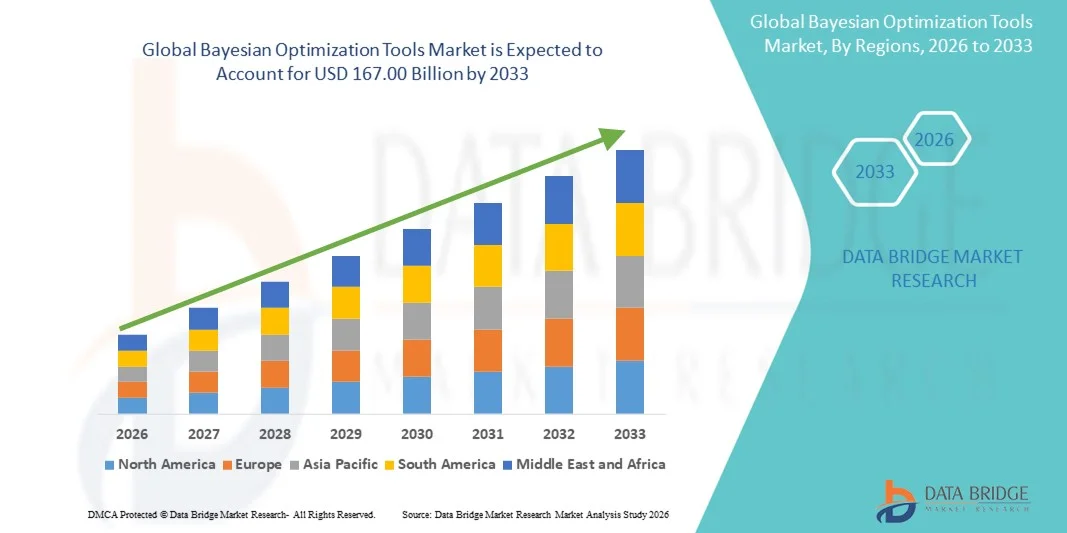
- The global Bayesian Optimization Tools market size was valued at USD 44.55 billion in 2025 and is expected to reach USD 167.00 billion by 2033, at a CAGR of 17.96% during the forecast period
- The market growth is largely fueled by the increasing adoption of advanced machine learning, AI-driven modeling, and automated hyperparameter tuning across industries such as healthcare, finance, manufacturing, and autonomous systems, as organizations seek faster and more accurate optimization of complex models
- Furthermore, rising demand for scalable, user-friendly, and high-performance optimization frameworks is positioning Bayesian Optimization Tools as a preferred solution for accelerating R&D workflows, reducing computational costs, and improving decision-making accuracy. These converging factors are significantly boosting the uptake of Bayesian Optimization Tools solutions and driving substantial industry growth
Bayesian Optimization Tools Market Analysis
- Bayesian optimization tools, designed to automate the optimization of complex functions and hyperparameters in machine learning models, are becoming increasingly vital components of modern AI and data science workflows across industries due to their ability to improve model accuracy, reduce computational costs, and streamline decision-making processes
- The escalating demand for Bayesian optimization tools is primarily fueled by the rapid adoption of AI/ML technologies, rising complexity in model architectures, and the growing need for automated, precise, and efficient optimization methods that outperform traditional trial-and-error or grid-search-based techniques
- North America dominated the Bayesian Optimization Tools market with the largest revenue share of 35% in 2025, characterized by early AI adoption, strong R&D investment, and a concentrated presence of leading technology companies. The U.S. experienced substantial growth in Bayesian optimization deployments, particularly across sectors such as autonomous systems, healthcare analytics, fintech, and cloud-based machine learning platforms, driven by innovations from both established AI firms and emerging optimization-focused startups
- Asia-Pacific is expected to be the fastest-growing region in the Bayesian Optimization Tools market during the forecast period, supported by expanding digital transformation initiatives, increasing investments in AI research, rapid growth of cloud computing, and rising demand for automated model optimization in countries such as China, Japan, India, and South Korea
- The Cloud-Based segment dominated the largest market revenue share of 54.6% in 2025, driven by its scalability, low upfront cost, and easy integration with existing AI/ML pipelines
Report Scope and Bayesian Optimization Tools Market Segmentation
|
Attributes |
Bayesian Optimization Tools Key Market Insights |
|
Segments Covered |
|
|
Countries Covered |
North America
Europe
Asia-Pacific
Middle East and Africa
South America
|
|
Key Market Players |
• IBM (U.S.) |
|
Market Opportunities |
|
|
Value Added Data Infosets |
In addition to the insights on market scenarios such as market value, growth rate, segmentation, geographical coverage, and major players, the market reports curated by the Data Bridge Market Research also include in-depth expert analysis, patient epidemiology, pipeline analysis, pricing analysis, and regulatory framework. |
Bayesian Optimization Tools Market Trends
Enhanced Convenience Through AI-Driven Optimization and Workflow Automation
- A significant and accelerating trend in the global Bayesian Optimization Tools market is the increasing integration of advanced AI-based optimization engines into broader data science, machine learning, and enterprise automation workflows. Companies across industries are adopting Bayesian Optimization Tools to streamline hyperparameter tuning, accelerate experimentation cycles, and enhance model performance with minimal manual intervention
- For instance, in March 2024, Google Cloud expanded Vertex AI’s Hyperparameter Tuning service by integrating enhanced Bayesian optimization algorithms, enabling enterprises to reduce model training time and improve experimentation efficiency across large datasets
- Bayesian Optimization Tools are increasingly leveraging probabilistic modeling, surrogate functions, and intelligent sampling strategies (such as Gaussian Processes, Tree-based models, and multi-objective optimization). These innovations allow enterprises to evaluate thousands of parameter combinations efficiently, reduce computation cost, and accelerate deployment timelines—especially within deep learning, financial modeling, robotics, material design, and pharmaceutical research
- The seamless integration of Bayesian optimization with MLOps, workflow orchestration platforms, and cloud-native environments enables enterprises to automate experimentation, manage large-scale trials, and optimize complex systems from a unified interface. This is reshaping user expectations toward end-to-end optimization rather than isolated model tuning
- As organizations demand more intelligent, scalable, and automated optimization capabilities, software providers are developing next-generation Bayesian optimization frameworks with features such as multi-fidelity optimization, distributed sampling, adaptive experimentation, and reinforcement-learning-driven tuning
- The demand for advanced Bayesian Optimization Tools is rising rapidly across R&D, AI/ML engineering, biotech, materials science, finance, and automated decision-making environments, as enterprises prioritize improved accuracy, reduced computing costs, and faster development cycles
Bayesian Optimization Tools Market Dynamics
Driver
Growing Need for Efficient Hyperparameter Tuning and Automated Model Optimization
- The increasing complexity of machine learning models, particularly deep learning architectures, is driving strong demand for Bayesian Optimization Tools, which offer systematic, efficient, and automated ways to identify optimal model parameters without exhaustive experimentation
- For instance, in July 2023, Amazon Web Services integrated advanced Bayesian optimization techniques into Amazon SageMaker’s Automatic Model Tuning module, allowing developers to improve model accuracy by up to 40% while cutting tuning time significantly
- As organizations prioritize accuracy, performance, and reduced training time, Bayesian optimization enables enhanced model tuning through probabilistic modeling, reducing computational cost relative to grid search or random search
- Furthermore, the growing adoption of AI systems and the need for scalable experimentation platforms in industries such as healthcare, automotive, finance, and chemicals are making Bayesian optimization an essential component of enterprise AI ecosystems
- The convenience of automated tuning, reduced runtime, resource-efficient exploration of search spaces, and integration with cloud-based machine learning pipelines are key factors propelling the adoption of Bayesian Optimization Tools across enterprises globally
Restraint/Challenge
High Computational Complexity and Lack of Skilled Workforce
- Despite its advantages, Bayesian optimization can face scalability challenges when modeling high-dimensional or extremely dynamic parameter spaces, particularly when relying on Gaussian Process-based approaches. These computational limitations can restrict adoption for very large models or rapidly changing objective landscapes
- For instance, in February 2022, a study by the Alan Turing Institute highlighted that traditional Gaussian Process–based Bayesian optimization methods show significant computational slowdown in high-dimensional AI research settings, limiting efficient experimentation for complex deep learning tasks
- In addition, many organizations lack personnel with expertise in probabilistic modeling, surrogate-based optimization, and advanced AI workflows, making implementation more complex compared to simpler tuning methods. This skill gap can slow deployment and hinder broader market penetration
- Addressing these challenges requires ongoing advancements in scalable Bayesian optimization techniques, including trust-region methods, high-dimensional sampling strategies, and hybrid surrogate models
- Another challenge is the relatively high initial cost associated with integrating advanced optimization frameworks into enterprise-level AI infrastructure. Companies may need to invest in specialized software, computational resources, and training for technical teams
- While costs are gradually decreasing, the perceived complexity and resource requirements of Bayesian optimization can still hinder adoption among organizations with limited technical capabilities or small AI teams
- Overcoming these barriers through scalable algorithms, simplified interfaces, cloud-native APIs, and workforce upskilling will be essential for sustained market growth in the Bayesian Optimization Tools industry
Bayesian Optimization Tools Market Scope
The market is segmented on the basis of type, deployment model, and application.
- By Type
On the basis of type, the Bayesian Optimization Tools market is segmented into Cloud-Based, On-Premise, and Hybrid. The Cloud-Based segment dominated the largest market revenue share of 54.6% in 2025, driven by its scalability, low upfront cost, and easy integration with existing AI/ML pipelines. Cloud platforms allow real-time optimization and rapid experimentation, supporting data science teams across industries. Enterprises prefer cloud-based Bayesian tools due to seamless collaboration and automated updates. The shift toward digital transformation in BFSI, healthcare, and automotive fuels cloud adoption. Increasing reliance on cloud-native ML frameworks strengthens the segment. Cloud-based vendors benefit from subscription models, boosting recurring revenue. High demand for distributed computing and large-scale hyperparameter tuning contributes to dominance. Cloud tools support API-based deployment, enabling faster implementation. Data governance features reassure enterprises regarding security. Cloud platforms also pair well with AutoML systems. This strong utility secures their leading share.
The Hybrid segment is anticipated to witness the fastest growth rate of 15.8% CAGR from 2026 to 2033, fueled by rising demand for flexible architectures that combine cloud efficiency with on-premise security. Hybrid environments support sensitive workloads, especially in regulated sectors like healthcare and BFSI. Organizations adopt hybrid solutions to maintain local data control while leveraging cloud scalability. Growing emphasis on compliance frameworks drives hybrid adoption. Vendor offerings increasingly support hybrid orchestration for ML workflows. Hybrid tools enable enterprises to perform experimentation locally and scale tuning tasks to the cloud. Improved integration middleware accelerates growth. Large enterprises transitioning from legacy systems prefer hybrid models. Cross-environment optimization boosts adoption. IT modernization initiatives further support the segment. As AI adoption matures, hybrid deployments deliver cost and performance balance.
- By Deployment Model
On the basis of deployment model, the Bayesian Optimization Tools market is segmented into Standalone, Integrated, and Others. The Integrated segment dominated the largest market revenue share of 48.3% in 2025, driven by its ability to embed Bayesian optimization within broader ML platforms and enterprise analytics systems. Integrated solutions reduce workflow friction for data scientists. Organizations prefer unified platforms that combine model development, tuning, and monitoring. Integration enables seamless connection with AutoML, deep learning frameworks, and MLOps pipelines. Vendors increasingly package Bayesian tools within AI suites, boosting adoption. Enterprises value reduced operational complexity. Integrated systems allow multi-team collaboration. They also improve experimentation traceability and governance. The growing shift toward end-to-end AI platforms strengthens the segment. Integration capabilities reduce deployment time. The flexibility to plug into cloud and hybrid workflows enhances appeal. This strong ecosystem support establishes dominance.
The Standalone segment is expected to witness the fastest CAGR of 14.9% from 2026 to 2033, driven by rising demand for lightweight, customizable Bayesian optimization engines. Startups and research institutions favor standalone tools for flexibility and experimentation control. Standalone systems offer faster adoption without heavy enterprise architecture dependencies. Open-source innovation accelerates the segment’s growth. Developers prefer standalone packages for hyperparameter tuning in deep learning and reinforcement learning environments. The segment benefits from lower cost and high adaptability. Standalone tools enable on-demand integration through APIs. Their simplicity attracts small and mid-sized organizations. Increasing experimental workloads in academia supports adoption. Standalone optimization tools pair well with cutting-edge research. Growing interest in fine-tuning LLMs and generative models amplifies demand. This combination drives the highest CAGR.
- By Application
On the basis of application, the Bayesian Optimization Tools market is segmented into Automotive, Healthcare, BFSI, IT & Telecom, Manufacturing, and Others. The IT & Telecom segment accounted for the largest market revenue share of 32.7% in 2025, fueled by high demand for hyperparameter tuning in complex ML models used for network optimization, fraud detection, and predictive analytics. IT enterprises rely on Bayesian tools to automate experimentation and accelerate model development cycles. Telecom providers use Bayesian optimization for resource allocation, network planning, and signal performance improvement. The rising need for AI-driven automation strengthens segment dominance. The surge in cloud-native AI applications enhances adoption. IT teams prefer Bayesian tools due to their high efficiency in handling expensive computations. Growth in LLM deployment increases optimization workloads. Enterprises value faster iteration speed. The need for real-time ML model management further supports dominance. As digital infrastructure expands, the segment maintains its lead.
The Healthcare segment is expected to witness the fastest CAGR of 16.4% from 2026 to 2033, driven by rising use of Bayesian optimization for diagnostic model tuning, personalized treatment modeling, and drug discovery simulations. Hospitals and research institutions adopt Bayesian tools to improve AI pipeline efficiency. Bayesian methods help optimize complex medical imaging algorithms. The growth of precision medicine boosts demand. Healthcare AI developers require efficient hyperparameter tuning for predictive models. Increased investment in clinical AI accelerates adoption. Pharmaceutical companies integrate Bayesian optimization to speed up R&D workflows. Compliance-friendly optimization systems gain traction. Healthcare datasets benefit from sample-efficient Bayesian methods. Growth in digital therapeutics supports expansion. AI-enabled diagnostic tools rely heavily on optimization algorithms, driving the segment’s fastest growth.
Bayesian Optimization Tools Market Regional Analysis
- North America dominated the Bayesian Optimization Tools market with the largest revenue share of 35% in 2025, characterized by early AI adoption, strong R&D investment, and a concentrated presence of leading technology companies
- The market experienced substantial growth in Bayesian optimization deployments, particularly across sectors such as autonomous systems, healthcare analytics, fintech, and cloud-based machine learning platforms
- Driven by innovations from both established AI firms and emerging optimization-focused startups
U.S. Bayesian Optimization Tools Market Insight
The U.S. Bayesian Optimization Tools market captured the largest revenue share of 38% in 2025 within North America, fueled by accelerated adoption of AI-driven optimization in cloud platforms, enterprise software, autonomous systems, and healthcare analytics. Organizations are increasingly leveraging Bayesian optimization tools for hyperparameter tuning, automated model selection, and improved algorithmic efficiency, further propelling the market's growth.
Europe Bayesian Optimization Tools Market Insight
The Europe Bayesian Optimization Tools market is projected to expand at a substantial CAGR throughout the forecast period, driven by increased AI adoption, digitalization across enterprises, and government initiatives supporting technology development. The region is witnessing strong uptake across automotive, manufacturing, and BFSI sectors, with companies prioritizing efficiency gains and predictive analytics.
U.K. Bayesian Optimization Tools Market Insight
The U.K. Bayesian Optimization Tools market is anticipated to grow at a noteworthy CAGR during the forecast period, supported by a robust AI research ecosystem, increasing adoption of cloud-based platforms, and strong presence of technology service providers. Demand is particularly high in fintech, healthcare analytics, and autonomous systems, driving market expansion.
Germany Bayesian Optimization Tools Market Insight
The Germany Bayesian Optimization Tools market is expected to expand at a considerable CAGR during the forecast period, fueled by widespread AI adoption, strong industrial automation initiatives, and investment in R&D for predictive modeling and advanced analytics. Companies in the manufacturing, automotive, and healthcare sectors are rapidly deploying Bayesian optimization tools to improve operational efficiency.
Asia-Pacific Bayesian Optimization Tools Market Insight
The Asia-Pacific Bayesian Optimization Tools market is poised to grow at the fastest CAGR during the forecast period of 2026 to 2033, driven by increasing digitalization, government-led AI initiatives, growing cloud infrastructure, and rising demand for automated and intelligent optimization solutions. Countries such as China, Japan, India, and South Korea are leading adoption, supported by expanding technology ecosystems and increasing investments in AI-driven analytics platforms.
Japan Bayesian Optimization Tools Market Insight
The Japan Bayesian Optimization Tools market is gaining momentum due to the country’s advanced technology adoption, high R&D expenditure, and the rising need for automation in sectors such as manufacturing, automotive, and healthcare. Enterprises are increasingly leveraging Bayesian optimization tools to improve AI model efficiency, predictive maintenance, and operational performance.
China Bayesian Optimization Tools Market Insight
The China Bayesian Optimization Tools market accounted for the largest market revenue share in Asia-Pacific in 2025 at 28%, attributed to rapid AI adoption, digital transformation initiatives, and strong government support for AI and cloud computing infrastructure. Enterprises across fintech, autonomous systems, and healthcare are adopting Bayesian optimization tools for advanced analytics, hyperparameter tuning, and scalable AI deployment.
Bayesian Optimization Tools Market Share
The Bayesian Optimization Tools industry is primarily led by well-established companies, including:
• IBM (U.S.)
• Google LLC (U.S.)
• Microsoft Corporation (U.S.)
• MathWorks (U.S.)
• Oracle Corporation (U.S.)
• Hyperopt (U.S.)
• Optuna (Japan)
• SigOpt (U.S.)
• BayesOpt (Spain)
• Scikit-Optimize – Skopt (France)
• Emukit (U.K.)
• Ax – Meta (U.S.)
• Weights & Biases (U.S.)
• Databricks (U.S.)
• Neptune.ai (Poland)
• DataRobot (U.S.)
• Altair Engineering (U.S.)
Latest Developments in Global Bayesian Optimization Tools Market
- In May 2022, Optuna — a leading open-source hyperparameter-optimization framework — published its v2.0 documentation and supporting materials, marking a major step in maturity and stability for an HPO tool widely used in industry and research; the v2.x series formalized production-grade features (distributed optimization support, improved pruning and samplers) that accelerated adoption of Bayesian/TPE-style optimization in production ML pipelines
- In September 2022, Amazon Web Services announced that Amazon SageMaker Automatic Model Tuning added multi-fidelity tuning with Hyperband and other improvements to speed up and reduce cost for large hyperparameter searches — enhancements built on top of SageMaker’s Bayesian optimization engine and aimed at making Bayesian HPO far faster and more practical for real-world, compute-intensive models
- In August 2023, Google announced a set of Vertex AI enhancements at Google Cloud Next (including improvements around Vizier/Hyperparameter Tuning and AutoML workflows), reinforcing Vertex AI Vizier’s role as a cloud-scale Bayesian/black-box optimizer for enterprises that need automated, production-ready hyperparameter tuning and experiment management
- In July 2023, a series of practical guides and blog posts (and Vertex AI case examples) highlighted how Vizier/Bayesian workflows reduce costly repeated training runs — demonstrating enterprise migration from manual/grid searches toward Bayesian optimization in large-scale workloads and documenting tangible cost/time savings in production ML. These community and vendor case studies helped accelerate adoption across industries
- In October 2024, peer-reviewed and technical literature continued to advance Bayesian-optimization methods (papers and technical reports focusing on scalability, multi-fidelity approaches, and BO for neural-architecture and HPO problems were published), reflecting active R&D that pushed Bayesian tools to handle higher-dimensional problems and integrate with AutoML and MLOps toolchains. This body of work has directly informed both open-source projects (Optuna, BoTorch, Nevergrad) and cloud offerings

- Interactive Data Analysis Dashboard
- Company Analysis Dashboard for high growth potential opportunities
- Research Analyst Access for customization & queries
- Competitor Analysis with Interactive dashboard
- Latest News, Updates & Trend analysis
- Harness the Power of Benchmark Analysis for Comprehensive Competitor Tracking
Data collection and base year analysis are done using data collection modules with large sample sizes. The stage includes obtaining market information or related data through various sources and strategies. It includes examining and planning all the data acquired from the past in advance. It likewise envelops the examination of information inconsistencies seen across different information sources. The market data is analysed and estimated using market statistical and coherent models. Also, market share analysis and key trend analysis are the major success factors in the market report. To know more, please request an analyst call or drop down your inquiry.
The key research methodology used by DBMR research team is data triangulation which involves data mining, analysis of the impact of data variables on the market and primary (industry expert) validation. Data models include Vendor Positioning Grid, Market Time Line Analysis, Market Overview and Guide, Company Positioning Grid, Patent Analysis, Pricing Analysis, Company Market Share Analysis, Standards of Measurement, Global versus Regional and Vendor Share Analysis. To know more about the research methodology, drop in an inquiry to speak to our industry experts.
Data Bridge Market Research is a leader in advanced formative research. We take pride in servicing our existing and new customers with data and analysis that match and suits their goal. The report can be customized to include price trend analysis of target brands understanding the market for additional countries (ask for the list of countries), clinical trial results data, literature review, refurbished market and product base analysis. Market analysis of target competitors can be analyzed from technology-based analysis to market portfolio strategies. We can add as many competitors that you require data about in the format and data style you are looking for. Our team of analysts can also provide you data in crude raw excel files pivot tables (Fact book) or can assist you in creating presentations from the data sets available in the report.













