What is the Beauty-from-Within FMCG Market Size and Overview?
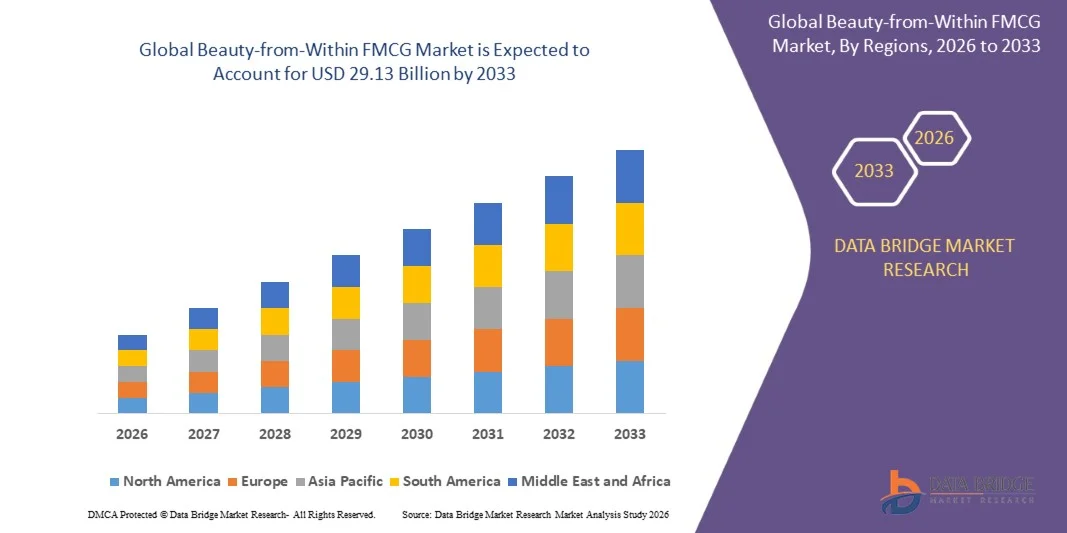
As per Data Bridge Market Research Analysis the beauty FMCG market was valued at USD 10 billion in 2025 and is projected to reach USD 29.13 billion by 2033, growing at a CAGR of 14.30% from 2026 to 2033. The market is experiencing consistent growth driven by rising consumer spending on premium beauty and personal care products, increasing awareness regarding skincare and personal grooming, and growing demand for high-quality formulations with advanced, clean-label ingredients.
The growing consumer preference for premium, personalized, and wellness-focused personal care products, combined with increasing demand for organic, natural, and sustainable formulations, is encouraging manufacturers to expand their premium product portfolios. Rising awareness regarding ingredient transparency—driven by concerns over synthetic chemicals causing skin irritation and allergies—along with the growing influence of social media and digital try-on technologies, is reshaping purchasing behaviour. The rapid growth of e-commerce platforms and direct-to-consumer distribution models is further enhancing product accessibility, helping companies expand their customer base and accelerate market growth.
Market Size & Forecast
- Global Market Value (2025): USD 10 Billion
- Expected Market Value (2033): USD 29.13 Billion
- Forecast CAGR (2026–2033): 14.30%
- Leading Region in 2025: Asia-Pacific
- Fastest Growing Region: North America
What are the Major Takeaways of Beauty-from-Within FMCG Market?
- Asia-Pacific dominated the global Beauty-from-Within FMCG market with the largest revenue share of 40.2% in 2025, supported by a large consumer base, rising disposable incomes, and increasing demand for premium beauty and personal care products.
- North America is expected to be the fastest-growing region at a CAGR of 5.98% from 2026 to 2033, fuelled by rising consumer spending on premium beauty products, increasing demand for personalized skincare, and growing preference for luxury wellness solutions.
- The conventional/synthetic ingredient segment led the market with a 62.4% share in 2025, driven by extensive product availability, established consumer trust, and strong distribution networks.
- Natural/organic is the fastest-growing ingredient type, projected to register a CAGR of 10.6% from 2026 to 2033, supported by rising consumer awareness regarding clean-label beauty products and sustainable consumption—reinforced by a 2025 NSF International study finding that 74% of consumers consider organic ingredients essential in personal care products.
- The skin care segment dominated the product category with a 38.7% revenue share in 2025, led by increasing consumer focus on anti-aging, hydration, skin protection, and premium wellness routines.
- Women accounted for 58.9% of the market in 2025, driven by high spending on premium skincare, cosmetics, fragrances, and haircare products.
- The perfume/fragrances segment is the fastest-growing product category, with a CAGR of 9.8% from 2026 to 2033, driven by increasing consumer preference for luxury self-care products and premium lifestyle experiences.
Report Scope and Beauty-from-Within FMCG Market Segmentation
|
Attributes |
Beauty-from-Within FMCG Key Market Insights |
|
Segments Covered |
|
|
Countries Covered |
North America
Europe
Asia-Pacific
Middle East and Africa
South America
|
|
Key Market Players |
|
|
Market Opportunities |
|
|
Value Added Data Infosets |
In addition to the insights on market scenarios such as market value, growth rate, segmentation, geographical coverage, and major players, the market reports curated by the Data Bridge Market Research also include in-depth expert analysis, pricing analysis, brand share analysis, consumer survey, demography analysis, supply chain analysis, value chain analysis, raw material/consumables overview, vendor selection criteria, PESTLE Analysis, Porter Analysis, and regulatory framework. |
What is the Key Trend in the Beauty-from-Within FMCG Market?
Trend: Rising Demand for Clean-Label and Sustainable Premium Personal Care Products
Consumers are increasingly preferring premium personal care products formulated with natural, organic, vegan, and sustainably sourced ingredients due to growing awareness regarding ingredient transparency, environmental impact, and product safety. Beauty brands are responding by expanding clean-label portfolios, adopting eco-friendly packaging solutions, and reducing the use of synthetic chemicals in premium formulations. A 2025 study by NSF International found that 74% of consumers consider organic ingredients essential in personal care products, reflecting a clear and growing shift toward clean beauty consumption.
Companies such as L'Oréal Groupe have strengthened their sustainability commitments through eco-designed packaging and renewable ingredient programs, while Unilever PLC continues to expand its portfolio of sustainable beauty and personal care products, reinforcing the industry-wide shift toward environmentally responsible premium formulations.
Beauty-from-Within FMCG Market Dynamics
Key Market Driver: Increasing Consumer Spending on Premium Beauty and Personal Grooming Products
Rising disposable incomes, growing beauty consciousness, and increasing focus on self-care are significantly driving demand for premium beauty-from-within and personal care products worldwide. Consumers are increasingly willing to spend on high-performance skincare, premium haircare, luxury fragrances, and advanced nutricosmetic formulations that combine indulgence with visible wellness benefits. Rising influence of social media and beauty influencers is further accelerating product discovery and premiumization trends, with studies indicating that nearly 60% of consumers trust influencer recommendations, driving purchase decisions particularly among younger demographics.
Key Restraint/Challenge: Greenwashing Concerns and Lack of Consumer Trust in Organic Claims
A significant restraint in the global beauty-from-within FMCG market is the widespread issue of greenwashing, were brands falsely market products as natural, organic, or environmentally friendly without adequate substantiation. The lack of standardized regulation around voluntary organic labels has led to growing consumer scepticism, undermining trust in clean-label claims. This challenge is compounded by the high cost of genuinely sourcing certified organic and natural ingredients, which increases production costs and retail pricing, making premium formulations less accessible to price-sensitive consumers. Third-party testing and certification are increasingly viewed as essential to rebuilding transparency and consumer confidence in authentic organic and natural beauty-from-within products.
Key Market Opportunity: Expansion of Personalized, AI-Driven Beauty Solutions and E-commerce Penetration
The integration of artificial intelligence in premium personal care presents a significant market opportunity. AI-enabled platforms can support personalized skincare diagnostics, virtual try-on experiences, and tailored nutricosmetic recommendations based on individual consumer profiles. The rapid growth of e-commerce and direct-to-consumer distribution models is further democratizing access to premium beauty-from-within products, opening growth opportunities across cost-sensitive and emerging markets in Asia-Pacific, Latin America, and the Middle East, while simultaneously fuelling rising demand for premium men's grooming products as a new consumer segment.
How is the Beauty-from-Within FMCG Market Segmented?
The beauty FMCG market is segmented on the basis of product type, category, ingredient type, end use, and distribution channel.
- By Product Type
On the basis of product type, the global Beauty-from-Within FMCG market is segmented into skin care, hair care, colour cosmetics/makeup products, shower and bath, and perfume/fragrances. The Skin Care segment dominated the market with a 38.7% revenue share in 2025, owing to increasing consumer focus on anti-aging, hydration, skin protection, and premium wellness routines. High adoption is driven by the growing integration of nutricosmetic ingredients, dermatologically-backed formulations, and rising demand for daily preventive skincare regimens among health-conscious consumers globally.
The Perfume/Fragrances segment is projected to register the fastest growth at a CAGR of 9.8% from 2026 to 2033, driven by increasing consumer preference for luxury self-care products and premium lifestyle experiences. Growing demand for niche, personalized, and long-lasting fragrance formulations, along with rising influence of celebrity and designer fragrance launches, is accelerating segment expansion across both developed and emerging markets.
- By Category Type
On the basis of category, the global Beauty-from-Within FMCG market is segmented into premium products and mass products. The Mass Products segment dominated the market with a 72.37% share in 2025, supported by extensive product availability, established consumer trust, affordable pricing, and strong distribution networks across supermarkets, drugstores, and convenience retail formats worldwide.
The Premium Products segment is expected to witness the fastest growth at a CAGR of 6.45% from 2026 to 2031, fuelled by rising disposable incomes, growing beauty consciousness, and increasing consumer willingness to invest in high-performance, ingredient-transparent, and result-driven formulations. Expanding influence of digital marketing, beauty influencers, and personalized skincare diagnostics is further accelerating premiumization trends across global markets.
- By Ingredient Type
On the basis of ingredient type, the global Beauty-from-Within FMCG market is segmented into natural/organic and conventional/synthetic. The Conventional/Synthetic segment dominated the market with a 71.38% revenue share in 2025, driven by extensive product availability, established consumer trust in proven formulations, and cost-effective large-scale manufacturing processes that support widespread retail penetration.
The Natural/Organic segment is expected to witness the fastest growth at a CAGR of 6.89% from 2026 to 2031, supported by rising consumer awareness regarding clean-label beauty products and sustainable consumption. A 2025 study by NSF International found that 74% of consumers consider organic ingredients essential in personal care products, reinforcing the growing shift toward plant-based, chemical-free, and cruelty-free formulations.
- By End User
On the basis of end use, the global Beauty-from-Within FMCG market is segmented into men, women, and unisex. The Women segment dominated the market, accounting for 58.9% share in 2025, driven by high spending on premium skincare, cosmetics, fragrances, and haircare products, alongside strong brand loyalty and greater responsiveness to influencer-driven marketing campaigns.
The Men's segment is expected to witness the fastest growth from 2026 to 2033, fueled by evolving social attitudes, heightened grooming awareness, and rising adoption of specialized skincare products such as cleansers, moisturizers, serums, and anti-aging formulations. Notable market developments, including celebrity-backed men's grooming lines, are further diversifying and accelerating demand within this segment.
- By Distribution Channel
On the basis of distribution channel, the global Beauty-from-Within FMCG market is segmented into specialty beauty stores, supermarkets & hypermarkets, pharmacies and drugstores, online/e-commerce channels, and others. The Specialty Beauty Stores segment dominated the market, capturing a 32.44% revenue share in 2025, owing to personalized in-store consultations, curated premium product assortments, and hands-on trial experiences that strongly influence high-value purchase decisions.
The Online/E-commerce segment is expected to witness the fastest growth at a CAGR of 7.97% from 2026 to 2031, driven by the proliferation of direct-to-consumer brands, AI-powered virtual try-on technologies, and the growing influence of social media platforms in shaping purchase decisions. A 2024 survey by the University of Portsmouth revealed that 60% of consumers trust influencer recommendations, with nearly half of purchasing decisions influenced by such digital endorsements.
Which Region Holds the Largest Share of the Beauty-from-Within FMCG Market?
Asia-Pacific dominated the beauty FMCG market and accounted for the largest revenue share of 40.2% in 2025, supported by a large consumer base, rising disposable incomes, expanding modern retail infrastructure, and increasing demand for premium beauty and personal care products across China, India, and Japan. The region also benefits from a rapidly growing middle class, rising urbanization, and strong e-commerce penetration, which continues to strengthen Asia-Pacific's leadership position in the global market.
China Beauty-from-Within FMCG Market Insight
The China market is growing rapidly, driven by increasing urbanization, expanding modern retail trade, and rising consumer focus on premium, ingredient-transparent formulations. Growing adoption of AI-enabled virtual try-on platforms and livestream commerce is significantly boosting demand across skincare and colour cosmetics categories. Rising disposable incomes and increasing awareness of clean-label and sustainable beauty practices are positioning China as one of the fastest-growing markets for premium personal care globally.
Japan Beauty-from-Within FMCG Market Insight
The Japan market is witnessing consistent growth due to rising consumer preference for advanced skincare technologies, anti-aging formulations, and premium wellness-oriented beauty regimens. Established domestic brands and international players are increasingly investing in R&D for innovative, dermatologically-tested formulations. Additionally, the country's aging population and strong beauty-consciousness continue to support steady demand for premium skincare and haircare products.
North America is expected to be the fastest-growing region at a CAGR of 5.98% from 2026 to 2033, fuelled by rising consumer spending on premium beauty products, increasing demand for personalized skincare, and growing preference for luxury wellness solutions.
U.S. Beauty-from-Within FMCG Market Insight
The U.S. market was valued at approximately USD 109.56 billion in 2025 and is projected to reach USD 196.33 billion by 2033, driven by rising investments in clean-label formulations, growing men's grooming adoption, and increasing demand for personalized, AI-driven skincare solutions. The country's mature digital ecosystem, strong influencer marketing culture, and expanding direct-to-consumer brand landscape continue to accelerate premiumization trends across skincare, haircare, and fragrance categories.
Europe Beauty-from-Within FMCG Market Insight
Europe continues to hold a significant position in the global market, supported by stringent cosmetic safety regulations, a highly mature health- and beauty-conscious consumer base, and strong R&D investments by leading global personal care manufacturers. Growing consumer demand for sustainable, cruelty-free, and clean-label formulations across Germany, the U.K., and France is further reinforcing the region's innovation-driven growth trajectory.
U.K. Beauty-from-Within FMCG Market Insight
The U.K. market is experiencing steady growth, supported by rising adoption of premium skincare and haircare products, increasing demand for sustainable and ethically-sourced formulations, and growing influence of digital beauty content and social commerce. Integration of AI-driven personalization tools and virtual consultation platforms is improving consumer engagement and driving premium product adoption.
Germany Beauty-from-Within FMCG Market Insight
The Germany market is expanding steadily due to the country's strong cosmetics manufacturing base, advanced R&D capabilities, and increasing consumer preference for organic and dermatologically-certified formulations. Continuous innovation in clean-label skincare, strong regulatory frameworks around ingredient safety, and rising demand for premium men's grooming products are further driving market growth in Germany.
Which are the Top Companies in Beauty-from-Within FMCG Market?
The beauty FMCG industry is primarily led by well-established companies, including:
- L'Oréal Groupe (France)
- Procter & Gamble Co. (U.S.)
- Unilever PLC (U.K.)
- The Estée Lauder Companies (U.S.)
- Shiseido Co., Ltd. (Japan)
- CHANEL (France)
- Beiersdorf AG (Germany)
- Coty Inc. (U.S.)
- Kao Corporation (Japan)
- Amorepacific Corporation (South Korea)
- DIOR (France)
- LVMH (France)
- Henkel AG & Co. KGaA (Germany)
- Colgate-Palmolive Company (U.S.)
- Puig S.L. (Spain)
- Natura & Co (Brazil)
- YSL Beauty (France)
- Revlon Inc. (U.S.)
- Oriflame Holding AG (Switzerland)
- Elizabeth Arden (U.S.)
What are Latest Developments in Beauty-from-Within FMCG Market?
- In February 2024, L'Oréal Groupe acquired Color Wow, a premium haircare brand renowned for its styling and treatment innovations, strengthening its prestige haircare portfolio and expanding its footprint in the fast-growing U.S. professional beauty segment. This acquisition reinforces L'Oréal's strategy of scaling high-growth, science-backed niche brands within its premium personal care division.
- In November 2024, The Estée Lauder Companies completed the full acquisition of DECIEM Beauty Group, parent company of The Ordinary, consolidating its position in the clean, ingredient-transparent skincare segment. The deal strengthens Estée Lauder's portfolio of affordable-prestige, science-backed skincare brands and expands its reach among younger, digitally-native beauty consumers.
- In June 2024, Unilever PLC completed the acquisition of K18 Hair, a biotech-driven haircare brand specializing in molecular hair repair technology. This move reinforces Unilever's premium beauty portfolio and accelerates its expansion into the fast-growing science-backed, results-driven haircare segment, complementing its broader clean-label and sustainability commitments.
- In December 2023, e.l.f. Beauty Inc. acquired Naturium, a rapidly growing clean skincare brand, to strengthen its position in the mass-premium ("masstige") skincare category. The acquisition expands e.l.f.'s distribution across e-commerce, specialty retail, and mass channels, aligning with rising consumer demand for accessible, ingredient-transparent formulations.

- Interactive Data Analysis Dashboard
- Company Analysis Dashboard for high growth potential opportunities
- Research Analyst Access for customization & queries
- Competitor Analysis with Interactive dashboard
- Latest News, Updates & Trend analysis
- Harness the Power of Benchmark Analysis for Comprehensive Competitor Tracking
Data collection and base year analysis are done using data collection modules with large sample sizes. The stage includes obtaining market information or related data through various sources and strategies. It includes examining and planning all the data acquired from the past in advance. It likewise envelops the examination of information inconsistencies seen across different information sources. The market data is analysed and estimated using market statistical and coherent models. Also, market share analysis and key trend analysis are the major success factors in the market report. To know more, please request an analyst call or drop down your inquiry.
The key research methodology used by DBMR research team is data triangulation which involves data mining, analysis of the impact of data variables on the market and primary (industry expert) validation. Data models include Vendor Positioning Grid, Market Time Line Analysis, Market Overview and Guide, Company Positioning Grid, Patent Analysis, Pricing Analysis, Company Market Share Analysis, Standards of Measurement, Global versus Regional and Vendor Share Analysis. To know more about the research methodology, drop in an inquiry to speak to our industry experts.
Data Bridge Market Research is a leader in advanced formative research. We take pride in servicing our existing and new customers with data and analysis that match and suits their goal. The report can be customized to include price trend analysis of target brands understanding the market for additional countries (ask for the list of countries), clinical trial results data, literature review, refurbished market and product base analysis. Market analysis of target competitors can be analyzed from technology-based analysis to market portfolio strategies. We can add as many competitors that you require data about in the format and data style you are looking for. Our team of analysts can also provide you data in crude raw excel files pivot tables (Fact book) or can assist you in creating presentations from the data sets available in the report.