


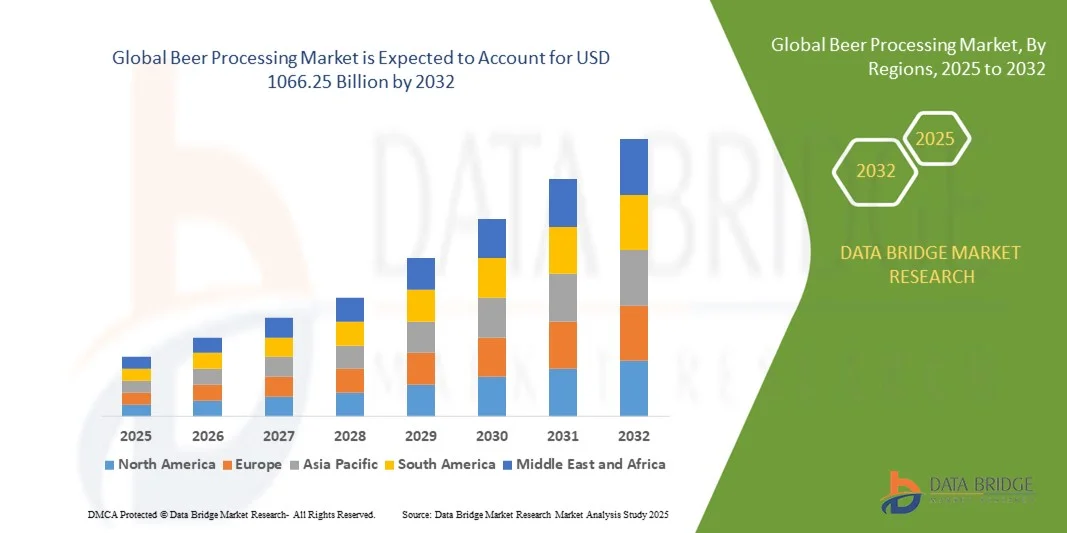
Beer Processing Market Size
- The global beer processing market size was valued at USD 806.6 billion in 2024 and is expected to reach USD 1066.25 billion by 2032, at a CAGR of 3.55% during the forecast period
- The market growth is largely fueled by increasing beer consumption globally, rising demand for craft and specialty beers, and technological advancements in brewing and processing equipment, leading to enhanced production efficiency and quality across both commercial and craft breweries
- Furthermore, growing investments in brewery automation, modernization of production facilities, and expansion of distribution networks are enabling breweries to meet evolving consumer preferences and rising demand, thereby accelerating the adoption of advanced beer processing solutions and driving overall market growth
Beer Processing Market Analysis
- Beer processing involves the transformation of raw ingredients such as barley, hops, water, and yeast into finished beer through stages including malting, mashing, fermentation, filtration, and packaging. Modern beer processing solutions incorporate automation, quality control systems, and energy-efficient equipment to enhance productivity, consistency, and product quality
- The escalating demand for beer processing solutions is primarily driven by rising consumer preference for craft, premium, and specialty beers, increasing investments in brewery infrastructure, and the need for efficient, scalable, and sustainable production processes across the brewing industry
- Asia-Pacific dominated the beer processing market in 2024, due to the rapid growth of the brewing industry, increasing beer consumption, and a strong presence of both craft and macro breweries
- North America is expected to be the fastest growing region in the beer processing market during the forecast period due to rising demand for craft, specialty, and premium beers, alongside technological advancements in brewing equipment
- Macro brewery segment dominated the market with a market share of 61.8% in 2024, due to high production capacity, well-established distribution networks, and strong brand recognition. Macro breweries benefit from economies of scale, making their products widely accessible and affordable to mainstream consumers. In addition, their consistent quality and broad marketing campaigns support sustained dominance in mature beer markets
Report Scope and Beer Processing Market Segmentation
|
Attributes |
Beer Processing Key Market Insights |
|
Segments Covered |
|
|
Countries Covered |
North America
Europe
Asia-Pacific
Middle East and Africa
South America
|
|
Key Market Players |
|
|
Market Opportunities |
|
|
Value Added Data Infosets |
In addition to the insights on market scenarios such as market value, growth rate, segmentation, geographical coverage, and major players, the market reports curated by the Data Bridge Market Research also include in-depth expert analysis, pricing analysis, brand share analysis, consumer survey, demography analysis, supply chain analysis, value chain analysis, raw material/consumables overview, vendor selection criteria, PESTLE Analysis, Porter Analysis, and regulatory framework. |
Beer Processing Market Trends
Growing Popularity of Craft and NOLO Beers
- A leading trend in the beer processing market is the surging popularity of craft beers and NOLO (no- and low-alcohol) alternatives, as consumers increasingly prefer unique flavors, artisanal brands, and healthier beverage choices. This trend is significantly reshaping production processes, prompting breweries to diversify their portfolios and adopt flexible brewing technologies to cater to evolving consumer tastes
- For instance, Anheuser-Busch InBev has expanded its craft beer segment through acquisitions such as Goose Island and also strengthened its NOLO portfolio with brands including Budweiser Zero. Similarly, Heineken has made notable moves with Heineken 0.0, reflecting how major breweries are restructuring product lines to meet this global trend
- The rising proportion of younger consumers and health-focused individuals is driving demand for NOLO beers that maintain taste and social appeal without high alcohol content. In parallel, the craft beer segment is experiencing elevated consumer loyalty as smaller brewers offer innovative brewing techniques, unique recipes, and local identity in their products
- The demand for diverse beer types is encouraging breweries to experiment with a wider range of ingredients such as exotic hops, fruits, and spices, in addition to sustainable sourcing practices. This is pushing beer processing companies to adopt advanced filtration and aroma retention technologies that ensure quality while supporting creativity
- Increased e-commerce and direct-to-consumer retail channels are further fuelling the growth of craft and NOLO beers, providing smaller breweries stronger visibility and market reach. These developments are pushing larger companies to invest more in consumer engagement strategies and premium packaging to remain competitive
- The prominence of craft and NOLO beers demonstrates a significant consumer shift toward premiumization, personalization, and wellness-driven purchasing decisions. This ensures that both traditional brewers and new entrants continue to gravitate towards technologically advanced processing capabilities to capitalize on the fastest-growing segments of the market
Beer Processing Market Dynamics
Driver
Adoption of Advanced Beer Processing Technologies
- The adoption of advanced beer processing technologies is a key driver of industry growth, as breweries seek innovation in brewing, filtration, and packaging to improve efficiency and product quality. Eliminating inefficiencies while enhancing flavor retention and shelf life has become essential for meeting consumer expectations and ensuring cost-competitive production
- For instance, GEA Group AG has provided state-of-the-art brewing and filtration solutions to breweries worldwide, enabling companies to achieve greater consistency and efficiency in craft and NOLO beer production. Such technological partnerships highlight how advanced processing innovations are central to competitive positioning in today’s beer market
- Automation in brewing, such as advanced mash filtration systems and automated cleaning processes, reduces downtime and enhances precision, allowing producers to handle higher volumes with consistent product outcomes. This supports scalability for both craft brewers and larger commercial operators seeking to balance production efficiency with diversity in beer offerings
- The rise of digitalization, such as the use of IoT-enabled monitoring systems and predictive analytics, empowers brewers to monitor quality parameters in real time. This ensures precise flavor profiles and rapid adjustment in brewing cycles, delivering superior beers aligned with consumer demand for fresher, distinctive products
- With the continued global expansion of the beer market, the adoption of technologically advanced processing solutions positions companies strongly for long-term success. It ensures that breweries can address rising demand, diversify product lines, and enhance overall efficiency without compromising product quality or sustainability objectives
Restraint/Challenge
High Capital Investment for Modern Equipment
- One of the critical challenges facing the beer processing market is the high capital investment required for modern brewing and filtration systems. Advanced equipment such as automated brewhouses, energy-efficient boilers, and precision filtration systems involve significant upfront costs, which can be restrictive for small and medium-sized breweries
- For instance, many microbreweries in Europe and North America face financial constraints in adopting next-generation brewing systems. Companies such as Sierra Nevada have invested heavily in advanced brewing infrastructure, but smaller local brewers often struggle to match such resource-intensive commitments due to budget limitations
- The maintenance and servicing costs of modern brewing and packaging equipment add further financial strain, with regular upgrades and part replacements needed to sustain quality control. This makes it difficult for emerging brewers to operate profitably while keeping up with evolving consumer preferences for craft and NOLO varieties
- Securing financing for state-of-the-art brewing systems becomes even more complex due to uncertainties in market demand and rapidly changing consumer habits. These risks discourage financial institutions from lending easily to new or small players without established revenue streams
- Overcoming this challenge requires breweries to explore collaborative investments, leasing of equipment, and government support programs for manufacturing innovation. By gradually adopting advanced systems in scalable and cost-effective ways, breweries can mitigate financial burdens and ensure competitiveness in a dynamic and consumer-driven beer processing market
Beer Processing Market Scope
The market is segmented on the basis of beer type, brewery type, price category, distribution channel, equipment type, and application.
- By Beer Type
On the basis of beer type, the beer processing market is segmented into Ale and Stout, Low Alcohol Beer, Lager, and Specialty Beer. The Lager segment dominated the largest market revenue share in 2024, driven by its global popularity, wide consumer acceptance, and consistent flavor profile. Lager beers benefit from established production techniques and large-scale distribution, making them a preferred choice for both breweries and consumers. The segment also sees high demand due to its compatibility with mass-market consumption trends and frequent pairing with food across multiple regions.
The Specialty Beer segment is anticipated to witness the fastest growth rate from 2025 to 2032, fueled by rising consumer interest in unique flavors, premium ingredients, and limited-edition brews. Craft breweries are increasingly experimenting with hops, malts, and fermentation techniques to cater to niche tastes. The growing appreciation for artisanal beers and the influence of social media trends promoting premium and exotic beer varieties contribute to this rapid growth.
- By Brewery Type
On the basis of brewery type, the market is segmented into Craft Brewery and Macro Brewery. The Macro Brewery segment held the largest market revenue share of 61.8% in 2024, driven by high production capacity, well-established distribution networks, and strong brand recognition. Macro breweries benefit from economies of scale, making their products widely accessible and affordable to mainstream consumers. In addition, their consistent quality and broad marketing campaigns support sustained dominance in mature beer markets.
The Craft Brewery segment is expected to witness the fastest CAGR from 2025 to 2032, fueled by the rising consumer preference for artisanal, small-batch, and locally brewed beers. Craft breweries focus on innovation, flavor diversity, and storytelling, appealing to millennials and Gen Z consumers. The trend of experiential drinking, brewery tours, and taproom experiences further boosts the adoption of craft beers.
- By Price Category
On the basis of price category, the market is segmented into Super-premium, Premium, Mainstream, and Discount. The Mainstream segment dominated the largest market revenue share in 2024 due to its affordability, widespread availability, and steady demand across diverse consumer demographics. Mainstream beers are often favored for everyday consumption and bulk purchase, supporting high-volume sales across off-trade and on-trade channels.
The Super-premium segment is anticipated to witness the fastest growth rate from 2025 to 2032, driven by the increasing consumer inclination toward luxury, high-quality ingredients, and exclusive brewing methods. Rising disposable income, premiumization trends, and the desire for sophisticated drinking experiences contribute to the expansion of this segment. Consumers are also influenced by limited-edition and specialty offerings, elevating demand for high-end products.
- By Distribution Channel
On the basis of distribution channel, the market is segmented into Off-trade and On-trade. The Off-trade segment held the largest market revenue share in 2024, driven by the growth of retail chains, supermarkets, and e-commerce platforms that make beer easily accessible to a broad consumer base. Off-trade channels allow consumers to purchase in bulk at competitive prices, catering to household consumption and convenience-driven buying behavior.
The On-trade segment is expected to witness the fastest CAGR from 2025 to 2032, fueled by the growing popularity of bars, pubs, and restaurants offering unique beer experiences. Increasing social outings, experiential consumption, and pairing of beer with gourmet meals are driving demand in this channel. In addition, on-trade establishments often promote specialty and craft beers, further supporting segment growth.
- By Equipment Type
On the basis of equipment type, the market is segmented into Macro Brewery Equipment and Craft Brewery Equipment. The Macro Brewery Equipment segment dominated the largest market revenue share in 2024, driven by high-volume production capacity, robust machinery, and advanced automation technologies. Macro brewery equipment allows for efficient large-scale brewing, fermentation, and packaging, meeting the consistent demand from mainstream consumers globally.
The Craft Brewery Equipment segment is anticipated to witness the fastest growth rate from 2025 to 2032, fueled by the surge of small-scale and artisanal breweries. Craft brewers prioritize versatile, modular, and innovative equipment to experiment with flavors and brewing techniques. The increasing focus on quality, customization, and unique product offerings supports the adoption of specialized craft brewery equipment.
- By Application
On the basis of application, the market is segmented into Hotel, Family, and Others. The Family segment dominated the largest market revenue share in 2024, driven by the widespread consumption of beer at home for personal and family occasions. Family consumption benefits from convenience, affordability, and bulk packaging trends, particularly through off-trade retail channels.
The Hotel segment is expected to witness the fastest CAGR from 2025 to 2032, fueled by the expansion of the hospitality industry and increasing demand for premium and specialty beer offerings in hotels, resorts, and event venues. Hotels and hospitality establishments are focusing on curated beer selections to enhance guest experiences, boosting the adoption of both craft and specialty beers.
Beer Processing Market Regional Analysis
- Asia-Pacific dominated the beer processing market with the largest revenue share in 2024, driven by the rapid growth of the brewing industry, increasing beer consumption, and a strong presence of both craft and macro breweries
- The region’s cost-effective manufacturing, expanding distribution networks, and rising urban population are accelerating market expansion
- The availability of skilled labor, supportive government policies, and growing investments in brewing technology are further contributing to increased adoption of advanced beer processing solutions
China Beer Processing Market Insight
China held the largest share in the Asia-Pacific beer processing market in 2024, owing to its position as one of the world’s leading beer consumers and producers. The country’s extensive brewery infrastructure, increasing domestic demand, and rising export potential are key growth drivers. Continued modernization of brewing facilities and investments in craft and specialty beer segments are further boosting the market.
India Beer Processing Market Insight
India is witnessing the fastest growth in the Asia-Pacific region, fueled by rising beer consumption, a growing middle-class population, and increased investment in brewery infrastructure. Government initiatives promoting food and beverage processing, combined with expanding craft beer culture and rising disposable incomes, are strengthening the demand for beer processing equipment and solutions.
Europe Beer Processing Market Insight
The Europe beer processing market is expanding steadily, supported by a well-established beer culture, strong regulatory frameworks, and high demand for high-quality, specialty, and craft beers. The region emphasizes sustainability, automation, and advanced brewing technologies, particularly in Germany, Belgium, and the U.K. Ongoing innovation in flavors, packaging, and production efficiency is further driving market growth.
Germany Beer Processing Market Insight
Germany’s beer processing market is driven by its strong brewing heritage, world-class brewery infrastructure, and export-oriented beer industry. Advanced R&D, integration of modern brewing technologies, and high demand for both craft and premium beers are major contributors.
U.K. Beer Processing Market Insight
The U.K. market benefits from a mature beer industry, growing craft beer consumption, and increased focus on modernization of brewing operations. Investments in sustainable brewing, automation, and specialty beer production are enhancing market prospects.
North America Beer Processing Market Insight
North America is projected to grow at the fastest CAGR from 2025 to 2032, driven by rising demand for craft, specialty, and premium beers, alongside technological advancements in brewing equipment. Strong investment in brewery modernization, increasing home consumption trends, and expansion of on-trade and off-trade channels are supporting market growth.
U.S. Beer Processing Market Insight
The U.S. accounted for the largest share in the North America market in 2024, supported by a robust craft beer culture, significant investment in modern brewery equipment, and high domestic beer consumption. Growing adoption of automated and advanced beer processing technologies, along with strong R&D and export capabilities, further consolidates the U.S.'s leading position in the region.
Beer Processing Market Share
The beer processing industry is primarily led by well-established companies, including:
- ASAHI GROUP HOLDINGS, LTD. (Japan)
- Anheuser-Busch Companies LLC (U.S.)
- Carlsberg Group (Denmark)
- Heineken N.V. (Netherlands)
- Sierra Nevada Brewing Co. (U.S.)
- UNITED BREWERIES LTD. (India)
- Diageo (U.K.)
- Squatters Pub (U.S.)
- Dogfish Head Craft Brewery Inc. (U.S.)
- The Boston Beer Company, Inc. (U.S.)
- Constellation Brands, Inc. (U.S.)
- Kirin Holdings Company, Limited. (Japan)
- Molson Coors Beverage Company (U.S.)
- Guizhou Moutai Co., Ltd. (China)
- Stone & Wood Brewing Company (Australia)
- China Resources Enterprise, Limited (China)
- Oettinger (Germany)
Latest Developments in Global Beer Processing Market
- In September 2024, SOM Distilleries and Breweries Ltd. is set to transform the Indian beer market with the launch of India’s first twist-cap beer, "Woodpecker Premium Beer." This innovation introduces a novel twist-style cap, offering unprecedented convenience and a unique drinking experience for consumers. By pioneering this packaging technology in India, SDBL is expected to strengthen its brand differentiation, drive consumer engagement, and capture market share in Karnataka—one of the company’s fastest-growing regions—while setting new standards for product innovation in the premium beer segment
- In September 2024, International Flavors & Fragrances (IFF) announced the launch of DIAZYME NOLO, a breakthrough enzyme solution designed to enhance flavor, production efficiency, and output for no- and low-alcohol (NOLO) beverages. This solution enables breweries to meet rising consumer demand for NOLO beers without requiring significant capital investment, allowing manufacturers to expand their product portfolios cost-effectively. The introduction of DIAZYME NOLO is expected to accelerate the growth of the NOLO segment globally, improving competitiveness for breweries targeting health-conscious and mindful drinking consumers
- In August 2024, an Indian craft brewer, backed by Japan’s Kirin Holdings Co., announced plans to construct a USD 70 million beer production facility and raise fresh funds ahead of a public listing projected for 2026. This strategic move aims to challenge established global brands by significantly expanding production capacity and strengthening distribution networks. The investment is expected to boost the craft beer market in India, improve product accessibility, and accelerate the penetration of premium and specialty beers among a growing consumer base
- In May 2024, Chobani CEO Hamdi Ulukaya acquired Anchor Brewing Company, preserving the 127-year legacy of this iconic brand. The acquisition is expected to stabilize Anchor Brewing’s operations, enhance its market presence, and provide resources for innovation and expansion. By securing this historic brewery, Chobani strengthens its position in the U.S. craft beer sector, safeguarding a heritage brand while positioning it for sustainable growth amid increasing competition in the premium craft beer segment
- In January 2024, ABB launched a new process automation solution specifically for the cold block stage of beer production. This innovation is designed to optimize production efficiency, reduce energy consumption, and enhance operational reliability. By automating critical stages of the brewing process, ABB’s solution enables breweries to increase throughput, improve product consistency, and lower production costs, thereby strengthening competitiveness in an increasingly technology-driven beer market

- Interactive Data Analysis Dashboard
- Company Analysis Dashboard for high growth potential opportunities
- Research Analyst Access for customization & queries
- Competitor Analysis with Interactive dashboard
- Latest News, Updates & Trend analysis
- Harness the Power of Benchmark Analysis for Comprehensive Competitor Tracking
Global Beer Processing Market, Supply Chain Analysis and Ecosystem Framework
To support market growth and help clients navigate the impact of geopolitical shifts, DBMR has integrated in-depth supply chain analysis into its Global Beer Processing Market research reports. This addition empowers clients to respond effectively to global changes affecting their industries. The supply chain analysis section includes detailed insights such as Global Beer Processing Market consumption and production by country, price trend analysis, the impact of tariffs and geopolitical developments, and import and export trends by country and HSN code. It also highlights major suppliers with data on production capacity and company profiles, as well as key importers and exporters. In addition to research, DBMR offers specialized supply chain consulting services backed by over a decade of experience, providing solutions like supplier discovery, supplier risk assessment, price trend analysis, impact evaluation of inflation and trade route changes, and comprehensive market trend analysis.
Data collection and base year analysis are done using data collection modules with large sample sizes. The stage includes obtaining market information or related data through various sources and strategies. It includes examining and planning all the data acquired from the past in advance. It likewise envelops the examination of information inconsistencies seen across different information sources. The market data is analysed and estimated using market statistical and coherent models. Also, market share analysis and key trend analysis are the major success factors in the market report. To know more, please request an analyst call or drop down your inquiry.
The key research methodology used by DBMR research team is data triangulation which involves data mining, analysis of the impact of data variables on the market and primary (industry expert) validation. Data models include Vendor Positioning Grid, Market Time Line Analysis, Market Overview and Guide, Company Positioning Grid, Patent Analysis, Pricing Analysis, Company Market Share Analysis, Standards of Measurement, Global versus Regional and Vendor Share Analysis. To know more about the research methodology, drop in an inquiry to speak to our industry experts.
Data Bridge Market Research is a leader in advanced formative research. We take pride in servicing our existing and new customers with data and analysis that match and suits their goal. The report can be customized to include price trend analysis of target brands understanding the market for additional countries (ask for the list of countries), clinical trial results data, literature review, refurbished market and product base analysis. Market analysis of target competitors can be analyzed from technology-based analysis to market portfolio strategies. We can add as many competitors that you require data about in the format and data style you are looking for. Our team of analysts can also provide you data in crude raw excel files pivot tables (Fact book) or can assist you in creating presentations from the data sets available in the report.













