


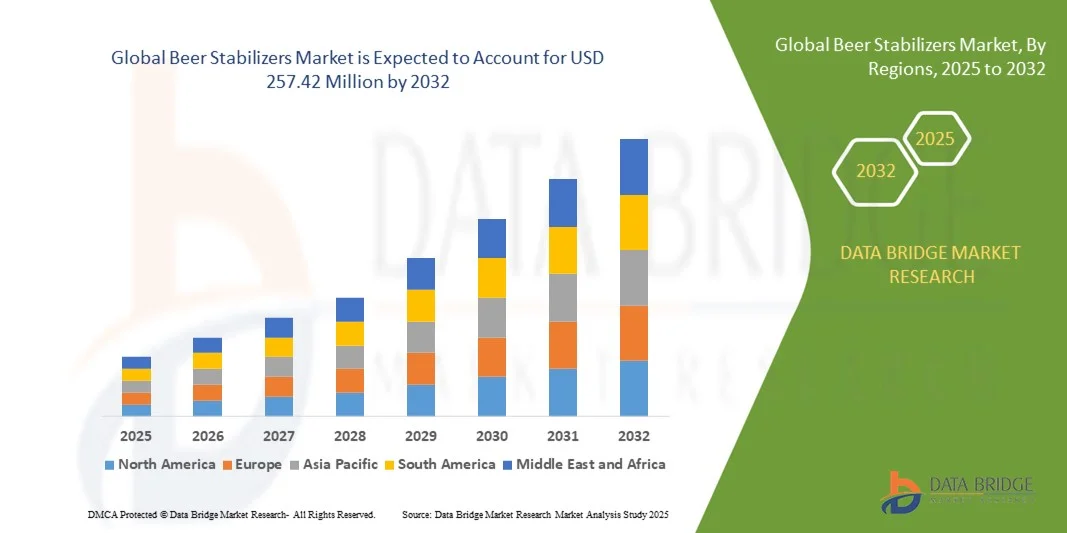
Global Beer Stabilizers Market Size
- The global Beer Stabilizers Market size was valued at USD 178.95 million in 2024 and is projected to reach USD 257.42 million by 2032, growing at a CAGR of 4.65% during the forecast period
- Market growth is primarily driven by increasing global beer consumption and rising demand for improved shelf-life and flavor stability, especially in emerging economies with expanding beverage industries
- Additionally, technological advancements in brewing processes and growing consumer preference for premium, craft, and specialty beers are fueling the adoption of stabilizing agents, significantly propelling the market forward
Global Beer Stabilizers Market Analysis
- Beer stabilizers, used to enhance the clarity, flavor stability, and shelf-life of beer, are becoming increasingly crucial in modern brewing processes across both large-scale breweries and craft beer producers due to growing demand for consistent, high-quality beverages
- The rising demand for beer stabilizers is largely driven by increasing global beer consumption, the surge in craft and premium beer production, and the need to minimize product spoilage during transportation and storage
- North America dominated the Global Beer Stabilizers Market with the largest revenue share of 32.5% in 2024, supported by the region’s mature brewing industry, strong consumer preference for high-quality beer, and the presence of leading manufacturers offering innovative stabilizing solutions
- Asia-Pacific is expected to be the fastest growing region in the Global Beer Stabilizers Market during the forecast period due to rapid urbanization, increasing disposable income, and expanding beer consumption among younger populations
- The Silica Gel segment dominated the market with the largest revenue share of 43.2% in 2024, attributed to its high efficiency in removing protein haze and its wide applicability across various beer types
Report Scope and Global Beer Stabilizers Market Segmentation
|
Attributes |
Beer Stabilizers Key Market Insights |
|
Segments Covered |
|
|
Countries Covered |
North America
Europe
Asia-Pacific
Middle East and Africa
South America
|
|
Key Market Players |
|
|
Market Opportunities |
|
|
Value Added Data Infosets |
In addition to the insights on market scenarios such as market value, growth rate, segmentation, geographical coverage, and major players, the market reports curated by the Data Bridge Market Research also include in-depth expert analysis, pricing analysis, brand share analysis, consumer survey, demography analysis, supply chain analysis, value chain analysis, raw material/consumables overview, vendor selection criteria, PESTLE Analysis, Porter Analysis, and regulatory framework. |
Global Beer Stabilizers Market Trends
Enhanced Beer Quality Through AI-Driven Brewing and Stabilization Technologies
- A significant and accelerating trend in the Global Beer Stabilizers Market is the integration of artificial intelligence (AI) and advanced automation technologies into brewing and stabilization processes. This digital transformation is enhancing consistency, efficiency, and overall beer quality across both large-scale and craft breweries.
- For Instance, AI-enabled brewing platforms such as IntelligentX Brewing Co. use machine learning algorithms to analyze consumer feedback and adjust beer recipes accordingly, optimizing stabilizer use for flavor balance and shelf-life. Similarly, some breweries are adopting AI to monitor haze levels in real time, ensuring precise dosing of stabilizers like silica gel or PVPP for optimal clarity.
- AI-driven quality control systems can detect fluctuations in temperature, pressure, and ingredient interactions, helping brewers automatically adjust stabilizer inputs to maintain consistent product quality. This reduces waste, minimizes manual errors, and ensures compliance with increasingly strict quality and safety standards in global markets.
- Furthermore, the use of AI and sensor-based technologies enables predictive maintenance of brewing equipment, ensuring optimal conditions for the effective functioning of stabilizers and reducing downtime in production lines. These smart systems also assist in forecasting inventory needs for stabilizing agents, enhancing supply chain efficiency.
- The integration of AI in beer stabilization is particularly impactful in high-output breweries, where consistency and efficiency are critical. As a result, industry leaders such as AB InBev and Carlsberg are exploring smart brewing systems that automate stabilization processes and integrate data-driven decision-making for continuous improvement.
- The growing demand for premium and craft beers, coupled with the push for automation and quality optimization, is driving the adoption of AI-based brewing technologies. This trend is expected to reshape the landscape of beer production and stabilization, making it more intelligent, sustainable, and responsive to consumer preferences.
Global Beer Stabilizers Market Dynamics
Driver
Growing Need Due to Rising Demand for Shelf-Life Stability and Premium Beer Quality
- The increasing demand for high-quality, long-lasting beer products—particularly in export markets—is a major driver of growth in the Global Beer Stabilizers Market. As breweries expand production and distribution globally, ensuring consistent flavor, clarity, and shelf stability is becoming essential.
- For instance, in February 2024, Ashland introduced a new line of plant-based beer stabilizers aimed at improving flavor retention and haze prevention in craft and specialty brews. These innovations reflect the brewing industry's focus on improving product integrity throughout storage and transportation.
- Consumers are increasingly seeking premium and craft beers with enhanced taste profiles and visual appeal, placing greater emphasis on stabilizers that reduce chill haze, oxidative reactions, and biological instability. Stabilizers like silica gel, PVPP, and enzymes are now critical to meeting evolving quality expectations.
- Furthermore, the rapid growth of microbreweries and the diversification of beer varieties are driving demand for customizable stabilization solutions that preserve specific flavor characteristics unique to small-batch and specialty brews.
- The use of stabilizers also supports extended distribution reach, allowing brewers to tap into international markets without compromising product quality. This is especially important as global beer exports rise and consumer preferences shift toward imported and exotic beer offerings. The adoption of clean-label and natural stabilizers in response to health-conscious trends is further strengthening market growth.
Restraint/Challenge
Health Concerns and Regulatory Challenges Related to Additives
- Despite growing demand, health-related concerns and tightening food safety regulations around the use of certain chemical stabilizers pose significant challenges to the Global Beer Stabilizers Market. Increasing scrutiny from regulatory bodies like the FDA, EFSA, and FSSAI regarding food-grade additives is impacting the formulation and approval of synthetic stabilizers.
- For instance, growing consumer preference for clean-label and additive-free beverages has led some breweries to reduce or eliminate synthetic stabilizers, opting instead for natural or enzymatic alternatives, which can be more expensive and less effective in certain applications.
- Additionally, regional differences in regulatory standards make it challenging for global breweries to use a uniform stabilization process across all markets. This leads to increased R&D costs and the need for tailored formulations to meet compliance in different regions.
- The perception that certain stabilizers may negatively impact health or alter the taste of beer can also deter some consumers, particularly in health-conscious or premium segments. Addressing these concerns through transparent labeling, natural ingredient innovations, and improved consumer education is crucial for building market trust.
- Moreover, the high cost of some advanced or natural stabilizers, particularly for small and mid-sized breweries, can limit adoption. This price sensitivity, combined with regulatory hurdles, may hinder market growth if not addressed through innovation, cost optimization, and clearer regulatory pathways.
Global Beer Stabilizers Market Scope
The beer stabilizers market is segmented on the basis of product, function, application and type.
- By Product
On the basis of product, the Global Beer Stabilizers Market is segmented into PVPP/R-PVPP, Silica Gel, Papain, Xanthan Gum, Carrageenan, Gum Arabic, CMC, and Others. The Silica Gel segment dominated the market with the largest revenue share of 43.2% in 2024, attributed to its high efficiency in removing protein haze and its wide applicability across various beer types. Silica gel offers excellent compatibility with brewing systems and does not impact the flavor profile, making it a preferred choice among both large-scale and craft brewers.
The PVPP/R-PVPP segment is expected to witness the fastest CAGR from 2025 to 2032, driven by its reusability, cost-effectiveness, and growing demand for environmentally sustainable stabilizing agents. R-PVPP, in particular, is gaining traction in commercial breweries for its ability to provide extended shelf-life and oxidative stability without compromising the sensory qualities of the beer.
- By Function
On the basis of function, the Global Beer Stabilizers Market is segmented into Stabilization, Texturization, and Viscosification. The Stabilization segment held the largest market share in 2024, dominating with over 60.5% revenue contribution, owing to its critical role in preventing haze formation, flavor degradation, and microbial instability during beer storage and transportation. Stabilizers such as PVPP, silica gel, and enzymes are extensively used to ensure clarity and prolong product shelf life, especially in bottled and canned beer products.
The Texturization segment is expected to register the fastest CAGR during the forecast period, driven by increasing innovation in specialty and craft beers that emphasize mouthfeel and foam stability. As brewers explore new flavor and texture profiles, demand for hydrocolloids such as xanthan gum and carrageenan is rising, particularly in low-alcohol and non-alcoholic beer formulations aimed at health-conscious consumers.
- By Application
On the basis of application, the Global Beer Stabilizers Market is segmented into Fruit Drinks, Dairy Products, and Soft Drinks. The Fruit Drinks segment held the largest market share in 2024, accounting for 45.8% of total revenue, owing to the rising use of beer stabilizers in flavored and fruit-based beer variants. These drinks often require additional stabilization to preserve natural ingredients and maintain clarity, especially in warmer climates or extended distribution channels.
The Soft Drinks segment is projected to grow at the fastest CAGR from 2025 to 2032, driven by the increasing popularity of malt-based non-alcoholic beverages and hybrid products that blur the lines between beer and soft drinks. As consumer preferences shift toward functional and alcohol-free options, the need for advanced stabilizing solutions that enhance taste and appearance is growing rapidly.
- By Type
On the basis of type, the Global Beer Stabilizers Market is segmented into Lager, Ale, Stout and Porter, Malt, and Others. The Lager segment dominated the market with the highest revenue share of 48.6% in 2024, due to its global popularity, consistent production, and longer shelf-life requirements. Lagers typically undergo cold storage, increasing the need for effective stabilizers to maintain clarity and freshness during extended aging and distribution.
The Ale segment is expected to grow at the fastest CAGR during the forecast period, fueled by the rising global interest in craft brewing, especially in North America and Europe. Ale varieties, known for their bold flavors and shorter fermentation periods, often require tailored stabilization methods to preserve their complex aroma profiles and appearance, contributing to increasing demand for innovative and natural stabilizers.
Global Beer Stabilizers Market Regional Analysis
- North America dominated the Global Beer Stabilizers Market with the largest revenue share of 32.5% in 2024, driven by the presence of major breweries, high beer consumption rates, and strong demand for premium and craft beer products
- Consumers in the region increasingly prioritize beer quality, clarity, and shelf stability, prompting breweries to adopt advanced stabilization techniques and ingredients such as silica gel, PVPP, and enzymes to meet these expectations
- This widespread adoption is further supported by a mature brewing industry, robust investment in R&D, and stringent quality regulations, which encourage the use of effective and compliant stabilizing agents—positioning North America as a leading market for both conventional and natural beer stabilizers
U.S. Global Beer Stabilizers Market Insight
The U.S. Global Beer Stabilizers Market captured the largest revenue share of 81% in 2024 within North America, driven by the country’s highly developed brewing industry, rising demand for craft and specialty beers, and stringent quality standards. Major brewers and a growing number of microbreweries are investing in advanced stabilizers such as PVPP and silica gel to maintain flavor, clarity, and shelf stability. Consumer preference for premium beer products with consistent taste and appearance is further propelling market demand. In addition, strong R&D investment, a focus on automation in brewing processes, and the rise of health-conscious beer consumers are contributing to the increasing use of natural and clean-label stabilizers.
Europe Global Beer Stabilizers Market Insight
The Europe Global Beer Stabilizers Market is projected to expand at a substantial CAGR throughout the forecast period, supported by the region’s deep-rooted beer culture, advanced brewing technologies, and strict quality control regulations. Increasing demand for organic and additive-free beers is encouraging the adoption of natural stabilizers such as enzymes and plant-based agents. Urbanization and rising exports of European beer brands are also fueling the need for stabilizers that enhance product shelf-life and transport resilience. Breweries across Germany, Belgium, and the Netherlands are leading in deploying innovative stabilization methods, including enzymatic and bio-based solutions, particularly in craft and specialty beer segments.
U.K. Global Beer Stabilizers Market Insight
The U.K. Global Beer Stabilizers Market is anticipated to grow at a noteworthy CAGR during the forecast period, driven by rising consumer interest in artisanal and low-alcohol beers, which require advanced stabilization to maintain sensory and visual quality. The country’s dynamic craft beer industry, combined with a push towards sustainable brewing practices, is increasing the adoption of natural and functional stabilizers. Additionally, the shift toward canned and bottled formats in the retail sector necessitates more robust stabilization solutions to support longer shelf life and product consistency across distribution channels.
Germany Global Beer Stabilizers Market Insight
The Germany Global Beer Stabilizers Market is expected to expand at a considerable CAGR during the forecast period, underpinned by the nation’s globally recognized brewing standards and its large-scale beer production volumes. The Reinheitsgebot (German Beer Purity Law) has historically limited additives, but recent technological innovations are allowing for the inclusion of stabilizers that meet regulatory and consumer expectations for quality and purity. Germany’s emphasis on clear, long-lasting beer—especially lagers and pilsners—is creating steady demand for silica-based and enzymatic stabilizers. The trend towards exporting German beer is also contributing to the need for enhanced shelf-life solutions.
Asia-Pacific Global Beer Stabilizers Market Insight
The Asia-Pacific Global Beer Stabilizers Market is poised to grow at the fastest CAGR of 24% during the forecast period of 2025 to 2032, driven by rapid urbanization, growing middle-class populations, and expanding beer consumption in countries like China, India, and Vietnam. As regional breweries scale up production to meet domestic and export demand, the adoption of stabilizers to improve beer clarity and preserve flavor is gaining traction. Government support for food and beverage manufacturing, along with rising consumer preference for international-style and premium beers, is encouraging breweries to invest in advanced stabilization technologies across the APAC region.
Japan Global Beer Stabilizers Market Insight
The Japan Global Beer Stabilizers Market is gaining momentum, fueled by the nation’s precision-driven brewing culture and growing demand for low-alcohol and functional beers. Japanese breweries place a strong emphasis on clarity, texture, and flavor consistency, making stabilizers such as PVPP and enzymes critical to product quality. Innovations in brewing targeted at health-conscious and aging populations are further contributing to the adoption of stabilizers that ensure taste retention without compromising label claims. The market also benefits from Japan’s advanced manufacturing capabilities and preference for premium, high-quality consumer goods.
China Global Beer Stabilizers Market Insight
The China Global Beer Stabilizers Market accounted for the largest market revenue share in Asia Pacific in 2024, supported by the country’s rapidly growing beer industry, increasing consumption of Western-style beers, and large-scale adoption of brewing automation. With a surge in premium and flavored beer varieties, stabilizers are increasingly being used to improve clarity and shelf stability. Domestic brands are expanding their product lines to cater to diverse tastes, and stabilizers play a key role in meeting this demand while maintaining consistent quality. Additionally, China’s robust manufacturing sector ensures a steady supply of both traditional and novel stabilizing agents.
Global Beer Stabilizers Market Share
The Beer Stabilizers industry is primarily led by well-established companies, including:
• Cargill, Incorporated (U.S.)
• ADM (U.S.)
• DuPont (U.S.)
• Dow (U.S.)
• Tate & Lyle (U.K.)
• 3M (U.S.)
• Ashland (U.S.)
• Eaton (Ireland)
• Lallemand Inc. (Canada)
• BASF SE (Germany)
• W. R. Grace & Co.-Conn. (U.S.)
• Gusmer Enterprises, Inc. (U.S.)
• PQ Corporation (U.S.)
• Qingdao Meigao Group Inc. (China)
• Erbslöh Geisenheim GmbH (Germany)
• Sinchem Europe (Belgium)
• Nexira (France)
• Palsgaard (Denmark)
• Kerry Group plc (Ireland)
• Glanbia plc (Ireland)
• Advanced Food Systems, Inc. (U.S.)
• Chemelco (Netherlands)
• Tolsa (Spain)
• Akzo Nobel N.V. (Netherlands)
• Galactic (Belgium)
What are the Recent Developments in Global Beer Stabilizers Market?
- In April 2023, Cargill, Incorporated, a global leader in food ingredients, announced the launch of a new line of natural beer stabilizers designed to enhance clarity and shelf life while meeting clean-label demands. This initiative highlights Cargill’s commitment to innovation and sustainability, providing brewers with effective solutions tailored to evolving consumer preferences for natural and additive-free products, thereby strengthening its position in the rapidly expanding Global Beer Stabilizers Market.
- In March 2023, ADM (Archer Daniels Midland Company) introduced an advanced PVPP stabilizer variant engineered to improve haze reduction and flavor stability specifically for craft and specialty beers. This product launch demonstrates ADM’s focus on supporting the growing craft brewing sector with targeted, high-performance ingredients that ensure product consistency and consumer satisfaction in competitive markets.
- In March 2023, DuPont successfully expanded its portfolio of enzymatic beer stabilizers, unveiling innovative enzymes that optimize protein breakdown and improve foam stability. These advancements are part of DuPont’s strategic push to deliver cutting-edge brewing solutions that enhance beer quality and shelf life, reinforcing the company’s leadership role in the Global Beer Stabilizers Market.
- In February 2023, BASF SE, a global chemical company, announced a strategic partnership with leading breweries in Europe to develop sustainable silica gel-based stabilizers. This collaboration aims to reduce the environmental impact of beer production while maintaining optimal clarity and taste, underscoring BASF’s commitment to innovation and sustainability within the Global Beer Stabilizers Market.
- In January 2023, Lallemand Inc., a specialist in yeast and fermentation products, launched a new range of natural stabilizers and enzymes targeting the growing demand for organic and craft beers. This product introduction, showcased at the Craft Brewers Conference, reflects Lallemand’s dedication to providing brewers with advanced tools to improve product stability and sensory quality, supporting market growth and diversification.

- Interactive Data Analysis Dashboard
- Company Analysis Dashboard for high growth potential opportunities
- Research Analyst Access for customization & queries
- Competitor Analysis with Interactive dashboard
- Latest News, Updates & Trend analysis
- Harness the Power of Benchmark Analysis for Comprehensive Competitor Tracking
Global Beer Stabilizers Market, Supply Chain Analysis and Ecosystem Framework
To support market growth and help clients navigate the impact of geopolitical shifts, DBMR has integrated in-depth supply chain analysis into its Global Beer Stabilizers Market research reports. This addition empowers clients to respond effectively to global changes affecting their industries. The supply chain analysis section includes detailed insights such as Global Beer Stabilizers Market consumption and production by country, price trend analysis, the impact of tariffs and geopolitical developments, and import and export trends by country and HSN code. It also highlights major suppliers with data on production capacity and company profiles, as well as key importers and exporters. In addition to research, DBMR offers specialized supply chain consulting services backed by over a decade of experience, providing solutions like supplier discovery, supplier risk assessment, price trend analysis, impact evaluation of inflation and trade route changes, and comprehensive market trend analysis.
Data collection and base year analysis are done using data collection modules with large sample sizes. The stage includes obtaining market information or related data through various sources and strategies. It includes examining and planning all the data acquired from the past in advance. It likewise envelops the examination of information inconsistencies seen across different information sources. The market data is analysed and estimated using market statistical and coherent models. Also, market share analysis and key trend analysis are the major success factors in the market report. To know more, please request an analyst call or drop down your inquiry.
The key research methodology used by DBMR research team is data triangulation which involves data mining, analysis of the impact of data variables on the market and primary (industry expert) validation. Data models include Vendor Positioning Grid, Market Time Line Analysis, Market Overview and Guide, Company Positioning Grid, Patent Analysis, Pricing Analysis, Company Market Share Analysis, Standards of Measurement, Global versus Regional and Vendor Share Analysis. To know more about the research methodology, drop in an inquiry to speak to our industry experts.
Data Bridge Market Research is a leader in advanced formative research. We take pride in servicing our existing and new customers with data and analysis that match and suits their goal. The report can be customized to include price trend analysis of target brands understanding the market for additional countries (ask for the list of countries), clinical trial results data, literature review, refurbished market and product base analysis. Market analysis of target competitors can be analyzed from technology-based analysis to market portfolio strategies. We can add as many competitors that you require data about in the format and data style you are looking for. Our team of analysts can also provide you data in crude raw excel files pivot tables (Fact book) or can assist you in creating presentations from the data sets available in the report.













