


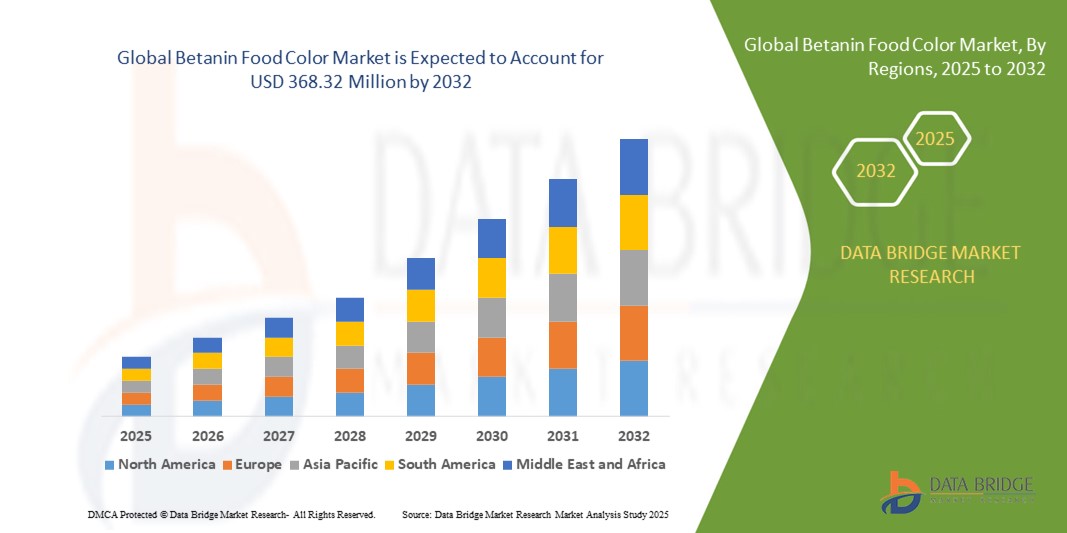
Betanin Food Color Market Size
- The global betanin food color market size was valued at USD 247.40 million in 2024 and is expected to reach USD 368.32 million by 2032, at a CAGR of 5.10% during the forecast period
- The market growth is largely fuelled by the rising consumer preference for natural and clean-label food products, alongside increasing demand for visually appealing processed foods and beverages
- Growing awareness about the harmful effects of synthetic colorants is further boosting the adoption of betanin, particularly in confectionery, dairy, bakery, and beverage applications
Betanin Food Color Market Analysis
- The market is witnessing strong growth due to the integration of betanin in a wide range of food and beverage formulations.
- Technological advancements in extraction and stabilization processes are enhancing the performance and shelf-life of betanin, further driving adoption
- North America dominated the betanin food color market with the largest revenue share of 38.25% in 2024, driven by increasing consumer preference for natural and clean-label food products, growing health consciousness, and the rising demand for processed and functional foods.
- Asia-Pacific region is expected to witness the highest growth rate in the global betanin food color market, driven by rapid urbanization, rising health awareness, expanding foodservice and bakery industries, and increased adoption of natural colorants across emerging markets
- The organic segment held the largest market revenue share in 2024, driven by rising consumer preference for clean-label and natural ingredients in food and beverages. Organic betanin is favored for its health benefits, regulatory compliance, and alignment with sustainable sourcing practices, making it highly popular among health-conscious consumers
Report Scope and Betanin Food Color Market Segmentation
|
Attributes |
Betanin Food Color Key Market Insights |
|
Segments Covered |
|
|
Countries Covered |
North America
Europe
Asia-Pacific
Middle East and Africa
South America
|
|
Key Market Players |
|
|
Market Opportunities |
• Expansion Of Natural And Clean-Label Food Products |
|
Value Added Data Infosets |
In addition to the insights on market scenarios such as market value, growth rate, segmentation, geographical coverage, and major players, the market reports curated by the Data Bridge Market Research also include in-depth expert analysis, pricing analysis, brand share analysis, consumer survey, demography analysis, supply chain analysis, value chain analysis, raw material/consumables overview, vendor selection criteria, PESTLE Analysis, Porter Analysis, and regulatory framework. |
Betanin Food Color Market Trends
Rising Preference For Natural And Clean-Label Colorants
• The growing shift toward natural food colorants is transforming the food and beverage industry by enabling healthier, clean-label formulations. Betanin, derived from beetroot, offers vibrant red hues without synthetic additives, meeting consumer demand for safe and natural ingredients. This shift enhances brand perception and supports regulatory compliance in processed foods, while also reducing dependency on artificial colorants that may have regulatory restrictions in multiple regions
• Increasing demand in processed foods, confectionery, dairy products, and beverages is accelerating the adoption of betanin food color. Its stability under various pH levels and compatibility with heat-processing makes it suitable for a wide range of applications, including juices, yogurts, and bakery products. Manufacturers are also exploring innovative blends and combinations with other natural pigments to expand color variety and appeal to diverse consumer tastes
• Manufacturers are focusing on cost-effective extraction and stabilization techniques to enhance the functionality and shelf-life of betanin colorants. Improved formulations allow for consistent color performance, which is critical for brand image and consumer acceptance. Companies are In addition investing in encapsulation and nanoemulsion technologies to improve thermal and light stability, ensuring reliable performance across different food matrices
• For instance, in 2023, several beverage manufacturers in Europe incorporated betanin-based natural colorants in fruit juices and smoothies, resulting in higher consumer preference scores and aligning with sustainability initiatives. Adoption was also supported by marketing campaigns highlighting clean-label ingredients, reinforcing brand loyalty and consumer trust
• While the adoption of betanin food color is increasing, continuous innovation in encapsulation, stabilization, and blending techniques is essential to maintain vibrant color, shelf stability, and cost efficiency. Manufacturers are expected to invest further in research to reduce production costs while improving compatibility with a wider range of processed and heat-treated foods
Betanin Food Color Market Dynamics
Driver
Increasing Demand For Clean-Label And Health-Oriented Food Products
• Rising consumer awareness about synthetic additives and health risks is driving the preference for natural colorants such as betanin. Clean-label trends in packaged foods, beverages, and confectioneries are creating consistent demand for natural red pigments. This trend is reinforced by growing social media influence and consumer education campaigns on the benefits of plant-based ingredients
• Expansion of the functional beverage sector and nutraceuticals is further fueling adoption, as betanin offers antioxidant properties in addition to coloring. This dual functionality appeals to health-conscious consumers seeking fortified and visually appealing products. Companies are increasingly highlighting the functional benefits of betanin on product labels to differentiate offerings and gain market share
• Global regulatory support for natural ingredients and stringent restrictions on synthetic dyes are encouraging manufacturers to replace artificial colors with betanin. This trend is boosting long-term market adoption across processed foods, confectionery, and beverages. In addition, regulatory alignment across North America, Europe, and APAC is providing a smoother pathway for commercialization of betanin-based products globally
• For instance, leading European and North American confectionery brands reported increased incorporation of betanin in 2023 due to consumer preference for natural ingredients, driving higher product launches and revenue growth. Manufacturers are leveraging betanin as part of broader “clean-label” product portfolios to attract health-conscious demographics and premium segments
• While demand is growing, manufacturers must focus on ensuring consistent color intensity, functional stability, and cost-effective sourcing of betanin from natural beetroot sources to sustain adoption. Investment in sustainable farming practices and partnerships with beetroot suppliers is also becoming critical to maintain supply chain stability
Restraint/Challenge
High Production Costs And Limited Stability In Certain Applications
• The cost of extracting and purifying betanin from beetroot is higher compared to synthetic red colorants, limiting its use in price-sensitive markets and high-volume applications. Smaller manufacturers often face adoption challenges due to cost constraints. Economies of scale, efficient extraction methods, and advanced stabilization technologies are needed to reduce overall production expenses
• Betanin is sensitive to high temperatures, light, and pH variations, which can reduce color stability during processing and storage. This limits its application in baked goods, canned products, and other heat-intensive food processing methods. Manufacturers are investing in protective encapsulation, anti-oxidative additives, and improved formulation strategies to expand its application range and enhance shelf-life
• Limited availability of high-quality raw beetroot sources in certain regions can lead to supply inconsistencies, affecting production planning and pricing. Manufacturers must secure reliable sourcing and invest in processing infrastructure. Seasonal fluctuations, weather conditions, and agricultural limitations add to the risk, making long-term supply chain agreements and multi-regional sourcing strategies essential
• For instance, in 2023, several beverage and dairy companies in Asia reported challenges maintaining consistent betanin color intensity during pasteurization, prompting investment in stabilization technologies. Companies also collaborated with technology providers to develop more resilient formulations suitable for high-heat and acidic food products
• While natural colorants continue to gain popularity, addressing cost, stability, and supply chain challenges remains critical. Stakeholders must invest in R&D, encapsulation technologies, and sustainable sourcing to unlock the market’s full potential. Market participants are also exploring innovative partnerships to share technology and resources for more efficient and scalable production
Betanin Food Color Market Scope
The betanin food color market is segmented on the basis of nature, product form, source, and application.
- By Nature
On the basis of nature, the betanin food color market is segmented into organic and conventional. The organic segment held the largest market revenue share in 2024, driven by rising consumer preference for clean-label and natural ingredients in food and beverages. Organic betanin is favored for its health benefits, regulatory compliance, and alignment with sustainable sourcing practices, making it highly popular among health-conscious consumers.
The conventional segment is expected to witness the fastest growth rate from 2025 to 2032, driven by cost-effectiveness, broader availability, and ease of incorporation in large-scale food manufacturing. Conventional betanin offers reliable color performance across a wide range of processed foods and beverages, supporting high-volume production without significantly increasing formulation costs.
- By Product Form
On the basis of product form, the market is segmented into powder and liquid. The powder segment held the largest market share in 2024, attributed to its longer shelf life, ease of handling, and stability under various processing conditions. Powdered betanin is widely used in bakery, confectionery, and beverage industries for consistent color application and reduced wastage.
The liquid segment is expected to witness the fastest growth rate from 2025 to 2032 due to its ease of blending in beverages, sauces, and liquid-based products, enabling uniform color distribution. Liquid betanin also allows for flexible dosing, faster dissolution, and suitability for automated production lines, making it increasingly attractive for large-scale manufacturers.
- By Source
On the basis of source, the market is segmented into red beet, yellow beet, prickly pear, Swiss chard, grain amaranth, cactus fruits, and others. Red beet accounted for the largest revenue share in 2024 due to its high betanin content, widespread cultivation, and ease of extraction. Red beet-based betanin is preferred for its vibrant color, stability, and versatility across various food and beverage applications.
Swiss chard is expected to witness the fastest growth rate from 2025 to 2032, driven by their increasing use in natural and functional colorant blends. Manufacturers are investing in alternative sources to diversify supply, improve color intensity, and meet growing demand for exotic natural ingredients.
- By Application
On the basis of application, the market is segmented into bakery and confectionery products, fruit preparations/fillings, dairy food products, beverages, soups, sauces and dressings, potatoes, pasta and rice, seasoning, meat, poultry, fish, and eggs, and others. Bakery and confectionery products held the largest market share in 2024, driven by high consumption of colored sweets, chocolates, and baked goods globally.
Beverages is expected to witness the fastest growth rate from 2025 to 2032 due to rising demand for naturally colored drinks, yogurts, and functional beverages. Applications in sauces, soups, and ready-to-eat meals are also expanding as manufacturers aim to replace synthetic red dyes with betanin to meet regulatory standards and consumer demand for natural ingredients.
Betanin Food Color Market Regional Analysis
• North America dominated the betanin food color market with the largest revenue share of 38.25% in 2024, driven by increasing consumer preference for natural and clean-label food products, growing health consciousness, and the rising demand for processed and functional foods.
• Manufacturers in the region are expanding production capacities, investing in advanced extraction technologies, and launching innovative betanin-based formulations to meet the surging demand from the food and beverage industry.
• This widespread adoption is further supported by urbanization, rising disposable incomes, and a strong regulatory framework promoting natural and safe food additives, establishing betanin as a favored natural colorant across bakery, dairy, beverage, and confectionery applications.
U.S. Betanin Food Color Market Insight
The U.S. betanin food color market captured the largest revenue share in North America in 2024, fueled by the growing adoption of natural, clean-label, and health-oriented food products. Rising consumer awareness regarding synthetic additives and increasing demand for functional beverages, bakery, and confectionery products are driving market growth. Companies are focusing on expanding distribution channels, product innovation, and partnerships with food manufacturers to strengthen their market presence.
Europe Betanin Food Color Market Insight
The Europe betanin food color market is expected to witness the fastest growth rate from 2025 to 2032, driven by regulatory support for natural ingredients and rising demand for clean-label and health-focused food products. Adoption is strong across bakery, dairy, beverages, and confectionery, with manufacturers emphasizing innovative extraction and stabilization techniques to meet stringent quality standards.
U.K. Betanin Food Color Market Insight
The U.K. betanin food color market is expected to witness the fastest growth rate from 2025 to 2032 due to rising health awareness, increased consumption of processed and convenience foods, and demand for natural and organic ingredients. Food manufacturers are leveraging betanin in confectionery, bakery, and beverages to meet consumer preferences while enhancing product appeal.
Germany Betanin Food Color Market Insight
The Germany betanin food color market is expected to witness the fastest growth rate from 2025 to 2032, fueled by strong consumer inclination toward clean-label and naturally colored food products. Manufacturers are focusing on improving color stability, shelf-life, and application versatility while addressing growing demand in dairy, bakery, beverages, and functional food sectors.
Asia-Pacific Betanin Food Color Market Insight
The Asia-Pacific betanin food color market is expected to witness the fastest growth rate from 2025 to 2032, driven by rising processed food consumption, urbanization, and growing health awareness in countries such as China, India, and Japan. Manufacturers are increasingly adopting advanced extraction and stabilization techniques to cater to expanding bakery, beverage, and confectionery sectors, supported by government initiatives promoting safe and natural food ingredients.
China Betanin Food Color Market Insight
The China betanin food color market accounted for the largest revenue share in Asia-Pacific in 2024, driven by rapid urbanization, rising disposable incomes, and increased demand for clean-label and natural food products. The market is further supported by expanding processed food and beverage industries, alongside domestic manufacturers investing in advanced production technologies.
Japan Betanin Food Color Market Insight
The Japan betanin food color market is expected to witness the fastest growth rate from 2025 to 2032 due to high consumer focus on health, nutrition, and natural ingredients. Rising adoption in functional foods, beverages, and bakery products, coupled with technological advancements in extraction and stabilization, is driving growth. The aging population is also boosting demand for safe, easy-to-use, and visually appealing food products.
Betanin Food Color Market Share
The Betanin Food Color industry is primarily led by well-established companies, including:
- Chr. Hansen A/S (Denmark)
- Kalsec Inc. (U.S.)
- Sensient Technologies Corporation (U.S.)
- Symrise (Germany)
- Hunan NutraMax Inc. (China)
- Nanjing Zelang Medical Technology Co., Ltd. (China)
- KINGHERBS LIMITED (China)
- TIANJIN JIANFENG NATURAL PRODUCT R&D CO., LTD (China)
- Bakels Worldwide (Switzerland)
- Monteloeder (Spain)
- Givaudan (Switzerland)
- Synthite Industries Ltd. (India)
- GNT Group (Netherlands)
- San-Ei Gen F.F.I.,Inc. (Japan)
- ROHA Group (India)
- Döhler GmbH (Germany)
- AECO Corp. (U.S.)
- Plant Lipids (India)
- Food Ingredient Solutions (U.S.)
- Vinayak Corporation (India)
- Henningsen Nederland bv (Netherlands)
- Sai Gopal Enterprises (India)
- Phytolon (Israel)
- DSM (Netherlands)
Latest Developments in Global Betanin Food Color Market
- In January 2024, Phytolon and Ginkgo Bioworks achieved a major development milestone in their multi-product collaboration to produce natural food colors using fermentation-based technologies. The partnership involved an equity milestone distribution to Ginkgo, marking a key step in advancing scalable, sustainable natural color solutions. This development is expected to enhance the availability of high-quality, natural colorants, reduce reliance on synthetic additives, and strengthen the market for clean-label and health-focused food products
- In August 2023, GNT Group launched Shade Vivid Orange - OS, the EXBERRY portfolio’s first 100% oil-soluble, plant-based color derived from non-GMO paprika. This innovative product offers a vibrant, flexible orange hue suitable for fat-based sweet and savory applications, enabling manufacturers to replace artificial colors and paprika oleoresin. The launch supports clean-label trends, expands product formulation options, and meets growing consumer demand for natural and visually appealing food colors

- Interactive Data Analysis Dashboard
- Company Analysis Dashboard for high growth potential opportunities
- Research Analyst Access for customization & queries
- Competitor Analysis with Interactive dashboard
- Latest News, Updates & Trend analysis
- Harness the Power of Benchmark Analysis for Comprehensive Competitor Tracking
Global Betanin Food Color Market, Supply Chain Analysis and Ecosystem Framework
To support market growth and help clients navigate the impact of geopolitical shifts, DBMR has integrated in-depth supply chain analysis into its Global Betanin Food Color Market research reports. This addition empowers clients to respond effectively to global changes affecting their industries. The supply chain analysis section includes detailed insights such as Global Betanin Food Color Market consumption and production by country, price trend analysis, the impact of tariffs and geopolitical developments, and import and export trends by country and HSN code. It also highlights major suppliers with data on production capacity and company profiles, as well as key importers and exporters. In addition to research, DBMR offers specialized supply chain consulting services backed by over a decade of experience, providing solutions like supplier discovery, supplier risk assessment, price trend analysis, impact evaluation of inflation and trade route changes, and comprehensive market trend analysis.
Data collection and base year analysis are done using data collection modules with large sample sizes. The stage includes obtaining market information or related data through various sources and strategies. It includes examining and planning all the data acquired from the past in advance. It likewise envelops the examination of information inconsistencies seen across different information sources. The market data is analysed and estimated using market statistical and coherent models. Also, market share analysis and key trend analysis are the major success factors in the market report. To know more, please request an analyst call or drop down your inquiry.
The key research methodology used by DBMR research team is data triangulation which involves data mining, analysis of the impact of data variables on the market and primary (industry expert) validation. Data models include Vendor Positioning Grid, Market Time Line Analysis, Market Overview and Guide, Company Positioning Grid, Patent Analysis, Pricing Analysis, Company Market Share Analysis, Standards of Measurement, Global versus Regional and Vendor Share Analysis. To know more about the research methodology, drop in an inquiry to speak to our industry experts.
Data Bridge Market Research is a leader in advanced formative research. We take pride in servicing our existing and new customers with data and analysis that match and suits their goal. The report can be customized to include price trend analysis of target brands understanding the market for additional countries (ask for the list of countries), clinical trial results data, literature review, refurbished market and product base analysis. Market analysis of target competitors can be analyzed from technology-based analysis to market portfolio strategies. We can add as many competitors that you require data about in the format and data style you are looking for. Our team of analysts can also provide you data in crude raw excel files pivot tables (Fact book) or can assist you in creating presentations from the data sets available in the report.













