


What is the Global Beverage Can Ends Market Size and Growth Rate?
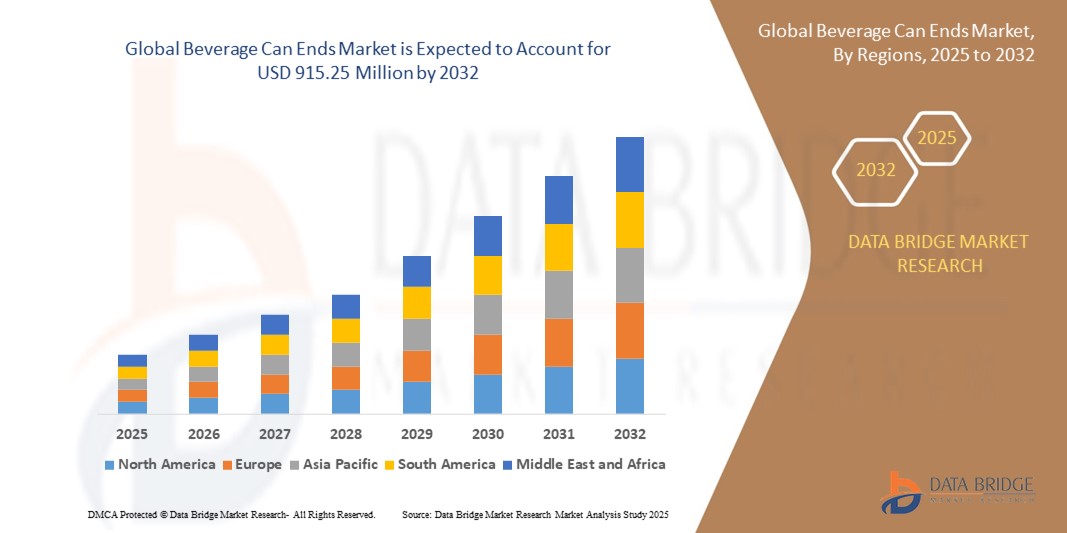
- As per Data Bridge Market Research Analysis the global beverage can ends market size was valued at USD 610.58 million in 2024 and is expected to reach USD 915.25 million by 2032, at a CAGR of 5.19% during the forecast period
- The beverage can ends market is experiencing notable growth, driven by ongoing innovations and increasing consumer demand for sustainable packaging solutions. Recent developments in the sector include advancements in can end designs that enhance product protection and ease of use
- For instance, companies are focusing on the creation of easy-open and resealable can ends, which cater to the convenience and usability preferences of consumers. In addition, there is a growing trend towards using recyclable and eco-friendly materials, such as aluminum, which is infinitely recyclable and reduces environmental impact compared to traditional materials
- The market is also seeing a shift towards smaller can formats and specialty designs to cater to diverse beverage types and consumer preferences. Such developments align with the broader sustainability goals of the beverage industry and address consumer demand for more functional and environmentally friendly packaging options, driving the market's expansion and innovation
Market Size & Forecast
- Global Market Value (2025):USD 610.58 million
- Expected Market Value (2033): USD 915.25 million
- Forecast CAGR (2026–2033):5.19%
- Leading Region in 2025: North America
- Fastest Growing Region: Asia-Pacific
-
What are the Major Takeaways of Beverage Can Ends Market?
- The increasing consumption of beverages significantly drives the global beverage can ends market, fueled by a growing preference for convenient and portable drink options
- According to the 2023 National Survey on Drug Use and Health (NSDUH), approximately 177.3 million individuals aged 12 and older reported alcohol consumption in the past year. Such high level of alcohol consumption underscores a substantial demand for beverage cans, particularly in the alcoholic drinks sector
- As consumer preferences shift towards ready-to-drink and convenient packaging, manufacturers are focusing on innovative can end solutions, such as easy-open and resealable designs, to cater to this rising demand
- This trend highlights the crucial role that beverage can ends play in the expanding market, driven by both convenience and the increasing variety of beverage options available to consumers
- North America dominated the beverage can ends market with the largest revenue share of 39.47% in 2024, driven by a high demand for sustainable, lightweight, and easily recyclable packaging solutions across carbonated drinks, energy beverages, and alcoholic products
- Asia-Pacific is poised to grow at the fastest CAGR of 9.48% from 2025 to 2032, driven by urbanization, rising disposable incomes, and high consumption of canned beverages in countries such as China, Japan, and India
- The Stay-on-tab segment dominated the beverage can ends market with the largest revenue share of 46.8% in 2024, owing to its widespread use across carbonated soft drinks and beer packaging
Report Scope and Beverage Can Ends Market Segmentation
|
|
|
|
|
|
|
|
|
|
|
|
-
What is the Key Trend in the Beverage Can Ends Market?
- “Sustainable and Lightweight Innovations Transforming Packaging”
- A prominent trend in the global beverage can ends market is the increasing shift toward lightweighting and sustainability, driven by both environmental regulations and consumer demand for eco-friendly packaging. Manufacturers are adopting innovative alloys and design efficiencies to reduce material use without compromising strength
- For instance, Crown Holdings introduced its “40mm SuperEnd” beverage can end, which reduces metal usage and lowers carbon emissions during production and transport. Ball Corporation is also focused on developing aluminum ends with increased recyclability and reduced environmental footprint
- Lightweight beverage can ends cut manufacturing and shipping costs and align with the growing regulatory focus on carbon neutrality and extended producer responsibility (EPR) in packaging. This positions sustainable can ends as a competitive advantage for global beverage brands
- Major players are also exploring reclosable and resealable ends to improve consumer convenience and reduce waste, especially in the ready-to-drink (RTD) and energy drink segments
- Smart manufacturing technologies, including AI-based quality control and data analytics, are increasingly being integrated to improve production efficiency and reduce defects
- The shift toward sustainability, reduced material usage, and smarter production is reshaping market dynamics, pushing manufacturers to innovate in both design and operations for long-term value
-
What are the Key Drivers of Beverage Can Ends Market?
- Rising demand for eco-friendly, recyclable, and tamper-proof packaging in the beverage industry is a key driver of the beverage can ends market. Brands are increasingly opting for aluminum-based ends due to their infinite recyclability and low environmental impact
- For instance, in October 2023, Ardagh Group expanded its lightweight beverage can end production line in the U.S., targeting energy drinks and flavored waters, reflecting increased demand for sustainable and premium packaging formats
- The global shift toward sugar-free soft drinks, craft beverages, and RTD cocktails is fueling demand for stylish, functional, and resealable can ends that enhance product integrity and shelf appeal
- Growing consumer preference for on-the-go consumption and the need for longer shelf life are encouraging beverage brands to adopt can ends that offer better protection, freshness retention, and ease of opening
- Advancements in easy-open and ergonomic designs, combined with improved sealing technologies, are driving adoption in sports drinks, carbonated beverages, and non-alcoholic malt drinks. The surge in e-commerce and direct-to-consumer beverage delivery is also fueling interest in robust and leakage-resistant ends
-
Which Factor is challenging the Growth of the Beverage Can Ends Market?
- One of the major challenges for the beverage can ends market is volatility in aluminum prices, which significantly impacts production costs and pricing strategies for both manufacturers and beverage brands
- For instance, global aluminum prices surged by over 25% in 2022, prompting packaging companies such as CANPACK and CPMC Holdings to reassess their sourcing strategies and consider cost pass-through mechanisms with clients
- Regulatory complexities, such as import tariffs and environmental compliance mandates in regions such as Europe and North America, can also disrupt supply chains and slow down new capacity expansions
- In addition, concerns about overreliance on single-material packaging may prompt some beverage producers to diversify toward hybrid or compostable packaging, creating competitive pressures
- In developing regions, limited recycling infrastructure and low consumer awareness regarding sustainable packaging may reduce the appeal of aluminum can ends despite their recyclability
- Overcoming these challenges requires a multi-pronged strategy involving price stabilization mechanisms, regional sourcing diversification, and greater collaboration with recycling networks to maintain market momentum
-
How is the Beverage Can Ends Market Segmented?
- The market is segmented on the basis of product type, material type, size, and end use.
- By Product Type
- On the basis of product type, the beverage can ends market is segmented into Pull Tab Beverage Can Ends, Stay-on-tab Beverage Can Ends, Top End Beverage Can Ends, and Full Aperture Beverage Can Ends. The Stay-on-tab segment dominated the beverage can ends market with the largest revenue share of 46.8% in 2024, owing to its widespread use across carbonated soft drinks and beer packaging. This type offers consumer convenience, minimizes litter, and is widely accepted by regulatory authorities promoting sustainable packaging.
- The Full Aperture Beverage Can Ends segment is anticipated to register the fastest CAGR from 2025 to 2032, driven by rising demand in the ready-to-eat food and specialty beverage markets, as it enables complete removal of the can top for ease of consumption or pouring.
- By Material Type
- On the basis of material type, the beverage can ends market is segmented into Aluminum, Steel, and Tin. The Aluminum segment held the largest market share of 63.5% in 2024, attributed to its lightweight properties, excellent corrosion resistance, and infinite recyclability. Beverage brands favor aluminum for its low carbon footprint and compatibility with modern beverage filling lines.
- The Steel segment is expected to witness the fastest growth from 2025 to 2032, particularly in emerging markets where cost-efficiency and durability are prioritized in packaging for both carbonated and non-carbonated beverages.
- By Size
- On the basis of size, the beverage can ends market is segmented into Up to 46 mm, 46 to 52 mm, 52 to 63 mm, and 63 to 65 mm. The 46 to 52 mm segment dominated the market with a revenue share of 38.2% in 2024, as it is the most commonly used size across soft drinks and energy beverages globally. This size range offers an optimal balance between material usage, user experience, and compatibility with standard beverage can bodies.
- The 52 to 63 mm segment is projected to witness the fastest growth, supported by its increasing use in larger beverage volumes such as energy drinks, beers, and functional beverages that require enhanced ergonomics and shelf appeal.
- By End Use
- On the basis of end use, the beverage can ends market is segmented into Alcoholic, Non-alcoholic, and Others. The Non-alcoholic segment accounted for the largest revenue share of 55.7% in 2024, driven by the massive consumption of carbonated soft drinks, sports drinks, and juices. The increasing demand for convenient, portable, and eco-friendly packaging solutions is a key factor supporting the segment’s dominance.
- The Alcoholic segment is expected to register the fastest CAGR from 2025 to 2032, fueled by the rising popularity of craft beers, hard seltzers, and RTD alcoholic beverages that leverage beverage cans for freshness and branding advantages.
-
Which Region Holds the Largest Share of the Beverage Can Ends Market?
- North America dominated the beverage can ends market with the largest revenue share of 39.47% in 2024, driven by a high demand for sustainable, lightweight, and easily recyclable packaging solutions across carbonated drinks, energy beverages, and alcoholic products
- The presence of major beverage brands and can manufacturers such as Ball Corporation and Crown Holdings supports large-scale regional consumption and innovation in design and material use
- Growing consumer awareness of eco-friendly packaging, combined with strong recycling infrastructure and regulations, has made beverage can ends the preferred closure system for aluminum beverage cans across the region
-
U.S. Beverage Can Ends Market Insight
- The U.S. captured the largest share within the North American Beverage Can Ends market in 2024, driven by the high production volume of canned beverages, especially soft drinks and beers. Major players such as Ball and Ardagh Group have expanded their manufacturing footprint and R&D in the country, supporting packaging innovations and catering to high-volume retail demand. Consumer preferences for convenient, portable, and recyclable packaging continue to boost the adoption of advanced Beverage Can Ends in both domestic and export-oriented beverage sectors.
-
Europe Beverage Can Ends Market Insight
- The Europe beverage can ends market is set to grow at a substantial CAGR through 2032, fueled by increasing environmental regulations, especially the EU’s focus on plastic reduction and aluminum recycling. Key trends include the adoption of reclosable and full-aperture ends in the craft beverage and functional drink segments. The region’s demand is bolstered by high beverage consumption per capita, modernization of packaging lines, and growing appeal for premium and aesthetic can end designs.
-
U.K. Beverage Can Ends Market Insight
- The U.K. beverage can ends market is anticipated to grow at a noteworthy CAGR during the forecast period due to rising demand for sustainable packaging in both alcoholic and non-alcoholic beverages. Growing environmental consciousness among consumers and compliance with post-Brexit packaging regulations are encouraging brands to adopt fully recyclable can formats. The market is also benefiting from the popularity of craft beers, sparkling water, and wellness drinks, which favor high-quality can ends with resealability and enhanced branding features.
-
Germany Beverage Can Ends Market Insight
- Germany is projected to witness considerable growth in the Beverage Can Ends market through 2032, supported by its strong engineering and manufacturing base and eco-conscious consumers. The country’s focus on circular economy practices and investment in automated filling and packaging systems encourages adoption of aluminum can ends across beverage segments. The integration of smart labeling and QR-code-enabled closures is also gaining traction, enhancing traceability and consumer engagement through Beverage Can Ends.
-
Which Region is the Fastest Growing in the Beverage Can Ends Market?
- Asia-Pacific is poised to grow at the fastest CAGR of 9.48% from 2025 to 2032, driven by urbanization, rising disposable incomes, and high consumption of canned beverages in countries such as China, Japan, and India. The shift toward affordable, mass-scale production and increased adoption of aluminum packaging due to sustainability drives in the region are major growth catalysts. Local production and innovation by companies such as CPMC Holdings and CANPACK Asia are also enhancing accessibility and customization in can end solutions.
-
Japan Beverage Can Ends Market Insight
- Japan’s beverage can ends market is expanding steadily, with growth fueled by the popularity of functional and convenience beverages, particularly among urban and aging populations. The country’s emphasis on precision engineering and quality assurance ensures strong demand for advanced, tamper-resistant can end designs. Consumer expectations for convenience, safety, and minimal waste are driving innovation in full-aperture and resealable end types across both alcoholic and non-alcoholic segments.
-
China Beverage Can Ends Market Insight
- China led the Asia-Pacific beverage can ends market in 2024 with the largest revenue share, driven by its robust manufacturing capacity and large-scale beverage consumption. The country’s booming middle class and urbanization trends have made canned beverages increasingly popular in retail and foodservice channels. Strong domestic players and government backing of aluminum recycling and sustainable packaging initiatives are positioning China as both a high-demand and high-supply market for can ends.
-
Which are the Top Companies in Beverage Can Ends Market?
- The beverage can ends industry is primarily led by well-established companies, including:
- BALL Corporation (U.S.)
- Crown Holdings, Inc. (U.S.)
- Tetra Laval International S.A. (Switzerland)
- Orora Packaging Australia Pty Ltd (Australia)
- Silgan Holdings Inc. (U.S.)
- Ardagh Group S.A. (Luxembourg)
- Mahmood Saeed Beverage Cans & Ends Industry Company Limited (MSCANCO) (Saudi Arabia)
- CPMC Holdings Limited (China)
- CANPACK (Poland)
- The Olayan Group (Saudi Arabia)
- Bangkok Post Public Company Limited (Thailand)
- Nampak Ltd. (South Africa)
- Kian Joo Can Factory Berhad (Malaysia)
- Resonac Holdings Corporation (Japan)
- SWAN Industries (Thailand) Co., Ltd. (Thailand)
-
What are the Recent Developments in Global Beverage Can Ends Market?
- In January 2024, Novelis, a leading provider of sustainable aluminum solutions and a global leader in aluminum rolling and recycling, signed a new agreement with Ardagh Group S.A., a global supplier of sustainable aluminum beverage packaging solutions. As part of the contract, Novelis will supply aluminum beverage packaging sheets to Ardagh's metal production facilities across North America
- In June 2023, U.K. based Marlish Waters Ltd introduced a new 150 ml aluminum can format for its range of tonics and mixers. This glass-free option offers the benefits of being infinitely recyclable, more cost-effective, and easier to recycle compared to traditional glass packaging
- In October 2023, Crown Holdings, Inc. finalized its acquisition of Helvetia Packaging AG, a prominent beverage can and end manufacturing facility located in Saarlouis, Germany. The acquisition is expected to bolster Crown’s ability to meet growing demand for beverage packaging solutions across the region and strengthen its competitive position in the industry

- Interactive Data Analysis Dashboard
- Company Analysis Dashboard for high growth potential opportunities
- Research Analyst Access for customization & queries
- Competitor Analysis with Interactive dashboard
- Latest News, Updates & Trend analysis
- Harness the Power of Benchmark Analysis for Comprehensive Competitor Tracking
Global Beverage Can Ends Market, Supply Chain Analysis and Ecosystem Framework
To support market growth and help clients navigate the impact of geopolitical shifts, DBMR has integrated in-depth supply chain analysis into its Global Beverage Can Ends Market research reports. This addition empowers clients to respond effectively to global changes affecting their industries. The supply chain analysis section includes detailed insights such as Global Beverage Can Ends Market consumption and production by country, price trend analysis, the impact of tariffs and geopolitical developments, and import and export trends by country and HSN code. It also highlights major suppliers with data on production capacity and company profiles, as well as key importers and exporters. In addition to research, DBMR offers specialized supply chain consulting services backed by over a decade of experience, providing solutions like supplier discovery, supplier risk assessment, price trend analysis, impact evaluation of inflation and trade route changes, and comprehensive market trend analysis.
Data collection and base year analysis are done using data collection modules with large sample sizes. The stage includes obtaining market information or related data through various sources and strategies. It includes examining and planning all the data acquired from the past in advance. It likewise envelops the examination of information inconsistencies seen across different information sources. The market data is analysed and estimated using market statistical and coherent models. Also, market share analysis and key trend analysis are the major success factors in the market report. To know more, please request an analyst call or drop down your inquiry.
The key research methodology used by DBMR research team is data triangulation which involves data mining, analysis of the impact of data variables on the market and primary (industry expert) validation. Data models include Vendor Positioning Grid, Market Time Line Analysis, Market Overview and Guide, Company Positioning Grid, Patent Analysis, Pricing Analysis, Company Market Share Analysis, Standards of Measurement, Global versus Regional and Vendor Share Analysis. To know more about the research methodology, drop in an inquiry to speak to our industry experts.
Data Bridge Market Research is a leader in advanced formative research. We take pride in servicing our existing and new customers with data and analysis that match and suits their goal. The report can be customized to include price trend analysis of target brands understanding the market for additional countries (ask for the list of countries), clinical trial results data, literature review, refurbished market and product base analysis. Market analysis of target competitors can be analyzed from technology-based analysis to market portfolio strategies. We can add as many competitors that you require data about in the format and data style you are looking for. Our team of analysts can also provide you data in crude raw excel files pivot tables (Fact book) or can assist you in creating presentations from the data sets available in the report.













