


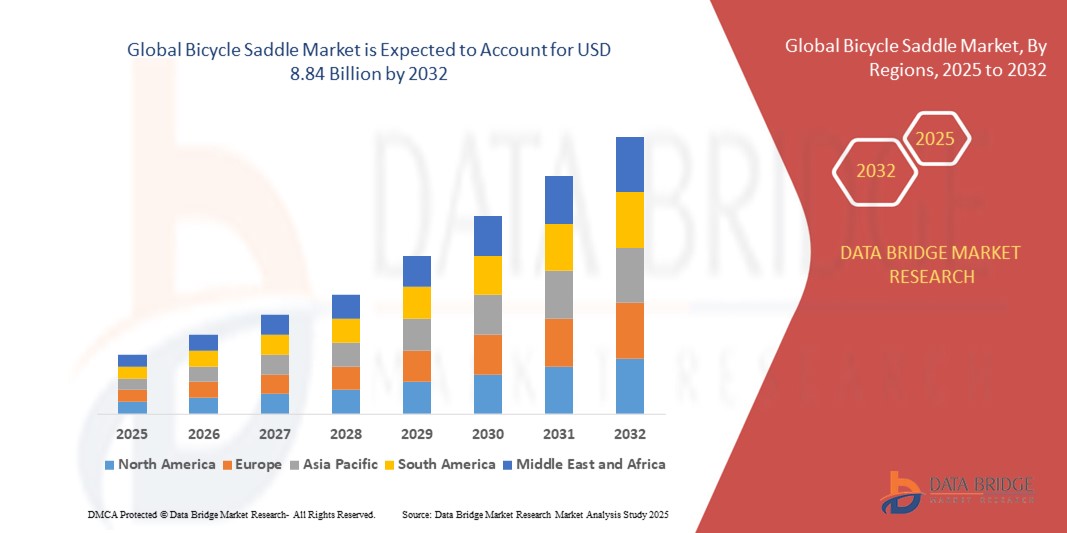
Bicycle Saddle Market Size
- The global bicycle saddle market size was valued at USD 2.13 billion in 2024 and is expected to reach USD 3.89 billion by 2032, at a CAGR of 7.8% during the forecast period
- The market growth is largely fuelled by the rising popularity of cycling as a recreational activity and a sustainable mode of transportation, coupled with increasing participation in cycling sports and events
- Growing health awareness, urban mobility initiatives, and the expansion of dedicated cycling infrastructure are further driving demand for high-quality and ergonomic bicycle saddles
Bicycle Saddle Market Analysis
- The market is witnessing significant innovation in saddle design, materials, and ergonomics, with manufacturers focusing on enhancing rider comfort, reducing pressure points, and improving overall performance.
- The demand for lightweight, durable, and customizable saddles is on the rise, with advancements in materials such as carbon fiber, gel padding, and memory foam contributing to improved comfort and efficiency
- North America dominated the bicycle saddle market with the largest revenue share of 38.5% in 2024, driven by a growing cycling culture, rising participation in recreational biking, and increasing adoption of bicycles for short-distance commuting
- \Asia-Pacific region is expected to witness the highest growth rate in the global bicycle saddle market, driven by expanding middle-class populations, rapid urban development, and growing investment in cycling infrastructure
- The OEM segment held the largest market revenue share in 2024, supported by the steady increase in global bicycle production and manufacturers’ focus on equipping bikes with high-quality saddles at the point of sale. OEM partnerships enable saddle brands to secure consistent, large-volume orders and gain visibility among first-time bicycle buyers
Report Scope and Bicycle Saddle Market Segmentation
|
Attributes |
Bicycle Saddle Key Market Insights |
|
Segments Covered |
|
|
Countries Covered |
North America
Europe
Asia-Pacific
Middle East and Africa
South America
|
|
Key Market Players |
|
|
Market Opportunities |
|
|
Value Added Data Infosets |
In addition to the market insights such as market value, growth rate, market segments, geographical coverage, market players, and market scenario, the market report curated by the Data Bridge Market Research team includes in-depth expert analysis, import/export analysis, pricing analysis, production consumption analysis, and pestle analysis. |
Bicycle Saddle Market Trends
Growing Popularity Of Ergonomic And Customizable Saddles
- The increasing focus on rider comfort and health is driving demand for ergonomic bicycle saddles designed to reduce pressure points, enhance posture, and prevent long-term discomfort. These designs are gaining popularity among both casual riders and professional cyclists seeking improved performance
- Customizable saddle options, such as adjustable width, interchangeable padding, and shape-modifying inserts, are becoming more accessible, enabling riders to fine-tune their saddles for personal comfort and riding style. This personalization trend is particularly strong in premium and sports cycling segments
- Advancements in materials, including lightweight carbon fiber bases and high-resilience foams, are further boosting the adoption of high-performance saddles. These innovations offer improved durability and comfort without adding weight, making them appealing for competitive cycling
- For instance, in 2024, several high-end saddle manufacturers introduced 3D-printed ergonomic models tailored to individual rider measurements, enhancing both comfort and power efficiency for long-distance cycling events
- While the adoption of ergonomic and customizable saddles is expanding, continued innovation, consumer education, and price accessibility will be key to penetrating broader market segments and increasing rider satisfaction
Bicycle Saddle Market Dynamics
Driver
Increasing Adoption Of Bicycles For Fitness And Sustainable Commuting
- The growing global emphasis on health, fitness, and eco-friendly commuting is boosting bicycle usage, directly driving demand for comfortable and high-quality saddles. As more people adopt cycling for daily transport and exercise, the need for supportive and long-lasting saddles is rising. This shift is reinforced by rising awareness of the health benefits of cycling, such as improved cardiovascular health and reduced carbon footprint, making comfort and ergonomics a top priority for new buyers
- Government initiatives promoting cycling infrastructure, such as bike lanes and public bike-sharing programs, are encouraging more commuters to switch from motorized transport to bicycles, further fueling saddle demand. In addition, subsidy schemes for bicycle purchases and cycling safety campaigns are boosting participation rates, creating a ripple effect in the aftermarket saddle segment. Municipal partnerships with manufacturers are also enabling bulk procurement of better-quality saddles for public bike fleets
- The rise of recreational cycling events and competitive sports is increasing consumer willingness to invest in performance-focused saddles that offer both comfort and efficiency. Enthusiasts are prioritizing saddles that enhance riding posture and reduce fatigue during long rides, fueling interest in premium and specialized designs. As more cycling clubs and events gain popularity globally, the demand for professional-grade saddles is expected to rise significantly
- For instance, in 2023, multiple European cities reported a surge in bicycle sales following the expansion of dedicated cycling tracks, with saddle upgrades becoming a key aftermarket purchase. This trend was also mirrored in North America and parts of Asia-Pacific, where cycling tourism and endurance events attracted both amateur and professional riders seeking improved saddle comfort. Several retailers reported a spike in 3D-printed and gel-based saddle sales during peak cycling seasons
- While the trend is favorable, manufacturers must focus on innovation and affordability to ensure quality saddles are accessible to a wider consumer base. Offering hybrid product lines that blend ergonomic benefits with cost-effective materials could help bridge the gap between premium and budget-conscious segments. In addition, expanding online customization tools could encourage more consumers to upgrade their saddles
Restraint/Challenge
Price Sensitivity And Availability Of Low-Cost Alternatives
- High-quality bicycle saddles, particularly those incorporating advanced materials and ergonomic designs, often come at a premium price, making them less accessible to budget-conscious consumers, especially in emerging markets. This pricing gap is exacerbated by currency fluctuations and import duties, which can push the cost of premium saddles beyond the reach of average riders. Consequently, many potential buyers postpone or forego upgrades despite recognizing the benefits
- Low-cost, mass-produced saddles with basic designs remain widely available, which can limit demand for premium products despite their superior comfort and performance benefits. These budget options often dominate retail shelves in local markets, especially in regions where price competition is fierce. Their widespread availability in online marketplaces further challenges premium manufacturers trying to convey value beyond the initial purchase price
- Many casual riders prioritize initial purchase price over long-term comfort, often resulting in lower adoption of advanced saddles. This is particularly evident in markets where cycling is primarily a necessity rather than a leisure activity, leading to limited awareness of the health risks associated with poorly designed saddles. As a result, discomfort and potential injuries may go unnoticed or unaddressed, slowing overall market penetration for high-quality options
- For instance, in 2023, surveys in Southeast Asia indicated that over 60% of urban commuters opted for factory-installed standard saddles, citing affordability as the key reason for avoiding aftermarket upgrades. Follow-up research revealed that even when exposed to better saddle options, many consumers considered them a “luxury” purchase rather than a necessity. This mindset poses a challenge for premium brands seeking to increase awareness and adoption
- To overcome this restraint, brands need to develop competitively priced mid-range options that balance quality, comfort, and accessibility, while also educating consumers on the long-term benefits of ergonomic saddle investments. Targeted awareness campaigns, partnerships with cycling clubs, and in-store trial programs could help shift consumer perception and encourage more upgrades in cost-sensitive markets
Bicycle Saddle Market Scope
The market is segmented on the basis of activity, distribution channel, type, and sales channel.
- By Activity
On the basis of activity, the bicycle saddle market is segmented into mountain bikes, hybrid bikes, and e-bikes. The mountain bikes segment dominated the market with the largest revenue share in 2024, driven by the sport’s global popularity and the growing trend of adventure tourism. Mountain biking requires durable, shock-absorbing saddles that can withstand rough terrains, which has led to increased demand for premium, ergonomically designed options. The segment also benefits from rising participation in competitive events and recreational trails, particularly in North America and Europe.
The e-bikes segment is expected to witness the fastest growth rate from 2025 to 2032, fueled by the rapid adoption of electric mobility solutions in both urban commuting and leisure riding. E-bike users often prioritize comfort due to longer ride times and higher average speeds, creating strong demand for padded, gel-based, and anatomically shaped saddles. In addition, supportive government policies promoting e-bike adoption are indirectly boosting saddle upgrades in this category.
- By Distribution Channel
On the basis of distribution channel, the bicycle saddle market is segmented into OEM and aftermarket. The OEM segment held the largest market revenue share in 2024, supported by the steady increase in global bicycle production and manufacturers’ focus on equipping bikes with high-quality saddles at the point of sale. OEM partnerships enable saddle brands to secure consistent, large-volume orders and gain visibility among first-time bicycle buyers.
The aftermarket segment is expected to witness the fastest growth rate from 2025 to 2032, driven by consumers’ growing interest in customizing and upgrading their bicycles for enhanced comfort and performance. This trend is particularly strong among avid cyclists and commuters who replace factory-installed saddles with more ergonomic or stylish options. Online retail platforms and specialty bike stores are playing a key role in expanding aftermarket product accessibility.
- By Type
On the basis of type, the bicycle saddle market is segmented into plastic, leather, and other materials. The plastic segment dominated the market in 2024 due to its affordability, lightweight design, and durability, making it a popular choice for both casual riders and entry-level bicycles. Advances in polymer technology have also improved comfort levels in plastic saddles, further supporting their widespread adoption.
The leather segment is expected to witness the fastest growth rate from 2025 to 2032, as consumers increasingly seek premium, long-lasting, and aesthetically appealing saddles. Leather saddles are favored by cycling enthusiasts and touring riders for their ability to mold to the rider’s shape over time, providing a customized fit. Rising demand for handcrafted and luxury bicycle components is further boosting growth in this category.
- By Sales Channel
On the basis of sales channel, the bicycle saddle market is segmented into online and offline. The offline segment accounted for the largest revenue share in 2024, driven by consumers’ preference for physically testing saddle comfort and fit before purchase. Specialty bike shops, sporting goods retailers, and large-format stores continue to play a key role in offline sales by offering personalized fitting advice and installation services.
The online segment is expected to witness the fastest growth rate from 2025 to 2032, supported by the growing penetration of e-commerce platforms, competitive pricing, and the availability of a wide variety of brands and designs. Enhanced product visualization tools, customer reviews, and direct-to-consumer sales strategies are making online channels increasingly attractive for both casual and professional riders.
Bicycle Saddle Market Regional Analysis
- North America dominated the bicycle saddle market with the largest revenue share of 38.5% in 2024, driven by a growing cycling culture, rising participation in recreational biking, and increasing adoption of bicycles for short-distance commuting
- Consumers in the region place strong emphasis on comfort, durability, and ergonomic designs, leading to high demand for premium and performance-oriented saddles
- This growth is further supported by well-developed cycling infrastructure, government initiatives promoting sustainable transport, and the popularity of organized cycling events, encouraging both professional and casual riders to invest in quality saddles
U.S. Bicycle Saddle Market Insight
The U.S. bicycle saddle market captured the largest revenue share in 2024 within North America, fueled by the rising popularity of cycling for health, fitness, and environmental benefits. Increasing participation in competitive cycling events, coupled with growing consumer awareness of the importance of proper saddle fit, is boosting sales of high-quality saddles. In addition, the strong presence of aftermarket retailers, e-commerce platforms, and customization services further strengthens the U.S. market’s position.
Europe Bicycle Saddle Market Insight
The Europe bicycle saddle market is expected to witness the fastest growth rate from 2025 to 2032, primarily driven by the region’s strong cycling tradition and extensive cycling infrastructure. European consumers are highly receptive to ergonomic and eco-friendly saddle materials, aligning with the continent’s sustainability goals. Demand is rising across both recreational and commuter segments, supported by government-backed initiatives to promote cycling as a primary mode of urban transportation.
U.K. Bicycle Saddle Market Insight
The U.K. bicycle saddle market is expected to witness the fastest growth rate from 2025 to 2032, supported by increasing cycling-to-work programs and a surge in leisure cycling activities. Rising awareness about posture-related health benefits and the availability of a wide range of saddles catering to different riding styles are key growth drivers. Furthermore, the expansion of cycling events and clubs is fostering demand for both high-performance and comfort-focused saddles.
Germany Bicycle Saddle Market Insight
The Germany bicycle saddle market is expected to witness the fastest growth rate from 2025 to 2032, driven by the country’s strong cycling culture and preference for high-quality engineering. German consumers tend to prioritize durability, comfort, and innovative designs, resulting in robust demand for premium saddles. In addition, Germany’s commitment to sustainable mobility and its extensive cycling infrastructure are creating long-term growth opportunities for saddle manufacturers.
Asia-Pacific Bicycle Saddle Market Insight
The Asia-Pacific bicycle saddle market is expected to witness the fastest growth rate from 2025 to 2032, driven by rapid urbanization, increasing disposable incomes, and government-led cycling promotion programs in countries such as China, Japan, and India. The region is also benefiting from the growth of local bicycle manufacturing hubs, which increases affordability and accessibility of quality saddles. Rising health consciousness and interest in recreational sports are further contributing to this upward trend.
Japan Bicycle Saddle Market Insight
The Japan bicycle saddle market is expected to witness the fastest growth rate from 2025 to 2032 due to the country’s emphasis on urban mobility, compact living, and technological innovation in cycling products. Japanese consumers value lightweight, ergonomic, and aesthetically pleasing saddles, driving demand for premium and custom-fit options. In addition, the integration of advanced materials and designs that cater to long-distance riding is attracting both commuters and enthusiasts.
China Bicycle Saddle Market Insight
The China bicycle saddle market accounted for the largest market revenue share in Asia Pacific in 2024, propelled by the country’s rapid adoption of bicycles for daily commuting and leisure activities. With a strong domestic manufacturing base, China offers a wide variety of saddles across price points, appealing to both budget-conscious and premium buyers. Government investments in cycling infrastructure, coupled with the popularity of bike-sharing programs, are further driving saddle demand across urban and suburban regions.
Bicycle Saddle Market Share
The bicycle saddle industry is primarily led by well-established companies, including:
- Bontrager (U.S.)
- Cionlli (Taiwan)
- DDK (Taiwan)
- Fabric (U.K.)
- Fizik (Italy)
- Giant Bicycles (Taiwan)
- MERIDA BIKES (Taiwan)
- Prologo (Italy)
- Schwinn (U.S.)
- SDG Components (U.S.)
- Selle Italia (Italy)
- SHIMANO INC. (Japan)
- Specialized Bicycle Components, Inc. (U.S.)
- Velo (Taiwan)
- WTB (U.S.)
Latest Developments in Global Bicycle Saddle Market
- In May 2023, Fizik introduced the enhanced Antares saddle range, designed to provide superior comfort and adaptability for cyclists. The updated line features a center cut-out, a sleek low-profile design, and a broader snout, all strategically incorporated to eliminate pressure points, enhance rider comfort, and promote increased mobility during seated cycling

- Interactive Data Analysis Dashboard
- Company Analysis Dashboard for high growth potential opportunities
- Research Analyst Access for customization & queries
- Competitor Analysis with Interactive dashboard
- Latest News, Updates & Trend analysis
- Harness the Power of Benchmark Analysis for Comprehensive Competitor Tracking
Data collection and base year analysis are done using data collection modules with large sample sizes. The stage includes obtaining market information or related data through various sources and strategies. It includes examining and planning all the data acquired from the past in advance. It likewise envelops the examination of information inconsistencies seen across different information sources. The market data is analysed and estimated using market statistical and coherent models. Also, market share analysis and key trend analysis are the major success factors in the market report. To know more, please request an analyst call or drop down your inquiry.
The key research methodology used by DBMR research team is data triangulation which involves data mining, analysis of the impact of data variables on the market and primary (industry expert) validation. Data models include Vendor Positioning Grid, Market Time Line Analysis, Market Overview and Guide, Company Positioning Grid, Patent Analysis, Pricing Analysis, Company Market Share Analysis, Standards of Measurement, Global versus Regional and Vendor Share Analysis. To know more about the research methodology, drop in an inquiry to speak to our industry experts.
Data Bridge Market Research is a leader in advanced formative research. We take pride in servicing our existing and new customers with data and analysis that match and suits their goal. The report can be customized to include price trend analysis of target brands understanding the market for additional countries (ask for the list of countries), clinical trial results data, literature review, refurbished market and product base analysis. Market analysis of target competitors can be analyzed from technology-based analysis to market portfolio strategies. We can add as many competitors that you require data about in the format and data style you are looking for. Our team of analysts can also provide you data in crude raw excel files pivot tables (Fact book) or can assist you in creating presentations from the data sets available in the report.













