


Big Data Market Overview
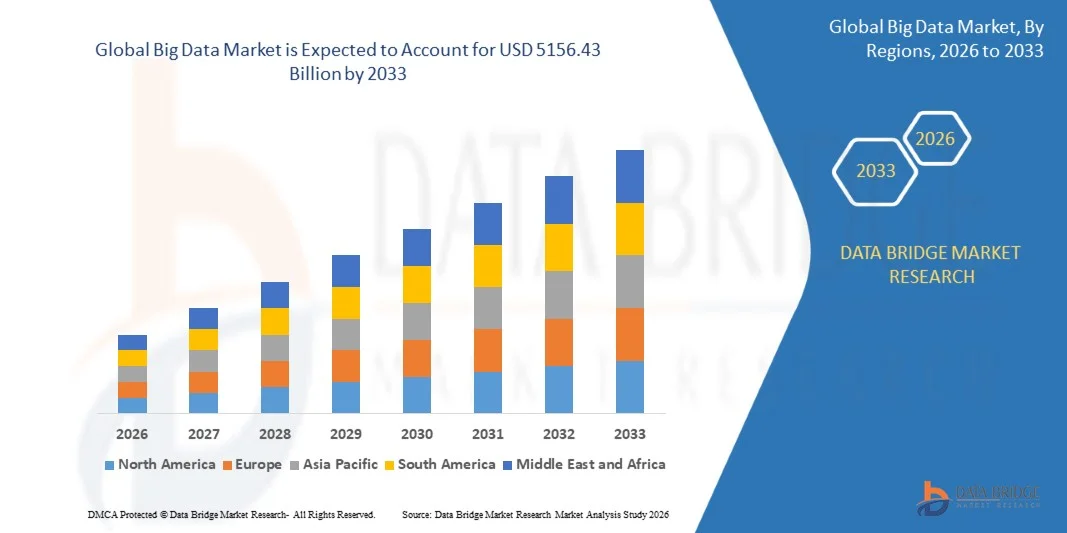
As per Data Bridge Market Research Analysis the big data market in smart cities was valued at USD 613.01 billion in 2025 and is projected to reach USD 5156.43 billion by 2033, growing at a CAGR of 30.50% from 2026 to 2033. The market is experiencing consistent growth driven by the rapid proliferation of connected urban infrastructure, rising demand for real-time data analytics across city operations, and expanding applications across smart governance, smart energy, smart mobility, and smart building management systems.
The increasing pace of global urbanization, combined with mounting pressure on city administrations to optimize resource utilization, reduce carbon emissions, and enhance citizen services, is compelling municipal governments, utility providers, and urban planners to adopt advanced big data technologies. Cloud-based and hybrid deployment models are progressively replacing traditional on-premise data architectures in many markets, offering scalable, cost-effective, and interoperable environments for processing the massive volumes of data generated by urban sensors, cameras, actuators, and digital signage networks.
Market Size & Forecast
- Global Market Value (2025): USD 613.01 Billion
- Expected Market Value (2033): USD 5156.43 Billion
- Forecast CAGR (2026–2033): 30.5%
- Leading Region in 2025: Asia-Pacific
- Fastest Growing Region: Asia-Pacific
Key Market Trends & Insights
- North America dominated the global big data market in smarter cities with the largest revenue share of approximately 38.5% in 2024, supported by early adoption of smart city frameworks, robust digital infrastructure, and strong government investments in urban data analytics platforms across the U.S. and Canada.
- Asia-Pacific is expected to be the fastest-growing region, fuelled by rapid urbanization, large-scale smart city initiatives in China, India, Japan, and South Korea, and significant government-backed investments in connected urban infrastructure and IoT sensor deployment.
- The sensors segment led the Data Generators category with the dominant revenue share of over 42% in 2021, as sensors embedded across urban infrastructure—including traffic management systems, environmental monitoring stations, and utility grids—generate the highest volume of continuous, real-time data streams feeding big data platforms in smarter cities.
- Cameras are the fastest-growing Data Generators segment, driven by the rapid expansion of smart surveillance networks, traffic monitoring systems, and AI-powered public safety applications across urban centers in Asia-Pacific and North America.
- The on cloud segment led the deployment category, dominating the market with an estimated 62% market share in 2021. It is preferred by city administrations and smart infrastructure operators for its scalability, reduced capital expenditure, and ability to support real-time data processing across geographically distributed urban sensor networks.
- The hadoop segment led the analytical tool category in 2021, driven by its widespread early adoption and proven capability to process and store extremely large, unstructured datasets generated by urban IoT ecosystems, making it the preferred framework for smart city big data workloads across government and utility applications.
- The smart governance segment led the application category, dominating the market with roughly a 27.5% revenue share in 2021, as municipal governments increasingly deploy big data analytics platforms to enhance public administration efficiency, optimize resource allocation, improve emergency response systems, and enable data-driven urban policy decisions.
- Smart mobility is the fastest-growing application segment, projected to register the highest CAGR through the forecast period, driven by surging demand for intelligent traffic management, real-time public transit optimization, connected vehicle data integration, and ride-sharing analytics across rapidly urbanizing cities in Asia-Pacific and Europe.
Report Scope and Big Data Market Segmentation
|
Attributes |
Big Data Key Market Insights |
|
Segments Covered |
|
|
Countries Covered |
North America
Europe
Asia-Pacific
Middle East and Africa
South America
|
|
Key Market Players |
|
|
Market Opportunities |
|
|
Value Added Data Infosets |
In addition to the market insights such as market value, growth rate, market segments, geographical coverage, market players, and market scenario, the market report curated by the Data Bridge Market Research team includes in-depth expert analysis, import/export analysis, pricing analysis, production consumption analysis, and pestle analysis. |
Big Data Market Trends
Trend: Accelerating Adoption of Real-Time Data Analytics in Smart Governance and Smart Infrastructure
Municipal governments and urban planners are increasingly deploying real-time big data analytics platforms to enhance the efficiency of city operations, optimize public resource allocation, and improve citizen service delivery. The integration of parallel and distributed algorithm-based programming models — including Hadoop and NoSQL frameworks — is enabling cities to process petabyte-scale datasets generated by urban sensor networks, traffic cameras, and connected utility grids at unprecedented speed and accuracy. Smart infrastructure applications, including intelligent traffic management, predictive utility maintenance, and real-time environmental monitoring, are among the fastest-growing use cases for big data in smarter cities. The smart infrastructure segment accounted for a 29% market share of the broader smart cities market in 2025, underscoring its central role in driving big data platform adoption.
Big Data Market Dynamics
Key Market Driver: Rapid Urbanization and Proliferation of Connected Urban Data Generators
The accelerating pace of global urbanization, combined with the exponential growth of connected devices embedded across city infrastructure, is the primary driver of the Global Big Data Market in Smarter Cities. Urban environments are generating unprecedented volumes of structured and unstructured data from sensors, actuators, cameras, digital signage, and IoT-connected utility networks, creating critical demand for scalable big data storage, network technology, and advanced analytical tools such as Hadoop and NoSQL. The global smart cities market was valued at USD 1.0 trillion in 2025 and is projected to reach USD 8.8 trillion by 2033 at a CAGR of 31.4%, with big data platforms serving as the foundational technology layer enabling this growth
Key Restraint/Challenge: Data Privacy, Security, and Interoperability Concerns
A significant restraint in the big data market in smarter cities is the complexity of ensuring data privacy, cybersecurity, and cross-platform interoperability across heterogeneous urban data ecosystems. Smart city deployments aggregate sensitive citizen data from cameras, sensors, and digital signage networks across multiple municipal departments, creating substantial regulatory compliance burdens and cybersecurity vulnerabilities. The high cost of implementing robust data governance frameworks, combined with the technical challenge of integrating legacy on-premise infrastructure with modern cloud and hybrid deployment architectures, continues to slow adoption — particularly among smaller municipalities and emerging-market city administrations with limited technical capacity and budget.
Key Market Opportunity: Convergence of Parallel and Distributed Algorithm Models with Cloud Deployment
The convergence of advanced programming models — including parallel and distributed algorithms — with scalable cloud and hybrid deployment architectures presents a significant market opportunity for big data platform providers serving smarter cities. Cloud-native distributed computing frameworks are enabling municipal governments to process real-time data streams from thousands of simultaneous urban data generators at dramatically reduced cost and latency compared to traditional on-premise deployments. This technological convergence is opening growth opportunities across cost-sensitive markets in Asia-Pacific, South America, and the Middle East, where rapid urbanization is generating strong demand for scalable, affordable smart city big data solutions. The IoT market in smart cities alone is forecast to exceed USD 650 billion by 2026, creating a massive addressable market for cloud-based big data platforms.
Big Data Market Scope
The big data market is segmented on the basis of data generators, technology, deployment, programming model, analytical tool, and application.
- By Data Generators
On the basis of data generators, the global big data market in smarter cities is segmented into sensors, actuators, digital signage, cameras, and others.
The sensors segment dominated the data generators category with the largest revenue share in 2025. Urban sensors — deployed across traffic management systems, environmental monitoring stations, smart utility grids, and public safety networks — generate the highest volume of continuous, real-time data streams feeding big data platforms in smarter cities. The exponential growth of IoT sensor deployments across urban infrastructure, with the global IoT smart cities market projected to grow from USD 300 billion in 2021 to over USD 650 billion by 2026, is directly reinforcing the dominance of the sensors segment as the primary data input layer for smart city big data ecosystems. The increasing deployment of environmental sensors for air quality monitoring, noise pollution tracking, and smart waste management is further broadening the application base of this segment across both developed and emerging smart city markets.
The cameras segment is the fastest-growing data generator category, driven by the rapid expansion of AI-powered smart surveillance networks, intelligent traffic monitoring systems, and computer vision-based public safety applications across urban centres globally. Cameras generate high-bandwidth, unstructured video data streams that require advanced big data storage and processing infrastructure — including distributed algorithm frameworks and NoSQL databases — to extract actionable urban intelligence in real time. The accelerating rollout of smart city surveillance and traffic management systems across Asia-Pacific and North America is a primary growth catalyst for this segment.
- By Technology
On the basis of technology, the global big data market in smarter cities is segmented into Network Technology and Storage.
The network technology segment dominated the market in 2025, as high-speed, low-latency communication infrastructure — including 5G networks, fiber-optic connectivity, and edge computing nodes — forms the critical backbone enabling real-time transmission of big data streams from urban sensors, cameras, actuators, and digital signage to centralized or distributed analytics platforms. The rollout of 5G infrastructure across major smart city deployments in North America, Europe, and Asia-Pacific is significantly enhancing network capacity and reducing data transmission latency, enabling more sophisticated real-time urban analytics applications.
The storage segment is experiencing rapid growth, driven by the exponential increase in data volumes generated by smart city IoT ecosystems. The need for scalable, cost-effective, and secure storage architectures — spanning on-premise data centres, cloud object storage, and hybrid storage solutions — is growing in direct proportion to the expansion of urban data generator networks. Advanced storage technologies, including distributed file systems and software-defined storage, are increasingly being deployed to manage the petabyte-scale datasets generated by smarter city infrastructure.
- By Deployment
On the basis of deployment, the global big data market in smarter cities is segmented into on cloud, on premise, and hybrid.
The on cloud deployment segment dominated the market in 2025, preferred by city administrations and smart infrastructure operators for its scalability, reduced capital expenditure, and ability to support real-time data processing across geographically distributed urban sensor networks. Cloud platforms enable municipalities to rapidly scale their big data processing capacity in response to growing data volumes without significant upfront infrastructure investment, making them particularly attractive for mid-sized and emerging-market cities. The broader smart cities market is projected to grow from USD 952.13 billion in 2025 to USD 6,315.12 billion by 2034 at a CAGR of 23.20%, with cloud-based big data platforms accounting for a significant and growing portion of this expansion. The Hybrid deployment segment is the fastest-growing deployment model, as city administrations increasingly seek to balance the scalability and cost advantages of cloud infrastructure with the data sovereignty, security, and low-latency performance requirements of on-premise systems. Hybrid architectures allow municipalities to process sensitive citizen data locally while leveraging cloud platforms for large-scale batch analytics and AI model training, making them the preferred long-term deployment strategy for large metropolitan smart city programs.
- By Programming Model
On the basis of programming model, the global big data market in smarter cities is segmented into parallel algorithm and distributed algorithm.
The distributed algorithm segment dominated the market in 2025, driven by its superior capability to process and analyse the massive, geographically distributed data streams generated by smart city IoT ecosystems. Distributed computing frameworks enable big data platforms to partition and process urban datasets across multiple nodes simultaneously, delivering the scalability and fault tolerance required for mission-critical smart city applications including real-time traffic management, smart grid optimization, and emergency response coordination. The Parallel Algorithm segment remains a significant contributor to the market, particularly in high-performance computing environments where simultaneous multi-threaded data processing is required for complex smart city analytics workloads. Parallel processing architectures are widely deployed in smart energy management systems and smart infrastructure monitoring platforms that require ultra-low latency data analysis across large sensor arrays.
- By Analytical Tool
On the basis of analytical tool, the global big data market in smarter cities is segmented into hadoop and nosql.
The hadoop segment dominated the analytical tools category in 2025, driven by its proven, enterprise-grade capability to store, manage, and process extremely large volumes of structured and unstructured datasets generated by urban IoT ecosystems. Hadoop's distributed file system (HDFS) and MapReduce processing framework make it the preferred analytical infrastructure for smart city big data workloads involving batch processing of historical sensor data, traffic pattern analysis, and urban planning analytics. Its open-source nature and extensive ecosystem of compatible tools have further reinforced its adoption across municipal government and utility operator deployments globally.
The NoSQL segment is the fastest-growing analytical tool category, driven by the surging demand for real-time, high-velocity data processing capabilities that traditional relational databases and batch-oriented Hadoop frameworks cannot efficiently support. NoSQL databases — including document stores, key-value stores, and time-series databases — are ideally suited for processing the continuous, high-frequency data streams generated by urban cameras, sensors, and actuators in smart mobility, smart energy, and smart building applications. The rapid expansion of real-time smart city analytics use cases is accelerating NoSQL adoption across both cloud and hybrid deployment environments.
- By Application
On the basis of application, the global big data market in smarter cities is segmented into Smart Governance, Smart Energy, Smart Building, Smart Mobility, Smart Infrastructure, and Others.
The smart governance segment dominated the application category in 2025, as municipal governments increasingly deploy big data analytics platforms to enhance public administration efficiency, optimize resource allocation, improve emergency response systems, and enable data-driven urban policy decisions. Smart governance applications leverage data from sensors, cameras, and digital signage networks to support real-time monitoring of public services, transparent citizen engagement platforms, and predictive analytics for urban planning. The smart infrastructure segment of the broader smart cities market accounted for a 29% share in 2025, reflecting the scale of investment in data-driven urban management. The Smart Mobility segment is the fastest-growing application category, projected to register the highest CAGR through the forecast period, driven by surging demand for intelligent traffic management systems, real-time public transit optimization platforms, connected vehicle data integration, and ride-sharing analytics across rapidly urbanizing cities globally. Smart mobility applications generate some of the highest volumes and velocities of urban data — from traffic cameras, road sensors, and GPS-enabled vehicles — making them among the most demanding and strategically important use cases for big data platforms in smarter cities. Asia-Pacific's rapid urbanization and large-scale smart transportation investments in China, India, and South Korea are primary growth catalysts for this segment.
Big Data Market Regional Analysis
Asia Pacific dominated the global big data market in smarter cities and accounted for the largest revenue share of 51.3% in 2025, driven by rapid urbanization, a growing need for sustainable and efficient city infrastructure, and large-scale government-backed smart city initiatives across China, Japan, South Korea, and India. The region benefits from massive IoT sensor and camera network deployments, strong investments in smart mobility and smart governance platforms, and the presence of leading technology manufacturers accelerating big data adoption across urban ecosystems. Increasing focus on real-time data analytics, cloud-based deployment models, and AI-powered urban management continues to strengthen Asia Pacific's leadership position in the global market.
U.K. Big Data Market Insight
The U.K. big data market in smarter cities market is experiencing steady growth, supported by rising adoption of big data analytics technologies across smart governance, smart mobility, and smart infrastructure applications. Increasing government investments in connected urban infrastructure, growing deployment of IoT sensors and camera networks across major cities including London, Manchester, and Birmingham, and strong focus on data-driven public service delivery are contributing to market growth. Furthermore, the integration of AI, distributed algorithm frameworks, and cloud-based deployment models is improving the efficiency and scalability of urban big data platforms, positioning the U.K. as a key innovation hub in the Global Big Data Market in Smarter Cities industry.
Germany Big Data Market Insight
The Germany big data market in smarter cities market is expanding steadily due to the country's advanced engineering capabilities, strong industrial IoT ecosystem, and increasing adoption of next-generation big data technologies across smart energy, smart building, and smart infrastructure applications. Municipal governments, utility operators, and technology companies are increasingly utilizing Hadoop and NoSQL-based analytical platforms for real-time urban data processing, predictive infrastructure maintenance, and smart grid optimization. Continuous advancements in parallel and distributed algorithm-based programming models, combined with strong government focus on digital transformation and sustainability, are further driving market growth in Germany. The broader smart cities market is projected to grow from USD 952.13 billion in 2025 to USD 6,315.12 billion by 2034 at a CAGR of 23.20%, with Germany serving as a leading contributor within the European regional market.
North America Big Data Market Insight
The North America big data market in smarter cities market held a significant revenue share of 33% in 2025, supported by advanced digital infrastructure, early adoption of smart city frameworks, and strong government investments in urban data analytics platforms across the U.S. and Canada. The region benefits from a mature ecosystem of big data technology providers, widespread deployment of IoT-connected sensors, cameras, and actuators across urban environments, and growing integration of Hadoop and NoSQL analytical frameworks in smart governance and smart infrastructure applications. The U.S. smart cities market continues to attract substantial federal and municipal investment, with the broader smart cities market projected to grow from USD 699.7 billion in 2025 to USD 1,445.6 billion by 2030 at a CAGR of 15.6%, reinforcing North America's position as a key revenue contributor in the global big data smarter cities landscape.
Asia-Pacific Big Data Market Insight
The Asia-Pacific big data market in smarter cities market is expected to witness rapid growth, driven by increasing urbanization, expanding smart city infrastructure investments, and rising deployment of IoT-connected sensors, cameras, actuators, and digital signage networks across countries such as China, India, Japan, and South Korea. Asia Pacific is poised to register a CAGR of 29.2% during the forecast period, making it the fastest-growing region globally. Growing awareness regarding data-driven urban management, rising adoption of cloud and hybrid big data deployment models, and increasing demand for scalable smart governance and smart mobility analytics solutions are supporting regional market expansion. Additionally, the growing presence of technology R&D centres and large-scale government smart city programs is accelerating big data platform adoption across both commercial and public sectors.
Japan Big Data Market Insight
The Japan big data market in smarter cities market is witnessing consistent growth due to rising investments in advanced urban data analytics technologies, smart infrastructure modernization, and government-led smart city initiatives including the Society 5.0 framework. Japanese municipalities and technology companies are increasingly adopting high-performance Hadoop and NoSQL-based big data platforms for smart energy management, smart building optimization, and intelligent transportation systems. Moreover, increasing integration of parallel and distributed algorithm models, combined with the country's focus on efficient, data-driven mobility solutions and aging infrastructure renewal, are further contributing to market growth.
China Big Data Market Insight
The China big data market in smarter cities is growing rapidly, driven by increasing urbanization, the government's ambitious smart city development programs, and rising deployment of AI-powered sensor networks, surveillance cameras, and digital signage infrastructure across hundreds of designated smart city pilot zones. China's national-level investments in big data infrastructure, 5G network rollout, and cloud computing platforms are significantly boosting demand for scalable on-cloud and hybrid big data deployment architectures. In addition, rising investments in smart governance, smart mobility, and smart infrastructure analytics, rapid technological advancements in distributed algorithm frameworks, and the presence of leading domestic technology companies are positioning China as one of the fastest-growing markets for the Global Big Data Market in Smarter Cities globally.
Big Data Market Share
The big data market industry is primarily led by well-established companies, including:
- IBM Corporation (U.S.)
- Microsoft Corporation (U.S.)
- Oracle Corporation (U.S.)
- Cisco Systems Inc. (U.S.)
- Siemens AG (Germany)
- SAP SE (Germany)
- Huawei Technologies Co., Ltd. (China)
- Amazon Web Services Inc. (U.S.)
- Google LLC (U.S.)
- Hitachi Ltd. (Japan)
- Schneider Electric SE (France)
- Ericsson AB (Sweden)
- Teradata Corporation (U.S.)
- Splunk Inc. (U.S.)
- Palantir Technologies Inc. (U.S.)
- Informatica Inc. (U.S.)
- Cloudera Inc. (U.S.)
- Tableau Software LLC (U.S.)
- Esri (Environmental Systems Research Institute) (U.S.)
- Tata Consultancy Services Ltd. (India)
Latest Developments in Big Data Market
- In recent developments scaling through 2025 and 2026, Microsoft Corporation has shifted its urban analytics strategy from standalone IoT platforms to integrating smart city capabilities directly into Azure AI and Microsoft Cloud for Government. Utilizing an On Cloud deployment model and advanced Parallel Algorithm processing, Microsoft empowers municipal governments to seamlessly analyze data streams from Sensors and Cameras. This pivot primarily supports Smart Governance and Smart Infrastructure applications, allowing cities to utilize real-time data for public safety and public finance without relying on legacy NoSQL or traditional database pipelines.
- In 2025 of recent developments, Siemens AG transitioned its smart city offerings away from the legacy MindSphere platform, focusing instead on its Building X platform as part of the Siemens Xcelerator portfolio. Leveraging Hybrid deployment models and robust Network Technology, the platform integrates real-time telemetry from HVAC Actuators and environmental Sensors. This development delivers cutting-edge Smart Building and Smart Energy applications, enabling fully autonomous building operations and deep decarbonization across global urban centers.
- Following the retirement of its Watson IoT platform, IBM Corporation significantly expanded its IBM Envizi ESG Suite and Maximo Application Suite through 2025 and 2026. Rather than relying on legacy Hadoop frameworks for Analytical Tools, IBM utilizes advanced AI-assisted data extraction and secure On Cloud deployments to process complex utility and emissions data. By aggregating data from diverse data generators like interval meters and Sensors, IBM delivers highly accurate Smart Energy and Smart Building applications, enabling city administrations to track multi-scope emissions and optimize public resources.
- Cisco Systems Inc., having retired its Kinetic for Cities platform, recently expanded its smart city footprint through strategic AI and networking infrastructure partnerships—including a major May 2025 initiative to build scalable AI infrastructure in Saudi Arabia. Focused heavily on advanced Network Technology and 5G connectivity, Cisco’s current architecture utilizes On Cloud deployment to manage massive data streams from Meraki Cameras and urban IoT Sensors. These infrastructure upgrades primarily target Smart Mobility and Smart Infrastructure applications, driving real-time traffic management and secure public safety networks.
- In May 2025, Huawei Technologies Co., Ltd. officially launched its Global City Intelligent Twins Architecture, a comprehensive framework designed to accelerate global city digital transformation. The platform integrates IoT, AI, and big data across On Cloud and Hybrid deployments, utilizing robust Distributed Algorithm models. Designed to aggregate real-time telemetry from Sensors, Cameras, and Digital Signage, the architecture natively supports a wide array of applications including Smart Governance, Smart Mobility, and Smart Energy, reinforcing Huawei's vast footprint in deploying smart transit and e-government services globally.

- Interactive Data Analysis Dashboard
- Company Analysis Dashboard for high growth potential opportunities
- Research Analyst Access for customization & queries
- Competitor Analysis with Interactive dashboard
- Latest News, Updates & Trend analysis
- Harness the Power of Benchmark Analysis for Comprehensive Competitor Tracking
Data collection and base year analysis are done using data collection modules with large sample sizes. The stage includes obtaining market information or related data through various sources and strategies. It includes examining and planning all the data acquired from the past in advance. It likewise envelops the examination of information inconsistencies seen across different information sources. The market data is analysed and estimated using market statistical and coherent models. Also, market share analysis and key trend analysis are the major success factors in the market report. To know more, please request an analyst call or drop down your inquiry.
The key research methodology used by DBMR research team is data triangulation which involves data mining, analysis of the impact of data variables on the market and primary (industry expert) validation. Data models include Vendor Positioning Grid, Market Time Line Analysis, Market Overview and Guide, Company Positioning Grid, Patent Analysis, Pricing Analysis, Company Market Share Analysis, Standards of Measurement, Global versus Regional and Vendor Share Analysis. To know more about the research methodology, drop in an inquiry to speak to our industry experts.
Data Bridge Market Research is a leader in advanced formative research. We take pride in servicing our existing and new customers with data and analysis that match and suits their goal. The report can be customized to include price trend analysis of target brands understanding the market for additional countries (ask for the list of countries), clinical trial results data, literature review, refurbished market and product base analysis. Market analysis of target competitors can be analyzed from technology-based analysis to market portfolio strategies. We can add as many competitors that you require data about in the format and data style you are looking for. Our team of analysts can also provide you data in crude raw excel files pivot tables (Fact book) or can assist you in creating presentations from the data sets available in the report.













