


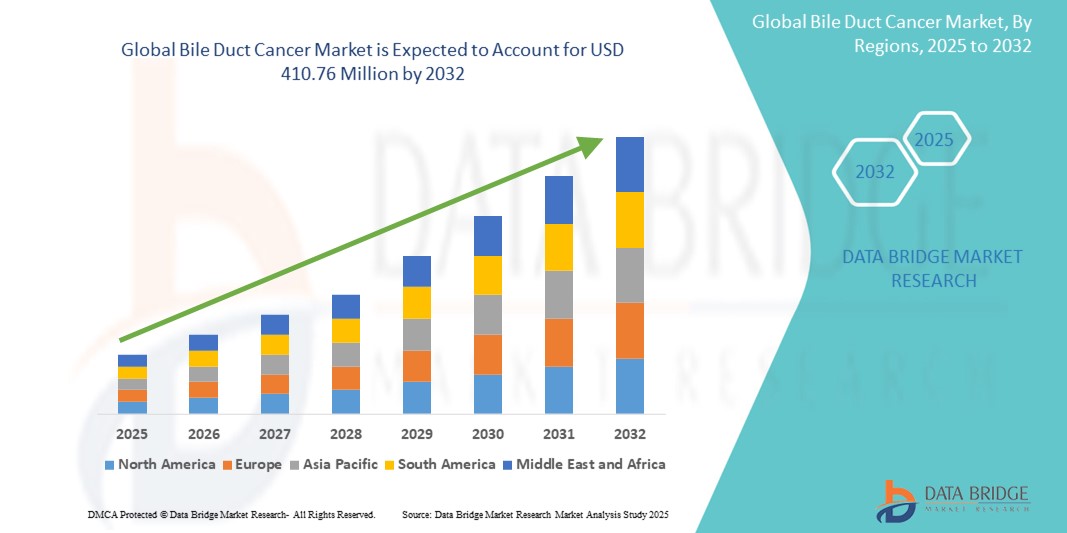
Bile Duct Cancer Market Size
- The global bile duct cancer market size was valued at USD 230.31 million in 2024 and is expected to reach USD 410.76 million by 2032, at a CAGR of 7.50% during the forecast period
- This growth is driven by factors such as the increasing prevalence of bile duct cancer, advancements in diagnostic techniques, and the growing elderly population
Bile Duct Cancer Market Analysis
- The global bile duct cancer market refers to the industry focused on the diagnosis, treatment, research, and development of therapies and technologies associated with bile duct cancer, also known as cholangiocarcinoma
- This cancer originates in the bile ducts, which are thin tubes responsible for carrying bile — a digestive fluid — from the liver and gallbladder to the small intestine
- North America is expected to dominate the bile duct cancers market with 40.2% due to well-established healthcare system, advanced diagnostic technologies, and a high adoption rate of innovative therapies
- Asia-Pacific is expected to be the fastest growing region in the bile duct cancer market during the forecast period due to Rapid economic development and improvements in healthcare infrastructure
- Chemotherapy segment is expected to dominate the market with a market share of 50.1% due to its proven efficacy as well as widespread acceptance among medical practitioners
Report Scope and Bile Duct Cancer Market Segmentation
|
Attributes |
Bile Duct Cancer Key Market Insights |
|
Segments Covered |
|
|
Countries Covered |
North America
Europe
Asia-Pacific
Middle East and Africa
South America
|
|
Key Market Players |
|
|
Market Opportunities |
|
|
Value Added Data Infosets |
In addition to the insights on market scenarios such as market value, growth rate, segmentation, geographical coverage, and major players, the market reports curated by the Data Bridge Market Research also include in-depth expert analysis, patient epidemiology, pipeline analysis, pricing analysis, and regulatory framework. |
Bile Duct Cancer Market Trends
“Advancements in Precision Medicine”
- The integration of molecular profiling and genomic sequencing has led to the development of targeted therapies, allowing for more personalized treatment plans that improve patient outcomes
- Drugs such as ivosidenib and pembrolizumab are gaining attention for their potential in treating bile duct cancer, reflecting a shift towards more specific and effective treatments
- Pharmaceutical companies are investing heavily in research and development, leading to a pipeline of new therapies aimed at improving survival rates
- Advancements in imaging techniques, such as MRI and ERCP, have improved the accuracy of early detection, enabling timely intervention
- The rise in clinical trials focusing on bile duct cancer is accelerating the discovery of novel treatments and expanding therapeutic options
Bile Duct Cancer Market Dynamics
Driver
“Increasing Incidence and Diagnostic Accuracy”
- The global incidence of bile duct cancer is increasing, particularly in regions with higher exposure to risk factors such as obesity and chronic liver diseases
- Advancements in diagnostic technologies, such as enhanced imaging and molecular testing, have led to earlier and more accurate detection of the disease
- Early detection allows for more accurate staging, which is crucial for determining the most effective treatment strategies
- Public health initiatives and educational programs have raised awareness about the symptoms and risks associated with bile duct cancer, leading to more individuals seeking medical evaluation
- With earlier diagnosis and improved treatment options, patient survival rates are expected to improve, driving further investment in the market
Opportunity
“Government Initiatives and Healthcare Investments”
- Governments worldwide are allocating more funds to healthcare, improving access to treatments and diagnostics for bile duct cancer
- Policies aimed at reducing the cost of cancer treatments and expanding insurance coverage are creating a more favorable environment for market growth
- Collaborations between governments and pharmaceutical companies are fostering innovation and accelerating the development of new therapies
- Investments in healthcare infrastructure, particularly in emerging markets, are improving access to diagnostic and treatment facilities
- Government-led awareness campaigns are educating the public about the importance of early detection and screening, leading to increased demand for diagnostic services
Restraint/Challenge
“High Treatment Costs and Limited Access”
- The high cost of advanced treatments, including targeted therapies and immunotherapies, can limit patient access, especially in low-income regions
- In many countries, insurance plans do not fully cover the cost of bile duct cancer treatments, leading to financial burdens on patients
- Access to state-of-the-art treatments and diagnostic services varies significantly between urban and rural areas, as well as between developed and developing countries
- Stringent regulatory requirements can delay the approval and availability of new therapies, hindering timely access for patients
- Economic downturns and political instability can lead to reduced healthcare budgets, impacting the availability and affordability of treatments
Bile Duct Cancer Market Scope
The market is segmented on the basis of treatment type, application, disease indication, and distribution channel.
|
Segmentation |
Sub-Segmentation |
|
By treatment Type |
|
|
By Targeted Therapy |
|
|
By Application |
|
|
By Disease Indication |
|
|
By Distribution Channel |
|
In 2025, the chemotherapy is projected to dominate the market with a largest share in treatment type segment
The chemotherapy segment is expected to dominate the bile duct cancer market with the largest share of 50.1% in 2025 due to its proven efficacy as well as widespread acceptance among medical practitioners. Chemotherapy has been the mainstay treatment option for bile duct cancer for several years now. Chemotherapy works by slowing or stopping the growth of cancer cells that grow and divide quickly.
The pemigatinib is expected to account for the largest share during the forecast period in targeted therapy segment
In 2025, the pemigatinib segment is expected to dominate the market with the largest market share due to it received FDA approval in 2020 as the first targeted therapy for cholangiocarcinoma with FGFR2 fusions or rearrangements and has been in clinical use since then.
Bile Duct Cancer Market Regional Analysis
“North America Holds the Largest Share in the Bile Duct Cancer Market”
- North America holds a significant share of the global bile duct cancer market of 40.2%, with the U.S. contributing over 49.5% of the market share
- The region boasts a well-established healthcare system, advanced diagnostic technologies, and a high adoption rate of innovative therapies
- Substantial investments in cancer research and the presence of leading pharmaceutical companies drive the development of novel treatments
- Favorable reimbursement policies enhance the affordability and accessibility of advanced treatments for patients
- The growing geriatric population, more susceptible to cancer, contributes to the steady rise in demand for bile duct cancer treatments
“Asia-Pacific is Projected to Register the Highest CAGR in the Bile Duct Cancer Market”
- The Asia-Pacific region is projected to experience the fastest growth in the bile duct cancer market
- High prevalence of liver fluke infections, hepatitis B and C, and chronic liver diseases in countries such as China, Vietnam, and Japan increase the risk of developing bile duct cancer
- Rapid economic development and improvements in healthcare infrastructure in countries such as China and India are expanding access to quality care
- Increased focus on research and development activities, including joint ventures and acquisitions, aim to facilitate domestic production of advanced medical technologies
- Less stringent regulations compared to developed regions encourage both regional and global players to test novel products in the market
Bile Duct Cancer Market Share
The market competitive landscape provides details by competitor. Details included are company overview, company financials, revenue generated, market potential, investment in research and development, new market initiatives, global presence, production sites and facilities, production capacities, company strengths and weaknesses, product launch, product width and breadth, application dominance. The above data points provided are only related to the companies' focus related to market.
The Major Market Leaders Operating in the Market Are:
- Johnson & Johnson Private Limited (U.S.)
- Mylan N.V. (U.S.)
- Teva Pharmaceutical Industries Ltd.(Jerusalem)
- Sanofi (France)
- Pfizer Inc. (U.S.)
- GlaxoSmithKline plc (U.K.)
- AbbVie Inc. (U.S.)
- Novartis AG (Switzerland)
- Fresenius Kabi AG (Germany)
- Eli Lilly and Company (U.S.)
- F. Hoffmann-La Roche Ltd. (Switzerland)
- Intercept Pharmaceuticals (U.S.)
- Kyowa Kirin Co., Ltd. (Japan)
- Delcath Systems, Inc. (U.S.)
- Accord Healthcare (U.S.)
- CONMED Corporation (U.S.)
- Boston Scientific Corporation (U.S.)
- Bayer AG (Germany)
- Bristol-Myers Squibb Company (U.S.)
- Merck & Co., Inc. (U.S.)
Latest Developments in Global Bile Duct Cancer Market
- In November 2023, Merck & Co., Inc. received the U.S. FDA approval for KEYTRUDA, anti-PD-1 therapy, in combination with gemcitabine and cisplatin, for the treatment of patients with locally advanced unresectable or metastatic biliary tract cancer (BTC). This approval marked the sixth indication for KEYTRUDA in gastrointestinal cancer, and helped the company expand its sales
- In February 2023, AstraZeneca, a global biopharmaceutical company, had received approval from the Central Drugs Standard Control Organisation (CDSCO) to introduce Durvalumab for treating biliary tract cancer (BTC) in India. BTC encompasses a set of uncommon and aggressive gastrointestinal (GI) cancers originating from the cells of the bile ducts (cholangiocarcinoma), gallbladder, or ampulla of Vater (junction of the bile and pancreatic ducts with the small intestine)
- In July 2021, Pemigatinib (Pemazyre) was approved by the National Institute of Health and Care Excellence (NICE) for patients with a rare form of bile duct cancer known as FGFR2-positive cholangiocarcinoma, which has advanced or spread following initial chemotherapy. Kruti Shrotri of Cancer Research U.K. praises the decision, emphasizing its significance in broadening treatment possibilities for patients grappling with the rarity and treatment resistance of their cancer
- In April 2020, the U.S. Food and Drug Administration had approved the first targeted treatment for patients with cholangiocarcinoma called Pemazyre (pemigatinib). Pemazyre's approval was based on the findings of a clinical trial in which 107 patients with locally advanced or metastatic cholangiocarcinoma who had previously received therapy and had a FGFR2 fusion or rearrangement were enrolled
- In April 2020, Incyte received the U.S. FDA approval for Pemazyre (pemigatinib), a kinase inhibitor, as first targeted treatment for adults with previously treated, unresectable locally advanced or metastatic cholangiocarcinoma. Pemazyre was the first targeted treatment approved for this specific patient population, giving the company a competitive edge in the market

- Interactive Data Analysis Dashboard
- Company Analysis Dashboard for high growth potential opportunities
- Research Analyst Access for customization & queries
- Competitor Analysis with Interactive dashboard
- Latest News, Updates & Trend analysis
- Harness the Power of Benchmark Analysis for Comprehensive Competitor Tracking
Data collection and base year analysis are done using data collection modules with large sample sizes. The stage includes obtaining market information or related data through various sources and strategies. It includes examining and planning all the data acquired from the past in advance. It likewise envelops the examination of information inconsistencies seen across different information sources. The market data is analysed and estimated using market statistical and coherent models. Also, market share analysis and key trend analysis are the major success factors in the market report. To know more, please request an analyst call or drop down your inquiry.
The key research methodology used by DBMR research team is data triangulation which involves data mining, analysis of the impact of data variables on the market and primary (industry expert) validation. Data models include Vendor Positioning Grid, Market Time Line Analysis, Market Overview and Guide, Company Positioning Grid, Patent Analysis, Pricing Analysis, Company Market Share Analysis, Standards of Measurement, Global versus Regional and Vendor Share Analysis. To know more about the research methodology, drop in an inquiry to speak to our industry experts.
Data Bridge Market Research is a leader in advanced formative research. We take pride in servicing our existing and new customers with data and analysis that match and suits their goal. The report can be customized to include price trend analysis of target brands understanding the market for additional countries (ask for the list of countries), clinical trial results data, literature review, refurbished market and product base analysis. Market analysis of target competitors can be analyzed from technology-based analysis to market portfolio strategies. We can add as many competitors that you require data about in the format and data style you are looking for. Our team of analysts can also provide you data in crude raw excel files pivot tables (Fact book) or can assist you in creating presentations from the data sets available in the report.












