


What is the Biliary Atresia Treatment Market Size and Growth Rate?
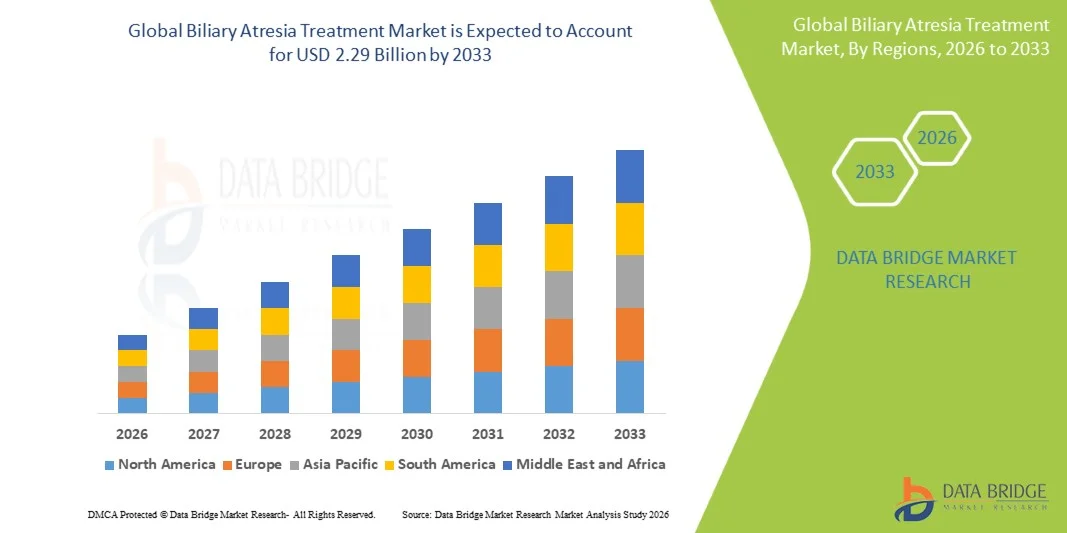
- As per Data Bridge Market Research analysis, the global biliary atresia treatment market size was valued at USD 1.24 billion in 2025 and is expected to reach USD 2.29 billion by 2033, at a CAGR of 8.00% during the forecast period
- The market growth is largely fueled by the rising incidence of biliary atresia in newborns and increasing awareness regarding early diagnosis and timely surgical and therapeutic interventions, leading to improved treatment adoption across pediatric healthcare settings
- Furthermore, growing advancements in pediatric hepatology, including improved surgical techniques such as the Kasai procedure and increasing availability of liver transplantation, are establishing Biliary Atresia Treatment as a critical care segment. These converging factors are accelerating the uptake of Biliary Atresia Treatment solutions, thereby significantly boosting the industry's growth
Market Size & Forecast
- Global Market Value (2025): USD 1.24 billion
- Expected Market Value (2033): USD 2.29 billion
- Forecast CAGR (2026-2033): 8.00%
What are the Major Takeaways of the Biliary Atresia Treatment Market?
- Biliary atresia treatment, encompassing surgical interventions (such as Kasai portoenterostomy) and liver transplantation support therapies, is a critical pediatric hepatology segment due to its life-threatening nature and the urgent need for early diagnosis and intervention to improve survival outcomes
- The escalating demand for biliary atresia treatment is primarily driven by increasing awareness of neonatal liver diseases, improved newborn screening programs, and advancements in pediatric surgical care and transplantation techniques, which are enhancing survival rates and treatment accessibility
- North America dominated the biliary atresia treatment market with the largest revenue share of 38.6% in 2025, driven by advanced pediatric healthcare infrastructure, high awareness levels, strong insurance coverage, and the presence of specialized liver transplant centers, particularly in the U.S.
- Asia-Pacific is expected to be the fastest growing region in the biliary atresia treatment market during the forecast period due to a higher birth rate, improving healthcare access, expanding pediatric care facilities, and increasing government focus on early diagnosis and treatment of congenital disorders
- The Bile Acids Analogues segment dominated the market with the largest revenue share of 44.6% in 2025, driven by their critical role in improving bile flow and reducing cholestasis in infants suffering from biliary atresia
Report Scope and Biliary Atresia Treatment Market Segmentation
|
Attributes |
Biliary Atresia Treatment Key Market Insights |
|
Segments Covered |
|
|
Countries Covered |
North America
Europe
Asia-Pacific
Middle East and Africa
South America
|
|
Key Market Players |
|
|
Market Opportunities |
|
|
Value Added Data Infosets |
In addition to the insights on market scenarios such as market value, growth rate, segmentation, geographical coverage, and major players, the market reports curated by the Data Bridge Market Research also include in-depth expert analysis, patient epidemiology, pipeline analysis, pricing analysis, and regulatory framework. |
What is the Key Trend in the Biliary Atresia Treatment Market?
“Enhanced Treatment Efficiency Through AI, Data Analytics, and Connected Healthcare Integration”
- A significant and accelerating trend in the global biliary atresia treatment market is the increasing integration of artificial intelligence (AI), predictive analytics, and connected healthcare systems to improve early diagnosis, treatment planning, and patient monitoring outcomes
- This integration is helping clinicians make more accurate and timely decisions, particularly in complex pediatric liver conditions such as biliary atresia
- AI-powered diagnostic tools are increasingly being used to analyze clinical data, imaging results, and biochemical markers to support earlier detection of biliary atresia, reducing delays in intervention and improving survival outcomes through timely surgical procedures such as the Kasai portoenterostomy
- Machine learning algorithms are also being explored to identify disease progression patterns and predict post-surgical outcomes, enabling more personalized treatment pathways and better long-term patient management strategies
- In addition, the integration of electronic health records (EHR), hospital information systems, and telemedicine platforms is enabling seamless data sharing between specialists, improving coordination of care in multi-disciplinary treatment environments
- This trend toward intelligent, data-driven, and connected healthcare ecosystems is fundamentally reshaping expectations in pediatric hepatology, encouraging hospitals and research institutions to adopt more advanced digital tools for improved clinical decision-making
- The demand for AI-enabled and digitally integrated treatment support systems is growing steadily across both developed and emerging healthcare markets, as providers increasingly prioritize precision medicine, efficiency, and improved patient outcomes in rare disease management
Biliary Atresia Treatment Market Dynamics
Driver
“Rising Prevalence Awareness and Advancements in Early Diagnostic Capabilities”
- The increasing awareness of rare pediatric liver disorders, combined with improvements in early diagnostic screening programs, is a key driver accelerating demand in the global biliary atresia treatment market. Early identification of the disease significantly improves treatment outcomes, particularly when surgical intervention is performed at an early stage
- For instance, in 2024, several national newborn screening initiatives in countries such as Japan and Taiwan strengthened early jaundice monitoring programs, leading to earlier detection of biliary atresia cases and improved surgical success rates
- Governments and healthcare organizations are increasingly focusing on newborn screening programs and pediatric liver disease awareness campaigns, which are contributing to earlier diagnosis and improved treatment access across multiple regions
- Advances in diagnostic imaging technologies, liver function testing, and genetic research are further supporting earlier and more accurate detection of biliary atresia, enabling timely clinical intervention
- In addition, growing investments in pediatric hepatology research and the development of improved surgical techniques and post-operative care protocols are enhancing survival rates and long-term prognosis
- The increasing availability of specialized pediatric healthcare centers and multidisciplinary treatment approaches is further driving adoption of advanced biliary atresia treatment options globally
Restraint/Challenge
“High Treatment Complexity, Limited Donor Availability, and Diagnostic Delays in Emerging Regions”
- One of the major challenges in the biliary atresia treatment market is the complexity of disease management, which often requires specialized surgical intervention and long-term follow-up care, limiting accessibility in resource-constrained healthcare systems
- For instance, hospitals in several low-income regions of Africa face shortages of trained pediatric hepatobiliary surgeons, restricting access to timely Kasai procedures
- In many cases, delayed diagnosis remains a critical issue, particularly in developing regions where awareness of rare pediatric liver diseases is low and access to advanced diagnostic tools is limited, resulting in poorer clinical outcomes
- Liver transplantation, which is often required in advanced cases, is constrained by the limited availability of suitable donor organs, creating significant treatment bottlenecks and long waiting periods for affected patients
- For instance, transplant registries in countries such as India report long waiting times for pediatric liver donors, significantly impacting survival outcomes
- The high cost associated with long-term treatment, surgical procedures, and post-operative care also presents a financial burden for families and healthcare systems, particularly in low- and middle-income countries
How is the Biliary Atresia Treatment Market Segmented?
The market is segmented on the basis of drugs, route of administration, end-users, and distribution channel.
• By Drugs
On the basis of drugs, the Biliary Atresia Treatment market is segmented into Bile Acids Analogues, Antibiotics, Corticosteroids, and Others. The Bile Acids Analogues segment dominated the market with the largest revenue share of 44.6% in 2025, driven by their critical role in improving bile flow and reducing cholestasis in infants suffering from biliary atresia. Drugs such as ursodeoxycholic acid are widely used as first-line supportive therapy to manage liver damage progression. Increasing prevalence of neonatal liver disorders significantly contributes to demand. Physicians prefer bile acid therapy due to its well-established safety and efficacy profile in pediatric patients. Strong adoption in hospital-based neonatal and pediatric care units supports market dominance. Rising awareness of early diagnosis and treatment further enhances usage. Availability of supportive care guidelines strengthens clinical adoption. Growing healthcare infrastructure for rare pediatric diseases boosts access. Overall, bile acids analogues remain the dominant drug segment.
The Corticosteroids segment is expected to witness the fastest CAGR of 15.8% from 2026 to 2033, driven by increasing use as adjunct therapy to reduce inflammation and improve post-surgical outcomes. Corticosteroids help manage immune-mediated bile duct injury and improve bile drainage. Rising adoption in combination therapy with surgical procedures such as Kasai portoenterostomy supports demand. Growing clinical research exploring improved outcomes enhances physician confidence. Increasing hospitalization of neonatal liver disease cases further drives usage. Expansion of pediatric hepatology services supports accessibility. Improved treatment protocols in developed healthcare systems accelerate adoption. Overall, corticosteroids are the fastest-growing drug class segment.
• By Route of Administration
On the basis of route of administration, the market is segmented into Oral and Parenteral. The Oral segment dominated the market with a revenue share of 63.2% in 2025, driven by the widespread use of oral bile acid therapies and antibiotics in long-term management of biliary atresia. Oral administration is preferred due to ease of dosing in infants and pediatric patients. High compliance and non-invasive nature support its dominance. Availability of liquid oral formulations enhances pediatric usability. Physicians prefer oral drugs for maintenance therapy after surgical intervention. Strong distribution through hospital and retail pharmacies supports access. Increasing awareness of early-stage disease management boosts adoption. Cost-effectiveness compared to injectable therapies further strengthens usage. Overall, oral administration remains the dominant segment.
The Parenteral segment is expected to witness the fastest CAGR of 16.3% from 2026 to 2033, driven by increasing use in hospital settings for severe or post-surgical cases. Injectable corticosteroids and antibiotics provide rapid therapeutic response in critical conditions. Rising number of neonatal intensive care admissions supports demand. Hospitals prefer parenteral administration for precise dosing and faster action. Advancements in pediatric injectable formulations improve safety profiles. Increasing prevalence of complex biliary atresia cases further accelerates adoption. Expansion of tertiary care hospitals enhances availability. Overall, parenteral administration is the fastest-growing segment.
• By End-Users
On the basis of end-users, the market is segmented into Hospitals, Homecare, Specialty Clinics, and Others. The Hospitals segment dominated the market with a revenue share of 58.7% in 2025, driven by the high requirement for specialized neonatal and pediatric care in biliary atresia treatment. Hospitals are the primary centers for diagnosis, surgical intervention, and post-operative management. Availability of advanced neonatal intensive care units supports effective treatment. Strong presence of pediatric hepatologists enhances patient outcomes. Increasing birth prevalence of congenital liver disorders supports demand. Government funding for rare disease treatment strengthens hospital infrastructure. Hospitals also serve as referral centers for complex cases. Overall, hospitals remain the dominant end-user segment.
The Specialty Clinics segment is expected to witness the fastest CAGR of 15.9% from 2026 to 2033, driven by increasing focus on specialized pediatric liver care. Growing establishment of dedicated hepatology and gastroenterology clinics supports adoption. Patients prefer specialty care for improved disease management and follow-up. Rising awareness of early diagnosis and intervention boosts clinic visits. Expansion of private healthcare facilities further supports growth. Availability of advanced diagnostic tools enhances treatment precision. Increasing collaboration with hospitals improves patient referral systems. Overall, specialty clinics are the fastest-growing end-user segment.
• By Distribution Channel
On the basis of distribution channel, the market is segmented into Hospital Pharmacy, Retail Pharmacy, Online Pharmacy, and Others. The Hospital Pharmacy segment dominated the market with a revenue share of 52.9% in 2025, driven by high dependency on hospital-based treatment for biliary atresia. Hospital pharmacies ensure immediate availability of critical pediatric medications. Strong integration with neonatal and pediatric departments supports efficient drug dispensing. Bulk procurement systems improve cost efficiency for healthcare institutions. Physicians prefer hospital pharmacies for controlled drug administration in infants. Increasing hospitalization rates for surgical interventions support demand. Strict regulatory oversight ensures safe drug handling. Overall, hospital pharmacy remains the dominant distribution channel segment.
The Online Pharmacy segment is expected to witness the fastest CAGR of 17.4% from 2026 to 2033, driven by rising digital healthcare adoption and improved access to pediatric medications. Online platforms offer convenient home delivery and prescription refills. Increasing internet penetration and telemedicine integration support growth. Parents prefer online channels for accessibility and cost savings. Expanding logistics infrastructure ensures safe drug delivery. Regulatory advancements in e-pharmacy systems enhance trust. Growing awareness of digital healthcare services accelerates adoption. Overall, online pharmacy is the fastest-growing distribution channel segment.
Which Region Holds the Largest Share of the Biliary Atresia Treatment Market?
- North America dominated the biliary atresia treatment market with the largest revenue share of 38.6% in 2025, driven by advanced pediatric healthcare infrastructure, high awareness levels of congenital liver disorders, strong insurance coverage, and the presence of specialized liver transplant centers, particularly in the U.S. The region continues to benefit from well-established neonatal screening programs, early diagnostic capabilities, and increasing adoption of multidisciplinary treatment approaches for pediatric liver diseases
- Patients and healthcare providers in North America increasingly rely on early intervention strategies, improved diagnostic pathways, and access to advanced surgical care, which is supporting higher treatment uptake and better clinical outcomes in biliary atresia management
- This growth is further supported by strong clinical research activity in pediatric hepatology, favorable reimbursement frameworks, and continuous improvements in transplant technologies and post-operative care, making North America a leading revenue-contributing region in the global biliary atresia treatment market
U.S. Biliary Atresia Treatment Market Insight
The U.S. biliary atresia treatment market captured a dominant revenue share within North America in 2025, supported by advanced neonatal screening systems, high awareness of rare pediatric liver diseases, and strong access to specialized pediatric hepatology and transplant centers. The country benefits from robust insurance coverage, well-established hospital networks, and increasing adoption of early diagnostic protocols that enable timely surgical intervention such as the Kasai procedure. For instance, leading pediatric hospitals in the U.S. are increasingly using standardized newborn jaundice screening pathways to identify suspected cases earlier, improving survival outcomes. In addition, strong clinical research initiatives and ongoing innovation in pediatric liver transplantation continue to enhance treatment effectiveness and availability across major healthcare centers.
Europe Biliary Atresia Treatment Market Insight
The Europe biliary atresia treatment market is projected to expand at a steady CAGR during the forecast period, supported by increasing awareness of rare congenital liver disorders and improving access to pediatric specialty care. Strong regulatory frameworks and well-established public healthcare systems are promoting standardized diagnostic and treatment protocols across the region. For instance, several European countries have strengthened neonatal screening guidelines to improve early detection of jaundice-related complications in infants. The region’s expanding pediatric hepatology expertise and growing investment in transplant infrastructure are further supporting consistent market growth across both developed and emerging economies.
U.K. Biliary Atresia Treatment Market Insight
The U.K. biliary atresia treatment market is expected to grow steadily during the forecast period, driven by strong NHS-supported healthcare access, increasing awareness of infant liver disorders, and improved referral systems for pediatric specialist care. For instance, hospitals under the NHS framework have enhanced early-stage jaundice monitoring programs to support quicker identification of suspected biliary atresia cases. Growing collaboration between pediatric gastroenterology and transplant units is further improving treatment coordination and patient outcomes.
Germany Biliary Atresia Treatment Market Insight
The Germany biliary atresia treatment market is anticipated to expand at a considerable CAGR during the forecast period, supported by advanced healthcare infrastructure, strong pediatric surgical expertise, and high awareness of congenital liver diseases. For instance, specialized children’s hospitals in Germany are increasingly adopting early diagnostic imaging techniques to improve detection accuracy. The country’s emphasis on precision medicine and structured healthcare pathways is further enhancing treatment success rates and long-term patient management.
Asia-Pacific Biliary Atresia Treatment Market Insight
The Asia-Pacific biliary atresia treatment market is expected to be the fastest growing region during the forecast period, driven by higher birth rates, improving healthcare access, expanding pediatric care facilities, and increasing government focus on early diagnosis and treatment of congenital disorders. For instance, government-backed newborn screening initiatives in countries such as China and India are gradually improving early detection rates of pediatric liver diseases. Expanding hospital infrastructure and growing availability of specialized pediatric services are further accelerating regional market growth.
Japan Biliary Atresia Treatment Market Insight
The Japan biliary atresia treatment market is gaining momentum due to its advanced healthcare system, strong focus on early disease detection, and high standards in pediatric care. For instance, Japanese hospitals are widely implementing early infant jaundice screening protocols to identify liver disorders at an earlier stage. The country’s well-developed transplant programs and multidisciplinary care models are further improving survival rates and treatment outcomes for biliary atresia patients.
China Biliary Atresia Treatment Market Insight
The China biliary atresia treatment market accounted for a significant revenue share in Asia Pacific in 2025, driven by rapid urbanization, expanding pediatric healthcare infrastructure, and increasing awareness of congenital liver disorders. For instance, large tertiary hospitals in urban centers are increasingly adopting standardized diagnostic pathways for neonatal liver conditions. Strong government healthcare initiatives, expanding insurance coverage, and growing investment in pediatric transplant facilities are further enhancing treatment accessibility and affordability across the country.
Which are the Top Companies in Biliary Atresia Treatment Market?
The Biliary Atresia Treatment industry is primarily led by well-established companies, including:
- Orphan Therapeutics (U.S.)
- Roche (Switzerland)
- Novartis (Switzerland)
- Pfizer (U.S.)
- Sanofi (France)
- AbbVie (U.S.)
- Bristol Myers Squibb (U.S.)
- Takeda Pharmaceutical Company (Japan)
- GlaxoSmithKline (U.K.)
- AstraZeneca (U.K.)
- Merck & Co. (U.S.)
- Johnson & Johnson (U.S.)
- Ipsen (France)
- Recordati Rare Diseases (Italy)
- Sobi (Sweden)
- Lupin (India)
- Sun Pharmaceutical Industries (India)
- Dr. Reddy’s Laboratories (India)
- Cipla (India)
- Bayer (Germany)
What are Latest Developments in Global Biliary Atresia Treatment Market?
- In July 2021, odevixibat, a drug initially developed for rare cholestatic liver diseases including biliary atresia, was granted orphan drug designation by regulatory authorities, supporting development incentives for treating rare pediatric liver conditions
- In February 2025, the American Academy of Pediatrics (AAP) issued updated guidance recommending earlier and more systematic screening of newborns for biliary atresia using simple clinical questions at well-child visits, aiming to reduce delays in diagnosis and improve treatment outcomes
- In June 2025, European hepatology experts urged improvements in newborn screening programmes for biliary atresia across Europe, emphasizing combined stool colour card and bilirubin testing to enable earlier detection and referral for treatment
- In November 2025, a new laparoscopic surgical approach for biliary atresia in newborns was highlighted in clinical news, showing reduced blood loss and faster jaundice recovery compared with traditional open surgery, representing a notable procedural advancement in treatment practice
- In March 2026, clinical commentary reinforced the critical importance of early hepatoportoenterostomy (Kasai procedure) timing, noting that delays beyond the first 60 days of life significantly affect outcomes, underscoring ongoing clinical focus on early intervention

- Interactive Data Analysis Dashboard
- Company Analysis Dashboard for high growth potential opportunities
- Research Analyst Access for customization & queries
- Competitor Analysis with Interactive dashboard
- Latest News, Updates & Trend analysis
- Harness the Power of Benchmark Analysis for Comprehensive Competitor Tracking
Data collection and base year analysis are done using data collection modules with large sample sizes. The stage includes obtaining market information or related data through various sources and strategies. It includes examining and planning all the data acquired from the past in advance. It likewise envelops the examination of information inconsistencies seen across different information sources. The market data is analysed and estimated using market statistical and coherent models. Also, market share analysis and key trend analysis are the major success factors in the market report. To know more, please request an analyst call or drop down your inquiry.
The key research methodology used by DBMR research team is data triangulation which involves data mining, analysis of the impact of data variables on the market and primary (industry expert) validation. Data models include Vendor Positioning Grid, Market Time Line Analysis, Market Overview and Guide, Company Positioning Grid, Patent Analysis, Pricing Analysis, Company Market Share Analysis, Standards of Measurement, Global versus Regional and Vendor Share Analysis. To know more about the research methodology, drop in an inquiry to speak to our industry experts.
Data Bridge Market Research is a leader in advanced formative research. We take pride in servicing our existing and new customers with data and analysis that match and suits their goal. The report can be customized to include price trend analysis of target brands understanding the market for additional countries (ask for the list of countries), clinical trial results data, literature review, refurbished market and product base analysis. Market analysis of target competitors can be analyzed from technology-based analysis to market portfolio strategies. We can add as many competitors that you require data about in the format and data style you are looking for. Our team of analysts can also provide you data in crude raw excel files pivot tables (Fact book) or can assist you in creating presentations from the data sets available in the report.












