


What is the Bio-Based Epoxy Resins Market Size and Growth Rate?
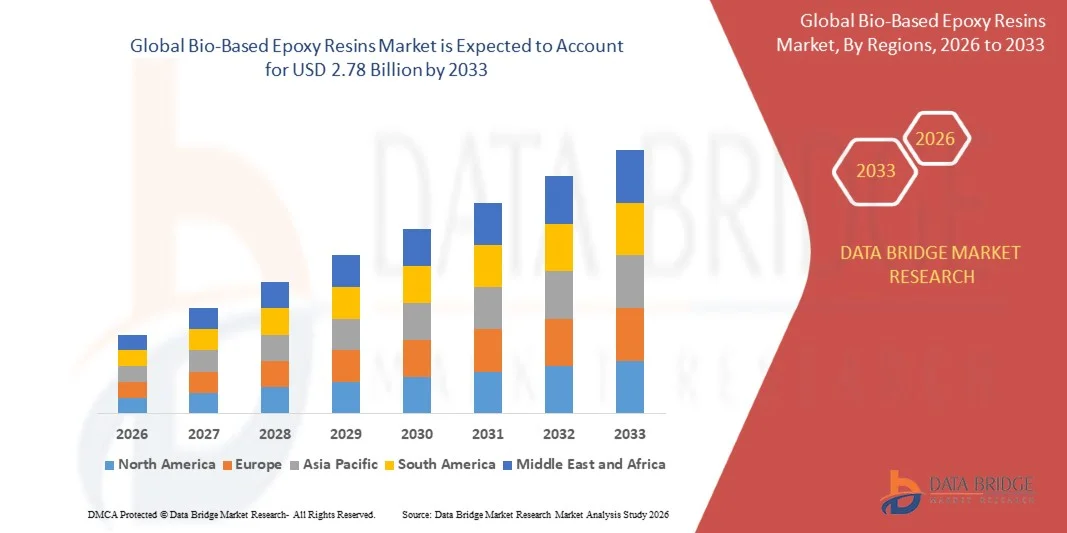
As per Data Bridge Market Research analysis the global bio-based epoxy resins market was valued at USD 1.40 billion in 2025 and is projected to reach USD 2.78 billion by 2033, growing at a CAGR of 9.00% from 2026 to 2033. The bio-based epoxy resins market is experiencing steady growth driven by increasing demand for sustainable and low-carbon materials, stringent environmental regulations on petroleum-based chemicals, and rising adoption of renewable raw materials across key end-use industries. Continuous advancements in bio-based resin formulations, improved mechanical performance, and growing investments in green chemistry are further accelerating market expansion across coatings, adhesives, composites, and electronics applications.
The increasing focus on reducing greenhouse gas emissions and dependence on fossil-based feedstocks, combined with growing consumer preference for environmentally friendly products, is encouraging manufacturers to adopt bio-based epoxy resins derived from renewable resources such as vegetable oils, lignin, glycerol, and cardanol. Bio-based epoxy resins are increasingly replacing conventional petroleum-based resins in automotive, construction, wind energy, marine, aerospace, and electrical & electronics applications due to their excellent adhesion, corrosion resistance, chemical stability, and lower environmental impact. Furthermore, supportive government policies promoting the bioeconomy, circular economy initiatives, and expanding investments in sustainable materials are expected to further drive the growth of the bio-based epoxy resins market throughout the forecast period.
Market Size & Forecast
- Market Value (2025): USD 1.40 Billion
- Expected Market Value (2033): USD 2.78 Billion
- Forecast CAGR (2026–2033): 9.00%
- Leading Region in 2025: Europe
- Fastest Growing Region: Asia-Pacific
What are the Major Takeaways of Bio-Based Epoxy Resins Market?
- Europe dominated the global bio-based epoxy resins market with an estimated revenue share of 39.2% in 2025, driven by stringent environmental regulations, strong adoption of sustainable materials across the automotive, construction, wind energy, and packaging industries, and increasing investments in bio-based chemicals under the European Green Deal and circular economy initiatives. The presence of leading bio-based resin manufacturers, advanced research capabilities, and supportive government policies promoting renewable feedstocks continue to strengthen Europe's leadership in the global market.
- The glycidyl ether segment dominated the bio-based epoxy resins market with an estimated 56.24% share in 2025 owing to its outstanding adhesion, high mechanical strength, excellent chemical resistance, and broad compatibility with various curing agents. glycidyl ether bio-based epoxy resins are extensively utilized in paints, coatings, adhesives, electrical laminates, composites, and protective industrial applications because they provide performance characteristics comparable to conventional petroleum-derived epoxy systems.
- Asia-Pacific is projected to be the fastest-growing regional market, registering an estimated CAGR of 8.4% during 2026–2033, supported by rapid industrialization, expanding wind energy installations, increasing production of electric vehicles, rising construction activities, and growing government initiatives promoting sustainable materials in countries such as China, India, Japan, and South Korea. Rising investments in bio-based polymers and expanding manufacturing capacity are further accelerating regional market growth.
- The construction segment dominated the market with an estimated 34.92% share in 2025 owing to the extensive utilization of bio-based epoxy resins in flooring systems, protective coatings, structural adhesives, repair mortars, waterproofing membranes, and composite building materials.
- The wind energy segment is projected to experience the fastest growth at an estimated CAGR of 9.0% from 2026 to 2033, driven by rapidly expanding investments in renewable energy infrastructure worldwide.
Report Scope and Bio-Based Epoxy Resins Market Segmentation
|
Attributes |
Bio-Based Epoxy Resins Key Market Insights |
|
Segments Covered |
|
|
Countries Covered |
North America
Europe
Asia-Pacific
Middle East and Africa
South America
|
|
Key Market Players |
|
|
Market Opportunities |
|
|
Value Added Data Infosets |
In addition to the insights on market scenarios such as market value, growth rate, segmentation, geographical coverage, and major players, the market reports curated by the Data Bridge Market Research also include in-depth expert analysis, geographically represented company-wise production and capacity, network layouts of distributors and partners, detailed and updated price trend analysis and deficit analysis of supply chain and demand. |
What is the Key Trend in the Bio-Based Epoxy Resins Market?
Trend: Increasing Adoption of Bio-Based Epoxy Resins in Wind Energy and Sustainable Composites
The growing transition toward sustainable manufacturing and renewable energy is accelerating the adoption of bio-based epoxy resins across wind energy, automotive, aerospace, marine, and construction industries. Manufacturers are increasingly replacing petroleum-based epoxy systems with bio-based alternatives derived from renewable feedstocks such as vegetable oils, lignin, cardanol, and glycerol to reduce carbon emissions and improve product sustainability. Advances in resin chemistry are enabling bio-based epoxy resins to deliver high mechanical strength, excellent adhesion, corrosion resistance, and thermal stability while meeting demanding industrial performance requirements. Increasing investments in circular economy initiatives and low-carbon materials are further encouraging commercial adoption across structural composite applications. For instance, in May 2024, Westlake Epoxy introduced EpoVIVE, a new portfolio of epoxy products incorporating renewable and circular raw materials based on the mass balance approach certifiedunder ISCC PLUS. The launch enables manufacturers to reduce the carbon footprint of coatings, adhesives, composites, and construction materials without compromising product performance, highlighting the industry's shift toward sustainable epoxy technologies. solutions The increasing commercialization of renewable epoxy formulations and rising demand for sustainable composite materials across wind energy, transportation, and industrial applications are expected to make bio-based epoxy resins a key pillar of the global transition toward low-carbon materials.
What are the Key Drivers of Bio-Based Epoxy Resins Market?
Key Market Driver: Rising Demand for Sustainable Materials and Stringent Environmental Regulations
The growing emphasis on reducing greenhouse gas emissions and replacing fossil-based chemicals with renewable alternatives is a major driver of the global bio-based epoxy resins market. Governments worldwide are implementing stricter environmental regulations while manufacturers increasingly adopt sustainable materials to meet corporate ESG goals and customer expectations. Bio-based epoxy resins offer lower environmental impact while maintaining excellent mechanical strength, chemical resistance, and adhesion properties, making them suitable for coatings, adhesives, electrical laminates, composites, and construction materials. Automotive manufacturers, wind turbine producers, and electronics companies are increasingly incorporating bio-based resins into their products to reduce lifecycle carbon emissions. Continuous advancements in bio-based feedstock technologies are also improving resin performance and commercial viability. For instance, in February 2024, Huntsman Corporation expanded its TEROL bio-based polyol portfolio to support the production of more sustainable polyurethane and resin systems using renewable raw materials, reinforcing the industry's increasing investment in sustainable specialty chemicals and bio-based material innovation. Increasing regulatory pressure, corporate sustainability commitments, and ongoing innovation in renewable raw materials will continue to accelerate the adoption of bio-based epoxy resins across multiple industrial sectors.
Key Restraint/Challenge: High Production Costs and Limited Availability of Renewable Feedstocks
A major challenge in the global bio-based epoxy resins market is the relatively high production cost compared with conventional petroleum-based epoxy resins. Manufacturing bio-based resins requires certified renewable feedstocks, specialized processing technologies, and advanced purification methods, increasing production expenses. In addition, fluctuations in the availability and pricing of renewable raw materials such as vegetable oils, lignin, and cardanol can impact manufacturing costs and supply chain stability. Achieving consistent product quality while maintaining large-scale commercial production also remains a challenge for manufacturers. Although technological advancements continue improving production efficiency, cost competitiveness remains a key barrier to widespread adoption, particularly in price-sensitive industries. For instance, the European Commission continues to identify the availability of sustainable biomass feedstocks as a critical factor influencing the scale-up of the European bioeconomy under its updated Bioeconomy Strategy, emphasizing the importance of secure renewable feedstock supply for expanding bio-based chemical production.
Key Market Opportunity: Expansion of Bio-Based Epoxy Resins in Electric Vehicles and Wind Energy Applications
The rapid growth of electric vehicles, renewable energy infrastructure, and lightweight composite materials presents a significant long-term opportunity for the global bio-based epoxy resins market. Bio-based epoxy resins are increasingly utilized in wind turbine blades, battery components, automotive structural composites, electrical insulation systems, and lightweight transportation materials due to their high strength-to-weight ratio and sustainability advantages. Increasing investment in offshore wind projects, electric mobility, and green building construction is creating substantial demand for environmentally friendly resin systems. Manufacturers are also developing high-performance bio-based formulations capable of meeting demanding industrial specifications while reducing dependence on fossil-derived raw materials. For instance, in April 2024, Sicomin launched GreenPoxy 56, a high bio-content structural epoxy resin system designed for composite applications including marine, sports equipment, transportation, and renewable energy sectors. The product contains a significant proportion of carbon derived from renewable plant-based sources while maintaining high mechanical performance, supporting the increasing commercialization of sustainable composite materials. Continued expansion of electric vehicles, renewable energy projects, and demand for lightweight sustainable composites is expected to create significant long-term growth opportunities for bio-based epoxy resin manufacturers worldwide.
How is the Bio-Based Epoxy Resins Market Segmented?
The bio-based epoxy resins market is segmented on the basis of source, type, and application.
- By Source
On the basis of source, the global bio-based epoxy resins market is segmented into plant oils, lignin, rosin, cardanol, glycerol, and others. The plant oils segment dominated the bio-based epoxy resins market with an estimated 44.86% share in 2025 owing to its abundant availability, renewable nature, and well-established commercial production processes. Plant oils including soybean oil, linseed oil, castor oil, palm oil, and other vegetable oils serve as the primary renewable feedstocks for manufacturing bio-based epoxy resins because of their excellent epoxidation efficiency and wide availability. Their favorable chemical structure enables the production of epoxy resins with strong adhesion, excellent mechanical properties, corrosion resistance, and good thermal stability, making them suitable for coatings, adhesives, composites, and construction materials. Increasing environmental regulations promoting renewable chemicals are encouraging manufacturers to reduce dependence on petroleum-derived raw materials. Continuous technological advancements in epoxidation processes have further improved resin quality and production efficiency. Rising investments in sustainable infrastructure, automotive lightweighting, and industrial coatings continue to support demand. Government incentives promoting bio-based chemicals and circular economy initiatives across Europe and North America are accelerating commercialization. In addition, expanding production capacities and increasing availability of renewable agricultural feedstocks continue to reinforce the dominance of the plant oils segment in the global bio-based epoxy resins market.
The cardanol segment is projected to witness the fastest growth with an estimated CAGR of 8.4% from 2026 to 2033, driven by increasing utilization of cashew nut shell liquid (CNSL) as a renewable and sustainable feedstock. cardanol-based epoxy resins offer superior flexibility, excellent corrosion resistance, improved chemical stability, and lower environmental impact compared with conventional petroleum-based epoxy systems. Growing demand for sustainable industrial coatings, marine coatings, flooring systems, specialty adhesives, and protective composites is accelerating product adoption. Increasing utilization of agricultural waste streams aligns with circular economy objectives while improving resource efficiency. Continuous research is enhancing curing performance, thermal resistance, and long-term durability, making cardanol increasingly suitable for high-performance industrial applications. Regulatory restrictions on volatile organic compounds (VOCs) and hazardous chemicals are encouraging manufacturers to adopt renewable alternatives. Expanding automotive, infrastructure, and renewable energy projects are further supporting market growth. Increasing investments in green chemistry and sustainable resin technologies are expected to position cardanol as the fastest-growing source segment throughout the forecast period.
- By Type
On the basis of type, the global bio-based epoxy resins market is segmented into glycidyl ether, glycidyl ester, glycidyl amine, and others. The glycidyl ether segment dominated the bio-based epoxy resins market with an estimated 56.24% share in 2025 owing to its outstanding adhesion, high mechanical strength, excellent chemical resistance, and broad compatibility with various curing agents. glycidyl ether bio-based epoxy resins are extensively utilized in paints, coatings, adhesives, electrical laminates, composites, and protective industrial applications because they provide performance characteristics comparable to conventional petroleum-derived epoxy systems. Increasing adoption across construction, automotive, renewable energy, marine, and electrical industries continues to strengthen market demand. Manufacturers are investing in advanced resin formulations that offer enhanced durability, corrosion resistance, thermal stability, and long service life while reducing environmental impact. Continuous innovation in renewable feedstocks and curing technologies has improved processing efficiency and commercial scalability. Regulatory initiatives promoting sustainable chemicals and bio-based materials are accelerating product commercialization worldwide. Rising infrastructure development, industrial manufacturing activities, and growing investments in lightweight composite materials continue to reinforce demand. Increasing adoption of environmentally friendly coating technologies and expanding production capacities further support the dominance of the glycidyl ether segment in the global bio-based epoxy resins market.
The glycidyl ester segment is projected to witness the fastest growth with an estimated CAGR of 8.1% from 2026 to 2033, driven by increasing demand for flexible, lightweight, and environmentally sustainable epoxy formulations. glycidyl ester resins offer excellent weather resistance, improved impact strength, lower viscosity, superior processing characteristics, and enhanced durability, making them highly suitable for advanced coatings, structural adhesives, transportation composites, and specialty industrial applications. Continuous innovation in bio-based ester chemistry is improving product consistency, curing efficiency, and commercial scalability. Increasing demand for lightweight composite materials in automotive, aerospace, wind energy, and marine industries is supporting rapid market expansion. Growing investments in sustainable product development and renewable raw materials are encouraging manufacturers to commercialize next-generation glycidyl ester technologies. Regulatory pressure to reduce carbon emissions and replace petroleum-derived chemicals is further strengthening adoption. Ongoing research focused on improving thermal stability and mechanical performance is expected to create new application opportunities. Expanding industrial applications and increasing global emphasis on green manufacturing are anticipated to position the glycidyl ester segment as the fastest-growing type throughout the forecast period.
- By Application
On the basis of application, the global bio-based epoxy resins market is segmented into paints & coatings, adhesives & sealants, composites, electrical & electronics, wind energy, automotive & transportation, building & construction, marine, aerospace, and others. The paints & coatings segment dominated the bio-based epoxy resins market with an estimated 31.78% share in 2025 owing to the growing demand for environmentally friendly protective coatings across industrial, commercial, marine, and infrastructure applications. paints & coatings formulated with bio-based epoxy resins provide excellent corrosion resistance, chemical durability, strong adhesion, and long-term weatherability while reducing dependence on petroleum-derived materials. Increasing investments in sustainable construction, industrial maintenance, transportation infrastructure, and protective coatings are significantly driving market demand. Stringent environmental regulations aimed at reducing volatile organic compound (VOC) emissions are encouraging manufacturers to adopt renewable resin systems. Continuous advancements in resin formulations have improved curing performance, abrasion resistance, and application efficiency, making bio-based coatings increasingly competitive with conventional alternatives. Rising demand from bridges, pipelines, manufacturing facilities, offshore structures, and commercial buildings further strengthens adoption. Growing emphasis on green buildings, sustainable infrastructure, and low-carbon industrial solutions continues to reinforce the dominance of the paints & coatings segment in the global bio-based epoxy resins market.
The wind energy segment is projected to witness the fastest growth with an estimated CAGR of 9.0% from 2026 to 2033, driven by rapidly increasing global investments in renewable energy infrastructure and next-generation wind turbine manufacturing. wind energy applications require lightweight, high-strength epoxy composites capable of providing excellent fatigue resistance, structural durability, and long operational life under harsh environmental conditions. Bio-based epoxy resins are increasingly being incorporated into wind turbine blades to reduce carbon emissions while maintaining high mechanical performance. Government initiatives promoting renewable energy deployment and carbon neutrality are accelerating investments in sustainable composite materials. Continuous improvements in resin chemistry, curing technologies, and composite manufacturing processes are enhancing product performance and commercial adoption. Expanding offshore wind installations and increasing demand for larger, more efficient wind turbines are creating substantial growth opportunities. Manufacturers are investing heavily in renewable resin technologies to improve sustainability without compromising structural integrity. Growing global decarbonization initiatives and clean energy investments are expected to position the wind energy segment as the fastest-growing application throughout the forecast period.
Which Region Holds the Largest Share of the Bio-Based Epoxy Resins Market?
The Europe bio-based epoxy resins market remains the largest regional market globally, accounting for an estimated 39.2% revenue share in 2025. Market growth is driven by stringent environmental regulations, increasing adoption of sustainable materials, and strong policy support for bio-based chemicals under the European Green Deal and Circular Economy Action Plan. The region is witnessing rising demand for bio-based epoxy resins across wind energy, automotive, aerospace, construction, marine, and electrical & electronics industries as manufacturers seek to reduce carbon emissions and dependence on petroleum-derived materials. Continuous investments in green chemistry, renewable feedstocks, and advanced composite technologies are further strengthening market expansion. The presence of leading resin manufacturers, well-established R&D infrastructure, and favorable regulatory frameworks promoting sustainable industrial materials continue to reinforce Europe's leadership in the bio-based epoxy resins market.
U.K. Bio-Based Epoxy Resins Market Insight
The U.K. bio-based epoxy resins market is experiencing steady growth, supported by increasing demand for sustainable materials across the aerospace, automotive, construction, and renewable energy industries. Companies are increasingly adopting bio-based resins to reduce product carbon footprints while complying with the country's environmental and net-zero commitments. Growing investments in advanced composites, lightweight materials, and circular economy initiatives are encouraging manufacturers to incorporate renewable epoxy systems into industrial applications. In addition, increasing research collaborations between universities, specialty chemical manufacturers, and composite producers are accelerating innovation in bio-based resin formulations. The country's strong focus on sustainable manufacturing, green infrastructure, and low-carbon industrial development continues to support long-term growth of the bio-based epoxy resins market.
Germany Bio-Based Epoxy Resins Market Insight
The Germany bio-based epoxy resins market is witnessing significant growth owing to the country's strong automotive, wind energy, construction, and industrial manufacturing sectors. German manufacturers are increasingly replacing conventional petroleum-based epoxy resins with renewable alternatives to meet ambitious sustainability targets and reduce lifecycle emissions. Rising investments in electric vehicles, lightweight composites, wind turbine manufacturing, and bio-based chemicals are driving demand for high-performance epoxy systems derived from renewable feedstocks. Furthermore, Germany's advanced research ecosystem, supportive government policies for the bioeconomy, and continuous innovation in green chemistry are accelerating commercial adoption. These factors continue to strengthen Germany's position as one of Europe's key markets for bio-based epoxy resins.
Asia-Pacific Bio-Based Epoxy Resins Market Insight
The Asia-Pacific bio-based epoxy resins market is projected to witness the fastest growth globally, registering an estimated CAGR of 8.4% during 2026–2033. Rapid industrialization, expanding wind energy capacity, increasing electric vehicle production, and rising construction activities are creating substantial demand for sustainable epoxy materials across China, India, Japan, South Korea, and Southeast Asia. Governments across the region are actively promoting renewable materials, sustainable manufacturing, and bio-based chemicals through favorable policies and investment programs. Increasing production of composite materials, expanding electronics manufacturing, and growing infrastructure development are further supporting market expansion. Rising investments in renewable feedstocks, bio-refineries, and domestic resin manufacturing capacities are expected to sustain strong growth throughout the forecast period.
Japan Bio-Based Epoxy Resins Market Insight
The Japan bio-based epoxy resins market is growing steadily due to increasing adoption of sustainable materials across the automotive, electronics, aerospace, and advanced manufacturing sectors. Japanese manufacturers are investing in bio-based polymers and high-performance composite materials to improve sustainability while maintaining superior product quality. Rising demand for lightweight electric vehicles, renewable energy infrastructure, and environmentally friendly industrial coatings is further driving market growth. In addition, continuous advancements in material science, strong government support for carbon neutrality, and increasing investments in green chemical technologies are encouraging broader commercialization of bio-based epoxy resins across multiple end-use industries.
China Bio-Based Epoxy Resins Market Insight
The China bio-based epoxy resins market is expanding rapidly owing to increasing industrial production, growing renewable energy installations, and rising demand for sustainable materials across automotive, construction, electrical & electronics, and wind energy sectors. Government initiatives promoting carbon neutrality, green manufacturing, and bio-based industrial materials are encouraging manufacturers to invest in renewable resin technologies. The rapid expansion of electric vehicle production, wind turbine manufacturing, and advanced composite applications is significantly increasing demand for bio-based epoxy systems. Furthermore, continuous investments in domestic bio-based chemical manufacturing, expanding research capabilities, and strong infrastructure development are positioning China as one of the fastest-growing countries within the bio-based epoxy resins market.
Which are the Top Companies in Bio-Based Epoxy Resins Market?
The bio-based epoxy resins industry is primarily led by well-established companies, including:
- Sicomin (France)
- Entropy Resins, Inc. (U.S.)
- Gougeon Brothers Inc.
- Westlake Corporation (U.S.)
- Olin Corporation (U.S.)
- Cardolite Corporation
- Huntsman International LLC. (U.S.)
- KUKDO CHEMICAL CO., LTD. (South Korea)
- Grasim Industries Limited (India)
- Nagase & Co., Ltd. (Japan)
- Spolchemie (Czech Republic)
- Atul Ltd. (India)
- DIC Corporation (Japan)
- Arkema (France)
- BASF SE (Germany)
- Covestro AG (Germany)
- Mitsubishi Chemical Group Corporation (Japan)
- Solvay (Belgium)
What are Latest Developments in Bio-Based Epoxy Resins Market?
- In January 2024, Sicomin announced that its GreenPoxy 33 bio-based epoxy resin had been selected by SPLEENE Kiteboarding for the production of its Eco Line RIP 39 kiteboards. Developed in collaboration with the Technical University of Applied Sciences Augsburg and supported by the German Federal Ministry for Economic Affairs and Climate Action, the project demonstrates the increasing commercialization of high bio-content epoxy resins in sustainable composite manufacturing. The development highlights the growing adoption of renewable epoxy systems in high-performance sporting goods and advanced composites
- In July 2024, Sicomin announced a collaboration with Fairmat to manufacture recycled carbon-composite stiffeners using its FireGreen 37 bio-based epoxy resin system. The partnership combines recycled carbon fiber with bio-based epoxy technology to produce lightweight structural components, demonstrating the expanding use of sustainable epoxy resins in advanced composite applications and circular manufacturing
- In October 2024, Westlake Epoxy joined the Better Bio-based Building Blocks (B4) Consortium in the Netherlands to develop renewable feedstocks for next-generation bio-based epoxy resins. The multi-partner initiative focuses on replacing fossil-based raw materials with bio-based alternatives derived from plant and agricultural residues while maintaining the performance characteristics required for industrial epoxy applications. The project reinforces the industry's growing investment in sustainable epoxy resin innovation
- In February 2025, Westlake Epoxy announced the launch of its EpoVIVE portfolio, a new range of sustainable epoxy resins, modifiers, and curing agents incorporating ISCC PLUS-certified renewable raw materials and circular feedstocks. Designed for applications including adhesives, coatings, composites, construction, electrical laminates, marine, automotive, and wind energy, the portfolio reflects the industry's continued transition toward low-carbon and bio-based epoxy technologies
- In November 2024, Westlake Epoxy announced its participation in the Netherlands-based B4 Consortium, working alongside industry and research partners to develop innovative bio-based building blocks from locally sourced biomass for epoxy resin production. The initiative aims to accelerate commercialization of renewable epoxy feedstocks for coatings, adhesives, composites, and construction materials, supporting Europe's circular economy objectives

- Interactive Data Analysis Dashboard
- Company Analysis Dashboard for high growth potential opportunities
- Research Analyst Access for customization & queries
- Competitor Analysis with Interactive dashboard
- Latest News, Updates & Trend analysis
- Harness the Power of Benchmark Analysis for Comprehensive Competitor Tracking
Global Bio Based Epoxy Resins Market, Supply Chain Analysis and Ecosystem Framework
To support market growth and help clients navigate the impact of geopolitical shifts, DBMR has integrated in-depth supply chain analysis into its Global Bio Based Epoxy Resins Market research reports. This addition empowers clients to respond effectively to global changes affecting their industries. The supply chain analysis section includes detailed insights such as Global Bio Based Epoxy Resins Market consumption and production by country, price trend analysis, the impact of tariffs and geopolitical developments, and import and export trends by country and HSN code. It also highlights major suppliers with data on production capacity and company profiles, as well as key importers and exporters. In addition to research, DBMR offers specialized supply chain consulting services backed by over a decade of experience, providing solutions like supplier discovery, supplier risk assessment, price trend analysis, impact evaluation of inflation and trade route changes, and comprehensive market trend analysis.
Data collection and base year analysis are done using data collection modules with large sample sizes. The stage includes obtaining market information or related data through various sources and strategies. It includes examining and planning all the data acquired from the past in advance. It likewise envelops the examination of information inconsistencies seen across different information sources. The market data is analysed and estimated using market statistical and coherent models. Also, market share analysis and key trend analysis are the major success factors in the market report. To know more, please request an analyst call or drop down your inquiry.
The key research methodology used by DBMR research team is data triangulation which involves data mining, analysis of the impact of data variables on the market and primary (industry expert) validation. Data models include Vendor Positioning Grid, Market Time Line Analysis, Market Overview and Guide, Company Positioning Grid, Patent Analysis, Pricing Analysis, Company Market Share Analysis, Standards of Measurement, Global versus Regional and Vendor Share Analysis. To know more about the research methodology, drop in an inquiry to speak to our industry experts.
Data Bridge Market Research is a leader in advanced formative research. We take pride in servicing our existing and new customers with data and analysis that match and suits their goal. The report can be customized to include price trend analysis of target brands understanding the market for additional countries (ask for the list of countries), clinical trial results data, literature review, refurbished market and product base analysis. Market analysis of target competitors can be analyzed from technology-based analysis to market portfolio strategies. We can add as many competitors that you require data about in the format and data style you are looking for. Our team of analysts can also provide you data in crude raw excel files pivot tables (Fact book) or can assist you in creating presentations from the data sets available in the report.













