


What is the Bio-Based Itaconic Acid Market Size and Growth Rate?
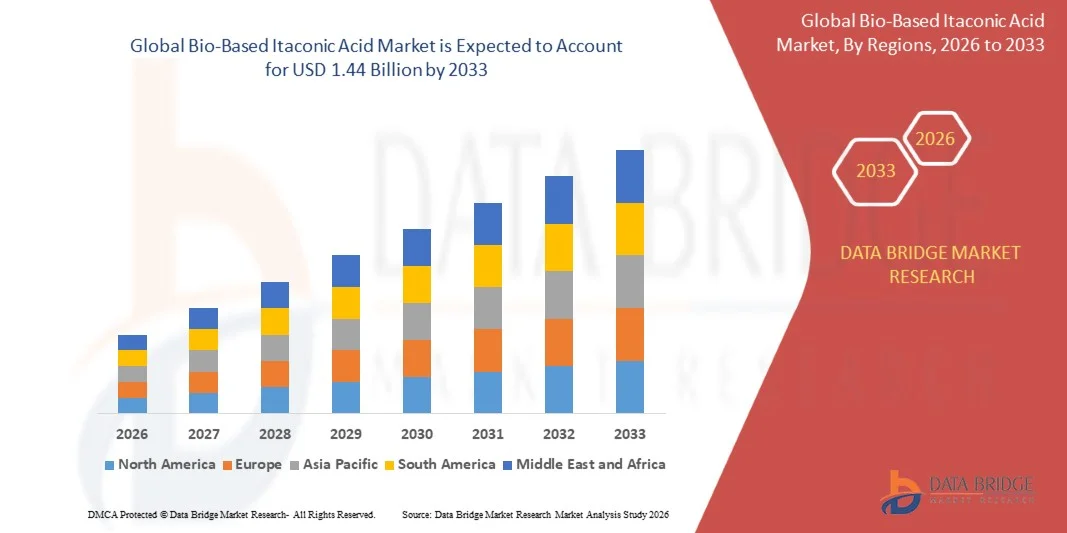
- As per Data Bridge Market Research analysis, the bio-based itaconic acid market was valued at USD 1.01 billion in 2025 and is projected to reach USD 1.44 billion by 2033, growing at a CAGR of 4.60% from 2026 to 2033.
- The market is experiencing consistent growth driven by the shifting trend toward environment-friendly products, increasing awareness of greenhouse gas emissions, and government regulations restricting the consumption of chemical-based itaconic acid in several applications.
- The growing demand for bio-based chemicals across adhesives, sealants, paints, coatings, and specialty polymers, combined with the increasing adoption of sustainable production processes, is supporting market expansion. The development of solid-state fermentation is also creating new opportunities for bio-based itaconic acid production, although high production costs and limited manufacturing technology remain key challenges.
Market Size & Forecast
- Global Market Value (2025): USD 1.01 Billion
- Expected Market Value (2033): USD 1.44 Billion
- Forecast CAGR (2026–2033): 4.60%
- Leading Region in 2025: North America
- Fastest Growing Region: Asia Pacific
What are the Major Takeaways of the Bio-based Itaconic Acid Market?
- North America dominated the bio-based itaconic acid market with the largest revenue share of 38.2% in 2025, supported by advanced biotechnology infrastructure, substantial research and development investments, and strong regulatory support for bio-based chemicals.
- Asia-Pacific is expected to be the fastest-growing region at a CAGR of 9.4% from 2026 to 2033, fueled by rapid industrialization, expanding construction activity, and rising demand for bio-polymers across India and Southeast Asia.
- The fermentation process segment led the market with a 85% share in 2025, driven by the established use of microbial fermentation for producing itaconic acid from renewable carbohydrate feedstocks
- Hybrid production systems are the fastest-growing product process type, projected to register a CAGR of 9.11%, reflecting the surge in efforts to combine biological production with advanced conversion and downstream-processing technologies.
- The styrene butadiene itaconic acid segment dominated the derivative type category with a 35% revenue share in 2025, led by extensive use in latex and rubber applications.
- Industrial grade accounted for 70% of the market share in 2025, preferred by the extensive consumption in polymer, latex, resin, coating, and chemical applications.
- The superabsorbent polymer segment is the fastest-growing application category, with a CAGR of 17.9%, driven by increasing demand for high-performance absorbent materials in hygiene products.
Report Scope and Bio-based Itaconic Acid Market Segmentation
|
Attributes |
Bio-based Itaconic Acid Key Market Insights |
|
Segments Covered |
|
|
Countries Covered |
North America
Europe
Asia-Pacific
Middle East and Africa
South America
|
|
Key Market Players |
|
|
Market Opportunities |
|
|
Value Added Data Infosets |
In addition to the insights on market scenarios such as market value, growth rate, segmentation, geographical coverage, and major players, the market reports curated by the Data Bridge Market Research also include import export analysis, production capacity overview, production consumption analysis, price trend analysis, climate change scenario, supply chain analysis, value chain analysis, raw material/consumables overview, vendor selection criteria, PESTLE Analysis, Porter Analysis, and regulatory framework. |
What is the Key Trend in the Bio-based Itaconic Acid Market?
- The market is witnessing increasing adoption of bio-based itaconic acid as an eco-friendly alternative to petrochemical-derived building blocks, supported by growing demand for sustainable chemicals and lower-emission materials across industries.
- For instance, in March 2025, ACS Applied Engineering Materials reported a fully biobased itaconate polyester adhesive developed using itaconic acid and brewer’s spent grain, demonstrating the growing use of itaconic acid in sustainable, high-performance adhesive applications.
- Manufacturers are increasingly utilizing bio-based itaconic acid in adhesives, sealants, paints, coatings, specialty polymers, and resins, where its renewable origin and favorable functional properties support the development of sustainable formulations.
- The development of itaconic acid-based polymers and biopolyesters is gaining attention as manufacturers seek renewable alternatives to petroleum-based acrylic and polyester materials while maintaining functional and mechanical performance.
- Bio-based itaconic acid is increasingly being explored for additive manufacturing, particularly photocurable formulations, as researchers seek renewable substitutes for fossil-derived methacrylate materials used in three-dimensional printing applications.
- For instance, in February 2025, the Journal of Polymers and the Environment reported the utilization of a bio-based monomer derived from camelina oil and itaconic acid for film-forming latexes; at 30 wt% bio-based monomer content, coatings achieved about 11% higher pendulum hardness, a 9°C increase in glass-transition temperature, and about 80% lower water whitening.
- Advancements in fermentation technology and alternative renewable feedstocks are supporting efforts to improve itaconic acid productivity, reduce manufacturing costs, and expand the commercial viability of bio-based production processes.
What are the Key Drivers of the Bio-based Itaconic Acid Market?
- The increasing shift toward environmentally friendly chemicals and renewable raw materials is driving demand for bio-based itaconic acid as industries seek alternatives that reduce dependence on fossil-derived chemical feedstocks.
- For instance, in February 2024, ACS Applied Polymer Materials reported the development of photocurable itaconic acid-functionalized polycaprolactone for vat photopolymerization, addressing the dependence of 3D printing on fossil-derived (meth)acrylic acid esters and demonstrating the potential of itaconic acid as a bio-based alternative.
- Growing concerns regarding greenhouse-gas emissions and volatile organic compounds are encouraging chemical manufacturers to adopt bio-based materials in adhesives, coatings, paints, sealants, and specialty polymer formulations.
- Rising demand for sustainable polymers and bio-based resins is expanding the use of itaconic acid as a renewable monomer for developing materials with potential applications across automotive, construction, packaging, and industrial sectors.
- For instance, in April 2024, Progress in Additive Manufacturing reported fully bio-based diurethanediol itaconates for photopolymerization-based 3D printing, achieving biobased contents of up to 90 wt.%, elastic moduli as high as 1 GPa, and tensile strengths above 30 MPa, supporting demand for sustainable itaconic acid-based materials.
- Advances in microbial fermentation and metabolic engineering are improving production pathways, enabling researchers to investigate alternative substrates and microorganisms for increasing itaconic acid yields and reducing dependence on conventional feedstocks.
Which Factors are Challenging the Growth of the Bio-based Itaconic Acid Market?
- High production costs remain a major challenge because fermentation, downstream recovery, and purification processes can significantly increase the overall cost of bio-based itaconic acid compared with established petrochemical alternatives.
- For instance, in November 2024, Chemical Engineering Science reported that bio-based itaconic acid production from sugarcane feedstocks was economically unattractive, with estimated internal rates of return ranging from only 4.49% to 11.61%, while production was also energy-intensive and involved prolonged fermentation times.
- The commercial scalability of bio-based itaconic acid is constrained by limited production technology, substrate costs, fermentation efficiency, and downstream processing requirements, which can restrict competitiveness against conventional chemical building blocks.
- The separation and recovery of itaconic acid from fermentation broth remains technically demanding, with downstream processing potentially accounting for approximately 30–40% of final product costs, increasing the economic burden of production.
- The low productivity and yield of microbial fermentation remain major challenges, increasing manufacturing costs and limiting the competitiveness of bio-based itaconic acid against established petrochemical alternatives.
- For instance, in May 2024, the Journal of Membrane Science reported that downstream processing is a major cost barrier for biobased itaconic acid, highlighting the need to reduce recovery costs to enable competitiveness with petrochemical production; the developed composite ultrathin membranes demonstrated simultaneous broth clarification and product recovery.
- The use of inexpensive alternative feedstocks remains technically difficult, as impurities in crude substrates can interfere with fermentation performance and require additional purification and processing steps.
How is the Bio-based Itaconic Acid Market Segmented?
The bio-based itaconic acid market is segmented on the basis of product process, derivative, purity grade, application, and end use.
- By Product Process
On the basis of product process, the bio-based itaconic acid market is segmented into fermentation process, catalytic bioconversion, and hybrid production systems. The fermentation process segment dominated the market with an estimated share of 85%in 2025, owing to the established use of microbial fermentation for producing itaconic acid from renewable carbohydrate feedstocks. Commercial production is primarily fermentation-based, commonly using carbohydrate feedstocks and microorganisms such as Aspergillus terreus. Fermentation provides a biological route for converting renewable sugars into itaconic acid while reducing dependence on petroleum-derived raw materials. Advances in microbial strain development and fermentation technology are improving production efficiency and productivity. Its established commercial pathway continues to make fermentation the most widely used production process globally.
The hybrid production systems segment is projected to register the fastest growth at an estimated CAGR of 9.11% during the forecast period, driven by increasing efforts to combine biological production with advanced conversion and downstream-processing technologies. Hybrid systems can provide greater flexibility in feedstock utilization and product development. Improvements in fermentation, separation, purification, and chemical conversion technologies are supporting integrated production approaches. These systems can potentially address productivity and cost limitations associated with conventional fermentation. Increasing development of high-value itaconic acid derivatives is also encouraging process innovation. Growing investment in sustainable chemical manufacturing is expected to accelerate adoption of integrated production technologies.
- By Derivative
On the basis of derivative, the bio-based itaconic acid market is segmented into styrene butadiene itaconic acid, methyl methacrylate, polyitaconic acid, and others. The styrene butadiene itaconic acid segment dominated the market with an estimated share of 35% in 2025, supported by extensive use in latex and rubber applications. Itaconic acid is widely associated with SBR latex, methyl methacrylate, and polyitaconic acid production. Styrene-butadiene-based materials benefit from the functional properties provided by itaconic acid in polymer formulations. The derivative is particularly relevant to latex and rubber applications requiring improved adhesion and polymer performance. Increasing demand for high-performance latex materials is supporting consumption. Its established industrial application base continues to support its leading position.
The polyitaconic acid segment is projected to register the fastest growth at an estimated CAGR of 9.12% during the forecast period, driven by increasing interest in bio-based and functional polymers. Polyitaconic acid provides multiple carboxylic groups that offer useful properties for specialty polymer applications. It is being investigated for use in dispersants, coatings, biomedical materials, and other advanced applications. Growing efforts to replace fossil-based polymer building blocks are supporting development of itaconic-acid-derived polymers. Advances in polymerization technologies are expanding potential application areas. Increasing demand for sustainable specialty polymers is expected to accelerate segment growth.
- By Purity Grade
On the basis of purity grade, the bio-based itaconic acid market is segmented into industrial grade, pharmaceutical grade, research grade, and others. The industrial grade segment dominated the market with an estimated share of 70% in 2025, owing to extensive consumption in polymer, latex, resin, coating, and chemical applications. Industrial-grade material provides the required specifications for large-volume manufacturing applications at comparatively lower costs. SBR latex, synthetic latex, unsaturated polyester resins, and dispersant applications represent important industrial consumption areas. The broad industrial application base creates substantial demand for commercially produced itaconic acid. Growing demand for renewable chemical feedstocks is further supporting industrial applications. Its established commercial utilization continues to make industrial grade the dominant purity category.
The pharmaceutical grade segment is projected to register the fastest growth at an estimated CAGR of 10.12% during the forecast period, supported by increasing research into itaconic-acid-based biomaterials and specialty polymers. High-purity itaconic acid can serve as a building block for functional materials used in pharmaceutical and biomedical applications. Growing interest in renewable and biocompatible materials is creating opportunities for bio-based itaconic acid. Research has demonstrated the potential of itaconic-acid-derived polymers in biomedical applications. Increasing demand for high-purity specialty chemicals is supporting opportunities in specialized applications. Continued development of advanced biomedical materials is expected to accelerate demand for pharmaceutical-grade products.
- By Application
On the basis of application, the bio-based itaconic acid market is segmented into SBR Latex, synthetic latex, chelant dispersant agent, superabsorbent polymer, unsaturated polyester resins, methyl methacrylate, detergent builder, and others. The synthetic latex segment dominated the market with a 34.6% share in 2025, supported by widespread use of itaconic acid as a comonomer in latex formulations. Itaconic acid improves adhesion, flexibility, and chemical resistance in synthetic latex applications. Demand is further supported by its use in paints, coatings, and paper-finishing applications. Manufacturers are increasingly adopting bio-based latex solutions to align with environmental sustainability objectives. The established scale of synthetic latex applications provides a substantial consumption base. Its broad industrial utilization continues to make synthetic latex the leading application segment.
The superabsorbent polymer segment is projected to witness the fastest growth at a CAGR of 17.9% during the forecast period, driven by increasing demand for high-performance absorbent materials in hygiene products. Itaconic acid provides functional groups that can contribute to water absorption and retention properties in polymer systems. Superabsorbent polymers are widely used in diapers, feminine hygiene products, and adult incontinence products. Increasing demand for sustainable hygiene materials is encouraging development of bio-based polymer components. Growing consumer preference for environmentally friendly products is further supporting innovation in this application. The segment's comparatively high growth rate makes superabsorbent polymers an important emerging application for itaconic acid.
- By End Use
On the basis of end use, the bio-based itaconic acid market is segmented into chemicals, construction, agriculture, personal care, packaging, and others. The chemicals segment dominated the market with an estimated share of 30% in 2025, owing to the role of itaconic acid as a bio-based platform chemical and intermediate. It is used to manufacture polymers, resins, latexes, dispersants, detergent builders, and other specialty chemical products. The broad range of downstream applications creates substantial demand from chemical manufacturers. Increasing substitution of petroleum-derived feedstocks with renewable alternatives is strengthening its position within the chemical industry. Growing development of sustainable polymers and specialty materials is further increasing demand. Its versatility across multiple downstream applications supports the dominance of the chemicals segment.
The packaging segment is projected to register the fastest growth at an estimated CAGR of 9.11% during the forecast period, driven by increasing demand for sustainable and bio-based packaging materials. Itaconic acid can serve as a renewable building block for bio-based polymers, resins, and polyester materials. Growing environmental concerns surrounding conventional plastic packaging are encouraging manufacturers to develop alternative materials. Regulatory initiatives aimed at reducing plastic waste are further supporting sustainable packaging development. Bio-based platform chemicals are increasingly being investigated for applications in polymers and plastic packaging. Rising consumer preference for environmentally friendly packaging is expected to create additional demand for itaconic-acid-derived materials.
Which Region Holds the Largest Share of the Bio-based Itaconic Acid Market?
- North America dominated the bio-based itaconic acid market with the largest revenue share of 38.2% in 2025, supported by advanced biotechnology infrastructure, substantial research and development investments, and strong regulatory support for bio-based chemicals.
- The region also benefits from a well-established chemical processing industry, early adoption of sustainable manufacturing practices, and strong demand from automotive and chemical manufacturing sectors. The United States leads regional consumption, while government initiatives supporting bio-based chemicals and increasing emphasis on environmental sustainability continue to strengthen North America's position in the global market.
U.S. Bio-based Itaconic Acid Market Insight
The U.S. bio-based itaconic acid market is witnessing growth due to increasing interest in renewable platform chemicals, biotechnology, and sustainable polymer production. The country benefits from established chemical and biotechnology capabilities and demand for bio-based alternatives to petroleum-derived materials. Growing applications in polymers, coatings, adhesives, and specialty chemicals are creating opportunities for itaconic acid. Increasing emphasis on reducing dependence on fossil resources is further supporting the adoption of bio-based building blocks. The development of advanced fermentation and metabolic-engineering technologies is also improving the potential for domestic production. Frontiers in Bioengineering and Biotechnology reported production of 54.55 g/L itaconic acid using engineered Yarrowia lipolytica in a 5-liter bioreactor with waste cooking oil as the sole carbon source
Asia-Pacific Bio-based Itaconic Acid Market Insight
The Asia-Pacific bio-based itaconic acid market is expected to witness rapid growth, driven by established itaconic acid manufacturing, expanding chemical industries, and increasing demand for sustainable bio-based materials across China and other regional markets. The region benefits from increasing investments in biotechnology and bioprocessing industries. Growing applications in polymers, latexes, coatings, adhesives, and specialty chemicals are supporting regional demand. China represents an important production center for global itaconic acid supply. Increasing availability of manufacturing infrastructure and renewable feedstocks is further supporting market development. Growing industrial demand for sustainable chemical intermediates is expected to strengthen the regional market. A study published in Biotechnology for Biofuels reported that China became the world's largest itaconic acid producer following production interruptions by major producers in other regions.
Japan Bio-based Itaconic Acid Market Insight
The Japan bio-based itaconic acid market is witnessing consistent growth due to its established chemical industry, biotechnology capabilities, and historical involvement in itaconic acid production. The country has a long history of commercial itaconic acid manufacturing and advanced research capabilities in bio-based chemicals. Increasing interest in renewable polymers and specialty materials is supporting opportunities for itaconic acid derivatives. Applications across polymers, coatings, resins, and other advanced materials provide additional growth opportunities. Japan's emphasis on technological innovation and sustainable manufacturing is supporting development of bio-based chemical technologies. Biotechnology for Biofuels reported that Iwata Chemical began commercial itaconic acid production in Japan in 1970, demonstrating the country's longstanding role in the global itaconic acid industry.
China Bio-based Itaconic Acid Market Insight
The China bio-based itaconic acid market is growing rapidly, driven by the country's strong position in global itaconic acid production, expanding biotechnology industry, and increasing demand for renewable chemical feedstocks. China has developed substantial manufacturing capabilities for itaconic acid and benefits from growing investment in bioprocessing industries. Demand from polymers, latexes, coatings, adhesives, and specialty chemicals is supporting market expansion. Increasing research into alternative feedstocks is also improving the sustainability and economics of domestic production. Growing emphasis on renewable chemicals is creating additional opportunities for bio-based itaconic acid. Biotechnology for Biofuels reported that Qingdao Kehai Biochemistry Company accounted for approximately 50% of China's total itaconic acid production capacity and about 18% of worldwide capacity, equivalent to approximately 10,000 metric tons per year.
U.K. Bio-based Itaconic Acid Market Insight
The U.K. bio-based itaconic acid market is experiencing steady growth, supported by increasing interest in renewable chemicals, biotechnology, and sustainable polymer development. The country's research ecosystem is contributing to the development of bio-based platform chemicals and renewable polymer materials. Growing emphasis on reducing dependence on fossil-derived raw materials is creating opportunities for itaconic acid as a renewable building block. Applications in polymers, coatings, adhesives, and specialty materials are supporting market opportunities. Increasing research into sustainable polymerization routes is further expanding potential applications. Green Chemistry published a 2026 study identifying itaconic acid as a promising bio-based platform chemical and highlighting its potential for bio-based polymers and reduced reliance on fossil resources.
Germany Bio-based Itaconic Acid Market Insight
The Germany bio-based itaconic acid market is expanding steadily due to strong industrial biotechnology capabilities, advanced chemical engineering expertise, and increasing development of renewable feedstocks. Germany has an established research base for improving fermentation and utilizing alternative substrates for sustainable chemical production. Growing focus on circular bioeconomy concepts is encouraging the conversion of agricultural and industrial side streams into valuable chemicals. Increasing efforts to improve fermentation economics are supporting the development of scalable production processes. The country's biotechnology and chemical research infrastructure provides opportunities for advancing bio-based itaconic acid manufacturing. RWTH Aachen University developed and scaled an itaconic acid production process using an alternative feedstock as the sole carbon source, reaching a 150-liter bioreactor scale.
Which are the Top Companies in Bio-based Itaconic Acid Market?
The bio-based itaconic acid industry is primarily led by well-established companies, including:
- Itaconix (U.K.)
- Qingdao Langyatai Group Co., Ltd (China)
- Tokyo Chemical Industry Co., Ltd. (Japan)
- Merck KGaA (Germany)
- Shandong Crownchem Industries Co., Ltd. (China)
- Zhejiang Guoguang Biochemistry Co., Ltd. (China)
- Shandong Xinhua Pharma. (China)
- Shanghai Macklin Biochemical Technology Co., Ltd. (China)
- Spectrum Chemical Mfg. Corp. (U.S.)
- Apollo Scientific Ltd (U.K.)
- Loba Chemie Pvt. Ltd. (India)
- Otto Chemie Pvt. Ltd. (India)
- Sisco Research Laboratories Pvt. Ltd. (India)
- MedChemExpress (U.S.)
- Aladdin Scientific Corporation (U.S.)
- ChemScene LLC (U.S.)
- Biosynth AG (Switzerland)
- abcr GmbH (Germany)
What are Latest Developments in Bio-based Itaconic Acid Market?
- In July 2025, Itaconix launched its BIO*Asterix range of plant-based specialty products for paints, coatings, and adhesives. The company stated that BIO*Asterix products are specialty derivatives of itaconic acid that can fully or partially replace fossil-based acrylate, methacrylate, or styrene monomers in resins and composites. The launch represents a direct commercial development for bio-based itaconic acid derivatives and expands their use in sustainable coatings, adhesives, and composite applications.

- Interactive Data Analysis Dashboard
- Company Analysis Dashboard for high growth potential opportunities
- Research Analyst Access for customization & queries
- Competitor Analysis with Interactive dashboard
- Latest News, Updates & Trend analysis
- Harness the Power of Benchmark Analysis for Comprehensive Competitor Tracking
Global Bio Based Itaconic Acid Market, Supply Chain Analysis and Ecosystem Framework
To support market growth and help clients navigate the impact of geopolitical shifts, DBMR has integrated in-depth supply chain analysis into its Global Bio Based Itaconic Acid Market research reports. This addition empowers clients to respond effectively to global changes affecting their industries. The supply chain analysis section includes detailed insights such as Global Bio Based Itaconic Acid Market consumption and production by country, price trend analysis, the impact of tariffs and geopolitical developments, and import and export trends by country and HSN code. It also highlights major suppliers with data on production capacity and company profiles, as well as key importers and exporters. In addition to research, DBMR offers specialized supply chain consulting services backed by over a decade of experience, providing solutions like supplier discovery, supplier risk assessment, price trend analysis, impact evaluation of inflation and trade route changes, and comprehensive market trend analysis.
Data collection and base year analysis are done using data collection modules with large sample sizes. The stage includes obtaining market information or related data through various sources and strategies. It includes examining and planning all the data acquired from the past in advance. It likewise envelops the examination of information inconsistencies seen across different information sources. The market data is analysed and estimated using market statistical and coherent models. Also, market share analysis and key trend analysis are the major success factors in the market report. To know more, please request an analyst call or drop down your inquiry.
The key research methodology used by DBMR research team is data triangulation which involves data mining, analysis of the impact of data variables on the market and primary (industry expert) validation. Data models include Vendor Positioning Grid, Market Time Line Analysis, Market Overview and Guide, Company Positioning Grid, Patent Analysis, Pricing Analysis, Company Market Share Analysis, Standards of Measurement, Global versus Regional and Vendor Share Analysis. To know more about the research methodology, drop in an inquiry to speak to our industry experts.
Data Bridge Market Research is a leader in advanced formative research. We take pride in servicing our existing and new customers with data and analysis that match and suits their goal. The report can be customized to include price trend analysis of target brands understanding the market for additional countries (ask for the list of countries), clinical trial results data, literature review, refurbished market and product base analysis. Market analysis of target competitors can be analyzed from technology-based analysis to market portfolio strategies. We can add as many competitors that you require data about in the format and data style you are looking for. Our team of analysts can also provide you data in crude raw excel files pivot tables (Fact book) or can assist you in creating presentations from the data sets available in the report.













