


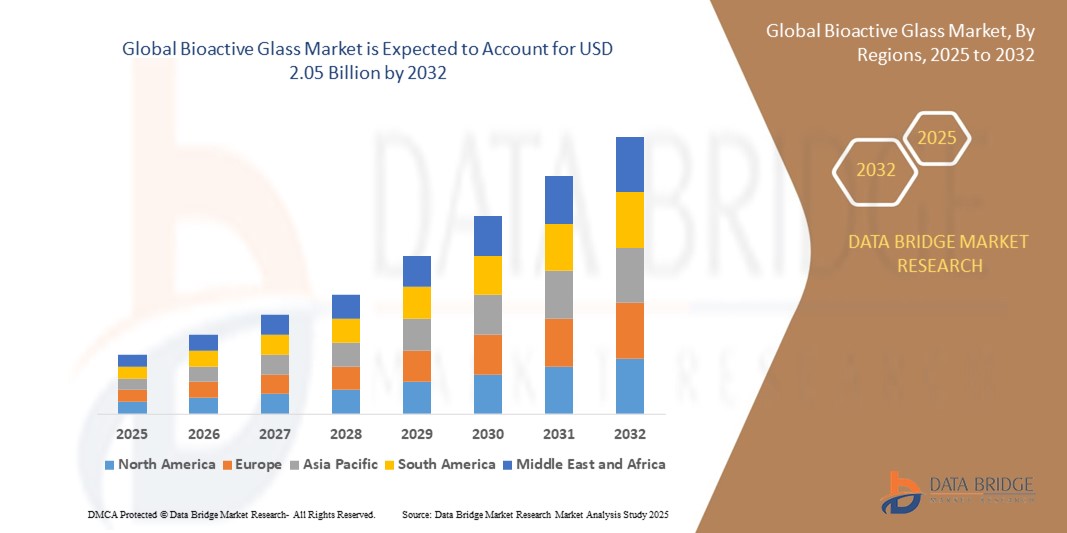
Bioactive Glass Market Size
- The global bioactive glass market size was valued at USD 1.25 billion in 2024 and is expected to reach USD 2.05 billion by 2032, at a CAGR of 6.43% during the forecast period
- The market growth is primarily driven by increasing demand for advanced biomaterials in medical and dental applications, coupled with technological advancements in bioactive glass synthesis processes
- Rising consumer awareness of biocompatible materials and their applications in orthopaedics, dentistry, and cosmetics is further propelling market expansion, positioning bioactive glass as a preferred material for tissue regeneration and cosmetic enhancements
Bioactive Glass Market Analysis
- Bioactive glass, known for its ability to bond with living tissues and promote regeneration, is a critical material in medical, dental, and cosmetic applications due to its biocompatibility, osteoconductivity, and versatility
- The surge in demand is fueled by growing applications in bone regeneration, dental restoration, and cosmetic procedures, alongside increasing investments in healthcare infrastructure and research into advanced biomaterials
- Asia-Pacific dominated the bioactive glass market with the largest revenue share of 42.5% in 2024, driven by robust healthcare advancements, high adoption of innovative biomaterials, and a strong presence of key manufacturers in countries such as China and Japan
- North America is expected to be the fastest-growing region during the forecast period due to rising investments in biomedical research, increasing prevalence of orthopedic and dental disorders, and growing consumer demand for cosmetic applications
- The 45S5 segment dominated the largest market revenue share of 60% in 2024, driven by its superior bioactivity, rapid bone-bonding capabilities, and widespread adoption in dental, orthopedic, and tissue engineering applications
Report Scope and Bioactive Glass Market Segmentation
|
Attributes |
Bioactive Glass Key Market Insights |
|
Segments Covered |
|
|
Countries Covered |
North America
Europe
Asia-Pacific
Middle East and Africa
South America
|
|
Key Market Players |
|
|
Market Opportunities |
|
|
Value Added Data Infosets |
In addition to the insights on market scenarios such as market value, growth rate, segmentation, geographical coverage, and major players, the market reports curated by the Data Bridge Market Research also include import export analysis, production capacity overview, production consumption analysis, price trend analysis, climate change scenario, supply chain analysis, value chain analysis, raw material/consumables overview, vendor selection criteria, PESTLE Analysis, Porter Analysis, and regulatory framework. |
Bioactive Glass Market Trends
“Increasing Integration of Advanced Biomaterials and Nanotechnology”
- The global bioactive glass market is experiencing a significant trend toward integrating advanced biomaterials and nanotechnology to enhance product performance and expand applications
- These technologies enable precise control over the composition, porosity, and degradation rates of bioactive glass, improving its bioactivity and compatibility for medical, dental, and cosmetic applications
- Nanotechnology-driven bioactive glass formulations, such as nano-powders, allow for enhanced surface reactivity, promoting faster tissue regeneration and bone bonding in orthopedic and dental procedures
- For instance, companies are developing nano-scale bioactive glass coatings for implants that improve osseointegration and reduce infection risks by incorporating antimicrobial ions such as silver or zinc
- This trend is increasing the appeal of bioactive glass for personalized medicine, such as 3D-printed scaffolds tailored to individual patient needs, driving adoption across medical and dental sectors
- Advanced analytics and material science innovations are enabling the customization of bioactive glass properties, such as ion release rates, to optimize therapeutic outcomes in tissue engineering and regenerative medicine
Bioactive Glass Market Dynamics
Driver
“Rising Demand for Biocompatible Materials and Regenerative Medicine”
- The growing demand for biocompatible materials in medical and dental applications, such as bone grafting, dental implants, and tissue regeneration, is a major driver for the global bioactive glass market
- Bioactive glass enhances healing by bonding with living tissues, offering superior biocompatibility, osteoconductivity, and biodegradability, particularly for applications in orthopedics and dentistry
- Government initiatives and regulatory approvals, such as the FDA’s breakthrough device designation for products such as S53P4 bioactive glass granules, are promoting wider adoption in clinical settings
- The rise of regenerative medicine and the increasing prevalence of bone-related disorders and dental conditions are further fueling demand for bioactive glass in innovative medical solutions
- The Asia-Pacific region, dominating the market, is seeing rapid growth due to increasing healthcare expenditures, rising population, and growing awareness of advanced medical technologies in countries such as China and India
Restraint/Challenge
“High Production Costs and Regulatory Complexities”
- The high cost of producing bioactive glass, particularly through advanced synthesis processes such as sol-gel and microwave synthesis, poses a significant barrier to market adoption, especially in cost-sensitive emerging markets
- The integration of bioactive glass into medical devices and implants requires sophisticated manufacturing techniques and stringent quality control, increasing overall costs
- In addition, regulatory complexities surrounding the approval and use of bioactive glass in medical and dental applications vary across regions, creating challenges for manufacturers operating globally
- Data from clinical trials and long-term safety studies are often required to meet regulatory standards, which can delay market entry and increase development costs
- In regions such as North America, the fastest-growing market, high initial investment and compliance with strict regulatory frameworks, such as those enforced by the FDA, can limit market expansion for smaller players
Bioactive Glass market Scope
The market is segmented on the basis of type, application, industry vertical, synthesis process, and product.
- By Type
On the basis of type, the global bioactive glass market is segmented into 45S5, S53P4, and Others. The 45S5 segment dominated the largest market revenue share of 60% in 2024, driven by its superior bioactivity, rapid bone-bonding capabilities, and widespread adoption in dental, orthopedic, and tissue engineering applications. Its ability to stimulate hydroxyapatite formation enhances its effectiveness in regenerative medicine.
The S53P4 segment is expected to witness the fastest growth rate of 8.5% from 2025 to 2032, fueled by its antimicrobial properties and increasing use in bone grafting for treating chronic bone infections such as osteomyelitis. Its stable performance in physiological environments further boosts demand.
- By Application
On the basis of application, the global bioactive glass market is segmented into Orthopaedics, Dentistry, Cosmetics, and Others. The Orthopaedics segment accounted for the largest market revenue share of 50% in 2024, driven by the extensive use of bioactive glass in bone substitutes, spinal implants, and trauma care due to its ability to bond with natural bone and support regeneration. The rising prevalence of bone-related disorders globally supports this segment’s dominance.
The Cosmetics segment is anticipated to experience the fastest growth rate of 9.2% from 2025 to 2032, propelled by increasing consumer demand for bioactive glass in skincare and anti-aging products. Its ability to stimulate collagen production and enhance skin rejuvenation is driving adoption in premium cosmetic formulations.
- By Industry Vertical
On the basis of industry vertical, the global bioactive glass market is segmented into Medical, Dental, and Cosmetics. The Medical segment dominated the market with a revenue share of 55% in 2024, owing to the critical role of bioactive glass in medical applications such as bone regeneration, wound care, and implant coatings. The growing demand for biocompatible materials in healthcare sustains this segment’s leadership.
The Cosmetics segment is expected to witness rapid growth from 2025 to 2032, driven by the rising incorporation of bioactive glass in cosmeceutical products such as dermal fillers and skincare solutions. Increasing consumer awareness of advanced bioactive ingredients fuels this growth.
- By Synthesis Process
On the basis of synthesis process, the global bioactive glass market is segmented into Melt Quench Synthesis, Sol-Gel Synthesis, and Microwave Synthesis. The Melt Quench Synthesis segment held the largest market revenue share of 57% in 2024, due to its dominance in industrial-scale production, yielding high-density materials with consistent bioactivity and structural stability. Its cost-effectiveness and scalability make it a preferred method.
The Sol-Gel Synthesis segment is projected to witness significant growth of 8.7% from 2025 to 2032, driven by its ability to produce bioactive glass with precise composition and high porosity, ideal for advanced applications such as bone tissue engineering and surface-functionalized implants.
- By Product
On the basis of product, the global bioactive glass market is segmented into Granules, Powders, and Nano-Powders. The Granules segment accounted for the largest market revenue share of 45% in 2024, driven by their widespread use in bone grafting, dental applications, and as bone void fillers due to their ease of handling and compatibility with surgical procedures.
The Nano-Powders segment is expected to witness the fastest growth rate of 10.1% from 2025 to 2032, fueled by advancements in nanotechnology and increasing demand for nano-sized bioactive glass in drug delivery systems, implant coatings, and cosmetic formulations. Their enhanced surface reactivity and bioactivity drive adoption.
Bioactive Glass Market Regional Analysis
- Asia-Pacific dominated the bioactive glass market with the largest revenue share of 42.5% in 2024, driven by robust healthcare advancements, high adoption of innovative biomaterials, and a strong presence of key manufacturers in countries such as China and Japan
- Consumers prioritize bioactive glass for its biocompatibility, osteoconductivity, and ability to bond with living tissues, particularly in orthopaedics, dentistry, and cosmetics, across regions with rising healthcare needs
- Growth is supported by advancements in synthesis processes, including melt quench, sol-gel, and microwave synthesis, alongside increasing adoption in medical, dental, and cosmetic industry vertical
Japan Bioactive Glass Market Insight
Japan’s bioactive glass market is expected to witness rapid growth due to strong consumer preference for high-quality, technologically advanced bioactive glass products, such as granules and powders, that enhance clinical outcomes in orthopaedics and dentistry. The presence of major medical device manufacturers and integration of bioactive glass in OEM applications accelerate market penetration. Rising interest in cosmetic applications also contributes to growth.
China Bioactive Glass Market Insight
China holds the largest share of the Asia-Pacific bioactive glass market, propelled by rapid urbanization, rising healthcare access, and increasing demand for biomaterials in medical and cosmetic applications. The country’s growing middle class and focus on advanced healthcare solutions support the adoption of bioactive glass products such as 45S5 and S53P4. Strong domestic manufacturing capabilities and competitive pricing enhance market accessibility.
U.S. Bioactive Glass Market Insight
The U.S. bioactive glass market is expected to witness significant growth, fueled by. The trend towards personalized medicine and increasing regulatory support for biocompatible materials further boost market expansion. The integration of bioactive glass in orthopedic implants and dental restorations complements both medical and aftermarket segments, creating a diverse product ecosystem.
Europe Bioactive Glass Market Insight
The Europe bioactive glass market is expected to witness significant growth, supported by regulatory emphasis on advanced medical treatments and patient safety. Consumers seek bioactive glass products that enhance tissue regeneration while offering antimicrobial properties. The growth is prominent in both clinical applications and research-driven projects, with countries such as Germany and the U.K. showing significant uptake due to rising healthcare demands and collaborative research initiatives.
U.K. Bioactive Glass Market Insight
The U.K. market for bioactive glass is expected to witness rapid growth, driven by demand for advanced biomaterials in orthopaedics and dentistry within urban healthcare settings. Increased interest in tissue engineering and rising awareness of bioactive glass’s regenerative benefits encourage adoption. Evolving medical regulations influence consumer choices, balancing bioactivity with compliance in applications such as bone grafts and wound care.
Germany Bioactive Glass Market Insight
Germany is expected to witness rapid growth in the bioactive glass market, attributed to its advanced medical manufacturing sector and high consumer focus on biocompatibility and tissue regeneration. German consumers prefer technologically advanced bioactive glass products, such as 45S5 and S53P4, that support bone healing and infection control. The integration of these materials in premium medical devices and aftermarket solutions supports sustained market growth.
Bioactive Glass Market Share
The bioactive glass industry is primarily led by well-established companies, including:
- Arthrex, Inc. (U.S.)
- NORAKER (France)
- SCHOTT AG (Germany)
- Stryker (U.S.)
- Bonalive Biomaterials Ltd. (Finland)
- British Glass Manufacturers' Confederation (U.K.)
- MO SCI, LLC (U.S.)
- LASAK s.r.o. (Czech Republic)
- Synergy Biomedical, LLC (U.S.)
- Medical Device Business Services, Inc. (U.S.)
- MATEXCEL (India)
- Medtronic (Ireland)
- NanoFUSE Biologics (U.S.)
- 3M (U.S.)
- Merck KGaA (Germany)
What are the Recent Developments in Global Bioactive Glass Market?
- In April 2024, SCHOTT AG announced that its skin-friendly bioactive glass powder, Vitryxx, can serve as an ammonia alternative in permanent hair dyes. This innovative application marks a significant expansion of bioactive glass into the cosmetics and personal care sector. Vitryxx is odorless, pH-boosting, and highly biocompatible, offering a gentler alternative to traditional alkalizing agents such as ammonia and 2-ethanolamine, which are known for their pungent odor and potential to irritate the skin. This development highlights the versatility of bioactive glass and SCHOTT’s commitment to sustainable and skin-friendly solutions beyond medical applications
- In October 2023, BonAlive Biomaterials expanded its innovative portfolio by launching bioactive glass granules specifically tailored for the chronic wound care market. These granules are based on the company’s proprietary S53P4 bioactive glass technology, which is known for its ability to inhibit bacterial growth and stimulate tissue regeneration. This launch marks BonAlive’s strategic move beyond bone regeneration into advanced wound healing, addressing the rising global demand for antibiotic-free, regenerative solutions. The product reinforces BonAlive’s leadership in the bioactive glass sector and supports its mission of enabling “Smart Healing” in complex clinical scenarios
- In November 2023, SCHOTT AG unveiled a new advanced composition of bioactive glass specifically engineered to enhance outcomes in spinal surgery. This innovation is part of SCHOTT’s broader commitment to advancing biomaterial technologies that improve patient recovery and surgical success rates. The newly developed bioactive glass formulation is designed to promote bone regeneration, reduce infection risks, and integrate seamlessly with the body’s natural healing processes. By targeting spinal applications, SCHOTT reinforces its position as a leader in high-performance medical materials, addressing the growing demand for next-generation solutions in orthopedics and neurosurgery
- In October 2023, NovaBone Products expanded its orthopedic portfolio by launching new bioactive putties designed to enhance bone regeneration and surgical outcomes in orthopedic procedures. These putties are formulated with Calcium Sodium Phosphosilicate (Bioglass) and a synthetic binder, offering osteostimulative properties that promote natural bone healing. The products are engineered for ease of use, with excellent handling characteristics that allow precise placement in bone defects. This development reinforces NovaBone’s commitment to advancing synthetic bone graft technologies and supporting improved patient care in orthopedic surgery
- In September 2023, Corning Incorporated announced plans to establish its first manufacturing facility in India, focused on producing Gorilla Glass for smartphones and other electronic devices. The facility, located in Telangana, represents a USD 113 million investment and is expected to create over 800 jobs. While the plant is not specifically for bioactive glass, this strategic expansion strengthens Corning’s manufacturing footprint in the Asia-Pacific region, potentially enabling future diversification into other advanced glass materials, including bioactive glass, to meet rising regional demand for biocompatible and high-performance materials

- Interactive Data Analysis Dashboard
- Company Analysis Dashboard for high growth potential opportunities
- Research Analyst Access for customization & queries
- Competitor Analysis with Interactive dashboard
- Latest News, Updates & Trend analysis
- Harness the Power of Benchmark Analysis for Comprehensive Competitor Tracking
Global Bioactive Glass Market, Supply Chain Analysis and Ecosystem Framework
To support market growth and help clients navigate the impact of geopolitical shifts, DBMR has integrated in-depth supply chain analysis into its Global Bioactive Glass Market research reports. This addition empowers clients to respond effectively to global changes affecting their industries. The supply chain analysis section includes detailed insights such as Global Bioactive Glass Market consumption and production by country, price trend analysis, the impact of tariffs and geopolitical developments, and import and export trends by country and HSN code. It also highlights major suppliers with data on production capacity and company profiles, as well as key importers and exporters. In addition to research, DBMR offers specialized supply chain consulting services backed by over a decade of experience, providing solutions like supplier discovery, supplier risk assessment, price trend analysis, impact evaluation of inflation and trade route changes, and comprehensive market trend analysis.
Data collection and base year analysis are done using data collection modules with large sample sizes. The stage includes obtaining market information or related data through various sources and strategies. It includes examining and planning all the data acquired from the past in advance. It likewise envelops the examination of information inconsistencies seen across different information sources. The market data is analysed and estimated using market statistical and coherent models. Also, market share analysis and key trend analysis are the major success factors in the market report. To know more, please request an analyst call or drop down your inquiry.
The key research methodology used by DBMR research team is data triangulation which involves data mining, analysis of the impact of data variables on the market and primary (industry expert) validation. Data models include Vendor Positioning Grid, Market Time Line Analysis, Market Overview and Guide, Company Positioning Grid, Patent Analysis, Pricing Analysis, Company Market Share Analysis, Standards of Measurement, Global versus Regional and Vendor Share Analysis. To know more about the research methodology, drop in an inquiry to speak to our industry experts.
Data Bridge Market Research is a leader in advanced formative research. We take pride in servicing our existing and new customers with data and analysis that match and suits their goal. The report can be customized to include price trend analysis of target brands understanding the market for additional countries (ask for the list of countries), clinical trial results data, literature review, refurbished market and product base analysis. Market analysis of target competitors can be analyzed from technology-based analysis to market portfolio strategies. We can add as many competitors that you require data about in the format and data style you are looking for. Our team of analysts can also provide you data in crude raw excel files pivot tables (Fact book) or can assist you in creating presentations from the data sets available in the report.













