What is the Biochar for Agricultural Applications Market Size and Growth Rate?
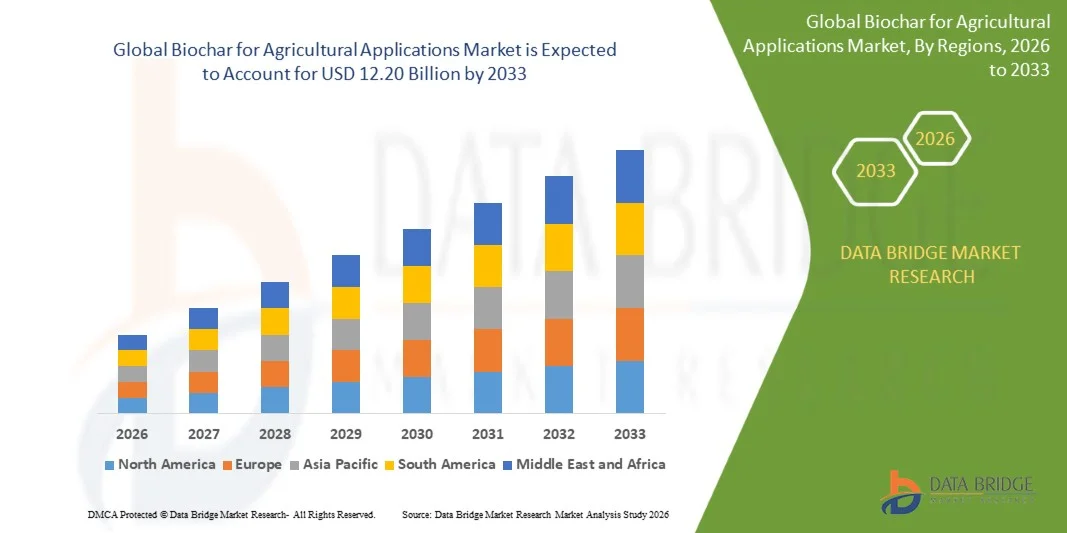
- As per Data Bridge Market Research analysis, the biochar for agricultural applications market was valued at USD 5.00 billion in 2025 and is projected to reach USD 12.20 billion by 2033, growing at a CAGR of 11.80% from 2026 to 2033.
- The market is experiencing strong growth driven by the increasing adoption of sustainable agricultural practices, rising demand for soil health improvement, growing awareness of carbon sequestration, and the expanding use of biochar to enhance crop productivity and nutrient retention.
- Government initiatives promoting regenerative agriculture, increasing utilization of agricultural biomass residues, and advancements in biochar production technologies are further accelerating market expansion. Farmers are increasingly adopting biochar as a long-term soil amendment to improve water retention, enhance fertilizer efficiency, reduce greenhouse gas emissions, and support climate-resilient farming systems.
Market Size & Forecast
- Market Value (2025): USD 5.00 Billion
- Expected Market Value (2033): USD 12.20 Billion
- Forecast CAGR (2026–2033): 11.80%
- Leading Region in 2025: Asia-Pacific
- Fastest Growing Region: North America
What are the Major Takeaways of the Biochar for Agricultural Applications Market?
- Asia-Pacific dominated the biochar for agricultural applications market with the largest revenue share of 39.93% in 2025, supported by abundant agricultural biomass availability, increasing adoption of regenerative farming practices, growing government initiatives promoting sustainable agriculture, and rising investments in biochar production technologies across China, India, Japan, and Southeast Asia.
- North America biochar for agricultural applications market is expected to witness the fastest growth rate from 2026 to 2033, primarily driven by the rapid adoption of regenerative agriculture practices, increasing investments in commercial-scale biochar production facilities, and expanding participation in carbon credit and carbon removal markets.
- The pyrolysis segment held the largest market revenue share of approximately 44.77% in 2025, driven by its high carbon conversion efficiency, commercial scalability, ability to produce stable and high-quality biochar, and widespread adoption for converting agricultural and forestry biomass into soil-enhancing biochar with long-term carbon sequestration benefits
- The hydrothermal treatment segment is expected to witness the fastest growth during the forecast period from 2026 to 2033, driven by increasing demand for processing high-moisture biomass feedstocks, advancements in biomass conversion technologies, and the growing adoption of sustainable and circular agricultural practices.
- The powder segment held the largest market revenue share of approximately 43.30% in 2025, driven by its ease of application, superior soil blending characteristics, high surface area for nutrient retention, and widespread adoption across agricultural soil amendment applications to improve soil fertility and water retention.
- The liquid suspension segment is expected to witness the fastest growth during the forecast period from 2026 to 2033, driven by its projected 24.26% CAGR, increasing adoption in precision agriculture, ease of application through fertigation and irrigation systems, and growing demand for uniform nutrient delivery and enhanced crop performance.
Report Scope and Biochar for Agricultural Applications Market Segmentation
|
Attributes |
Biochar for Agricultural Applications Key Market Insights |
|
Segments Covered |
|
|
Countries Covered |
North America
Europe
Asia-Pacific
Middle East and Africa
South America
|
|
Key Market Players |
|
|
Market Opportunities |
|
|
Value Added Data Infosets |
In addition to the insights on market scenarios such as market value, growth rate, segmentation, geographical coverage, and major players, the market reports curated by the Data Bridge Market Research also include import export analysis, production capacity overview, production consumption analysis, price trend analysis, climate change scenario, supply chain analysis, value chain analysis, raw material/consumables overview, vendor selection criteria, PESTLE Analysis, Porter Analysis, and regulatory framework. |
What is the Key Trend in the Biochar for Agricultural Applications Market?
- Biochar, a carbon-rich material produced through the pyrolysis of agricultural residues, forestry waste, and other biomass sources under low-oxygen conditions, is gaining increasing attention as a sustainable soil amendment and carbon removal solution. Its ability to improve soil structure, enhance water retention, increase nutrient availability, and support long-term carbon sequestration is driving adoption across modern agricultural practices.
- The key trend shaping the biochar for agricultural applications market is the development of large-scale biochar production systems integrated with circular agriculture models. Companies are increasingly converting agricultural and food-processing residues into biochar and returning them to farmland to improve soil health while generating additional revenue streams through carbon credit markets. This integration of soil enhancement and carbon removal benefits is accelerating the commercialization of biochar-based agricultural solutions.
- For instance, in June 2026, Jain Irrigation commissioned a biochar production facility in Jalgaon, Maharashtra, India, with an annual processing capacity of approximately 20,000 tonnes. The facility is designed to process agricultural and fruit-processing residues into biochar, which can be utilized in farming applications while supporting carbon sequestration initiatives through potential carbon credit generation.
- As agricultural companies, irrigation providers, and carbon management firms continue investing in scalable biochar production infrastructure, the adoption of biochar is expected to increase as a dual-purpose solution supporting soil productivity improvement and climate change mitigation.
What are the Key Drivers of the Biochar for Agricultural Applications Market?
- Increasing focus on sustainable agriculture, soil restoration, and carbon sequestration is driving demand for biochar-based solutions across farming systems. Farmers are increasingly adopting soil amendments that improve water retention, nutrient efficiency, and crop resilience, particularly in regions affected by soil degradation, drought, and climate variability.
- Growth in the biochar for agricultural applications market is being driven by the expansion of voluntary carbon markets and increasing recognition of biochar as a durable carbon removal technology. The ability of biochar to store carbon for extended periods while providing agricultural benefits is encouraging investments from technology developers, carbon credit companies, and agricultural solution providers.
- For instance, in July 2024, Applied Carbon raised USD 21.5 million in Series A funding to expand its mobile biochar production technology. The company’s technology enables the conversion of agricultural residues into biochar directly near farming operations, helping reduce transportation requirements while supporting soil improvement and carbon removal credit generation.
- As investments in carbon removal technologies, sustainable farming practices, and decentralized biochar production systems continue to increase, biochar is expected to become an important component of climate-smart agriculture strategies worldwide.
Which Factors are Challenging the Biochar for Agricultural Applications Market?
- Despite growing interest in biochar-based agricultural solutions, high production costs, limited availability of application infrastructure, and lack of awareness among farmers remain significant barriers to widespread adoption.
- The key challenge affecting the biochar for agricultural applications market is the economic viability of biochar adoption for farmers. Although biochar provides long-term soil health benefits, the initial purchase and application costs can be higher compared with conventional soil amendments. In addition, inconsistent supply chains, limited access to specialized spreading equipment, and uncertainty regarding carbon credit monetization can restrict adoption among small and medium-sized agricultural producers.
- For instance, at the 2025 North American Biochar Conference, CIBO Technologies highlighted that although farmers recognize the potential benefits of biochar, upfront costs, availability of biochar supplies, and access to application equipment remain major adoption barriers. The company is working to connect farmers with biochar producers and carbon buyers while supporting access to incentive programs such as the USDA Environmental Quality Incentives Program (EQIP).
- Until production costs decline, distribution networks expand, and financial mechanisms such as carbon credits and agricultural incentive programs become more accessible, cost and implementation challenges are expected to remain key factors limiting large-scale adoption of biochar for agricultural applications.
How is the Biochar for Agricultural Applications Market Segmented??
The biochar for agricultural applications market is segmented on the basis of technology and form.
- By technology
On the basis of technology, the biochar for agricultural applications market is segmented into pyrolysis, gasification, hydrothermal treatment, and others. The pyrolysis segment held the largest market revenue share of approximately 44.77% in 2025, driven by its high carbon conversion efficiency, commercial scalability, ability to produce stable and high-quality biochar, and widespread adoption for converting agricultural and forestry biomass into soil-enhancing biochar with long-term carbon sequestration benefits.
The hydrothermal treatment segment is expected to witness the fastest growth during the forecast period from 2026 to 2033, driven by increasing demand for processing high-moisture biomass feedstocks, advancements in biomass conversion technologies, and the growing adoption of sustainable and circular agricultural practices.
- By form
On the basis of form, the biochar for agricultural applications market is segmented into powder, pellets/granules, and liquid suspension. The powder segment held the largest market revenue share of approximately 43.30% in 2025, driven by its ease of application, superior soil blending characteristics, high surface area for nutrient retention, and widespread adoption across agricultural soil amendment applications to improve soil fertility and water retention.
The liquid suspension segment is expected to witness the fastest growth during the forecast period from 2026 to 2033, driven by its projected 24.26% CAGR, increasing adoption in precision agriculture, ease of application through fertigation and irrigation systems, and growing demand for uniform nutrient delivery and enhanced crop performance.
Which Region Holds the Largest Share of the Biochar for Agricultural Applications Market?
Asia-Pacific Biochar for Agricultural Applications Market Insight
- Asia-Pacific dominated the biochar for agricultural applications market with the largest revenue share of 39.93% in 2025, supported by abundant agricultural biomass availability, increasing adoption of regenerative farming practices, growing government initiatives promoting sustainable agriculture, and rising investments in biochar production technologies across China, India, Japan, and Southeast Asia.
- The region also benefits from a large agricultural sector, increasing awareness of soil health improvement, expanding utilization of crop residues for biochar production, and supportive policies encouraging carbon sequestration and climate-smart farming. The growing demand for sustainable soil amendments and efficient agricultural waste management continues to strengthen Asia-Pacific's leadership position in the global market.
Japan Biochar for Agricultural Applications Market Insight
The Japan biochar for agricultural applications market is witnessing steady growth due to increasing government support for sustainable agriculture, rising adoption of regenerative farming practices, and growing emphasis on improving soil fertility and carbon sequestration. Farmers and agricultural organizations are increasingly utilizing biochar to enhance water retention, nutrient-use efficiency, and crop productivity. Furthermore, ongoing research into advanced biomass conversion technologies and the country's commitment to achieving carbon neutrality are supporting continued market expansion.
China Biochar for Agricultural Applications Market Insight
The China biochar for agricultural applications market is growing rapidly, driven by abundant agricultural biomass availability, increasing government initiatives promoting sustainable residue management, and rising demand for soil restoration technologies. The widespread adoption of biochar in crop production, combined with investments in commercial-scale pyrolysis facilities and circular agriculture projects, is significantly boosting market demand. In addition, supportive carbon reduction policies, expanding regenerative agriculture practices, and increasing awareness of climate-smart farming are positioning China as one of the fastest-growing markets for biochar for agricultural applications globally.
North America Biochar for Agricultural Applications Market Insight
North America biochar for agricultural applications market is expected to witness the fastest growth rate from 2026 to 2033, primarily driven by the rapid adoption of regenerative agriculture practices, increasing investments in commercial-scale biochar production facilities, and expanding participation in carbon credit and carbon removal markets. Rising government support for sustainable farming initiatives, growing awareness of soil health restoration, and the increasing utilization of agricultural and forestry biomass for biochar production are further accelerating market growth. In addition, continuous technological advancements in pyrolysis systems, favorable research funding, and strong collaboration between agricultural organizations, research institutions, and biochar producers are expected to strengthen the region's position as one of the fastest-growing markets during the forecast period.
U.S. Biochar for Agricultural Applications Market Insight
The U.S. biochar for agricultural applications market is witnessing robust growth due to increasing adoption of regenerative agriculture, expanding carbon credit programs, and rising investments in commercial-scale biochar production facilities. Farmers are increasingly utilizing biochar to improve soil fertility, water retention, and nutrient-use efficiency while reducing greenhouse gas emissions. In addition, supportive government initiatives, growing research activities, and the availability of abundant agricultural biomass are further driving market expansion.
Europe Biochar for Agricultural Applications Market Insight
The Europe biochar for agricultural applications market is experiencing steady growth, driven by stringent environmental regulations, increasing focus on circular economy practices, and rising adoption of sustainable farming techniques. The region is witnessing growing investments in biomass conversion technologies and carbon sequestration projects, while increasing awareness of soil restoration and organic farming continues to support demand for agricultural biochar across several European countries.
Germany Biochar for Agricultural Applications Market Insight
The Germany biochar for agricultural applications market is expanding steadily due to strong government support for climate-smart agriculture, increasing investments in renewable biomass utilization, and growing adoption of regenerative farming practices. Rising research and development activities in advanced pyrolysis technologies, coupled with the country's emphasis on carbon neutrality and sustainable soil management, are contributing significantly to market growth.
U.K. Biochar for Agricultural Applications Market Insight
The U.K. biochar for agricultural applications market is gaining momentum owing to increasing initiatives promoting carbon removal technologies, sustainable land management, and regenerative agriculture. Growing participation in voluntary carbon markets, rising investments in commercial biochar production, and increasing awareness among farmers regarding soil health improvement and carbon sequestration are supporting the continued expansion of the market.
Which are the Top Companies in Biochar for Agricultural Applications Market?
The biochar for agricultural applications industry is primarily led by well-established companies, including:
- Airex Energy Inc. (Canada)
- Carbofex Oy (Finland)
- Carbon Gold Ltd. (U.K.)
- Biochar Supreme LLC (U.S.)
- Pacific Biochar Benefit Corporation (U.S.)
- Wakefield BioChar LLC (U.S.)
- Swiss Biochar GmbH (Switzerland)
- ArSta Eco Pvt. Ltd. (India)
- Phoenix Energy (U.S.)
- Oregon Biochar Solutions, Inc. (U.S.)
- Bioforcetech Corporation (U.S.)
- NetZero SAS (France)
- Circular Carbon GmbH (Germany)
- Ecoera AB (Sweden)
- Vega Biofuels, Inc. (U.S.)
What are Latest Developments in Biochar for Agricultural Applications Market?
- In October 2024, Myno Carbon secured USD 20.4 million in funding from the U.S. Department of Agriculture (USDA) through the Fertilizer Production Expansion Program to establish its CRF001 biochar carbon removal facility in Port Angeles, Washington. The facility is expected to increase the production of biochar-enhanced fertilizers that improve soil fertility, enhance water retention, reduce nutrient loss, and support sustainable agricultural practices.
- In July 2024, Applied Carbon raised USD 21.5 million in Series A funding to expand its mobile biochar production technology, enabling the on-site conversion of agricultural residues into biochar. The company plans to deploy mobile pyrolysis units across multiple U.S. states to improve soil health, promote sustainable biomass utilization, and generate carbon removal credits through agricultural applications.
- In January 2025, Charm Industrial signed a long-term carbon removal agreement with Google, representing one of the largest carbon dioxide removals (CDR) purchases announced to date. The agreement is expected to accelerate the commercialization of biomass-based carbon removal technologies by utilizing biomass pyrolysis, sustainable agricultural residues, and long-term carbon sequestration solutions, supporting the broader adoption of biochar and other carbon-negative technologies.
- In May 2025, Airex Energy, Groupe Rémabec, and SUEZ inaugurated Carbonity, Canada's first industrial-scale biochar production facility, in Port-Cartier, Québec. The facility is designed to commercialize large-scale biochar production from forestry biomass using advanced CarbonFX continuous pyrolysis technology, strengthening biochar supply for agricultural applications while supporting renewable energy integration and carbon sequestration.
- In October 2025, The International Biochar Initiative (IBI), the U.S. Biochar Initiative (USBI), and the State of Carbon Dioxide Removal launched the Second Global Biochar Market Survey to provide updated global benchmarks on biochar production, market development, investment activity, and carbon removal deployment. The initiative aims to improve industry transparency and support the expansion of biochar adoption across sustainable agricultural and climate mitigation applications.

- Interactive Data Analysis Dashboard
- Company Analysis Dashboard for high growth potential opportunities
- Research Analyst Access for customization & queries
- Competitor Analysis with Interactive dashboard
- Latest News, Updates & Trend analysis
- Harness the Power of Benchmark Analysis for Comprehensive Competitor Tracking
Data collection and base year analysis are done using data collection modules with large sample sizes. The stage includes obtaining market information or related data through various sources and strategies. It includes examining and planning all the data acquired from the past in advance. It likewise envelops the examination of information inconsistencies seen across different information sources. The market data is analysed and estimated using market statistical and coherent models. Also, market share analysis and key trend analysis are the major success factors in the market report. To know more, please request an analyst call or drop down your inquiry.
The key research methodology used by DBMR research team is data triangulation which involves data mining, analysis of the impact of data variables on the market and primary (industry expert) validation. Data models include Vendor Positioning Grid, Market Time Line Analysis, Market Overview and Guide, Company Positioning Grid, Patent Analysis, Pricing Analysis, Company Market Share Analysis, Standards of Measurement, Global versus Regional and Vendor Share Analysis. To know more about the research methodology, drop in an inquiry to speak to our industry experts.
Data Bridge Market Research is a leader in advanced formative research. We take pride in servicing our existing and new customers with data and analysis that match and suits their goal. The report can be customized to include price trend analysis of target brands understanding the market for additional countries (ask for the list of countries), clinical trial results data, literature review, refurbished market and product base analysis. Market analysis of target competitors can be analyzed from technology-based analysis to market portfolio strategies. We can add as many competitors that you require data about in the format and data style you are looking for. Our team of analysts can also provide you data in crude raw excel files pivot tables (Fact book) or can assist you in creating presentations from the data sets available in the report.