What is the Biodegradable Crop Support Twines Market Size and Growth Rate?
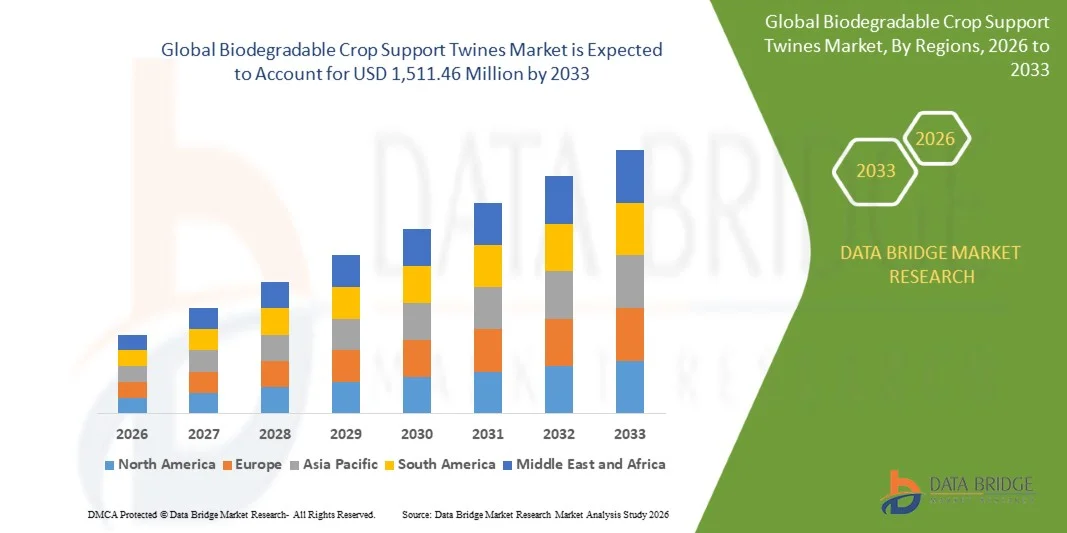
- As per Data Bridge Market Research analysis the biodegradable crop support twines market was valued at USD 700.00 Million in 2025 and is projected to reach USD 1,511.46 Million by 2033, growing at a CAGR of 10.10% from 2026 to 2033.
- The market is witnessing strong growth driven by the increasing adoption of sustainable agricultural practices, rising demand for biodegradable farming inputs, and growing awareness regarding the environmental impact of conventional plastic twines.
- The implementation of stringent regulations aimed at reducing agricultural plastic waste, coupled with the expansion of greenhouse cultivation, organic farming, and high-value horticulture, is encouraging farmers and commercial growers to shift toward biodegradable crop support twines.
Market Size & Forecast
- Market Value (2025): USD 700.00 Million
- Expected Market Value (2033): USD 1,511.46 Million
- Forecast CAGR (2026–2033): 10.10%
- Leading Region in 2025: North America
- Fastest Growing Region: Asia-Pacific
What are the Major Takeaways of the Biodegradable Crop Support Twines Market?
- North America dominated the biodegradable crop support twines market in 2025, supported by the growing adoption of sustainable agricultural practices and stringent regulations aimed at reducing plastic waste in farming.
- Asia-Pacific biodegradable crop support twines market is expected to witness the fastest growth rate from 2026 to 2033, supported by expanding horticultural production, increasing awareness of sustainable farming practices, and rising government initiatives promoting environmentally friendly agricultural inputs.
- The natural fiber twines segment held the largest market revenue share in 2025 driven by their widespread adoption in horticulture, vineyards, and greenhouse farming due to their complete biodegradability, high tensile strength, and compatibility with organic farming practices. Materials such as jute, sisal, hemp, and coir are extensively used as sustainable alternatives to conventional plastic twines, supported by increasing restrictions on agricultural plastic waste.
- The biopolymer-based twines segment is projected to register the fastest growth during the forecast period from 2026 to 2033, driven by growing demand for high-performance biodegradable materials that offer improved durability, moisture resistance, and consistent field performance. Increasing commercialization of PLA, PBS, and starch-based twines for precision agriculture and protected cultivation is further supporting segment growth.
- The vegetables segment accounted for the largest market revenue share in 2025 owing to the extensive use of biodegradable support twines in tomato, cucumber, pepper, and bean cultivation. The expansion of greenhouse vegetable production and increasing adoption of sustainable cultivation practices have significantly contributed to the dominance of this segment.
- The vine crops segment is projected to register the fastest growth during the forecast period from 2026 to 2033, driven by rising cultivation of grapes, hops, and other climbing crops requiring reliable plant support systems. Increasing investment in high-value horticultural farming and vineyard modernization is accelerating the adoption of biodegradable crop support twines.
Report Scope and Biodegradable Crop Support Twines Market Segmentation
|
Attributes |
Biodegradable Crop Support Twines Key Market Insights |
|
Segments Covered |
|
|
Countries Covered |
North America
Europe
Asia-Pacific
Middle East and Africa
South America
|
|
Key Market Players |
|
|
Market Opportunities |
|
|
Value Added Data Infosets |
In addition to the insights on market scenarios such as market value, growth rate, segmentation, geographical coverage, and major players, the market reports curated by the Data Bridge Market Research also include import export analysis, production capacity overview, production consumption analysis, price trend analysis, climate change scenario, supply chain analysis, value chain analysis, raw material/consumables overview, vendor selection criteria, PESTLE Analysis, Porter Analysis, and regulatory framework. |
What is the Key Trend in the Biodegradable Crop Support Twines Market?
- Greenhouse growers and commercial horticulture producers are increasingly adopting biodegradable crop support twines to reduce plastic waste, simplify crop residue management, and comply with sustainability targets and circular agriculture initiatives.
- For instance, in April 2024, BASF launched ecovio T 2206, a certified industrially compostable biopolymer specifically developed for greenhouse crop support twines. The material enables twines to be composted together with plant residues after harvest, eliminating the need to separate conventional plastic twines while reducing persistent microplastic pollution.
- Compostable crop support solutions are increasingly being integrated into protected cultivation systems, helping growers reduce labor costs associated with twine removal while supporting environmentally responsible crop production.
- As commercial greenhouse operators continue replacing conventional polypropylene twines with certified compostable alternatives, biodegradable crop support twines are expected to become a standard component of sustainable horticultural production systems.
What are the Key Drivers of the Biodegradable Crop Support Twines Market?
- Growing regulatory pressure to reduce agricultural plastic waste, coupled with the expansion of greenhouse cultivation and organic farming, is accelerating demand for biodegradable crop support twines across commercial agriculture.
- For instance, in June 2024, Bayer CropScience and Novamont announced the successful completion of year-long greenhouse trials using Mater-Bi compostable twines and clips across more than 80 hectares in Spain. The products maintained mechanical performance throughout the crop cycle and were composted together with crop residues, demonstrating their commercial viability for sustainable greenhouse production.
- Commercial growers are increasingly adopting biodegradable crop support materials to improve operational efficiency, reduce disposal costs, and meet retailer and consumer sustainability requirements.
- As governments and food producers continue promoting circular agricultural practices, biodegradable crop support twines are expected to witness increasing adoption across high-value fruit and vegetable cultivation.
Which Factors are Challenging the Growth of the Biodegradable Crop Support Twines Market?
- Biodegradable crop support twines remain more expensive than conventional polypropylene twines due to the higher cost of certified compostable raw materials, specialized manufacturing processes, and product certification requirements.
- In addition, manufacturers must ensure that biodegradable twines provide sufficient tensile strength, UV stability, and durability throughout the entire crop cycle before decomposing under industrial composting conditions.
- For instance, Novamont highlights that Mater-Bi twines are specifically engineered to maintain mechanical performance during cultivation while achieving certified compostability at end-of-life, requiring extensive material development, validation, and certification before commercialization.
- The combination of higher production costs, rigorous certification requirements, and the need to consistently match the performance of conventional plastic twines continues to limit adoption, particularly among price-sensitive growers and emerging agricultural markets.
How is the Biodegradable Crop Support Twines Market Segmented?
The market is segmented on the basis of material, crop type, and end user.
- By Material
On the basis of material, the biodegradable crop support twines market is segmented into natural fiber twines, biopolymer-based twines, and blended biodegradable twines. The natural fiber twines segment held the largest market revenue share in 2025 driven by their widespread adoption in horticulture, vineyards, and greenhouse farming due to their complete biodegradability, high tensile strength, and compatibility with organic farming practices. Materials such as jute, sisal, hemp, and coir are extensively used as sustainable alternatives to conventional plastic twines, supported by increasing restrictions on agricultural plastic waste.
The biopolymer-based twines segment is projected to register the fastest growth during the forecast period from 2026 to 2033, driven by growing demand for high-performance biodegradable materials that offer improved durability, moisture resistance, and consistent field performance. Increasing commercialization of PLA, PBS, and starch-based twines for precision agriculture and protected cultivation is further supporting segment growth.
- By Crop Type
On the basis of crop type, the biodegradable crop support twines market is segmented into vegetables, fruits, vine crops, flowers & ornamentals, and others. The vegetables segment accounted for the largest market revenue share in 2025 owing to the extensive use of biodegradable support twines in tomato, cucumber, pepper, and bean cultivation. The expansion of greenhouse vegetable production and increasing adoption of sustainable cultivation practices have significantly contributed to the dominance of this segment.
The vine crops segment is projected to register the fastest growth during the forecast period from 2026 to 2033, driven by rising cultivation of grapes, hops, and other climbing crops requiring reliable plant support systems. Increasing investment in high-value horticultural farming and vineyard modernization is accelerating the adoption of biodegradable crop support twines.
- By End User
On the basis of end user, the biodegradable crop support twines market is segmented into commercial farms, greenhouses, organic farms, and research institutions & others. The commercial farms segment dominated the market in 2025, driven by large-scale adoption of biodegradable twines to improve operational efficiency while complying with sustainability regulations. Growing emphasis on reducing plastic residue in agricultural fields and minimizing post-harvest disposal costs has strengthened demand across commercial farming operations.
The organic farms segment is expected to register the fastest growth during the forecast period from 2026 to 2033, supported by increasing global demand for certified organic produce and stricter environmental standards for agricultural inputs. Rising awareness regarding eco-friendly cultivation practices and biodegradable farming materials continues to drive adoption across organic farming operations.
Which Region Holds the Largest Share of the Biodegradable Crop Support Twines Market?
- North America dominated the biodegradable crop support twines market in 2025, supported by the growing adoption of sustainable agricultural practices and stringent regulations aimed at reducing plastic waste in farming.
- growers across the U.S. and Canada are increasingly replacing conventional polypropylene twines with biodegradable alternatives to minimize field residue and disposal costs. The presence of advanced horticulture, greenhouse cultivation, and strong awareness regarding environmentally friendly farming inputs further strengthens regional market growth.
U.S. Biodegradable Crop Support Twines Market Insight
The U.S. biodegradable crop support twines market captured the largest revenue share in 2025 within North America, driven by the rapid adoption of sustainable farming materials and expanding greenhouse vegetable production. Farmers are increasingly prioritizing biodegradable crop support solutions to comply with environmental regulations and improve operational efficiency. Growing demand for organic produce, precision agriculture, and eco-friendly cultivation practices continues to accelerate the adoption of biodegradable crop support twines across commercial farms and protected cultivation facilities.
Europe Biodegradable Crop Support Twines Market Insight
Europe biodegradable crop support twines market is expected to witness the fastest growth rate from 2026 to 2033, primarily driven by stringent environmental regulations restricting agricultural plastic waste and strong government support for sustainable farming. Increasing organic cultivation, expanding greenhouse production, and rising demand for biodegradable agricultural inputs are encouraging widespread product adoption. The region is also witnessing growing investments in circular agriculture, further supporting market expansion.
U.K. Biodegradable Crop Support Twines Market Insight
The U.K. biodegradable crop support twines market is expected to witness the fastest growth rate from 2026 to 2033, driven by increasing adoption of sustainable horticultural practices and the country's focus on reducing plastic use in agriculture. Rising greenhouse vegetable production, expanding organic farming, and growing consumer preference for environmentally responsible food production are encouraging growers to shift toward biodegradable crop support materials.
Germany Biodegradable Crop Support Twines Market Insight
Germany biodegradable crop support twines market is expected to witness the fastest growth rate from 2026 to 2033, fueled by the country's strong emphasis on sustainable agriculture, environmental protection, and advanced horticultural production. Growing investments in biodegradable farming materials, combined with increasing adoption of organic cultivation and greenhouse farming, are supporting market growth. The country's focus on reducing agricultural plastic waste further accelerates the transition toward biodegradable crop support twines.
Asia-Pacific Biodegradable Crop Support Twines Market Insight
The Asia-Pacific biodegradable crop support twines market is expected to witness the fastest growth rate from 2026 to 2033, supported by expanding horticultural production, increasing awareness of sustainable farming practices, and rising government initiatives promoting environmentally friendly agricultural inputs. Rapid growth in greenhouse cultivation, protected agriculture, and high-value fruit and vegetable production across countries such as China, India, and Japan is creating significant demand for biodegradable crop support twines.
Japan Biodegradable Crop Support Twines Market Insight
Japan biodegradable crop support twines market is expected to witness the fastest growth rate from 2026 to 2033 due to the country's advanced protected agriculture sector, strong focus on sustainable farming, and increasing demand for premium-quality horticultural produce. The adoption of biodegradable crop support materials is rising as growers seek to improve farm efficiency while reducing agricultural waste. Government initiatives supporting environmentally friendly cultivation practices are further contributing to market growth.
China Biodegradable Crop Support Twines Market Insight
The China biodegradable crop support twines market accounted for the largest market revenue share in Asia Pacific in 2025, attributed to the country's extensive fruit and vegetable cultivation, expanding greenhouse farming industry, and growing focus on reducing agricultural plastic pollution. Rising investments in sustainable farming technologies, coupled with increasing adoption of biodegradable agricultural inputs and supportive government policies, are driving strong demand for biodegradable crop support twines across commercial farming operations.
Which are the Top Companies in Biodegradable Crop Support Twines Market?
The biodegradable crop support twines industry is primarily led by well-established companies, including:
- Beaulieu Technical Textiles (Belgium)
- GreenStrand S.r.l. (Italy)
- Karatzis S.A. (Greece)
- INTERMAS (Spain)
- Tenax S.p.A. (Italy)
- Buitendijk Slaman B.V. (Netherlands)
- Juta a.s. (Czech Republic)
- Cotesi – Companhia de Têxteis Sintéticos S.A. (Portugal)
- Beaulieu Fibres International (Belgium)
- TAMA Plastic Industry (Israel)
- Berry Global Inc. (U.S.)
- Dolezych GmbH & Co. KG (Germany)
- Cordex S.A. (Portugal)
- TVU Textiles Pvt. Ltd. (India)
- Lankhorst Yarns (Netherlands)
What are Latest Developments in Biodegradable Crop Support Twines Market?
- In February 2025, BASF expanded its sustainable horticulture portfolio by introducing certified industrially compostable plant clips that complement its ecovio greenhouse twine solution. Together, these products enable growers to implement nearly plastic-free crop support systems and simplify organic waste recycling after harvest.

- Interactive Data Analysis Dashboard
- Company Analysis Dashboard for high growth potential opportunities
- Research Analyst Access for customization & queries
- Competitor Analysis with Interactive dashboard
- Latest News, Updates & Trend analysis
- Harness the Power of Benchmark Analysis for Comprehensive Competitor Tracking
Data collection and base year analysis are done using data collection modules with large sample sizes. The stage includes obtaining market information or related data through various sources and strategies. It includes examining and planning all the data acquired from the past in advance. It likewise envelops the examination of information inconsistencies seen across different information sources. The market data is analysed and estimated using market statistical and coherent models. Also, market share analysis and key trend analysis are the major success factors in the market report. To know more, please request an analyst call or drop down your inquiry.
The key research methodology used by DBMR research team is data triangulation which involves data mining, analysis of the impact of data variables on the market and primary (industry expert) validation. Data models include Vendor Positioning Grid, Market Time Line Analysis, Market Overview and Guide, Company Positioning Grid, Patent Analysis, Pricing Analysis, Company Market Share Analysis, Standards of Measurement, Global versus Regional and Vendor Share Analysis. To know more about the research methodology, drop in an inquiry to speak to our industry experts.
Data Bridge Market Research is a leader in advanced formative research. We take pride in servicing our existing and new customers with data and analysis that match and suits their goal. The report can be customized to include price trend analysis of target brands understanding the market for additional countries (ask for the list of countries), clinical trial results data, literature review, refurbished market and product base analysis. Market analysis of target competitors can be analyzed from technology-based analysis to market portfolio strategies. We can add as many competitors that you require data about in the format and data style you are looking for. Our team of analysts can also provide you data in crude raw excel files pivot tables (Fact book) or can assist you in creating presentations from the data sets available in the report.