


What is the Biodegradable Scaffold Market Size and Growth Rate?
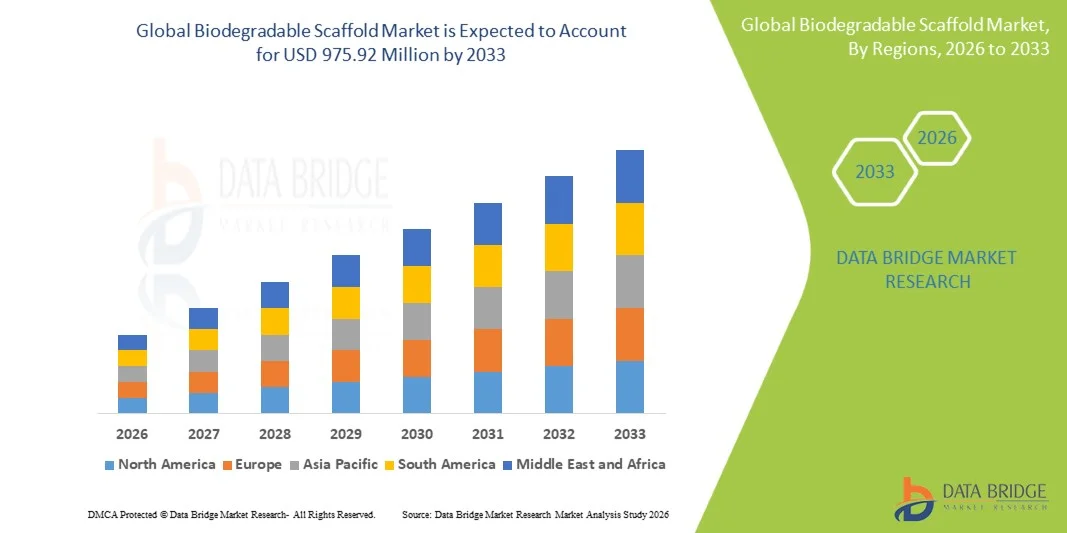
- As per Data Bridge Market Research analysis, the biodegradable scaffold market was valued at USD 610.00 million in 2025 and is projected to reach USD 975.92 million by 2033, growing at a CAGR of 6.05% from 2026 to 2033.
- The market is experiencing consistent growth driven by rising demand for tissue-engineering solutions, increasing adoption of regenerative medicine, advancements in biomaterials and scaffold fabrication technologies, and expanding applications across orthopedics, wound healing, and tissue regeneration.
- The growing prevalence of chronic diseases and tissue-related disorders, combined with increasing investments in regenerative medicine and biomedical research, is compelling healthcare institutions and research organizations to adopt advanced biodegradable scaffold technologies. Biodegradable scaffolds provide temporary structural support for tissue regeneration and gradually degrade as new tissue forms, supporting their use in minimally invasive and personalized regenerative therapies.
Market Size & Forecast
- Global Market Value (2025): USD 610.00 Million
- Expected Market Value (2033): USD 975.92 Million
- Forecast CAGR (2026–2033): 6.05%
- Leading Region in 2025: North America
- Fastest Growing Region: Asia Pacific
What are the Major Takeaways of the Biodegradable Scaffold Market?
- North America dominated the biodegradable scaffold market with the largest revenue share of 39.55% in 2025, supported by advanced healthcare infrastructure, strong regenerative medicine research, and established regulatory pathways for scaffold products.
- Asia-Pacific is expected to be the fastest-growing region at a CAGR of 14.83% from 2026 to 2033, fueled by expanding regenerative medicine capabilities, increasing healthcare investments, and growing adoption of advanced tissue-engineering technologies.
- The hydrogels segment led the market with a 35.78% share in 2025, driven by their high water content, biocompatibility, and ability to replicate important characteristics of the extracellular matrix.
- Nanofiber-based scaffolds are the fastest-growing product type, projected to register a CAGR of 11.59%, reflecting the surge in demand for extracellular-matrix-like structures in tissue engineering.
- The 3D printing segment dominated the technology category with a 39.52% revenue share in 2025, led by its ability to manufacture scaffolds with customized geometries and precisely controlled internal structures.
- Collagen accounted for 44.43% of the market share in 2025, preferred by its strong biocompatibility and biological similarity to the natural extracellular matrix
- The cardiology and vascular segment is the fastest-growing software category, with a CAGR of 13.59%, driven by increasing research into bioresorbable cardiovascular and vascular tissue-engineering solutions.
Report Scope and Biodegradable Scaffold Market Segmentation
|
Attributes |
Biodegradable Scaffold Key Market Insights |
|
Segments Covered |
|
|
Countries Covered |
North America
Europe
Asia-Pacific
Middle East and Africa
South America
|
|
Key Market Players |
|
|
Market Opportunities |
|
|
Value Added Data Infosets |
In addition to the insights on market scenarios such as market value, growth rate, segmentation, geographical coverage, and major players, the market reports curated by the Data Bridge Market Research also include in-depth expert analysis, patient epidemiology, pipeline analysis, pricing analysis, and regulatory framework. |
What is the Key Trend in the Biodegradable Scaffold Market?
- Biodegradable scaffold development is increasingly shifting toward 3D-printed and patient-specific architectures that provide controlled porosity, geometry, degradation, and mechanical properties for targeted tissue regeneration.
- For instance, in July 2025, Next Materials published a review on 3D-printed biodegradable polymer scaffolds for tissue engineering, covering PLA, PCL, and PGA and highlighting advances in controlling scaffold architecture and properties for tissue regeneration.
- Biomimetic and multifunctional scaffold designs are gaining attention, with researchers integrating bioactive compounds, nanomaterials, and vascularization strategies to better replicate the structure and biological functions of native tissues.
- Researchers are increasingly combining biodegradable polymers such as PLA, PCL, and PGA with bioactive materials, cells, and nanocomposites to improve biocompatibility, tissue integration, and scaffold performance.
- For instance, in September 2025, Biomimetics published a state-of-the-art review on bioprinted scaffolds for biomimetic applications, highlighting advances in 3D bioprinting for reproducing native tissue structures and supporting tissue-engineering applications.
- The market is also moving toward biomimetic and multifunctional scaffolds capable of supporting tissue regeneration while providing controlled drug delivery, cellular signaling, and localized therapeutic effects.
What are the Key Drivers of the Biodegradable Scaffold Market?
- The growing adoption of regenerative medicine and tissue engineering is significantly increasing demand for biodegradable scaffolds that provide temporary structural support while enabling natural tissue formation and reducing the need for permanent implants.
- For instance, in January 2025, Nature Reviews Bioengineering highlighted the growing role of personalized regenerative treatments, noting that resorbable implant scaffolds can be customized through technologies such as 3D printing to address individual patient requirements and support tissue repair.
- The increasing prevalence of orthopedic injuries, chronic wounds, cardiovascular disorders, and tissue defects is encouraging healthcare providers and researchers to pursue regenerative approaches that can restore damaged tissues more effectively.
- Biodegradable scaffolds can gradually disappear after fulfilling their intended function, potentially reducing the need for secondary implant-removal procedures and improving patient outcomes in selected applications.
- For instance, in February 2025, a study published in ACS Biomaterials Science & Engineering demonstrating a 3D degradable PLLA/β-TCP/calcium sulfate scaffold designed for bone-defect reconstruction, illustrating the expanding use of biodegradable scaffolds in regenerative orthopedic applications.
- Advances in biomaterials, 3D printing, electrospinning, decellularization, and bioactive scaffold engineering are improving the ability to manufacture structures with tissue-specific mechanical and biological characteristics.
Which Factors are Challenging the Growth of the Biodegradable Scaffold Market?
- Biodegradable scaffolds face significant material-performance challenges, particularly the need to balance mechanical strength, biocompatibility, porosity, and degradation rates according to the requirements of different tissues.
- For instance, in July 2025, Next Materials highlighted that rapid degradation of certain biodegradable scaffold materials can result in loss of mechanical properties and structural stability, demonstrating the challenge of balancing degradation rate with tissue-regeneration requirements.
- Vascularization remains a major technical challenge, particularly for large and complex scaffolds, because insufficient blood-vessel formation can limit oxygen and nutrient delivery and restrict effective tissue regeneration.
- Unpredictable degradation kinetics can cause scaffolds to lose mechanical integrity too early or remain in the body longer than required, potentially disrupting tissue regeneration and cellular behavior.
- For instance, in July 2024, a study published in the Journal of Neural Engineering identified biocompatibility, degradation rate, mechanical properties, manufacturing complexity, and vascularization as key design challenges for biodegradable nerve guidance scaffolds, highlighting barriers to broader clinical translation.
- Manufacturing advanced scaffolds with precise architectures, consistent quality, and clinically reproducible properties remains technically complex and can increase production costs, particularly for sophisticated 3D-printed and cell-integrated constructs.
How is the Biodegradable Scaffold Market Segmented?
The biodegradable scaffold market is segmented on the basis of product type, technology, material, and application
- By Product Type
On the basis of product type, the biodegradable scaffold market is segmented into hydrogels, polymeric scaffolds, nanofiber-based scaffolds, micropatterned surface microplates, and others. The hydrogels segment dominated the market with a 35.78% share in 2025, owing to their high water content, biocompatibility, and ability to replicate important characteristics of the extracellular matrix. Hydrogels are widely used for cell encapsulation, drug delivery, wound healing, and tissue regeneration applications. Their adjustable mechanical properties allow researchers to design formulations according to the requirements of different tissues. Injectable hydrogel systems can also conform to irregular tissue defects and support minimally invasive treatment approaches. Increasing development of bioactive and cell-loaded hydrogels is further strengthening their position across regenerative medicine applications.
The nanofiber-based scaffolds segment is projected to register the fastest growth at a CAGR of 11.59% through 2033, driven by increasing demand for extracellular-matrix-like structures in tissue engineering. Nanofiber scaffolds provide a high surface-area architecture that supports cell attachment, proliferation, and differentiation. Electrospinning enables precise control of fiber characteristics and scaffold structure for different regenerative applications. These properties make nanofiber-based scaffolds particularly attractive for skin, nerve, vascular, and musculoskeletal tissue regeneration. Increasing commercial development of electrospun biodegradable scaffolds is expanding their clinical potential. Their ability to reproduce structural features of native extracellular matrices is expected to support continued adoption.
- By Technology
On the basis of technology, the biodegradable scaffold market is segmented into 3D printing, decellularized technology, synthetic scaffold fabrication, electrospinning, and others. The 3D printing segment dominated the market with a 39.52% share in 2025, supported by its ability to manufacture scaffolds with customized geometries and precisely controlled internal structures. The technology allows researchers to develop patient-specific scaffolds based on anatomical defects and tissue requirements. It provides greater control over porosity, pore architecture, and material distribution during fabrication. Increasing use of biodegradable polymers in additive manufacturing is strengthening its application across tissue engineering. The technology is also supporting the development of complex scaffold structures that are difficult to produce using conventional fabrication methods.
The decellularized technology segment is projected to register the fastest growth at a CAGR of 12.36% through 2033, driven by increasing interest in biologically derived extracellular-matrix scaffolds. Decellularization removes cellular components from biological tissues while retaining important structural and biochemical characteristics of the extracellular matrix. These characteristics can provide biological signals that support cell attachment, proliferation, and differentiation. The technology is increasingly investigated for applications involving complex tissue and organ regeneration. Improvements in tissue processing and decellularization protocols are supporting greater consistency and biological performance. Continued development of standardized processing approaches is expected to improve the technology's potential for broader regenerative medicine applications.
- By Material
On the basis of material, the biodegradable scaffold market is segmented into polylactic acid (PLA), polyglycolic acid (PGA), polycaprolactone (PCL), collagen, chitosan, and others. The collagen segment dominated the market with a 44.43% share in 2025, supported by its strong biocompatibility and biological similarity to the natural extracellular matrix. Collagen provides favorable conditions for cell adhesion, proliferation, and tissue remodeling. It is widely investigated for wound care, orthopedic, spinal, and tissue-engineering applications. Its established biological properties make it suitable for combining with other materials to improve scaffold performance. Increasing development of collagen-based composite and hybrid scaffolds is expanding its application across regenerative medicine.
The polycaprolactone (PCL) segment is projected to register the fastest growth at a CAGR of 12.89% through 2033, driven by its favorable processability, biocompatibility, and suitability for controlled degradation applications. PCL can be processed through multiple fabrication techniques, including 3D printing and electrospinning. This versatility allows manufacturers to develop complex and patient-specific scaffold structures. Its relatively slow degradation profile can provide prolonged structural support during tissue regeneration. PCL is also increasingly combined with bioactive materials to improve biological activity and tissue integration. Growing research into PCL-based orthopedic, cranio-maxillofacial, and soft-tissue scaffolds is expected to support its expansion.
- By Application
On the basis of application, the biodegradable scaffold market is segmented into orthopedics, musculoskeletal, and spine, neurology; urology, dental and cranio-maxillofacial, cardiology and vascular, cancer and disease modeling, skin and integumentary, gastroenterology and gynecology, and others. The orthopedics, musculoskeletal, and spine segment dominated the market with a 26.96% share in 2025, supported by demand for regenerative solutions for bone, cartilage, tendon, and spinal tissue repair. Biodegradable scaffolds can provide temporary structural support while gradually degrading as regenerated tissue develops. Their use is being investigated across fracture repair, spinal procedures, cartilage regeneration, and tendon reconstruction. Growing demand for regenerative orthopedic solutions is supporting the segment's leading position. Continued development of biodegradable polymer and composite scaffolds with improved mechanical characteristics is further expanding their orthopedic applications.
The cardiology and vascular segment is projected to register the fastest growth at a CAGR of 13.59% through 2033, driven by increasing research into bioresorbable cardiovascular and vascular tissue-engineering solutions. Biodegradable scaffolds can provide temporary structural support while allowing tissue remodeling and regeneration to occur. Potential applications include vascular grafts, cardiovascular tissue engineering, and regenerative repair procedures. Advances in biomaterials are enabling researchers to develop scaffold structures with improved biological compatibility and controlled degradation. Increasing research into vascular regeneration is creating additional opportunities for biodegradable scaffold technologies. Growing interest in reducing the long-term presence of permanent foreign materials is expected to support the segment's rapid expansion.
Which Region Holds the Largest Share of the Biodegradable Scaffold Market?
- North America dominated the biodegradable scaffold market with the largest revenue share of 39.55% in 2025, supported by advanced healthcare infrastructure, strong regenerative medicine research, and established regulatory pathways for scaffold products.
- The region also benefits from strong clinical research capabilities, established regulatory pathways, increasing adoption of 3D-printed scaffold technologies, and substantial investment in tissue engineering and regenerative medicine. The presence of major academic and biotechnology institutions, along with growing hospital adoption of resorbable products, continues to strengthen North America’s leadership position in the global market.
U.S. Biodegradable Scaffold Market Insight
The U.S. biodegradable scaffold market is witnessing strong growth due to rising investments in regenerative medicine, tissue engineering, and advanced biomaterial technologies. The country’s mature biotechnology and medical device ecosystem, along with increasing adoption of 3D-printed, polymeric, and bioactive scaffold systems, is driving demand across orthopedic, wound healing, and tissue regeneration applications. In addition, growing research activity in personalized medicine and increasing clinical development of resorbable implants are accelerating biodegradable scaffold adoption across hospitals, research institutions, and medical device manufacturers.
Asia-Pacific Biodegradable Scaffold Market Insight
The Asia-Pacific biodegradable scaffold market is expected to witness rapid growth, driven by expanding healthcare infrastructure, increasing biomedical research, and rising investments in regenerative medicine across countries such as China, India, and Japan. Growing prevalence of orthopedic and chronic diseases, rising awareness regarding tissue-engineering therapies, and increasing demand for advanced biomaterials are supporting regional market expansion. In addition, the growing presence of biotechnology companies and research institutes is accelerating the development and adoption of 3D-printed, nanofiber, and polymer-based biodegradable scaffolds across clinical and research applications.
Japan Biodegradable Scaffold Market Insight
The Japan biodegradable scaffold market is witnessing consistent growth due to rising investments in regenerative medicine, advanced tissue engineering, and innovative biomaterial technologies. Medical institutions, biotechnology companies, and research organizations are increasingly adopting biodegradable scaffolds for orthopedic repair, wound healing, and tissue regeneration applications. Moreover, increasing integration of 3D bioprinting, nanofiber fabrication, and cell-based technologies, along with Japan’s strong focus on regenerative medicine, is further contributing to market growth.
China Biodegradable Scaffold Market Insight
The China biodegradable scaffold market is growing rapidly, driven by expanding healthcare infrastructure, increasing biomedical research, and rising government support for regenerative medicine and advanced medical technologies. Growing adoption of 3D printing, electrospinning, and biodegradable polymer technologies across research, orthopedic, and tissue-engineering applications is significantly boosting market demand. In addition, rising investments in biotechnology, increasing demand for advanced healthcare solutions, and rapid development of domestic medical technology capabilities are positioning China as one of the fastest-growing markets for biodegradable scaffolds globally.
U.K. Biodegradable Scaffold Market Insight
The U.K. biodegradable scaffold market is experiencing steady growth, supported by rising adoption of regenerative medicine, tissue-engineering technologies, and advanced biomaterials in clinical and research applications. Increasing investments in biomedical research and growing demand for innovative solutions for tissue repair are contributing to market growth. Furthermore, integration of 3D printing, biomimetic materials, and cell-based technologies is improving scaffold design and functionality, positioning the U.K. as a key research and innovation hub in the biodegradable scaffold industry.
Germany Biodegradable Scaffold Market Insight
The Germany biodegradable scaffold market is expanding steadily due to the country’s strong biomedical research base, advanced healthcare infrastructure, and increasing adoption of next-generation tissue-engineering technologies. Biotechnology companies, universities, hospitals, and research institutions are increasingly utilizing biodegradable scaffolds for orthopedic, dental, wound-healing, and regenerative medicine applications. Continuous advancements in 3D printing, electrospinning, biomaterials, and bioactive scaffold development, along with strong research focus on regenerative medicine and personalized healthcare, are further driving market growth in Germany.
Which are the Top Companies in Biodegradable Scaffold Market?
The biodegradable scaffold industry is primarily led by well-established companies, including:
- BD (U.S.)
- Stryker (U.S.)
- Abbott (U.S.)
- Smith+Nephew (U.K.)
- Anika Therapeutics, Inc. (U.S.)
- Evonik Industries AG (Germany)
- Meril Life Sciences India Pvt. Ltd. (India)
- BellaSeno GmbH (Germany)
- TENSIVE s.r.l. (Italy)
- Neotherix Ltd (U.K.)
- PrintBio, Inc. (U.S.)
- GenesisTissue Inc. (U.S.)
- Zentek Surgical (U.S.)
- botiss biomaterials GmbH (Germany)
- Viscofan BioEngineering (Spain)
- CELLINK AB (Sweden)
- T&R Biofab Co., Ltd. (South Korea)
- 3D Biotechnologies Solutions (Brazil)
- Inmito Healthtech Pvt. Ltd. (India)
- Akira Science, Inc. (U.S.)
What are Latest Developments in Biodegradable Scaffold Market?
- In February 2025, Atreon Orthopedics announced the FDA 510(k) clearance and full U.S. market launch of BioCharge Autobiologic Matrix, a fully resorbable synthetic scaffold for rotator cuff repair. The scaffold uses polyglycolic acid (PGA) and poly(lactide-co-caprolactone) (PLCL) fibers and is designed to reinforce the tendon-suture interface, support cellular activity, and promote native tissue remodeling. The product was made available across the U.S., representing a direct commercial launch of a biodegradable scaffold technology for orthopedic tissue repair
- In April 2024, Abbott received U.S. FDA approval for the Esprit BTK Everolimus Eluting Resorbable Scaffold System, an absorbable, drug-coated scaffold designed to treat below-the-knee arterial disease in patients with chronic limb-threatening ischemia. The scaffold temporarily supports the artery while releasing everolimus and is gradually absorbed by the body. The FDA approval allowed Abbott to market the product in the U.S., representing a significant commercial expansion of resorbable scaffold technology into peripheral vascular applications.
- In August 2023, Anika Therapeutics announced that its Hyalofast resorbable hyaluronic acid scaffold had completed enrollment in its U.S. pivotal Phase III clinical trial and remained on track for a U.S. regulatory submission. Hyalofast is a single-stage, off-the-shelf, 100% hyaluronic-acid resorbable scaffold designed for cartilage repair.
- In September 2021, Stryker launched the Citrelock Tendon Fixation Device System, incorporating its resorbable Citregen material for orthopedic surgical applications. Citregen is designed to undergo controlled resorption while maintaining structural integrity during the healing phase and subsequently being replaced by host tissue. The launch expanded Stryker's resorbable biomaterial portfolio into tendon fixation and other orthopedic applications.
- In February 2021, IMDEA Materials Institute announced its development of biodegradable polymer and biodegradable-metal scaffolds for tissue engineering, including scaffolds based on PCL, PLA, PLGA, magnesium, and zinc. The technology was designed to produce scaffolds with tailored porosity, degradation rate, stiffness, and strength for different tissue-engineering applications.

- Interactive Data Analysis Dashboard
- Company Analysis Dashboard for high growth potential opportunities
- Research Analyst Access for customization & queries
- Competitor Analysis with Interactive dashboard
- Latest News, Updates & Trend analysis
- Harness the Power of Benchmark Analysis for Comprehensive Competitor Tracking
Data collection and base year analysis are done using data collection modules with large sample sizes. The stage includes obtaining market information or related data through various sources and strategies. It includes examining and planning all the data acquired from the past in advance. It likewise envelops the examination of information inconsistencies seen across different information sources. The market data is analysed and estimated using market statistical and coherent models. Also, market share analysis and key trend analysis are the major success factors in the market report. To know more, please request an analyst call or drop down your inquiry.
The key research methodology used by DBMR research team is data triangulation which involves data mining, analysis of the impact of data variables on the market and primary (industry expert) validation. Data models include Vendor Positioning Grid, Market Time Line Analysis, Market Overview and Guide, Company Positioning Grid, Patent Analysis, Pricing Analysis, Company Market Share Analysis, Standards of Measurement, Global versus Regional and Vendor Share Analysis. To know more about the research methodology, drop in an inquiry to speak to our industry experts.
Data Bridge Market Research is a leader in advanced formative research. We take pride in servicing our existing and new customers with data and analysis that match and suits their goal. The report can be customized to include price trend analysis of target brands understanding the market for additional countries (ask for the list of countries), clinical trial results data, literature review, refurbished market and product base analysis. Market analysis of target competitors can be analyzed from technology-based analysis to market portfolio strategies. We can add as many competitors that you require data about in the format and data style you are looking for. Our team of analysts can also provide you data in crude raw excel files pivot tables (Fact book) or can assist you in creating presentations from the data sets available in the report.













