What is the Biofertilizers Market Size and Overview?
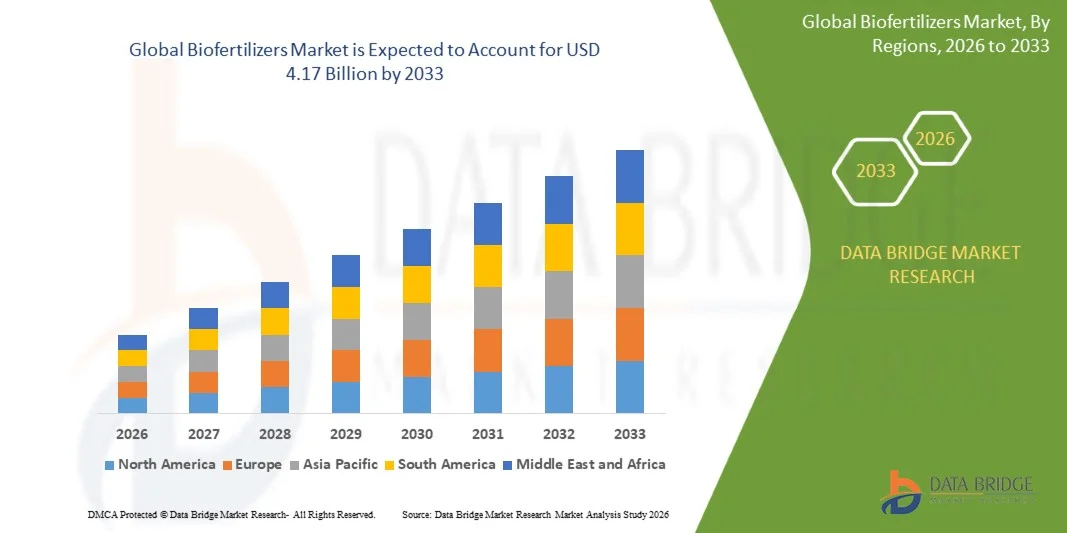
As per Data Bridge Market Research Analysis the Biofertilizers Market was valued at USD 1.60 billion in 2025 and is projected to reach USD 4.17 billion by 2033, growing at a CAGR of 12.74% from 2026 to 2033. The Biofertilizers Market is experiencing consistent growth driven by rising demand for sustainable agriculture practices, increasing adoption of organic farming methods, growing awareness regarding soil health improvement, and the need to reduce dependency on chemical fertilizers.
The increasing focus on environmental sustainability, declining soil fertility due to excessive use of synthetic fertilizers, and stringent regulations promoting eco-friendly agricultural inputs are encouraging farmers and agribusinesses to adopt biofertilizer solutions. Microbial-based fertilizers such as nitrogen-fixing, phosphate-solubilizing, and potassium-mobilizing biofertilizers are gaining popularity due to their ability to enhance nutrient availability, improve crop productivity, and support long-term soil quality. In addition, government initiatives supporting organic farming, rising demand for chemical-free food products, and expanding agricultural activities across emerging markets are further accelerating the adoption of biofertilizers globally.
Market Size & Forecast
- Global Market Value (2025): USD 1.60 Billion
- Expected Market Value (2033): USD 4.17 Billion
- Forecast CAGR (2026–2033): 12.74%
- Leading Region in 2025: North America
- Fastest Growing Region: Asia-Pacific
Key Market Trends & Insights
- North America dominated the Biofertilizers Market with the largest revenue share of 34.1% in 2025, supported by increasing adoption of sustainable farming practices, strong government initiatives promoting organic agriculture, rising demand for chemical-free crop production, and the presence of advanced agricultural research and biotechnology companies. The region benefits from growing use of microbial-based fertilizers across large-scale farming operations, increasing awareness regarding soil health improvement, and rising demand for environmentally friendly agricultural inputs.
- The carrier enriched biofertilizers segment dominated the market with a 54.7% share in 2025, due to its long shelf life, cost-effectiveness, and widespread availability among farmers.
- Asia-Pacific is expected to be the fastest-growing regional market, registering a CAGR of 9.1% from 2026 to 2033, fueled by rising agricultural production, increasing government support for sustainable farming, growing awareness regarding soil degradation, expanding organic farming practices, and rising adoption of biofertilizers across China, India, and Japan.
- The liquid biofertilizers segment is witnessing the fastest growth among technology types, supported by longer shelf life, easier application methods, improved microbial survival rates, and increasing preference among farmers for efficient and convenient biofertilizer solutions.
Report Scope and Biofertilizers Market Segmentation
|
Attributes |
Biofertilizers Key Market Insights |
|
Segments Covered |
|
|
Countries Covered |
North America
Europe
Asia-Pacific
Middle East and Africa
South America
|
|
Key Market Players |
|
|
Market Opportunities |
|
|
Value Added Data Infosets |
In addition to the insights on market scenarios such as market value, growth rate, segmentation, geographical coverage, and major players, the market reports curated by the Data Bridge Market Research also include in-depth expert analysis, geographically represented company-wise production and capacity, network layouts of distributors and partners, detailed and updated price trend analysis and deficit analysis of supply chain and demand. |
What is the Key Trend in the Biofertilizers Market?
Trend: Rising Adoption of Biofertilizers in Sustainable and Regenerative Agriculture
The Biofertilizers Market is witnessing strong growth due to increasing adoption of sustainable farming practices and rising concerns over soil degradation caused by excessive use of chemical fertilizers. Farmers are increasingly shifting toward microbial-based inputs such as nitrogen-fixing and phosphate-solubilizing bacteria to improve soil fertility and enhance crop productivity. Governments across major agricultural economies are promoting organic and residue-free farming through subsidies and policy support, further accelerating adoption. For instance, large-scale farming regions in India, Brazil, and parts of Europe are increasingly integrating biofertilizers into cereal, pulse, and horticulture crop production to reduce dependency on synthetic fertilizers and improve long-term soil health.
Biofertilizers Market Dynamics
Key Market Driver: Rising Demand for Organic Farming and Soil Health Improvement Solutions
The increasing global demand for organic food and sustainable agriculture is a major driver for the biofertilizers market. Farmers are adopting microbial inoculants such as Rhizobium, Azotobacter, and mycorrhiza to naturally enhance nitrogen fixation, phosphorus availability, and overall soil nutrient balance. According to agricultural studies, biofertilizer usage can significantly reduce chemical fertilizer dependency while improving crop yield quality. Governments in countries like India have expanded national organic farming missions and subsidy programs to encourage biofertilizer adoption among small and large-scale farmers. Additionally, growing consumer preference for chemical-free food products is pushing agricultural producers to adopt environmentally friendly farming inputs.
Key Restraint/Challenge: Limited Awareness and Short Shelf Life of Microbial Products
A major challenge in the Biofertilizers Market is the limited awareness among farmers in developing regions regarding the correct application and benefits of microbial fertilizers. Improper storage conditions and lack of technical knowledge can reduce product effectiveness, limiting adoption. In addition, biofertilizers have relatively shorter shelf life compared to chemical fertilizers, requiring controlled storage and transportation conditions. This creates logistical challenges, especially in rural and remote agricultural areas with limited cold chain infrastructure. Variability in soil conditions and crop compatibility also affects consistent performance, making farmer education and product standardization critical for market expansion.
Key Market Opportunity: Expansion of Organic Farming and Precision Agriculture Technologies
The integration of biofertilizers with precision agriculture and smart farming technologies presents significant growth opportunities. Advanced soil testing, drone-based crop monitoring, and IoT-enabled agricultural systems are enabling farmers to apply biofertilizers more efficiently and at optimized dosages. This improves nutrient uptake and reduces waste, increasing overall farm productivity. For instance, in countries like India, large-scale adoption of biofertilizers in wheat, rice, and pulse cultivation has been supported by government-backed soil health card programs and organic farming initiatives. Similarly, in Europe, increasing demand for organic cereals and vegetables is encouraging farmers to use microbial fertilizers as part of regenerative agriculture practices. The rising shift toward sustainable food systems, carbon reduction goals in agriculture, and expansion of organic farming markets in Asia-Pacific and Latin America are expected to create strong long-term opportunities for biofertilizer manufacturers.
How is the Biofertilizers Market Segmented?
The Biofertilizers market is segmented on the basis of microorganism, technology type, application, type, and crop type.
By Microorganism
On the basis of microorganism, the Biofertilizers Market is segmented into Rhizobium, Azotobacter, Azospirillum, Blue-Green Algae, Phosphate Solubilizing Bacteria, Mycorrhiza, and other microorganisms. The Rhizobium segment dominated the market with a 32.5% share in 2025, owing to its extensive adoption in leguminous crops due to its ability to fix atmospheric nitrogen and improve soil fertility naturally. Rhizobium-based biofertilizers are widely used in soybean, pulses, and other nitrogen-demanding crops, reducing dependency on chemical fertilizers and improving crop productivity. Increasing demand for sustainable farming practices, organic agriculture, and soil health management is further strengthening the adoption of Rhizobium products globally. In addition, government initiatives promoting biological inputs and integrated nutrient management are supporting market growth.
The Phosphate Solubilizing Bacteria (PSB) segment is expected to witness the fastest growth at a CAGR of 11.2% from 2026 to 2033, driven by increasing awareness regarding phosphorus availability and nutrient efficiency in agricultural soils. PSB biofertilizers help convert insoluble phosphorus into forms easily absorbed by plants, improving crop yield and reducing chemical fertilizer usage. Rising adoption in intensive farming systems, organic farming practices, and sustainable crop production is accelerating demand for PSB-based solutions.
By Technology Type
On the basis of technology type, the Biofertilizers Market is segmented into Carrier Enriched Biofertilizers, Liquid Biofertilizers, and other technology types. The carrier enriched biofertilizers segment dominated the market with a 54.7% share in 2025, due to its long shelf life, cost-effectiveness, and widespread availability among farmers. Carrier-based formulations provide stable microbial support and are extensively used in traditional agricultural practices across developing and emerging markets. Their easy application methods and compatibility with different crops have contributed to strong adoption among small and medium-scale farmers. In addition, established production processes and distribution networks continue to support segment dominance.
The liquid biofertilizers segment is projected to register the fastest CAGR of 12.0% from 2026 to 2033, driven by increasing preference for advanced agricultural inputs with higher microbial concentration and improved application efficiency. Liquid formulations offer better shelf stability, easier storage, uniform application, and faster nutrient availability compared with traditional carrier-based products. The growing adoption of precision agriculture, modern farming techniques, and mechanized fertilizer application is further supporting demand for liquid biofertilizer technologies.
By Application
On the basis of application, the Biofertilizers Market is segmented into soil treatment, seed treatment, and others. The seed treatment segment dominated the market with a 46.8% share in 2025, owing to its cost efficiency, easy adoption, and ability to enhance early plant growth and nutrient absorption. Seed treatment with biofertilizers improves germination, strengthens root development, and protects crops during early growth stages. Increasing awareness among farmers regarding sustainable crop production and reduced chemical dependency is driving the use of biological seed treatment solutions. Additionally, agricultural extension programs and government support for eco-friendly farming practices are reinforcing market expansion.
The soil treatment segment is expected to witness the fastest CAGR of 11.5% from 2026 to 2033, driven by growing concerns regarding soil degradation, declining fertility, and excessive chemical fertilizer usage. Farmers are increasingly adopting soil-applied biofertilizers to restore microbial activity, improve nutrient availability, and enhance long-term soil productivity. The rising adoption of regenerative agriculture and organic farming systems is creating significant growth opportunities for soil treatment applications.
By Type
On the basis of type, the Biofertilizers Market is segmented into Nitrogen-Fixing Biofertilizers, Phosphate Solubilizing and Mobilizing Biofertilizers, Potash Solubilizing and Mobilizing Biofertilizers, and Others. The nitrogen-fixing biofertilizers segment dominated the market with a 48.6% share in 2025, supported by increasing demand for natural nitrogen sources to improve crop productivity and reduce dependence on synthetic fertilizers. These biofertilizers enhance nitrogen availability through microbial activity and are widely used in cereals, pulses, and oilseed crops. Growing environmental concerns associated with chemical fertilizer usage and increasing adoption of sustainable agriculture practices are strengthening segment growth.
The phosphate solubilizing and mobilizing biofertilizers segment is expected to register the fastest CAGR of 11.7% from 2026 to 2033, driven by increasing demand for efficient phosphorus management in agricultural production. These biofertilizers improve phosphorus absorption and help optimize fertilizer usage, making them valuable for high-yield farming systems. Rising focus on improving soil nutrient balance and enhancing crop output is expected to accelerate adoption during the forecast period.
By Crop Type
On the basis of crop type, the Biofertilizers Market is segmented into cereals and grains, oilseeds and pulses, fruits and vegetables, and other Crops. The cereals and grains segment dominated the market with a 39.4% share in 2025, due to large cultivation areas and high fertilizer requirements for crops such as wheat, rice, and maize. Biofertilizers are increasingly used in cereal production to improve nutrient efficiency, enhance soil quality, and maintain sustainable productivity. Growing global demand for food security, increasing cereal production, and government initiatives promoting sustainable farming practices are supporting segment growth.
The fruits and vegetables segment is projected to witness the fastest CAGR of 12.3% from 2026 to 2033, driven by rising consumer demand for organic, residue-free, and sustainably produced food products. Farmers producing high-value horticultural crops are increasingly adopting biofertilizers to improve quality, yield, and soil health. Expanding organic farming practices, increasing exports of fresh produce, and growing awareness regarding chemical-free agriculture are creating strong opportunities for biofertilizer adoption in fruit and vegetable cultivation.
Which Region Holds the Largest Share of the Biofertilizers Market?
North America dominated the Biofertilizers Market and accounted for the largest revenue share of 34.1% in 2025, supported by increasing adoption of sustainable farming practices, strong government initiatives promoting organic agriculture, rising demand for chemical-free crop production, and the presence of advanced agricultural research and biotechnology companies. The region benefits from growing use of microbial-based fertilizers across large-scale farming operations, increasing awareness regarding soil health improvement, and rising demand for environmentally friendly agricultural inputs. Expanding organic farming activities, advanced agricultural technologies, and increasing focus on reducing chemical fertilizer dependency continue to strengthen North America’s leading position in the global market.
U.S. Biofertilizers Market Insight
The U.S. biofertilizers market is witnessing strong growth due to rising adoption of sustainable agriculture practices, increasing demand for organic food products, and growing focus on improving soil fertility. The country’s advanced agricultural sector, strong presence of biotechnology companies, and increasing investments in microbial-based agricultural solutions are driving market expansion. In addition, government support for regenerative farming practices and increasing use of biofertilizers in cereals, grains, and specialty crops are accelerating adoption across commercial farming operations.
Europe Biofertilizers Market Insight
The Europe biofertilizers market remains a major contributor to global revenue, driven by strong environmental regulations, increasing organic farming practices, and rising demand for sustainable agricultural inputs. The region benefits from government initiatives supporting reduced chemical fertilizer usage, improved soil health management, and environmentally responsible farming methods. Increasing adoption of nitrogen-fixing and phosphate-solubilizing biofertilizers across crop production, along with growing consumer preference for organic food products, continues to support market growth across Europe.
U.K. Biofertilizers Market Insight
The U.K. biofertilizers market is experiencing steady growth, supported by increasing awareness regarding sustainable farming, rising demand for organic produce, and growing adoption of biological crop inputs. Farmers are increasingly utilizing microbial-based fertilizers to improve nutrient availability and reduce environmental impact. Furthermore, government efforts toward sustainable agriculture and soil health improvement are encouraging greater adoption of biofertilizer solutions across agricultural applications.
Germany Biofertilizers Market Insight
The Germany biofertilizers market is expanding steadily due to the country’s strong agricultural research capabilities, focus on sustainable farming, and increasing adoption of environmentally friendly crop inputs. Farmers and agricultural companies are increasingly incorporating microbial fertilizers to enhance soil quality, improve nutrient efficiency, and support organic crop production. Continuous innovation in agricultural biotechnology and strong emphasis on reducing synthetic fertilizer usage are further driving market growth in Germany.
Asia-Pacific Biofertilizers Market Insight
The Asia-Pacific biofertilizers market is expected to witness rapid growth, registering a CAGR of 9.1% from 2026 to 2033, fueled by rising agricultural production, increasing government support for sustainable farming, growing awareness regarding soil degradation, expanding organic farming practices, and rising adoption of biofertilizers across China, India, and Japan. The region is experiencing increasing demand for microbial-based fertilizers due to the need to improve crop productivity, restore soil fertility, and reduce dependence on chemical fertilizers. Expansion of agricultural biotechnology, government-backed organic farming programs, and rising food demand are further accelerating regional market growth.
Japan Biofertilizers Market Insight
The Japan biofertilizers market is witnessing consistent growth due to increasing focus on sustainable agriculture, advanced farming technologies, and rising demand for high-quality agricultural products. Japanese farmers are adopting microbial fertilizers to improve soil health, optimize nutrient management, and support environmentally sustainable crop production. In addition, the country’s emphasis on agricultural innovation and precision farming is contributing to the growing adoption of biofertilizer solutions.
China Biofertilizers Market Insight
The China biofertilizers market is growing rapidly, driven by increasing agricultural production, rising government initiatives supporting sustainable farming, and growing concerns regarding soil degradation caused by excessive chemical fertilizer use. The country is witnessing greater adoption of nitrogen-fixing, phosphate-solubilizing, and other microbial-based fertilizers across major crops. Increasing investments in agricultural biotechnology, organic farming expansion, and the need for improved crop productivity are positioning China as one of the fastest-growing markets for biofertilizers globally.
Which are the Top Companies in Biofertilizers Market?
The biofertilizers industry is primarily led by well-established companies, including:
- Novozymes A/S (Denmark)
- BASF SE (Germany)
- UPL Limited (India)
- National Fertilizers Limited (India)
- Rizobacter Argentina S.A. (Argentina)
- T. Stanes & Company Limited (India)
- Madras Fertilizers Limited (India)
- Symborg (Spain)
- Lallemand Inc. (Canada)
- Koppert Biological Systems (Netherlands)
- IPL Biologicals Limited (India)
- Camson Bio Technologies Limited (India)
- Aumgene Biosciences (India)
- AgriLife (India)
- Coromandel International Limited (India)
- IPL Biologicals Pvt. Ltd. (India)
- Bayer AG (Germany)
- Syngenta AG (Switzerland)
- Valent BioSciences LLC (U.S.)
- Gujarat State Fertilizers & Chemicals Ltd. (India)
- BioWorks Inc. (U.S.)
- Fertilizers and Chemicals Travancore Ltd. (India)
- Hikal Ltd. (India)
- Mapleton Agri Biotech (India)
- Vegalab SA (Spain)
- Tradecorp International (Spain)
- Agrinos AS (Norway)
- Biofa GmbH (Germany)
- Rovensa Next (Portugal)
- Mitsui & Co. AgriScience (Japan)
- Sumitomo Chemical Co., Ltd. (Japan)
What are Latest Developments in Biofertilizers Market?
- In February 2021, Novozymes announced its entry into the agricultural biocontrol segment with new enzyme-based biological solutions, expanding beyond its existing microbial-based BioAg portfolio. The company highlighted the development of sustainable agricultural solutions designed to reduce dependence on chemical inputs and improve crop protection through biological technologies. This development strengthened the role of biotechnology-driven solutions in sustainable agriculture and supported the broader growth of the global biofertilizers and agricultural biologicals market
- In September 2021, Novozymes launched a new portfolio of BioAg solutions for North American growers, introducing biological products aimed at improving nutrient availability, nitrogen fixation, fertility, and crop performance. The company expanded its agricultural biological offerings by utilizing beneficial soil microbes and biological active ingredients to support sustainable farming practices. This launch reflected increasing demand for microbial-based agricultural inputs that improve soil health and reduce reliance on conventional fertilizers
- In March 2024, Bioiberica launched Terra-Sorb® SymBiotic, a probiotic biostimulant designed to optimize fertilization efficiency by combining microbial technology with plant nutrition benefits. The product incorporated Bioiberica’s Priming Tech™ technology and Bacillus velezensis PH023 strain to support soil fertility, nutrient absorption, and plant development. This launch highlighted the growing industry focus on advanced microbial formulations that combine biofertilization and biostimulation benefits
- In May 2024, Fresh Del Monte Produce Inc. partnered with Vellsam Materias Bioactivas to develop biofertilizers from pineapple processing residues through a new production facility in Kenya. The initiative focused on converting agricultural waste into biological fertilizer products, supporting circular economy practices and sustainable nutrient management. This development demonstrated the increasing adoption of waste-derived biofertilizer solutions to improve agricultural sustainability
- In July 2024, Rovensa Next launched Wiibio, a soil-regenerating biofertilizer with biostimulant properties designed to improve soil health and plant development. The product was based on a selected Bacillus subtilis strain combined with organic matter and plant-supporting components to enhance microbial diversity and nutrient efficiency. The launch reflected the growing trend toward regenerative agriculture and biological solutions for improving soil productivity
- In July 2024, EnviroKure launched PhylloZone, an advanced foliar biofertilizer product designed to enhance plant health by improving microbial activity on the plant surface. The product contained beneficial microorganisms including Azospirillum and Bacillus species to support nitrogen fixation, plant growth, and crop performance. This launch reinforced the increasing adoption of microbial consortia-based biofertilizers for improving crop productivity and resilience
- In September 2024, KRIBHCO introduced Rhizosuper, a mycorrhizal biofertilizer solution developed with Novonesis technology, aimed at improving nutrient utilization and supporting farmers with sustainable crop solutions. The product was introduced to address challenges related to soil fertility, nutrient efficiency, and sustainable agricultural productivity, particularly among Indian farmers. This development highlighted the increasing adoption of advanced microbial biofertilizers in emerging agricultural markets
- In October 2024, MAFA Bioscience launched ASPERBIO, a microbial biofertilizer based on Aspergillus niger strain EEZ-93, across European markets including Spain, Italy, Germany, Portugal, Austria, and Bulgaria. The product was designed to improve plant stress tolerance, enhance soil microbial activity, and support nutrient efficiency through natural biological processes. This launch reflected continued innovation in microbial-based biofertilizer products targeting sustainable crop production
- In November 2024, Enhanced Nature announced the launch of its AMF (arbuscular mycorrhizal fungi) bionutrient supply operations, expanding availability of mycorrhizal-based agricultural biological products worldwide. The company focused on supplying concentrated AMF solutions to support plant nutrient uptake, soil health improvement, and sustainable farming practices. This development highlighted the increasing commercial importance of mycorrhizal biofertilizers in modern agriculture
- In January 2025, Kula Bio continued expanding commercialization activities for Kula-N, a nitrogen-fixing biofertilizer solution, by strengthening field technology and research capabilities. The company focused on advancing biological nitrogen solutions designed to improve nutrient availability while reducing dependence on synthetic nitrogen fertilizers. This development reflects the growing investment in next-generation biofertilizers aimed at sustainable crop production

- Interactive Data Analysis Dashboard
- Company Analysis Dashboard for high growth potential opportunities
- Research Analyst Access for customization & queries
- Competitor Analysis with Interactive dashboard
- Latest News, Updates & Trend analysis
- Harness the Power of Benchmark Analysis for Comprehensive Competitor Tracking
Data collection and base year analysis are done using data collection modules with large sample sizes. The stage includes obtaining market information or related data through various sources and strategies. It includes examining and planning all the data acquired from the past in advance. It likewise envelops the examination of information inconsistencies seen across different information sources. The market data is analysed and estimated using market statistical and coherent models. Also, market share analysis and key trend analysis are the major success factors in the market report. To know more, please request an analyst call or drop down your inquiry.
The key research methodology used by DBMR research team is data triangulation which involves data mining, analysis of the impact of data variables on the market and primary (industry expert) validation. Data models include Vendor Positioning Grid, Market Time Line Analysis, Market Overview and Guide, Company Positioning Grid, Patent Analysis, Pricing Analysis, Company Market Share Analysis, Standards of Measurement, Global versus Regional and Vendor Share Analysis. To know more about the research methodology, drop in an inquiry to speak to our industry experts.
Data Bridge Market Research is a leader in advanced formative research. We take pride in servicing our existing and new customers with data and analysis that match and suits their goal. The report can be customized to include price trend analysis of target brands understanding the market for additional countries (ask for the list of countries), clinical trial results data, literature review, refurbished market and product base analysis. Market analysis of target competitors can be analyzed from technology-based analysis to market portfolio strategies. We can add as many competitors that you require data about in the format and data style you are looking for. Our team of analysts can also provide you data in crude raw excel files pivot tables (Fact book) or can assist you in creating presentations from the data sets available in the report.