


Global Biohybrid Robotics For Medical Applications Market Size
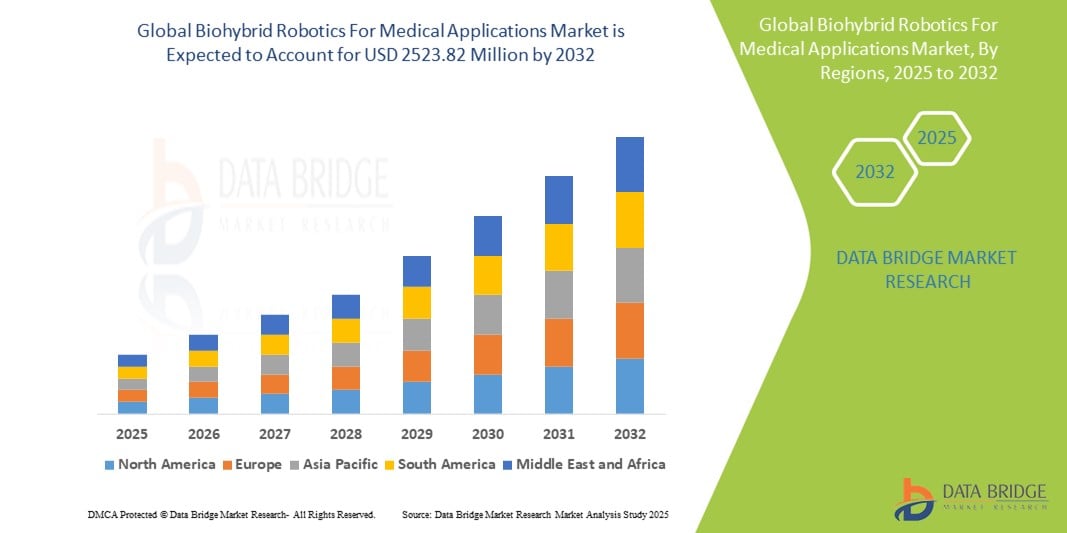
- The global biohybrid robotics for medical applications market size was valued at USD 317.1 million in 2024 and is expected to reach USD 2,523.82 million by 2032, at a CAGR of 29.60% during the forecast period
- The market growth for biohybrid robotics for medical applications is largely fueled by the rapid advancements in biotechnology, material science, and micro-robotics, leading to the development of novel solutions for complex medical challenges and promoting the integration of biological components with synthetic systems in various healthcare settings
- Furthermore, rising demand for highly precise, minimally invasive, and adaptive medical interventions, particularly in targeted drug delivery, regenerative medicine, and advanced prosthetics, is establishing biohybrid robots as a cutting-edge approach to addressing unmet clinical needs. These converging factors are accelerating the uptake of biohybrid robotics for medical applications solutions, thereby significantly boosting the industry's growth
Global Biohybrid Robotics For Medical Applications Market Analysis
- Biohybrid robotics, integrating living biological components with synthetic materials and robotic mechanisms, are increasingly vital for advanced medical interventions and therapeutic applications, offering unprecedented capabilities for precise, adaptive, and autonomous functions within the body
- The escalating demand for biohybrid robots is primarily fueled by groundbreaking advancements in cellular engineering and microfabrication techniques, growing interest in personalized medicine, and a rising imperative for highly targeted and minimally invasive treatments
- North America leads the global biohybrid robotics for medical applications market with a share of 41.8%, driven by the global research and development funding and a high concentration of innovative biotech and robotics firms, characterized by robust investment in cutting-edge medical technologies and a strong academic-industrial collaboration
- Asia-Pacific is expected to be the fastest growing region in the global biohybrid robotics for medical applications market with a CAGR of 25.4% during the forecast period due to increasing government support for biotechnology research, rising healthcare expenditure, and a rapidly expanding pool of scientific talent in countries such as China and South Korea
- Drug delivery systems application segment dominates the global biohybrid robotics for medical applications market with a market share of 32.8%, driven by the critical need for highly targeted and efficient delivery of therapeutics to specific disease sites, such as tumors.
Report Scope and Global Biohybrid Robotics For Medical Applications Market Segmentation
|
Attributes |
Biohybrid Robotics For Medical Applications Key Market Insights |
|
Segments Covered |
|
|
Countries Covered |
North America
Europe
Asia-Pacific
Middle East and Africa
South America
|
|
Key Market Players |
|
|
Market Opportunities |
|
|
Value Added Data Infosets |
In addition to the insights on market scenarios such as market value, growth rate, segmentation, geographical coverage, and major players, the market reports curated by the Data Bridge Market Research also include in-depth expert analysis, pricing analysis, brand share analysis, consumer survey, demography analysis, supply chain analysis, value chain analysis, raw material/consumables overview, vendor selection criteria, PESTLE Analysis, Porter Analysis, and regulatory framework. |
Global Biohybrid Robotics For Medical Applications Market Trends
“Increasing Focus on Developing Biohybrid Robots for Targeted Drug Delivery”
- A significant and accelerating trend in the global biohybrid robotics for medical applications market is the increasing focus on developing biohybrid robots for targeted drug delivery and therapeutic interventions at the cellular and tissue levels. This trend is driven by the potential of these robots to offer minimally invasive, precise, and localized treatments, enhancing efficacy and reducing side effects compared to traditional methods
- For instance, researchers are actively developing micro- and nano-scale biohybrid robots that can be guided to specific locations within the body to deliver drugs directly to cancerous tumors or infected tissues. These robots often utilize biological components, such as bacteria or cells, for propulsion and targeting, combined with synthetic materials for structural support or drug encapsulation
- The integration of advanced imaging techniques, such as MRI or ultrasound, with these biohybrid systems allows for real-time tracking and navigation, ensuring accurate delivery of the therapeutic payload. For instance, magnetically guided biohybrid microrobots carrying anti-cancer drugs can be steered through the bloodstream to reach a tumor site with high precision, releasing the drug locally and minimizing systemic exposure
- Furthermore, there's a growing interest in using biohybrid robots for active therapeutic interventions beyond drug delivery. This includes applications such as clearing arterial blockages, performing minimally invasive biopsies, or even assisting in tissue regeneration by delivering growth factors or scaffolding materials directly to the targeted area
- The global biohybrid robotics for medical applications market is in a nascent but rapidly evolving stage. While specific market trend reports in the format you requested are limited, the increasing focus on targeted drug delivery and therapeutic interventions at the micro and nano scales is a clearly emerging and significant trend. The potential for these technologies to revolutionize treatment modalities is driving significant research and development efforts
Global Biohybrid Robotics For Medical Applications Market Dynamics
Driver
“Propelling Growth Due to Unmet Medical Needs and Converging Technologies”
- The increasing prevalence of complex and chronic diseases for which traditional treatments are insufficient, coupled with accelerating advancements in biotechnology, robotics, and material science, is a significant driver for the heightened demand for biohybrid robotics in medical applications
- For instance, continuous breakthroughs in cellular engineering, micro-robotics, and biocompatible materials are enabling the creation of systems with unprecedented capabilities, such as self-propulsion and adaptive behavior within the human body
- As healthcare professionals become more aware of the potential for highly precise, targeted, and less invasive interventions, biohybrid robots offer advanced features such as autonomous drug delivery, targeted diagnostics, and regenerative capabilities, providing a compelling upgrade over conventional medical devices
- Furthermore, the growing sophistication of medical imaging, biological sensing, and robotic platforms is making biohybrid robots an integral component of integrated therapeutic environments, offering seamless interaction with real-time patient data and other medical systems
- The promise of enhanced therapeutic efficacy, reduced patient recovery times, and the potential for in-situ repair are key factors propelling the adoption of biohybrid robotics in both research and clinical settings. The trend towards personalized medicine and the increasing investment in breakthrough medical technologies further contribute to market growth
Restraint/Challenge
“Concerns Regarding Ethical Implications, Regulatory Hurdles, and High Development Costs”
- Concerns surrounding the complex ethical considerations of integrating living biological components with machines, alongside the significant regulatory hurdles for novel medical devices, pose a substantial challenge to broader market penetration. As biohybrid robots interact directly with living systems, they raise anxieties among potential stakeholders about long-term biocompatibility, unpredictable biological responses, and the fundamental definition of life
- For instance, the inherent unpredictability and variability of biological components, coupled with the stringent safety and efficacy requirements for medical devices, necessitate extensive and costly preclinical validation and protracted clinical trial pathways, hindering rapid market entry
- Addressing these ethical and regulatory concerns through transparent research practices, robust standardized testing protocols, and clear regulatory guidelines is crucial for building public and clinical trust. Companies and research consortia are emphasizing their adherence to strict ethical frameworks and rigorous safety testing to reassure potential adopters.
- In addition, the relatively high research and development (R&D) costs of some advanced Biohybrid Robotics for Medical Applications systems, due to their interdisciplinary nature and complexity, can be a barrier to innovation and commercialization for smaller entities. While initial research funding is growing, scaling production and navigating clinical trials demand significant capital
- While the potential benefits are immense, the nascent stage of the technology and the perceived premium for such cutting-edge solutions can still hinder widespread adoption, especially for those who prioritize immediate and proven clinical solutions over long-term transformative potential
Global Biohybrid Robotics For Medical Applications Market Scope
The market is segmented on the basis of type, biomaterial used, size scale, operating environment, powering source, application, and end-user.
- By Type
On the basis of type, the global biohybrid robotics for medical applications market is segmented into fully biohybrid robots, semi-biohybrid robots, hybridized soft robots, muscle-driven biohybrids, neuron-driven biohybrids, and others. The muscle-driven biohybrids segment held the largest market revenue share in 2024, driven by significant research focus on utilizing biological muscle tissue for actuation due to its potential for self-healing and adaptive movement. Researchers often prioritize muscle-driven systems for their biomimetic characteristics and straightforward demonstration of hybrid functionality.
The hybridized soft robots segment is anticipated to witness rapid growth during the forecast period, fueled by increasing adoption of soft robotics principles in medical devices due to their inherent flexibility and biocompatibility, making them suitable for navigating delicate biological environments. Their integration with biological components provides highly adaptive and safe solutions for internal medical applications.
- By Biomaterial Used
On the basis of biomaterial used, the global biohybrid robotics for medical applications market is segmented into natural biomaterials, synthetic biomaterials, and others. The natural biomaterials segment held the largest market revenue share in 2024, driven by the fundamental definition of biohybrid robotics—the integration of living biological components. These materials are essential for conferring biomimetic functionality such as sensing, actuation, and even self-repair.
The synthetic biomaterials segment is expected to witness substantial growth during the forecast period, driven by their increasing sophistication in mimicking biological scaffolds and providing stable interfaces for living cells. These materials are crucial for constructing the robotic framework, providing structural support, and enabling precise control over integrated biological elements, making them ideal for developing durable and functional biohybrid devices.
- By Size Scale
On the basis of size scale, the global biohybrid robotics for medical applications market is segmented into nanoscale biohybrid robots, microscale biohybrid robots, milliscale biohybrid robots, macroscale biohybrid robots, and others. The microscale biohybrid robots segment held the largest market revenue share in 2024, driven by the critical need for agents capable of navigating within the human body for targeted interventions. These robots are often prioritized for their potential in targeted drug delivery, minimally invasive diagnostics, and cellular-level manipulation.
The nanoscale biohybrid robots segment is anticipated to witness rapid growth during the forecast period, fueled by increasing research into ultra-precise medical interventions at the cellular and molecular level. These tiny robots offer the ultimate potential for highly localized diagnostics, gene therapy delivery, and intracellular manipulation, pushing the boundaries of medical treatment and significantly advancing the field.
- By Operating Environment
On the basis of operating environment, the global biohybrid robotics for medical applications market is segmented into in-vivo applications, aqueous environment, terrestrial environment, aerial environment, laboratory settings, industrial settings, and others. The in-vivo applications segment held the largest market revenue share in 2024, driven by its critical role in preclinical and clinical research for evaluating the safety and efficacy of new medical treatments. In-vivo studies provide comprehensive insights into biological processes within living organisms, offering data that in-vitro models cannot replicate.
The laboratory settings segment is expected to witness significant growth alongside in-vivo applications, as robust laboratory-based research and testing are critical for the development and validation of biohybrid robots before clinical translation. The continuous need for controlled environments to study biological interactions and robot performance fuels investment in this area.
- By Powering Source
On the basis of powering source, the global biohybrid robotics for medical applications market is segmented into ATP-based systems, chemical energy harvesting, external power supply, glucose-powered, hybrid power systems, solar-powered, and others. The ATP-based systems segment held the largest market revenue share in 2024, as it represents the most natural and biomimetic way to power biological components within biohybrid robots, drawing energy directly from living cells. This method is crucial for achieving true autonomy and long-term operation within biological systems.
The hybrid power systems segment is anticipated to witness substantial growth during the forecast period, fueled by the pragmatic need for versatile and reliable energy sources for biohybrid robots, especially as they move toward more complex tasks and diverse environments. Combining biological power generation with external or chemical sources offers robustness and extended operational capabilities.
- By Application
On the basis of application, the Global biohybrid robotics for medical applications market is segmented into drug delivery systems, prosthetics, rehabilitation devices, surgical assistance, tissue engineering, biosensing/imaging, diagnostics, and others. Drug delivery systems application segment held the largest market revenue share in 2024, with a market share of 32.8%, driven by the critical need for highly targeted and efficient delivery of therapeutics to specific disease sites, minimizing systemic side effects. Biohybrid robots offer unprecedented accuracy in navigating complex biological pathways for this purpose.
The tissue engineering segment is expected to witness significant growth during the forecast period, fueled by the increasing demand for regenerative medicine and the ability of biohybrid robots to precisely manipulate cells and scaffolds to create or repair tissues. Their capability for fine-scale construction and interaction with living cells makes them ideal for advancing this field.
- By End-User
On the basis of end-user, the global biohybrid robotics for medical applications market is segmented into healthcare facilities, pharmaceutical companies, research institutions, educational institutions, and others. The Research Institutions segment c held the largest market revenue share in 2024, driven by the foundational and exploratory nature of biohybrid robotics development. Universities and dedicated research labs are at the forefront of breakthroughs in this interdisciplinary field.
The pharmaceutical companies segment is expected to witness substantial growth during the forecast period, fueled by their increasing interest in leveraging biohybrid robotics for novel drug discovery, high-throughput screening, and highly efficient targeted drug delivery systems. The potential for these robots to revolutionize preclinical testing and therapeutic administration drives their investment in this emerging technology.
Global Biohybrid Robotics For Medical Applications Market Regional Analysis
- North America holds a leading position in the global biohybrid robotics for medical applications market with the largest revenue share of 41.8% in 2024. This dominance is driven by robust investments in research and development, a strong presence of leading academic institutions and biotech companies, and advanced healthcare infrastructure
- Researchers and medical innovators in the region highly value the potential for breakthroughs in personalized medicine, targeted therapies, and regenerative solutions offered by biohybrid robotics. This is supported by substantial funding from both government grants and private venture capital
- This widespread adoption is further supported by a technologically sophisticated ecosystem, a high concentration of skilled scientific talent, and the growing demand for cutting-edge medical technologies, establishing biohybrid robotics as a favored solution for addressing complex clinical challenges and pushing the boundaries of medical science
U.S. Biohybrid Robotics For Medical Applications Market Insight
The U.S. biohybrid robotics for medical applications market captured the largest revenue share of 75.1% due to substantial government and private funding in biotechnology and advanced robotics, coupled with a robust ecosystem of leading research institutions and pharmaceutical companies. This leadership is further bolstered by the rapid adoption of advanced medical technologies in a well-established healthcare system. The growing preference for precision medicine and minimally invasive interventions, combined with strong venture capital investment and a high concentration of skilled scientific talent, further propels the biohybrid robotics industry.
Europe biohybrid robotics for medical applications market Insight
The Europe biohybrid robotics for medical applications market is projected to expand at a substantial CAGR, throughout the forecast period (similar to broader medical robotics growth in Europe), primarily driven by strong governmental support for scientific research through initiatives such as Horizon Europe, and a growing emphasis on advanced healthcare solutions for an aging population. The increase in interdisciplinary research collaborations, coupled with a demand for innovative therapeutic and diagnostic tools, is fostering the adoption of biohybrid robotics. European nations are also drawn to the potential for personalized medicine and highly precise interventions these devices offer. The region is experiencing significant growth across research, clinical trial, and early commercialization applications, with biohybrid solutions being explored in both novel treatments and the enhancement of existing medical procedures.
U.K. Biohybrid Robotics For Medical Applications Market Insight
The U.K. biohybrid robotics for medical applications market is anticipated to grow at a noteworthy CAGR, during the forecast period (aligned with overall UK medical robotics market growth), driven by a thriving academic research sector and increasing public and private investment in life sciences and robotics. Additionally, the National Health Service (NHS)'s drive for efficiency and improved patient outcomes is encouraging the exploration of advanced medical technologies. The U.K.’s strong focus on scientific innovation, alongside its robust regulatory frameworks for medical devices, is expected to continue to stimulate market growth in this niche yet promising field.
Germany Biohybrid Robotics For Medical Applications Market Insight
The Germany biohybrid robotics for medical applications market is expected to expand at a considerable CAGR during the forecast period, fueled by increasing awareness of advanced medical solutions and a strong demand for technologically sophisticated and high-quality medical devices. Germany’s well-developed engineering and manufacturing infrastructure, combined with its emphasis on precision and rigorous testing, promotes the development and adoption of biohybrid robotics, particularly in surgical assistance and complex diagnostics. The integration of biohybrid research with leading medical technology companies is also becoming increasingly prevalent, with a strong preference for secure and reliable solutions aligning with local clinical expectations.
Asia-Pacific biohybrid robotics for medical applications market Insight
The Asia-Pacific biohybrid robotics for medical applications market is poised to grow at the fastest CAGR of 25.4% 2025 to 2032, driven by increasing healthcare expenditure, rising prevalence of chronic diseases, and rapid technological advancements in countries such as China, Japan, and India. The region's growing inclination towards advanced medical solutions, supported by government initiatives promoting biotech innovation and robotics, is driving the adoption of biohybrid robotics research. Furthermore, as APAC emerges as a manufacturing hub for high-tech components and systems, the potential for more affordable and accessible biohybrid solutions is expanding to a wider research and clinical base.
Japan biohybrid robotics for medical applications market Insight
The Japan biohybrid robotics for medical applications market is gaining momentum due to the country’s high-tech culture, significant investment in robotics, and an increasing demand for advanced healthcare solutions driven by an aging population. The Japanese market places a significant emphasis on precision and technological sophistication, and the adoption of biohybrid robotics is driven by the increasing number of smart healthcare initiatives and advanced medical facilities. The integration of biohybrid research with other cutting-edge technologies, such as AI and advanced materials science, is fueling growth. Moreover, Japan's aging population is likely to spur demand for more intuitive and effective regenerative and assistive biohybrid solutions in both research and clinical sectors.
China biohybrid robotics for medical applications market Insight
The China biohybrid robotics for medical applications market accounted for a leading market share within Asia Pacific, attributed to the country's massive investment in R&D, rapid technological advancement, and a large patient population with diverse healthcare needs. China stands as one of the largest markets for medical robotics and biotechnology, and biohybrid robotics is becoming an increasingly important area of focus in both academic research and strategic industrial development. The push towards smart hospitals and the availability of significant government funding for advanced medical technologies, alongside strong domestic manufacturers and research capabilities, are key factors propelling the market in China.
Global Biohybrid Robotics For Medical Applications Market Share
The biohybrid robotics for medical applications industry is primarily led by well-established companies, including:
- Intuitive Surgical (U.S.)
- Medtronic (Ireland)
- Johnson & Johnson Services, Inc. (U.S.)
- Stryker Corporation (U.S.)
- Zimmer Biomet (U.S.)
- PROCEPT BioRobotics Corporation (U.S.)
- Lifeward, Inc. (U.S.)
- Asensus Surgical, Inc. (U.S.)
- Festo AG (Germany)
- Boston Dynamics (U.S.)
- ABB (U.S.)
Latest Developments in Global global biohybrid robotics for medical applications market
- In April 2023, Johnson & Johnson MedTech (Ethicon) announced the launch of its innovative ENSEAL X1 Curved Jaw Tissue Sealer, designed to enhance precision and control in laparoscopic and open surgical procedures. This advancement, while not directly biohybrid, represents continuous innovation in surgical instrumentation crucial for highly precise medical interventions, a foundational aspect for future biohybrid systems
- In March 2023, Intuitive Surgical, Inc., a global leader in robotic-assisted surgery, announced the first cases performed with its da Vinci SP surgical system in specific thoracic procedures in Japan. This expansion highlights the continuous advancement and adoption of sophisticated robotic platforms in medical applications, which are often the deployment vehicles for future biohybrid components
- In March 2023, Medtronic plc continued to highlight the global expansion and clinical utilization of its Hugo Robotic-Assisted Surgery (RAS) system, with increasing installations and procedures worldwide. Medtronic's investments in robotic surgery platforms contribute to the infrastructure and technological base that could eventually integrate biohybrid elements for enhanced surgical capabilities
- In February 2023, Microbot Medical Inc., a company focused on robotic technologies for medical applications, announced progress in its clinical trials for the LIBERTY Robotic System, designed for neurovascular interventions. While not purely biohybrid, this demonstrates advancements in miniaturized robotics for navigating complex human anatomy, a key challenge also addressed by biohybrid approaches
- In January 2023, Stryker Corporation continued to report on the strong adoption of its Mako SmartRobotics system for orthopedic procedures, showcasing its expansion into new hospitals and increased procedural volumes. Stryker's continuous innovation in orthopedic robotics, including advancements in haptics and precision, lays groundwork for future integration with biological elements

- Interactive Data Analysis Dashboard
- Company Analysis Dashboard for high growth potential opportunities
- Research Analyst Access for customization & queries
- Competitor Analysis with Interactive dashboard
- Latest News, Updates & Trend analysis
- Harness the Power of Benchmark Analysis for Comprehensive Competitor Tracking
Data collection and base year analysis are done using data collection modules with large sample sizes. The stage includes obtaining market information or related data through various sources and strategies. It includes examining and planning all the data acquired from the past in advance. It likewise envelops the examination of information inconsistencies seen across different information sources. The market data is analysed and estimated using market statistical and coherent models. Also, market share analysis and key trend analysis are the major success factors in the market report. To know more, please request an analyst call or drop down your inquiry.
The key research methodology used by DBMR research team is data triangulation which involves data mining, analysis of the impact of data variables on the market and primary (industry expert) validation. Data models include Vendor Positioning Grid, Market Time Line Analysis, Market Overview and Guide, Company Positioning Grid, Patent Analysis, Pricing Analysis, Company Market Share Analysis, Standards of Measurement, Global versus Regional and Vendor Share Analysis. To know more about the research methodology, drop in an inquiry to speak to our industry experts.
Data Bridge Market Research is a leader in advanced formative research. We take pride in servicing our existing and new customers with data and analysis that match and suits their goal. The report can be customized to include price trend analysis of target brands understanding the market for additional countries (ask for the list of countries), clinical trial results data, literature review, refurbished market and product base analysis. Market analysis of target competitors can be analyzed from technology-based analysis to market portfolio strategies. We can add as many competitors that you require data about in the format and data style you are looking for. Our team of analysts can also provide you data in crude raw excel files pivot tables (Fact book) or can assist you in creating presentations from the data sets available in the report.













