


Biohybrid Solar Cell Market Overview
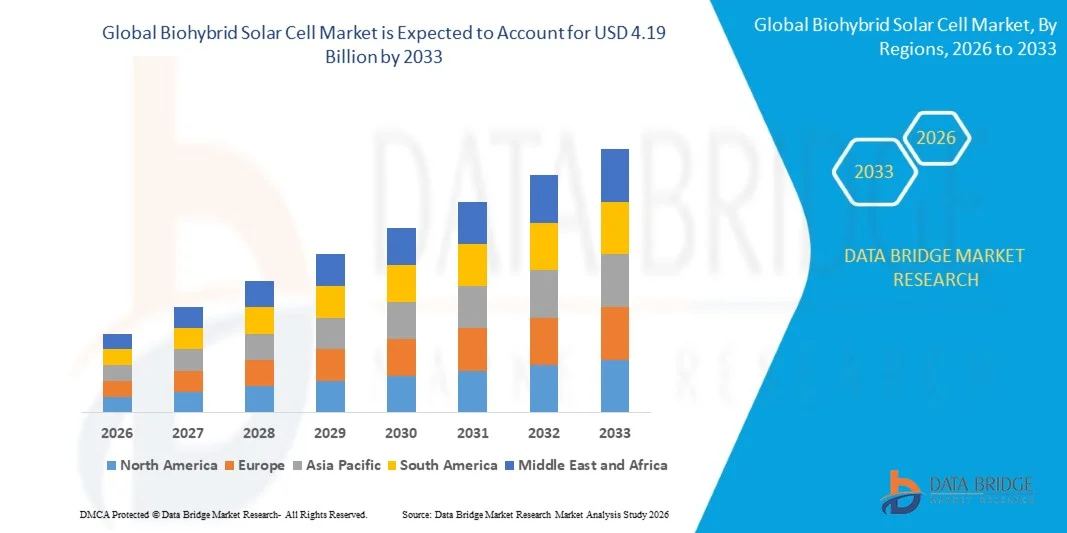
The biohybrid solar cell market was valued at USD 1.83 billion in 2025 and is projected to reach USD 4.19 billion by 2033, growing at a CAGR of 10.93% from 2026 to 2033. The biohybrid solar cell market is experiencing steady growth, driven by increasing demand for sustainable next-generation photovoltaic technologies, rapid advancements in bio-inspired energy conversion systems, and growing investments in renewable energy research. Continuous developments in photosynthetic proteins, biological photosystems, nanomaterials, and bioelectronic interfaces are enhancing solar energy conversion efficiency while supporting environmentally friendly photovoltaic solutions. Expanding research collaborations among universities, research institutes, and clean energy companies are further accelerating innovation and commercialization of biohybrid solar cell technologies.
The increasing emphasis on carbon neutrality, renewable energy deployment, and sustainable energy generation is encouraging researchers and technology developers to explore biohybrid solar cells as an alternative to conventional photovoltaic technologies. Advances in protein engineering, artificial photosynthesis, nanotechnology, and biomolecular electron transfer are improving device stability, light-harvesting efficiency, and overall photovoltaic performance. In addition, growing government funding for clean energy research and increasing investments in next-generation photovoltaic technologies are expected to accelerate the development and future commercialization of biohybrid solar cells.
Market Size & Forecast
- Market Value (2025): USD 1.83 Billion
- Expected Market Value (2033): USD 4.19 Billion
- Forecast CAGR (2026–2033): 10.93%
- Leading Region in 2025: Asia Pacific
- Fastest Growing Region: Europe
Key Market Trends & Insights
- Asia-Pacific dominated the biohybrid solar cell market with an estimated revenue share of 48.60% in 2025, supported by strong photovoltaic manufacturing capabilities, increasing investments in biohybrid and nanotechnology research, expanding renewable energy infrastructure, and significant government funding for advanced solar technologies across China, Japan, South Korea, and India.
- The silicon crystal segment dominated the market with 12% share in 2025 owing to its excellent compatibility with biohybrid photovoltaic architectures, established semiconductor manufacturing ecosystem, superior electrical properties, and widespread availability.
- Europe is expected to be the fastest-growing region, registering an estimated CAGR of 17.20% from 2026 to 2033, driven by increasing investments through Horizon Europe, expanding research on biohybrid photovoltaics and artificial photosynthesis, strong collaborations between academia and industry, and ambitious clean energy and carbon neutrality initiatives across the European Union.
- The military and aerospace segment is projected to register the fastest CAGR of 17.4% from 2026to 2033, driven by increasing demand for lightweight, high-efficiency, and highly reliable photovoltaic technologies for satellites, unmanned aerial vehicles (UAVs), remote defense installations, and space exploration missions.
- The commercial segment dominated the market with an estimated 36.84% share in 2025 due to increasing investments in next-generation renewable energy technologies and the growing adoption of sustainable photovoltaic systems across commercial buildings, research facilities, and industrial establishments.
Report Scope and Biohybrid Solar Cell Market Segmentation
|
Attributes |
Biohybrid Solar Cell Key Market Insights |
|
Segments Covered |
|
|
Countries Covered |
North America · U.S. · Canada · Mexico Europe · Germany · France · U.K. · Netherlands · Switzerland · Belgium · Russia · Italy · Spain · Turkey · Rest of Europe Asia-Pacific · China · Japan · India · South Korea · Singapore · Malaysia · Australia · Thailand · Indonesia · Philippines · Rest of Asia-Pacific Middle East and Africa · Saudi Arabia · U.A.E. · South Africa · Egypt · Israel · Rest of Middle East and Africa South America · Brazil · Argentina · Rest of South America |
|
Key Market Players |
· Mitsubishi Chemical Group Corporation (Japan) · National Renewable Energy Laboratory (U.S.) · Fraunhofer Institute for Solar Energy Systems ISE (Germany) · EPFL (École Polytechnique Fédérale de Lausanne) (Switzerland) · Helmholtz-Zentrum Berlin (Germany) · RIKEN (Japan) · Forschungszentrum Jülich (Germany) · Phycobloom (U.K.) · Solaronix SA |
|
Market Opportunities |
· Commercialization of Photosystem-Based High-Efficiency Photovoltaic Devices · Integration of Biomolecules into Advanced Solar Cell Architectures · Biohybrid Semiconductor Systems for Artificial Photosynthesis and Solar Fuel Production |
|
Value Added Data Infosets |
In addition to the insights on market scenarios such as market value, growth rate, segmentation, geographical coverage, and major players, the market reports curated by the Data Bridge Market Research also include in-depth expert analysis, geographically represented company-wise production and capacity, network layouts of distributors and partners, detailed and updated price trend analysis and deficit analysis of supply chain and demand. |
Biohybrid Solar Cell Market Trends
Trend: Increasing Research on Biohybrid Photosynthetic Solar Technologies
Research institutions and renewable energy developers are increasingly focusing on biohybrid solar cells that combine biological photosynthetic components, such as Photosystem I (PSI), Photosystem II (PSII), chlorophyll, and light-harvesting proteins, with semiconductor materials to improve solar energy conversion efficiency. Advances in protein engineering, nanomaterials, and bioelectronic interfaces are enhancing charge transfer, light absorption, and device stability. Growing collaborations between universities, government laboratories, and photovoltaic researchers are accelerating innovation, positioning biohybrid solar cells as a promising next-generation photovoltaic technology for sustainable energy production. For Instance, In June 2023, researchers at University of Cambridge reported advances in semi-artificial photosynthesis by integrating biological photosynthetic enzymes with synthetic light absorbers to convert sunlight, water, and carbon dioxide into sustainable fuels. The work demonstrated the potential of combining biological photosystems with engineered materials to improve solar energy conversion and inspired further research into biohybrid photovoltaic technologies. The convergence of synthetic biology, nanotechnology, and advanced photovoltaic engineering is accelerating innovation in biohybrid solar technologies. Continued research into biological light-harvesting systems is expected to improve device efficiency and long-term commercial viability, supporting the transition toward sustainable next-generation solar energy systems.
Biohybrid Solar Cell Market Dynamics
Key Market Driver: Growing Demand for High-Efficiency Sustainable Photovoltaic Technologies
The increasing emphasis on renewable energy generation and high-efficiency photovoltaic technologies is driving research and development in the biohybrid solar cell market. Conventional silicon photovoltaic technologies are approaching their practical efficiency limits, encouraging researchers to integrate biological light-harvesting complexes with semiconductor materials to improve photon utilization and charge separation. Continuous advancements in nanotechnology, bioelectronics, synthetic biology, and photovoltaic engineering, together with increasing government funding for clean energy research, are accelerating the development of biohybrid solar cells for future commercial deployment across utility-scale and specialty photovoltaic applications. According to the International Energy Agency, renewable electricity capacity additions reached 700 GW in 2024, with solar PV accounting for nearly 80% of new renewable capacity, highlighting the increasing demand for next-generation photovoltaic technologies. For instance, In January 2024, the U.S. Department of Energy announced new funding under its Solar Energy Technologies Office (SETO) to accelerate research on advanced photovoltaic materials and next-generation solar technologies, including bio-inspired and hybrid solar energy systems designed to improve efficiency and sustainability. Rising investments in advanced photovoltaic research, combined with renewable energy targets and continuous technological innovation, are expected to accelerate the development of biohybrid solar cells as a future high-efficiency clean energy solution.
Key Restraint/Challenge: Limited Stability and Complex Manufacturing of Biohybrid Devices
A significant restraint in the biohybrid solar cell market is the limited operational stability of biological materials and the complexity associated with large-scale manufacturing. Photosynthetic proteins and enzymes are highly sensitive to environmental conditions such as temperature, humidity, ultraviolet radiation, and oxidation, resulting in reduced device lifetime compared with conventional photovoltaic technologies. In addition, integrating biological molecules with semiconductor materials requires sophisticated fabrication techniques, increasing production costs and limiting commercial scalability. These technical challenges continue to restrict widespread industrial adoption despite significant laboratory-scale performance improvements. For instance, in March 2024, researchers from Helmholtz-Zentrum Berlin published research highlighting that improving long-term stability remains one of the major barriers to commercial deployment of bio-inspired photovoltaic systems because biological light-harvesting complexes degrade significantly under prolonged illumination and environmental stress. Although laboratory efficiencies continue to improve, enhancing the durability, scalability, and manufacturing consistency of biological photovoltaic components remains essential before large-scale commercialization becomes feasible.
Key Market Opportunity: Integration of Biohybrid Solar Cells with Artificial Photosynthesis and Next-Generation Photovoltaics
The integration of biohybrid solar cells with artificial photosynthesis, perovskite photovoltaics, and tandem solar cell architectures presents a significant long-term market opportunity. Researchers have demonstrated that biological light-harvesting systems can enhance photon absorption and improve charge transport when combined with advanced semiconductor materials. Increasing investments in sustainable hydrogen production, solar fuel generation, and next-generation photovoltaic technologies are expected to accelerate commercialization opportunities. As research advances in biomolecular engineering, nanofabrication, and hybrid photovoltaic systems continue, biohybrid solar cells are anticipated to play an important role in future high-efficiency, environmentally sustainable solar energy technologies. For instance, in July 2024, researchers from École Polytechnique Fédérale de Lausanne (EPFL) reported progress in integrating artificial photosynthesis technologies with advanced photovoltaic systems for solar fuel production, demonstrating how bio-inspired materials can improve light harvesting and energy conversion efficiency in next-generation solar energy platforms. The convergence of artificial photosynthesis, biomolecular engineering, and advanced photovoltaic materials is expected to create significant long-term opportunities for biohybrid solar cells, particularly in sustainable electricity generation, solar fuels, and hydrogen production. Continued public and private investment in these technologies is likely to accelerate their transition from laboratory research to commercial applications.
Biohybrid Solar Cell Market Scope
The Biohybrid Solar Cell market is segmented on the basis of material and application.
- By Material
On the basis of material, the biohybrid solar cell market is segmented into silicon crystal, cadmium telluride, gallium arsenide, and others. The silicon crystal segment dominated the market with an estimated 43.12% share in 2025 owing to its excellent compatibility with biohybrid photovoltaic architectures, established semiconductor manufacturing ecosystem, superior electrical properties, and widespread availability. Silicon provides a stable substrate for integrating biological light-harvesting complexes such as Photosystem I (PSI), Photosystem II (PSII), chlorophyll derivatives, and other biomolecular components. Extensive research infrastructure, mature fabrication technologies, and continuous advancements in silicon surface engineering further support its dominance. Moreover, the availability of cost-effective silicon wafers enables researchers to investigate biohybrid photovoltaic concepts without significantly increasing manufacturing complexity. Increasing investments in renewable energy R&D, university-industry collaborations, and government-supported photovoltaic innovation programs continue to strengthen silicon's leading position. Its excellent charge transport characteristics, long operational stability, and scalability make it the preferred material for laboratory-scale and prototype biohybrid solar cell development. Furthermore, compatibility with existing photovoltaic manufacturing processes is expected to facilitate future commercialization.
The gallium arsenide segment is projected to register the fastest CAGR of 16.8% from 2026 to 2033, driven by its exceptional photovoltaic conversion efficiency, superior electron mobility, and outstanding optical absorption properties. Researchers are increasingly investigating gallium arsenide-based biohybrid devices for next-generation high-efficiency photovoltaic applications because the material performs exceptionally well under concentrated sunlight and harsh environmental conditions. The combination of gallium arsenide with biological photosynthetic complexes has demonstrated promising improvements in light harvesting and charge separation efficiency. Growing investments in advanced semiconductor research, aerospace photovoltaics, and tandem solar cell technologies are accelerating development activities. In addition, increasing demand for ultra-high-efficiency photovoltaic systems in defense, aerospace, and specialized energy applications is expected to support long-term market growth. Continuous advancements in nanotechnology and bioelectronics are further expanding the commercial potential of gallium arsenide-based biohybrid solar cells.
- By Application
On the basis of application, the biohybrid solar cell market is segmented into battery storage, solar lighting, commercial, military and aerospace, and others. The commercial segment dominated the market with an estimated 36.84% share in 2025 due to increasing investments in next-generation renewable energy technologies and the growing adoption of sustainable photovoltaic systems across commercial buildings, research facilities, and industrial establishments. Commercial organizations are actively investing in high-efficiency solar technologies to reduce operational energy costs and achieve corporate sustainability targets. Biohybrid solar cells offer promising opportunities through improved light harvesting, environmentally friendly materials, and the potential for enhanced photovoltaic efficiency. Growing government incentives for renewable energy deployment, rising demand for green buildings, and increasing private-sector funding for advanced photovoltaic research are further strengthening commercial adoption. In addition, collaborations between universities, photovoltaic manufacturers, and technology companies are accelerating prototype development and pilot-scale commercialization. Continuous advancements in biomolecular engineering and semiconductor integration are expected to improve device performance, making commercial installations the leading application segment throughout the forecast period.
The military and aerospace segment is projected to register the fastest CAGR of 17.4% from 2026to 2033, driven by increasing demand for lightweight, high-efficiency, and highly reliable photovoltaic technologies for satellites, unmanned aerial vehicles (UAVs), remote defense installations, and space exploration missions. Biohybrid solar cells have significant potential in aerospace applications because of their ability to improve light absorption while reducing material consumption and device weight. Defense organizations and space agencies are investing in advanced photovoltaic technologies capable of delivering higher power conversion efficiency under challenging environmental conditions. Continuous progress in nanotechnology, bioelectronics, and hybrid semiconductor systems is supporting the development of next-generation energy harvesting devices for military and aerospace platforms. Furthermore, growing investments in space exploration, portable defense power systems, and long-duration autonomous missions are expected to create substantial growth opportunities for biohybrid photovoltaic technologies during the forecast period.
Reference:
Biohybrid Solar Cell Market Regional Analysis
The Asia-Pacific biohybrid solar cell market dominated the market and accounted for an estimated revenue share of48.60% in 2025, supported by the region's strong photovoltaic manufacturing ecosystem, increasing investments in renewable energy research, and expanding nanotechnology capabilities. Countries including China, Japan, South Korea, and India are investing heavily in advanced photovoltaic technologies, artificial photosynthesis, and biohybrid energy systems through government-funded research initiatives and public-private collaborations. The region also benefits from the presence of leading solar manufacturers, well-established semiconductor supply chains, and growing demand for sustainable energy solutions. Rising electricity demand, favorable renewable energy policies, and continuous investments in next-generation photovoltaic materials are further accelerating research and commercialization efforts. Moreover, increasing collaboration between universities, research institutes, and photovoltaic companies is supporting the development of high-efficiency biohybrid solar cell technologies across the region.
China Biohybrid Solar Cell Market Insight
The China biohybrid solar cell market is expanding rapidly owing to the country's leadership in photovoltaic manufacturing, semiconductor production, and renewable energy deployment. China continues to invest substantially in advanced solar technologies, nanomaterials, and clean energy research under its long-term carbon neutrality strategy. Leading universities and research organizations are increasingly exploring biohybrid photovoltaic technologies to improve solar conversion efficiency and reduce material consumption. Furthermore, strong government funding, large-scale renewable energy programs, and the presence of major photovoltaic manufacturers are supporting continuous innovation in next-generation solar cells. Growing investments in artificial photosynthesis, advanced biomaterials, and high-efficiency photovoltaic systems are expected to position China as one of the most important markets for biohybrid solar cell research and future commercialization.
Japan Biohybrid Solar Cell Market Insight
The Japan biohybrid solar cell market is witnessing steady growth due to the country's strong focus on advanced photovoltaic research, nanotechnology innovation, and carbon neutrality goals. Japanese universities, research institutes, and technology companies are actively developing biohybrid photovoltaic systems by integrating biological light-harvesting complexes with advanced semiconductor materials. Government support for clean energy innovation, combined with increasing investments in artificial photosynthesis and next-generation solar technologies, continues to strengthen market development. In addition, Japan's well-established electronics and semiconductor industries provide an excellent foundation for manufacturing advanced photovoltaic components. Continuous research collaborations between academia and industry are expected to accelerate commercialization opportunities for biohybrid solar cells over the coming years.
Europe Biohybrid Solar Cell Market Insight
The Europe biohybrid solar cell market is expected to register the fastest growth with an estimated CAGR of 17.20% from 2026 to 2033, driven by substantial investments in advanced photovoltaic research through Horizon Europe, increasing funding for artificial photosynthesis projects, and ambitious European Union decarbonization policies. The region is home to several world-leading research institutions specializing in biohybrid photovoltaics, nanotechnology, and sustainable energy materials. Strong collaboration between universities, research organizations, and photovoltaic manufacturers is accelerating innovation and prototype development. In addition, supportive government funding, stringent climate targets, and increasing investment in next-generation renewable energy technologies are creating favorable conditions for commercialization. Europe's leadership in scientific research and clean energy innovation is expected to make it the fastest-growing regional market during the forecast period.
U.K. Biohybrid Solar Cell Market Insight
The U.K. biohybrid solar cell market is experiencing significant growth owing to increasing research activities in advanced photovoltaic materials, synthetic biology, and nanotechnology. Leading universities and research centers are actively investigating biohybrid solar technologies to improve light harvesting efficiency and sustainable electricity generation. Government funding for clean energy innovation, combined with collaboration between academia and technology companies, is accelerating technology development. Furthermore, the country's strong emphasis on achieving net-zero emissions and expanding renewable energy capacity is creating new opportunities for next-generation photovoltaic research. Continuous advancements in biomolecular engineering and semiconductor integration are expected to support future commercialization.
Germany Biohybrid Solar Cell Market Insight
The Germany biohybrid solar cell market is growing steadily due to the country's strong renewable energy sector, advanced materials research capabilities, and well-established photovoltaic manufacturing industry. German universities, research institutes, and technology companies are investing in biohybrid photovoltaics, nanomaterials, and artificial photosynthesis to develop highly efficient solar energy conversion technologies. Government support through national energy transition programs and European research initiatives is encouraging innovation across the sector. Moreover, Germany's leadership in semiconductor engineering, precision manufacturing, and sustainable energy technologies is accelerating research collaborations and prototype development. Continuous investments in next-generation photovoltaic technologies are expected to strengthen Germany's position in the European biohybrid solar cell market.
Biohybrid Solar Cell Market Share
The biohybrid solar cell industry is primarily led by well-established companies, including:
- Oxford PV (U.K.)
- Mitsubishi Chemical Group Corporation. (Japan)
- Panasonic Holdings Corporation (Japan)
- Sharp Corporation (Japan)
- First Solar (U.S.)
- Hanwha Group. (South Korea)
- LONGi. (China)
- Trinasolar. (China)
- Jinko Solar (China)
- Canadian Solar.(Canada)
- REC Solar Holdings (Singapore)
- SunPower Inc (U.S.)
- Maxeon Solar Technologies, Ltd.,(Singapore)
- Oxford University Innovation Limited (U.K.)
- National Renewable Energy Laboratory (U.S.)
- EPFL(Switzerland)
Latest Developments in Biohybrid Solar Cell Market
- In June 2021, researchers from the University of Cambridge and collaborators developed a semi-artificial photosynthesis platform that combines biological catalysts with synthetic light absorbers to convert sunlight into sustainable fuels with improved efficiency. The breakthrough demonstrated the growing commercial potential of biohybrid solar technologies by integrating biological and semiconductor components for solar energy conversion
- In September 2022, researchers from the Uppsala University reported significant progress in biohybrid photoelectrochemical systems, demonstrating improved integration of enzymes with semiconductor photoelectrodes for efficient solar-to-chemical energy conversion. The work strengthened the scientific foundation for next-generation biohybrid photovoltaic and artificial photosynthesis technologies
- In September 2024, Fraunhofer Institute for Solar Energy Systems ISE announced the development of a 6% efficient scalable perovskite-silicon tandem solar cell using an industrially compatible hybrid manufacturing process. Although focused on tandem photovoltaics, the advancement represents an important milestone for hybrid solar architectures that are also influencing biohybrid solar cell research through improved light-harvesting strategies
- In November 2024, researchers published a study in Elsevier Bioresource Technology introducing machine learning-based optimization of semiconductor photosynthetic biohybrid systems. The research demonstrated how ensemble machine learning models can optimize apparent quantum yield and accelerate the design of high-performance biohybrid solar systems, supporting commercialization of advanced biohybrid photovoltaics
- In October 2025, researchers from Uppsala University published a comprehensive Nature Communications perspective on bio-hybrid photoelectrochemical catalysis, highlighting recent advances in combining biological catalysts with semiconductor materials for efficient solar fuel and chemical production. The publication outlines future commercialization pathways for biohybrid solar technologies and next-generation renewable energy systems

- Interactive Data Analysis Dashboard
- Company Analysis Dashboard for high growth potential opportunities
- Research Analyst Access for customization & queries
- Competitor Analysis with Interactive dashboard
- Latest News, Updates & Trend analysis
- Harness the Power of Benchmark Analysis for Comprehensive Competitor Tracking
Global Biohybrid Solar Cell Market, Supply Chain Analysis and Ecosystem Framework
To support market growth and help clients navigate the impact of geopolitical shifts, DBMR has integrated in-depth supply chain analysis into its Global Biohybrid Solar Cell Market research reports. This addition empowers clients to respond effectively to global changes affecting their industries. The supply chain analysis section includes detailed insights such as Global Biohybrid Solar Cell Market consumption and production by country, price trend analysis, the impact of tariffs and geopolitical developments, and import and export trends by country and HSN code. It also highlights major suppliers with data on production capacity and company profiles, as well as key importers and exporters. In addition to research, DBMR offers specialized supply chain consulting services backed by over a decade of experience, providing solutions like supplier discovery, supplier risk assessment, price trend analysis, impact evaluation of inflation and trade route changes, and comprehensive market trend analysis.
Data collection and base year analysis are done using data collection modules with large sample sizes. The stage includes obtaining market information or related data through various sources and strategies. It includes examining and planning all the data acquired from the past in advance. It likewise envelops the examination of information inconsistencies seen across different information sources. The market data is analysed and estimated using market statistical and coherent models. Also, market share analysis and key trend analysis are the major success factors in the market report. To know more, please request an analyst call or drop down your inquiry.
The key research methodology used by DBMR research team is data triangulation which involves data mining, analysis of the impact of data variables on the market and primary (industry expert) validation. Data models include Vendor Positioning Grid, Market Time Line Analysis, Market Overview and Guide, Company Positioning Grid, Patent Analysis, Pricing Analysis, Company Market Share Analysis, Standards of Measurement, Global versus Regional and Vendor Share Analysis. To know more about the research methodology, drop in an inquiry to speak to our industry experts.
Data Bridge Market Research is a leader in advanced formative research. We take pride in servicing our existing and new customers with data and analysis that match and suits their goal. The report can be customized to include price trend analysis of target brands understanding the market for additional countries (ask for the list of countries), clinical trial results data, literature review, refurbished market and product base analysis. Market analysis of target competitors can be analyzed from technology-based analysis to market portfolio strategies. We can add as many competitors that you require data about in the format and data style you are looking for. Our team of analysts can also provide you data in crude raw excel files pivot tables (Fact book) or can assist you in creating presentations from the data sets available in the report.













